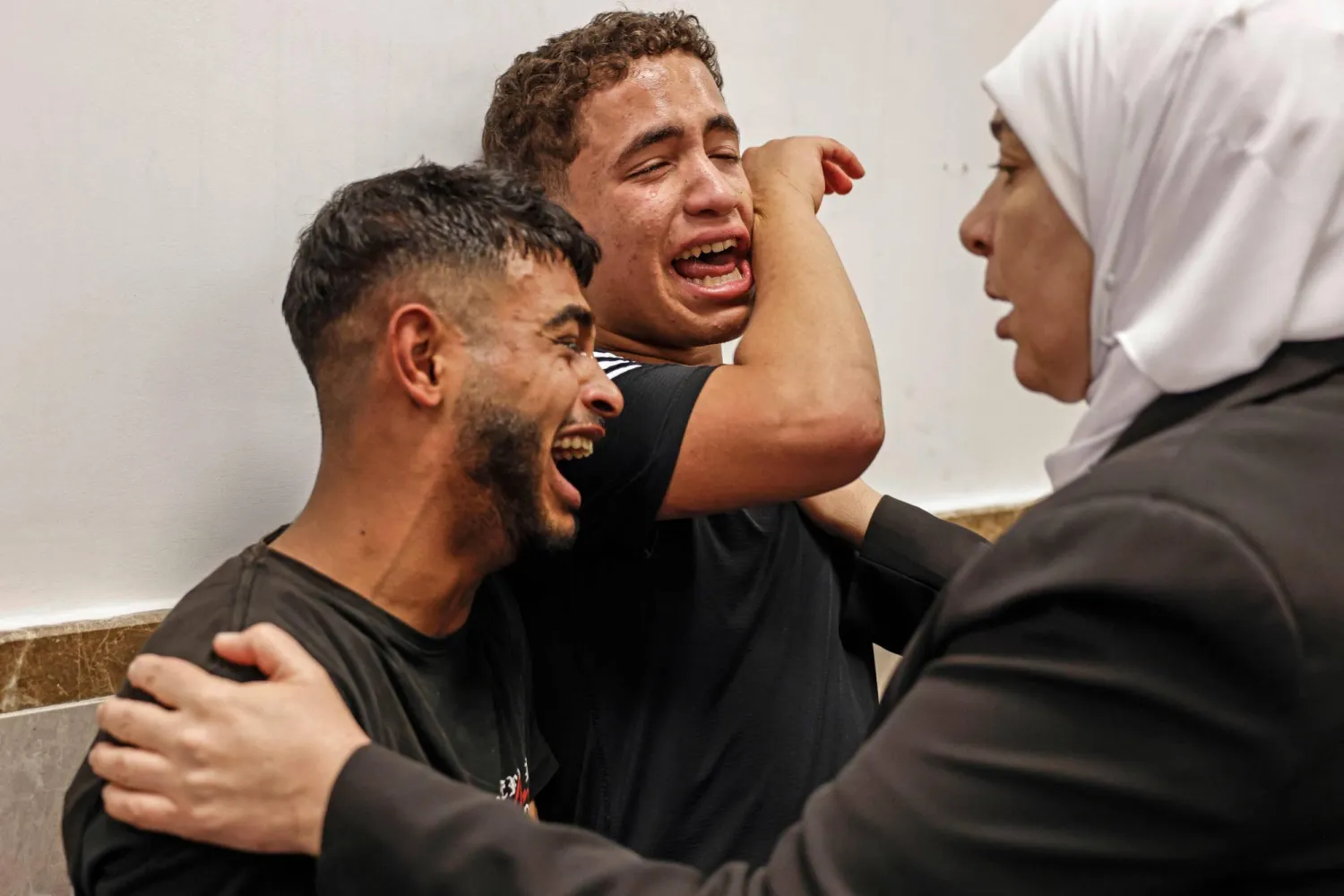
Israeli Forces Kill Palestinian Teen in West Bank

Relatives mourn the death of Amir Ahmad Jawad Jaber, a Palestinian teenager who was killed during an Israeli raid, at a hospital in Ramallah, in the Israeli-occupied West Bank on June 29, 2026. (AFP)
TT

Israeli Forces Kill Palestinian Teen in West Bank

Relatives mourn the death of Amir Ahmad Jawad Jaber, a Palestinian teenager who was killed during an Israeli raid, at a hospital in Ramallah, in the Israeli-occupied West Bank on June 29, 2026. (AFP)

Israeli forces fatally shot a 15-year-old Palestinian teenager during a raid in the occupied West Bank on Monday, the Palestinian health ministry said, as violence surges in the Israeli-occupied territory.

"The child Amir Ahmad Jawad Jaber, 15 years old, was martyred after being shot in the head and once in the chest by occupation soldiers during their raid in the Umm al-Sharayit neighborhood in Al-Bireh" near the West Bank city of Ramallah, the ministry said.

There was no immediate response from the Israeli military when asked by AFP about the incident.

The Palestinian Red Crescent had earlier said its teams were transporting to hospital and trying to resuscitate a 15-year-old who was shot in the head with live ammunition during a raid in the Umm al-Sharayit area.

Dozens of mourners gathered at the Palestine Medical Complex as grieving relatives wept over the teenager's body.

"Today, we witnessed a clear-cut execution in broad daylight," Laila Ghannam, governor of Ramallah and Al-Bireh, told AFP.

"This is a disgrace to all institutions who claim to uphold democracy and human rights.

"When it comes to our cause, they see nothing. They allow this occupation to escalate its campaign of terror every single day -- not only across Palestine, but throughout the entire region."

Since the start of the Gaza war in October 2023, violence has escalated in the West Bank, which Israel has occupied since 1967.

Israeli soldiers or settlers have killed at least 1,085 Palestinians in the West Bank since October 2023, including both gunmen and civilians, according to an AFP tally based on Palestinian health ministry data, which says 71 people were killed in 2026.

Official Israeli figures show that at least 46 Israelis, both soldiers and civilians, have been killed in Palestinian attacks or during Israeli military operations in the West Bank since the start of the Gaza war.


Halt of Iranian Flights Sparks Debate within Iraq’s Ruling Coalition

 Iraqi Prime Minister Ali al-Zaidi meets with US President Donald Trump in New York on September 23, 2026. (Iraqi government)
Iraqi Prime Minister Ali al-Zaidi meets with US President Donald Trump in New York on September 23, 2026. (Iraqi government)
TT

Halt of Iranian Flights Sparks Debate within Iraq’s Ruling Coalition

 Iraqi Prime Minister Ali al-Zaidi meets with US President Donald Trump in New York on September 23, 2026. (Iraqi government)
Iraqi Prime Minister Ali al-Zaidi meets with US President Donald Trump in New York on September 23, 2026. (Iraqi government)

The Iraqi government's decision to enforce the US Treasury Department's ban on Iranian aviation remains highly contentious, as factions within the ruling Coordination Framework refuse to comply despite Baghdad's officially declared commitment to the policy.

According to a government source, Baghdad has received a serious American warning against receiving any Iranian airline at Iraqi airports. The government of Prime Minister Ali al-Zaidi had, however, requested that Washington grant it an exemption from the flight ban for certain airports, including Najaf airport, for humanitarian reasons.

According to an informed political source, "Iraq is currently caught between the American hammer and the Iranian anvil."

The source told Asharq Al-Awsat that "the situation in reality appears extremely difficult, as complying with Tehran's desire to completely ignore the flight ban could result in sanctions that Iraq can no longer tolerate.”

“This is particularly critical given that a shipment of US dollars is scheduled to arrive in Baghdad soon, as part of successful talks held by al-Zaidi with the US administration, specifically President Donald Trump, during his participation in the United Nations General Assembly meetings,” it added.

According to the informed political source, "leaders of the Coordination Framework are attempting to strike a middle ground during their discussions with and in the presence of al-Zaidi, in terms of not going too far in defying the US decision, while simultaneously declaring their support for the PM’s efforts to secure a single exemption, even if only for Najaf airport."

A government source confirmed on Sunday that Baghdad "has received a serious and direct American warning that continuing to receive any Iranian airline at Iraqi airports exposes the airport, as well as the entities and companies providing services to these flights, to US sanctions."

"The Americans made it clear to the Iraqi government that the punitive measures will not be limited solely to the sanctioned Iranian airlines, but could also extend to any entity or airport providing services or facilitating the operation of those companies' flights, including landing, ground handling, refueling, and other services,” it said.

"This warning has left the government with a single option: to avoid exposing Iraqi airports, the aviation sector, and the operating entities to US sanctions,” it continued.

"The decision was not linked to an Iraqi political stance regarding air traffic with Iran, but rather came as a result of the legal and economic risks resulting from US sanctions,” it explained.


Syrian Security Forces Arrest Official Responsible for Torture of Child Hamza al-Khatib in Daraa

Hamza al-Khatib became a symbol of the Syrian revolution. (SANA)
TT

Syrian Security Forces Arrest Official Responsible for Torture of Child Hamza al-Khatib in Daraa

Hamza al-Khatib became a symbol of the Syrian revolution. (SANA)

Syrian Internal Security Forces arrested Brig. Gen. Jaber Mehrez Ibrahim, who served as commander of the 138th Air Defense Brigade in the town of Saida during the era of the deposed regime, following a precise surveillance and tracking operation, reported Syria’s state news agency SANA on Sunday.

Records and preliminary investigations showed that Ibrahim was involved in issuing orders to kill and arrest people and suppress protesters, as well as participating in military campaigns targeting villages and towns in eastern Daraa countryside, pursuing civilians and targeting their homes.

Investigations also indicate that he was directly responsible for the Saida Housing massacre, in which nearly 120 people were killed, and that his name was linked to systematic arrests and torture involving a large number of people from the province, including child martyr Hamza al-Khatib.

The ousted regime arrested al-Khatib, 13, in the early days of the Syrian uprising that erupted in the city of Daraa on March 18, 2011. He died under torture in detention.

On May 21, 2011, al-Khatib’s tortured and mutilated body was returned to his family, weeks after his arrest during an anti-government demonstration.

His death, alongside the torture of other children and teenagers arrested for writing anti-Assad graffiti, triggered widespread protests and a brutal crackdown by government forces.

Following the ouster of the regime in December 2024, the new authorities launched a crackdown against former officials and military personnel. Ibrahim’s arrest is part of these ongoing prosecutions over allegations of abuses committed during the former regime's years in power.


Hezbollah Chief Says Israel Unable to ‘Break’ Group on Anniversary of Nasrallah’s Killing

Supporters of Hezbollah shout slogans as they watch a televised speech by Hezbollah chief Naim Qassem during a ceremony held to mark the second anniversary of the killing of former leader Hassan Nasrallah in a strike by Israel, in Beirut's southern suburbs on September 27, 2026. (AFP)
TT

Hezbollah Chief Says Israel Unable to ‘Break’ Group on Anniversary of Nasrallah’s Killing

Supporters of Hezbollah shout slogans as they watch a televised speech by Hezbollah chief Naim Qassem during a ceremony held to mark the second anniversary of the killing of former leader Hassan Nasrallah in a strike by Israel, in Beirut's southern suburbs on September 27, 2026. (AFP)

Hezbollah chief Naim Qassem told supporters gathered in Lebanon on Sunday to mark two years since the killing of longtime leader Hassan Nasrallah that Israel had been unable to break his Iran-backed group.

The party was weakened after all-out war with Israel in 2024, but regrouped and drew Lebanon into the Middle East conflict in March this year by attacking Israel, which responded with massive airstrikes and a ground invasion that Lebanon says have killed more than 4,300 people.

Hezbollah has demonstrated that Israel and its soldiers "were unable to achieve their goals to break the resistance, end its existence, consolidate the Israeli occupation and establish settlements in Lebanon", Qassem said in a televised speech broadcast at the gathering.

AFP correspondents saw tens of thousands of people, some carrying Hezbollah, Lebanese and Iranian flags or pictures of Nasrallah, rallying for the commemorative event near the slain leader's tomb in Beirut's southern suburbs, a Hezbollah stronghold that Israel bombed during conflicts this year and in 2024.

Some in the crowd chanted "death to America, death to Israel".

Nasrallah, a leader revered by his supporters but who headed a group whose armed wing is blacklisted by many Western capitals, was killed in a massive Israeli airstrike on Beirut's southern suburbs on September 27, 2024.

The assassination came during more than two months of all-out war that pummeled Hezbollah and decimated its top leadership.

Nasrallah's chosen successor Hashem Safieddine, who was also being commemorated on Sunday, was killed in another strike days after his predecessor.

The latest hostilities have further weakened the group.

- 'Liberate the south' -

Ali Nasser, 30, from Haddatha in south Lebanon, said "this is a historic day. Every year we commemorate it to renew our pledge" to Nasrallah "that we are walking along his path".

The former chief "illuminated the path for us and God willing, we'll carry on... these crowds are proof of our continuation and our loyalty to this pledge", he added.

After a November 2024 ceasefire, Lebanese authorities committed to disarming Hezbollah and banned the group's military activities after it drew Lebanon into this year's Middle East war.

Violence in Lebanon has decreased since a fragile ceasefire announced in June after the signing of a US-Iran understanding on the broader conflict.

Lebanon and Israel reached a framework agreement later that month, under which Hezbollah is supposed to disarm and the Lebanese military to deploy in so-called pilot zones in south Lebanon as Israel withdraws.

But progress has largely stalled, with Israel warning it will stay put as long as Hezbollah remains a threat.

"We are ready for dialogue and discussion, but first, liberate the south, and let the people return," Qassem said.

He said that with the framework agreement, "the authorities are helping the Israeli-US project instead of confronting it".

"All the pressure on Lebanon today aims to accomplish what Israel was unable to achieve over two years," he said, adding that the Lebanese national army should not be used as "a tool" against the group.

Israel has kept up its attacks and maintains troops in a self-declared "security zone" running around 10 kilometers (six miles) inside south Lebanon.

Israel's far-right finance minister Bezalel Smotrich called on Sunday for the annexation of areas of south Lebanon under Israeli military control "as far as the Litani River", which runs about 30 kilometers (20 miles) from the Israeli border.

Qassem said holding onto positions "is not the main objective" for his group, after Israel carried out massive detonations this month to destroy Hezbollah infrastructure on the strategic Ali al-Taher ridge.

"With the great sacrifices that we have made up until now, we can only keep going, and we cannot be defeated," Qassem vowed.