


Saudi Arabia Encourages Companies to Import Lebanese Products After Royal Order

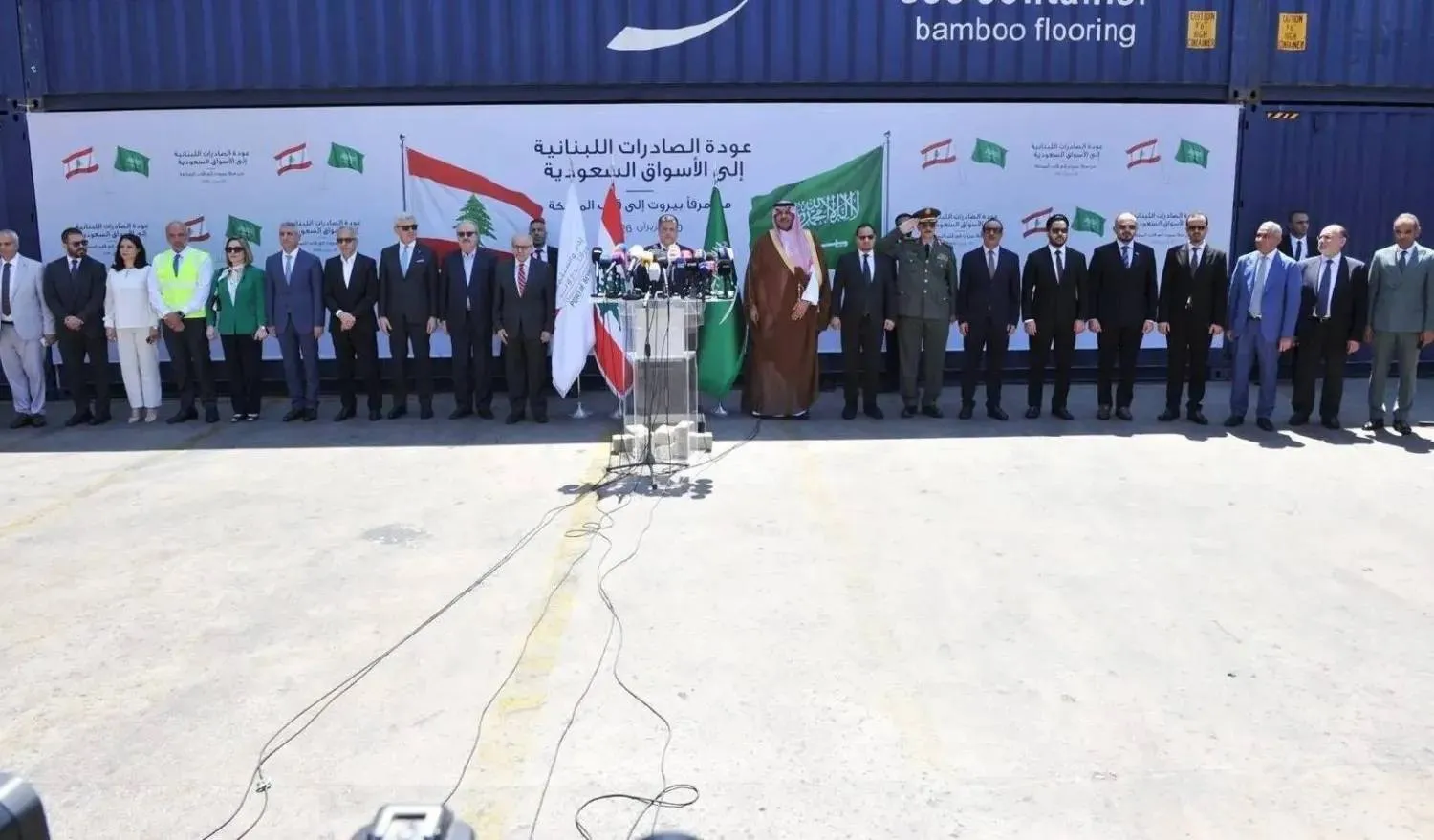
 Saudi Ambassador to Beirut Fahd Al-Dosari and officials from both countries at Beirut port at the launch of Lebanese exports to Saudi Arabia. (SPA)
Saudi Ambassador to Beirut Fahd Al-Dosari and officials from both countries at Beirut port at the launch of Lebanese exports to Saudi Arabia. (SPA)
TT

Saudi Arabia Encourages Companies to Import Lebanese Products After Royal Order

 Saudi Ambassador to Beirut Fahd Al-Dosari and officials from both countries at Beirut port at the launch of Lebanese exports to Saudi Arabia. (SPA)
Saudi Ambassador to Beirut Fahd Al-Dosari and officials from both countries at Beirut port at the launch of Lebanese exports to Saudi Arabia. (SPA)

Saudi Arabia has officially begun encouraging its private sector to import Lebanese goods, a concrete step to revive trade between the two countries after years of disruption.

The step implements directives from Prince Mohammed bin Salman, Crown Prince and Prime Minister, and follows a request from Lebanon’s presidency and government.

Beirut port recently saw the first shipment leave for the Kingdom, in a ceremony officials said marked the rebuilding of economic trust, backed by modern and strict security controls to safeguard exports.

According to information obtained by Asharq Al-Awsat, Saudi Arabia’s General Authority of Foreign Trade informed the Federation of Saudi Chambers that a royal order had approved the resumption of Lebanese exports to the Kingdom.

It asked that the decision be circulated across the private sector so companies could benefit from it.

The move is expected to spur Saudi companies to tap the Lebanese market and push trade between the two countries toward broader horizons in line with their ambitions.

First export shipment

Acting on the Saudi royal order, Lebanese products were shipped again to Saudi Arabia on June 20, in the presence of the Saudi Ambassador to Lebanon, Fahd Al-Dosari. The shipment carried more than goods and merchandise.

It carried “a message of trust rebuilt after years of disruption, and an economic opportunity Lebanon eagerly awaits at a time when the need to stimulate production and increase exports is growing.”

The return of the Saudi market, which alone represents about 85% of the Gulf market, is not only a recovery of what was lost when exports stood at about $378 million before the ban. It also opens the door to greater ambitions to expand Lebanon’s presence in this vast market.

Al-Dosari said in a speech: “In implementation of the directives of Crown Prince Mohammed bin Salman to resume Lebanese exports to the Kingdom, and in response to the request of Lebanese President General Joseph Aoun and Prime Minister Nawaf Salam, and in line with the positive steps taken by the government toward rebuilding state institutions and the work completed by the specialized teams, we gather today to witness the departure of the first exports bound for Jeddah Islamic Port through Beirut port.”

He added: “As an embodiment of brotherly relations and out of the Kingdom’s keenness to stand by its brothers, this decision to resume Lebanese exports to the Kingdom confirms beyond doubt its support for Lebanon’s stability, its sovereignty over all its territory and the welfare of its brotherly people.”

Security screening

Prime Minister Nawaf Salam said Lebanon would not be allowed to again become “a launchpad for any harm against its Arab brothers,” and thanked Crown Prince Mohammed for lifting the ban on Lebanese exports.

The attendees then inspected modern scanning devices recently installed at Beirut port to examine goods and containers with precision. The equipment is designed to tighten security controls and speed up customs clearance.

Saudi Arabia had been Lebanon’s top export market before the ban. In 2014 and 2015, it ranked first, accounting for about 12% of Lebanon’s total exports, with a value of around $378 million in 2014, according to Lebanese customs and Chamber of Commerce data.

Bilateral trade was estimated at hundreds of millions of dollars annually.


Riyadh to Host Global Logistics, Supply Chain Forums in November

A view of Riyadh, Saudi Arabia. (SPA)
TT

Riyadh to Host Global Logistics, Supply Chain Forums in November

A view of Riyadh, Saudi Arabia. (SPA)

Under the patronage of Custodian of the Two Holy Mosques King Salman bin Abdulaziz Al Saud, Saudi Arabia will host the second editions of the Global Logistics Forum (GLF) and the UNCTAD Global Supply Chain Forum (GSCF) in Riyadh from November 29 to December 1, reported the Saudi Press Agency on Tuesday.

The GLF, organized by the Saudi Ministry of Transport and Logistic Services, and the GSCF, hosted in partnership with the United Nations and the Saudi Ports Authority, form a pivotal international platform bringing together global leaders, decision-makers, and experts in transport, supply chains, and international trade.

Aligning with Saudi Vision 2030, the GLF aims to solidify the Kingdom's position as a global logistics hub connecting continents while driving innovation, global connectivity, and sustainable supply chains.

The Ministry of Transport and Logistic Services stressed that the co-located forums will serve as a premier launchpad for strategic initiatives and international partnerships, inviting global specialists to participate.

The inaugural 2024 GLF in Riyadh drew over 13,000 attendees, 140 speakers, and 80 exhibitors from more than 30 countries, resulting in 67 agreements valued at over SAR16 billion ($4.3 billion).


Saudi Arabia Tightens Auto Dealer Obligations to Protect Consumers, Improve Ownership Experience

People are seen at the Riyadh Motor Show. (Riyadh Season)
TT

Saudi Arabia Tightens Auto Dealer Obligations to Protect Consumers, Improve Ownership Experience

People are seen at the Riyadh Motor Show. (Riyadh Season)

Saudi Arabia’s auto market is moving toward greater discipline and competition as the Ministry of Commerce steps up oversight of dealers, seeking to strengthen consumer protection and improve compliance with after-sales service requirements.

The ministry announced it had suspended an auto dealership, barred it from importing vehicles and fined it SAR 8.12 million ($2.1 million) after recording 175 violations. These included failure to provide spare parts and replacement vehicles to customers during maintenance, as well as other breaches involving consumer rights, the Commercial Agencies Law and its implementing regulations.

The ministry investigated the violations, contacted affected consumers and followed up to ensure they received their rights and due compensation, including replacement vehicles.

It also summoned the manufacturer, oversaw corrective measures and recall campaigns, and began transferring the brand to another dealer after verifying its readiness and ability to provide the necessary services.

Mohammed Al-Farraj, chief asset management officer at Arbah Capital, told Asharq Al-Awsat that Saudi Arabia’s large auto market and sustained demand make it one of the region’s most attractive, supported by population and economic growth, expansion of the non-oil economy and mega-projects, and growth in tourism and logistics.

The availability and variety of financing options play a key role in supporting demand, particularly because cars are a necessity for a large segment of the population rather than a luxury, Al-Farraj noted.

Market performance is influenced by vehicle prices, financing costs, income levels and supply, as well as competition among brands and the quality of after-sales services.

Al-Farraj described the ministry’s tougher oversight as a positive step toward protecting consumers and improving market discipline, stressing that a dealer’s obligations do not end with a sale but extend to warranties, maintenance, spare parts and replacement vehicles when needed.

Stronger after-sales compliance should bolster market confidence and gradually shift competition toward quality and reliability rather than price alone.

Al-Farraj expects intensifying competition to push dealers to focus more on the value offered throughout vehicle ownership, including total cost of ownership and customer service.


Mega-Projects, Investment Flows Draw Bank of Jordan to Saudi Arabia

A group photo of Bank of Jordan officials following the inauguration ceremony for the bank’s first branch in Riyadh. (Asharq Al-Awsat)
TT

Mega-Projects, Investment Flows Draw Bank of Jordan to Saudi Arabia

A group photo of Bank of Jordan officials following the inauguration ceremony for the bank’s first branch in Riyadh. (Asharq Al-Awsat)

Saudi Arabia’s appeal extends beyond rising foreign investment and expanding mega-projects to the banking sector, where institutions see the economic transformation driven by Vision 2030 as an opportunity to establish a long-term presence in one of the region’s fastest-growing markets.

Bank of Jordan Group’s entry into the Kingdom reflects growing interest among regional financial institutions in tapping the country’s expanding investment cycle.

The group opened its first branch in Riyadh on Monday, launching its financial and banking operations in Saudi Arabia. The move underscores the Kingdom’s ability to attract not only capital, but also financial institutions seeking to finance the next phase of investment.

Mega-projects, private sector expansion and growing foreign and domestic investment are creating significant opportunities for banks to provide financing solutions and services to companies and investors. At the same time, Saudi Arabia is seeking to deepen the financial sector’s role as a driver of growth and economic diversification.

Saleh Hammad, general manager of Bank of Jordan Group, told Asharq Al-Awsat that the bank’s strategy is based on a clear view of the economic transformations reshaping Saudi Arabia and the wider region.

The group has pursued carefully considered regional expansion, focusing on markets with sustainable economic fundamentals and strategic importance, with Saudi Arabia at the forefront.

Hammad said the Kingdom is undergoing an unprecedented economic transformation under Vision 2030, fueled by investment growth, private-sector expansion and the development of its financial and banking environment.

Establishing a presence in one of the region’s leading financial and economic hubs strengthens Bank of Jordan’s position as a regional institution capable of supporting trade, development and investment opportunities, he noted.

Hammad also highlighted Saudi Arabia’s strong banking system and evolving regulatory environment, supported by the Saudi Central Bank, as key advantages that enhance the group’s position while creating added value for clients and investors.
