Red Sea Film Foundation Concludes Participation in 12th Saudi Film Festival

The Red Sea Fund presented four awards within the Production Market at the Saudi Film Festival - SPA
TT

Red Sea Film Foundation Concludes Participation in 12th Saudi Film Festival

The Red Sea Fund presented four awards within the Production Market at the Saudi Film Festival - SPA

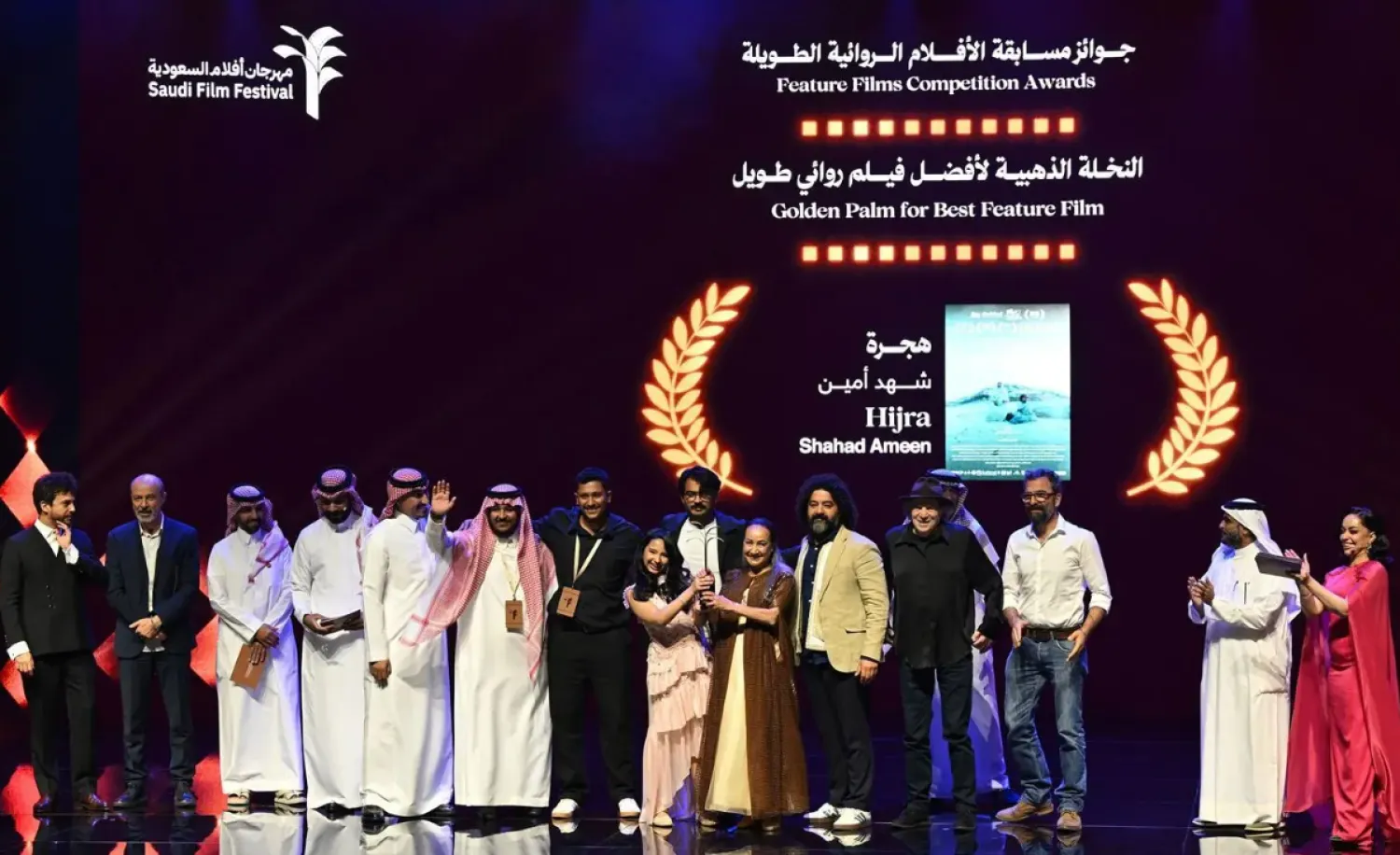
The Red Sea Film Foundation won four awards for the three films supported by the Red Sea Fund during its participation in the 12th Saudi Film Festival, held at the King Abdulaziz Center for World Culture (Ithra) in Dhahran.

Hijra won the Golden Palm for Best Narrative Feature Film, while Irkalla: Gilgamesh’s Dream won the Golden Palm for Best GCC Feature Film. A Matter of Life and Death received a Jury Special Mention, while Sarah Taibah won the Golden Palm for Best Acting for her role in the film, SPA reported.

These awards reflect the presence of Red Sea Fund-supported films in the Saudi and regional film landscape and underscore the impact of the fund’s support for film projects at various stages, through to their screening before audiences and participation in festivals.

The Red Sea Fund presented four awards within the Production Market at the Saudi Film Festival. The short-film awards went to the projects Shareet and Bin Jalmoud, while the feature-film awards went to From Zero to a Thousand and Between the Two, directed by Malak Quota.

The Red Sea Film Foundation’s participation in the Saudi Film Festival comes as part of its ongoing cooperation with local film events and its support for Saudi and Arab talent and projects through its various programs and initiatives, foremost of which are the Red Sea Fund, Red Sea Souk, and Red Sea Labs.


UK Museums at 'Sharp End' of Climate Change Challenge

Tannis Davidson, Head of Zoology and Science collections at the Grant Museum of Zoology in London, holds a device displaying the temperature inside the display cases in the museum, in central London on June 26, 2026. (Photo by CARLOS JASSO / AFP)
TT

UK Museums at 'Sharp End' of Climate Change Challenge

Tannis Davidson, Head of Zoology and Science collections at the Grant Museum of Zoology in London, holds a device displaying the temperature inside the display cases in the museum, in central London on June 26, 2026. (Photo by CARLOS JASSO / AFP)

As visitors peered at skeletons and preserved animals in a London zoological museum during a UK heatwave, staff focused on a different attraction: a computer screen glowing with red and green temperature indicators.

With each one linked to a sensor in a different display case, the system allows staff to see when an exhibit is in danger of overheating.

Last year during a hot spell, staff arrived one morning to find an antique specimen jar -- containing a nearly two-centuries-old tabby cat -- had "blown out" amid the heat.

By monitoring temperatures in the display cases, staff at the Grant Museum of Zoology hope they can prevent damage to other exhibits by identifying any needing to be preventively decanted.

"They are very precious and valuable to us," said Tannis Davidson, head of zoology at the 200-year-old collection home to some 100,000 specimens covering every major animal group.

"We want to safeguard them for the next 200 years at least so students and researchers and members of public can enjoy the collection and learn more about the natural world," she told AFP.

But she said curators were having to deal with a whole "new set of challenges due to climate change and extended long periods of high temperatures within our spaces".

Emma Howard Boyd, chair of the independent National Heat Risk Commission, says the impact of climate change is no longer a distant threat but a present-day reality with the cultural sector at the "sharp end".

Last month's UK heatwave forced the closure of a number of London cultural attractions including the Young Victoria & Albert (V&A) museum, The Cutty Sark museum ship, Tower Bridge and some galleries at the V&A.

And the Met Office said Monday that the UK was entering its third heatwave of the year, although it was not expected to break any records.

Art works also require careful monitoring of temperature and humidity levels to prevent damage, according to Claire Teasdale of the National Trust heritage body.

"We're having more storms. We're having more wet weather and more extreme weather which is affecting everything," said Teasdale who manages the collections at Cragside, a 19th century mansion in northeastern Northumberland.

Cragside is home to an important art collection that includes works by J.M.W. Turner and John Everett Millais.

It was built to cope with "Victorian rainfall levels and not with 21st century rainfall levels," she said, adding rain and sunshine both hiked levels of potentially damaging humidity.

Six of the UK's 10 wettest years have occurred since 1998, the Met Office says.
Flooding poses another threat to cultural treasures.

The Museum of Making in the central city of Derby suffered major flooding in October 2023 during Storm Babet.

None of the industrial heritage museum's collections were damaged, but the cost of damage to the building was estimated at over £100,000 and the museum closed for nearly three months.

"Heat waves often end with flash flooding because of intense rainfall," added Howard Boyd who chaired a 2024 review of London's preparedness for more extreme weather commissioned by mayor Sadiq Khan.

John Calautit, lecturer in sustainable and low carbon technologies at University College London, said installing air conditioning was not a silver bullet for large spaces and historic buildings often subject to highly restrictive building regulations.

But he said experts were developing alternatives to provide ventilation and cooling based on the "windcatcher" principles used for centuries in architecture.

It is "a ventilation system which is attached to the roof which can capture air at higher altitude. It brings air flow into the space at higher volume ... and extracts air out of the space," he told AFP.

Modern-day systems incorporated some form of low energy cooling and had already been commercially produced and used in Middle Eastern countries, he said.

Howard Boyd argues museums and historic properties need to explore all options for climate resilience.

She envisages a future in which venues become community hubs offering people a refuge from the heat.

A joint UK-wide initiative launched last month by organizations including the British Film Institute highlights venues where people can find local spaces to keep cool.


British Town to Open its 250-Year-Old Underground Tunnels to Public

The glassworks tunnels have never before been open to the public. (Stourbridge Glass Museum)
TT

British Town to Open its 250-Year-Old Underground Tunnels to Public

The glassworks tunnels have never before been open to the public. (Stourbridge Glass Museum)

A West Midlands glassmaking museum is set to open its 250-year-old underground tunnels to the public for the first time.

Stourbridge Glass Museum has unveiled a major new project that will transform its historic tunnel network into an immersive, family-friendly visitor experience, according to the Independent.

Visitors can expect VR and project mapping technology bringing local glassmaking heritage to life.

The tunnels were once used by generations of glassworkers in the local area to store materials and to control temperatures during the production of their fragile products.

The new experience hopes to attract more visitors to the area, giving a boost to the local economy through hotel stays and spending in other local businesses.

The mayor of Dudley, Pete Lowe, praised the new project, using the Black Country phrase “Bostin’” in response to the news.

Museum director Alexander Goodger said: “This is just one part of our new phase of capital development designed to boost the site for locals, expand the offer, give it a wider appeal and bring in tourists to the area who then go on to stay in hotels and eat in restaurants, regenerating the area.”

He added: “We want to bring in investment for the Black Country’s heritage. We have an incredible and unique history."

“Before opening the tunnels to the public, the museum will undertake essential improvements to health and safety, signage, public access, and lighting, ensuring a safe and free‑flowing visitor experience,” he added.

In exact date for the opening of the tunnels has not yet been announced.

Stourbridge Glass Museum currently has exhibitions showcasing 400 years of glassmaking in the town, depicting work within a “glass cone,” which is a towering brick structure with a furnace in the middle where workers would shape and blow the molten glass in the hot environment while letting gas escape from the top.


Gold Rings Around 2,000 Years Old Found During Dig at Thailand Archaeological Site

In this photo released by The Fine Arts Department, an archaeologist shows two rings with human bones during an ongoing dig at the Don Yai Thong archeological site in Phetchaburi province, Thailand Thursday, July 2, 2026. (The Fine Arts Department via AP)
TT

Gold Rings Around 2,000 Years Old Found During Dig at Thailand Archaeological Site

In this photo released by The Fine Arts Department, an archaeologist shows two rings with human bones during an ongoing dig at the Don Yai Thong archeological site in Phetchaburi province, Thailand Thursday, July 2, 2026. (The Fine Arts Department via AP)

Two gold rings aged around 2,000 years old were discovered during an excavation at a new archaeological site in western Thailand, officials said.

The rings were found with human bones during an ongoing dig at the Don Yai Thong archaeological site in Phetchaburi province last week, the Thai government's Fine Arts Department said in a statement.

One ring found Thursday was engraved with characters believed to be Bhrami script, an ancient Indian writing system. An initial assessment by experts identified the script reading as “pusarakhitasa,” meaning “the one protected by Pushya,” said to be one of the most auspicious zodiac signs in Indian astronomy, The Associated Press quoted the department as saying.

The other ring found with the same skeletal remains is a plain gold ring without any pattern. Experts believe the rings’ owner may have been a merchant of the Indian ancient caste system Vaishyas, the department said.

The Don Yai Thong archaeological site, about 130 kilometers (80 miles) southwest of the capital Bangkok, was discovered early this year after residents found pieces of ancient bronze drums in a rice field, leading to further excavation.

The site was dated to a late prehistoric era in Thailand, a period of human settlement also known as the Iron Age, established to be around 1,500 to 2,500 years ago.

Since February, archaeologists have discovered eight human skeletons, bronze and gold jewelry, pottery and other artifacts indicating a ceremonial burial of wealthy people or members of the society’s upper classes.

The excavation is expected to be complete in another month, with plans to showcase the archaeological finds to the public, the Fine Arts Department said.