


IEA Says Global Oil Demand Picks Up Despite War Fears

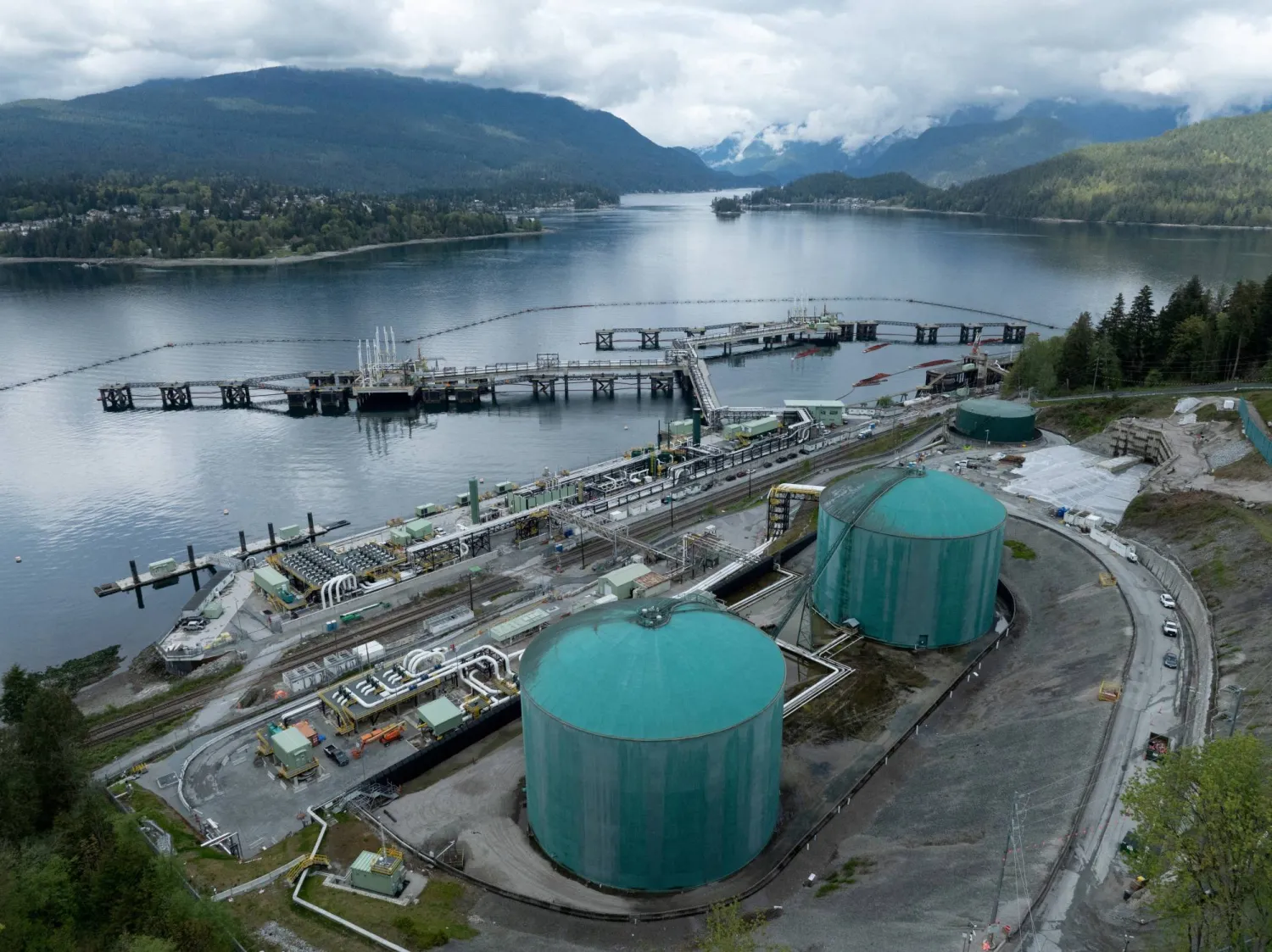
FILE PHOTO: A drone view of three berths able to load vessels with oil is seen after their construction at Westridge Marine Terminal, the terminus of the Canadian government-owned Trans Mountain pipeline expansion project in Burnaby, British Columbia, Canada, April 26, 2024. REUTERS/Chris Helgren/File Photo
TT

IEA Says Global Oil Demand Picks Up Despite War Fears

FILE PHOTO: A drone view of three berths able to load vessels with oil is seen after their construction at Westridge Marine Terminal, the terminus of the Canadian government-owned Trans Mountain pipeline expansion project in Burnaby, British Columbia, Canada, April 26, 2024. REUTERS/Chris Helgren/File Photo

The International Energy Agency said Friday that "a recovery" in global oil demand had started as supplies tentatively start moving through the strategic Strait of Hormuz again and prices ease.

"A recovery in world oil demand is underway, with consumption set to rise from its May nadir," AFP quoted the IEA's monthly report as saying.

The agency had in June predicted a fall in demand of 1.1 million barrels a day (mbd) through 2026 because of the Middle East war, which strangled traffic through the strait. It now expects a one million barrel a day fall.

"Global oil supply rebounded by a sharp 4.1 mbd to 98.8 mbd in June, as a resumption of flows through the Strait of Hormuz underpinned a partial recovery in Gulf production. World output was nevertheless some 9.4 mb/d below pre-war levels," it said.

"Total Gulf oil exports, including volumes bypassing the Strait, surged by 6.5 mbd in June, to 16.1 mbd - a big jump but still well below the 24 mbd average before the war started."

According to the IEA, world supply improved to 102.6 mbd in June and would continue to get better if there was "a swift de-escalation of renewed hostilities".

"If transit volumes improve, oil supply will expand by 7.5 mbd next year," the agency added.

The agency said world oil reserves increased for the first time since the US-Israeli attacks on Iran on February 28 set off the war.

It added that stocks in the richest nations had fallen as their oil imports remained low despite the rise in volumes being transported by sea.

While oil prices fell dramatically in June, fresh fighting between US and Iranian forces this week "clouds the outlook", the IEA said.

"Renewed exchanges of fire in the Gulf this week highlight the risks of not reaching a lasting peace agreement, which is a must for the normalization in oil markets," it commented.



Oil Prices Slide on Hopes of Diplomacy in Iran War

Oil tankers in Basra port (Reuters)
TT

Oil Prices Slide on Hopes of Diplomacy in Iran War

Oil tankers in Basra port (Reuters)

Oil prices slid to their lowest in more than a week on Monday as investors hoped for diplomatic progress on the Iran war due to this week's UN meeting.

Brent crude futures and US West Texas Intermediate crude touched their lowest since September 10 earlier on Monday. The Brent contract for November was at $102.09 a barrel at 0655 GMT, down $1.78, or 1.71%, after settling 0.91% lower on Friday, Reuters said.

The WTI October contract that is expiring on Tuesday fell $1.97, or 1.96%, to $98.33 a barrel following a ‌1.58% drop in the ‌previous session.

"It seems that a degree of risk premium is ‌being ⁠removed from oil prices ⁠on hopes that a diplomatic path to de-escalate the US-Iran war may arrive this week," said Tim Waterer, chief market analyst at KCM Trade.

"Whether that hope proves to be warranted or not is another question. Time will tell."

WTI broke a key psychological support at $100 a barrel while some investors may have rolled over their positions in the October contract a day ahead of expiry to November, a Singapore-based broker said.

Iran and the US exchanged new threats on Sunday, although President Donald Trump said ⁠he would be open to meeting Iranian President Masoud Pezeshkian, who is ‌expected to be in New York this week for ‌the United Nations General Assembly.

Iran has conveyed its conditions to mediators for re-engaging in negotiations aimed at ‌ending the war with the US, Al Jazeera cited Iran's security chief, Mohsen Rezaei, as ‌saying in an interview on Saturday.

On Monday, a spokesman ‌for the Revolutionary Guards, Hossein Mohebbi, said Iran would use new weapons and target locations not previously attacked if the US launched a ⁠new offensive against it, ⁠according to the Fars news agency.

China has asked Iran to help rein in the Houthis after an appeal to Beijing following the attacks, according to three Iranian sources familiar with the matter.


Gold Slips as Focus Remains on Middle East, Rate Outlook

Gold bars, each weighing 1000 grams, displayed at a gold and silver refinery in Vienna (AFP)
TT

Gold Slips as Focus Remains on Middle East, Rate Outlook

Gold bars, each weighing 1000 grams, displayed at a gold and silver refinery in Vienna (AFP)

Gold prices slipped on Monday as market participants assessed developments in the Middle East and their implications for inflation and interest rates.

Spot gold fell 0.3% to $4,362.60 per ounce by 0417 GMT after hitting a one-week high on Friday. US gold futures were down 0.6% at $4,400.20, Reuters reported.

Iran and the United States exchanged new threats, with President ‌Donald Trump ‌warning Iran would fail economically or face its ‌leadership ⁠being wiped out ⁠if it didn't make a deal, and the Iranian military saying it would retaliate harshly to any fresh attack.

"The focus remains on geopolitics, oil and the reaction in bond yields. For gold to gain meaningful upside traction, a clear move lower in oil and/or bond yields is likely required," said Tim Waterer, chief market ⁠analyst at KCM Trade.

"Gold may trade in a ‌roughly $4,200 to $4,580 range in the near ‌term."

Oil prices fell on hopes diplomacy in the Iran war will ‌get a chance this week amid a UN meet.

The prospect of a new global rate-tightening cycle has come into focus as some of the world's top central banks ‌raise rates and signal more may be needed to tame inflation fueled by the Iran war.

The Bank ⁠of Japan ⁠became the latest big central bank to tighten on Friday, following rate increases by the Federal Reserve earlier that week and the European Central Bank the week before.

Though gold is often seen as an inflation hedge, rising rates tend to curb its demand by making interest-bearing assets more attractive.

Analysts at Standard Chartered said in a note that gold remains volatile but continues to find firm downside support from official-sector demand. They said structural drivers remain in place to lift prices, albeit at a slower pace.

Among other metals, spot silver rose 0.2% to $66.37, platinum fell 0.1% to $1,798.31 and palladium added 0.6% at $1,309.65.


Qatar Launches Wealth Fund Division for Domestic Investments

Qatari flag flutters in Doha - AAWSAT/File
TT

Qatar Launches Wealth Fund Division for Domestic Investments

Qatari flag flutters in Doha - AAWSAT/File

Qatar's prime minister announced on Sunday the creation of a new division of the Qatar Investment Authority dedicated to developing domestic investments.

"We aim to expand the role of the private sector in driving Qatar's economic growth," Sheikh Mohammed bin Abdulrahman Al Thani said as he announced the new division, Doha Investment, at a special edition of the Qatar Economic Forum in New York.

The annual gathering was cancelled in May, following weeks of Iranian missile and drone attacks on Gulf states, including Qatar, according to Reuters.

"It will support our strongest companies, help emerging businesses grow, deepen capital markets and attract international capital and expertise to contribute to this effort," he added.

The new division will operate as the dedicated manager of QIA's local portfolio, initially overseeing 45 state-owned enterprises that represent roughly one-third of the wealth fund's total assets, according to Sheikh Faisal bin Thani Al Thani, Qatar's minister of commerce and industry. He will serve as managing director and vice-chairman of Doha Investment.

Sheikh Faisal described the division not as a new creation but a consolidation, adding that the step has been under consideration for more than a decade.