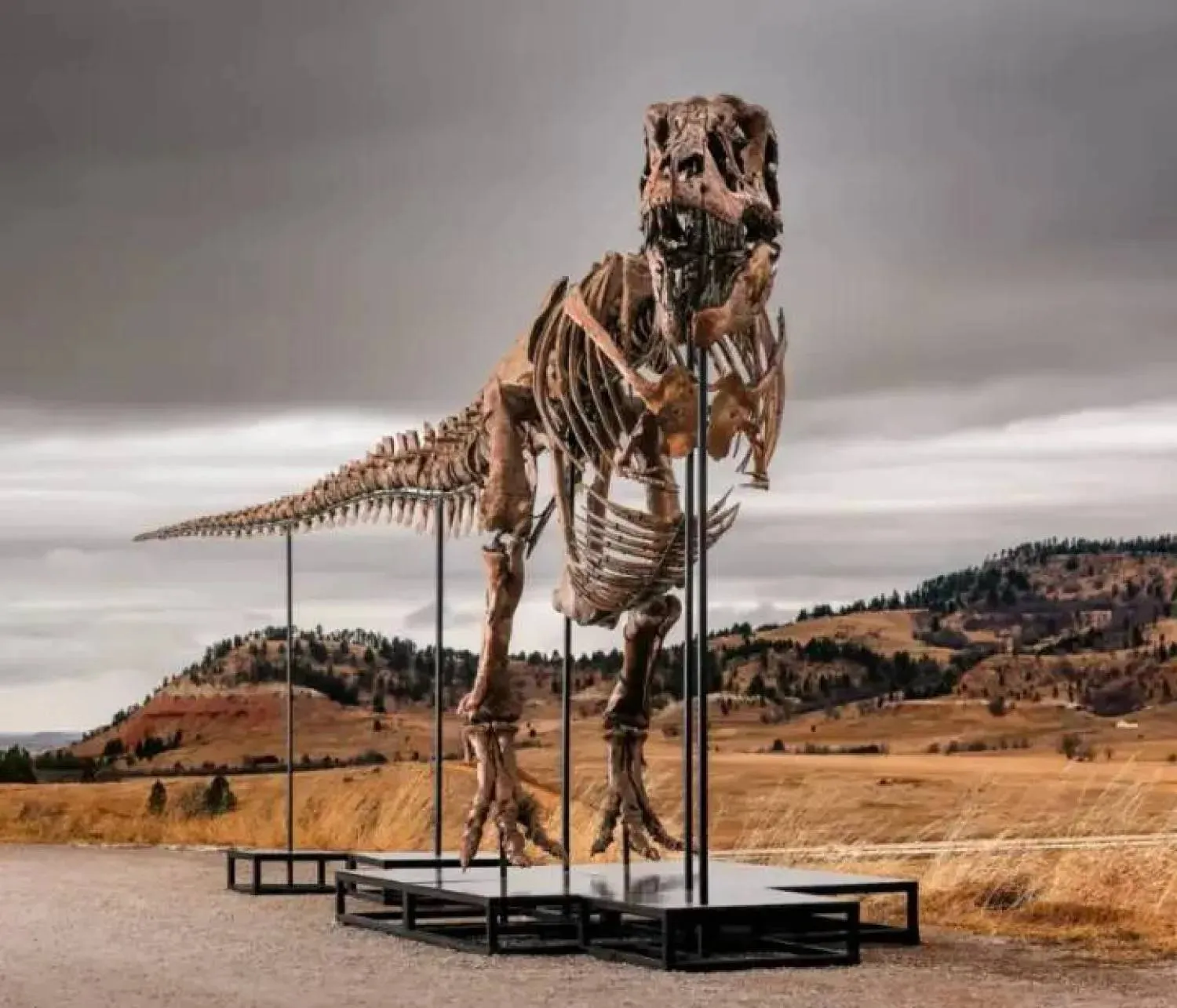
T. Rex Dinosaur Could Become Most Expensive Fossil Ever

A Tyrannosaurus Rex dinosaur (Sotheby's) 
TT

T. Rex Dinosaur Could Become Most Expensive Fossil Ever

A Tyrannosaurus Rex dinosaur (Sotheby's) 

In 1997, Sotheby's hosted a natural history auction selling wonders of our prehistoric world - but for the first time a dinosaur was on the books.

It was a niche event mostly attended by the world's museums looking for specimens to add to their collections.

The dinosaur in question was a Tyrannosaurus Rex called Sue - she was eventually sold for $8 million (£6 million) to the Field Museum in Chicago.

Nearly 30 years later, on Tuesday, another T. rex will make an appearance at the annual auction - one of the most complete specimens of this kind ever found, according to BBC.

And this time it is not just scientists who are dinosaur-hunting but also the super-rich.

The new specimen, known as Gus, has already been valued at $30 million but it could fetch more, possibly even becoming the most expensive dinosaur ever sold.

It adds to a growing debate in the natural history world – should specimens of such scientific importance be reserved for museums and their scientists?

Or - as auctioneers would argue - should fossil hunters be rewarded for their discovery of dinosaurs lost to science and saving them from a second extinction?

Cassandra Hatton, global head of natural history at Sotheby's, knows very well the lengths some fossil scientists - paleontologists - are willing to go to in the search for these creatures.

“People die on excavations,” she said.

And for many of these hunters, the ultimate prize is the Tyrannosaurus Rex.

This dinosaur that lived millions of years ago hardly needs describing, having been immortalized in culture by appearances in films like King Kong and Jurassic Park, and as the namesake of an English rock band.

“The people that look for these fossils will spend months out in the field with tents and their food in their backpacks and they're camping out in the middle of nowhere with the rattlesnakes and the bugs and the mountain lions,” she explained.


Saudi Team Successfully Separates Moroccan Conjoined Twins

The medical and surgical team of the Saudi Conjoined Twins Program began the separation surgery for 13-month-old Moroccan conjoined twins. SPA
TT

Saudi Team Successfully Separates Moroccan Conjoined Twins

The medical and surgical team of the Saudi Conjoined Twins Program began the separation surgery for 13-month-old Moroccan conjoined twins. SPA

The medical and surgical team of the Saudi Conjoined Twins Program succeeded on Thursday in separating 13-month-old Moroccan conjoined twins Saja and Doha at King Abdullah Specialist Children’s Hospital in Riyadh.

The surgery was in implementation of the directives of Custodian of the Two Holy Mosques King Salman bin Abdulaziz Al Saud and Prince Mohammed bin Salman bin Abdulaziz Al Saud, Saudi Crown Prince and Prime Minister.

Supervisor General of the King Salman Humanitarian Aid and Relief Center (KSrelief) and head of the medical and surgical team Dr. Abdullah Al Rabeeah said the twins arrived in the Kingdom on April 24.

The medical team conducted extensive and detailed examinations and held several meetings, determining that the twins were conjoined at the chest and abdomen and shared the membranes surrounding the heart, liver, and intestines.

He earlier noted that the surgery was being performed in six stages over approximately 10 hours, involving 23 consultants, specialists, nurses, and technical staff. He added that the complex procedure has a success rate of more than 70%.

He also noted that this is the fourth separation surgery performed for conjoined twins from Morocco and the 73rd case undertaken by the Saudi Conjoined Twins Program, which has cared for 159 sets of twins from 28 countries across five continents since 1990.


WWF: Populations of Wild Species Fell by an Average of 73% from 1970 to 2022

FILE PHOTO: A giraffe and zebras walk at a water point at the Amboseli National Park as authorities investigate the deaths of 18 elephants in Kenya's Amboseli ecosystem, in Kajiado County, Kenya,  August 26, 2026. REUTERS/Monicah Mwangi/File Photo
FILE PHOTO: A giraffe and zebras walk at a water point at the Amboseli National Park as authorities investigate the deaths of 18 elephants in Kenya's Amboseli ecosystem, in Kajiado County, Kenya, August 26, 2026. REUTERS/Monicah Mwangi/File Photo
TT

WWF: Populations of Wild Species Fell by an Average of 73% from 1970 to 2022

FILE PHOTO: A giraffe and zebras walk at a water point at the Amboseli National Park as authorities investigate the deaths of 18 elephants in Kenya's Amboseli ecosystem, in Kajiado County, Kenya,  August 26, 2026. REUTERS/Monicah Mwangi/File Photo
FILE PHOTO: A giraffe and zebras walk at a water point at the Amboseli National Park as authorities investigate the deaths of 18 elephants in Kenya's Amboseli ecosystem, in Kajiado County, Kenya, August 26, 2026. REUTERS/Monicah Mwangi/File Photo

Nearly 6,000 monitored vertebrate species across more than 35,000 populations declined by an average of 73% from 1970 to 2022, the World Wide Fund for Nature said in its latest Living Planet Report published on Thursday.

The Living Planet Index, managed by the Zoological Society of London and WWF, monitored a total of 35,803 populations covering 5,790 different species of mammals, birds, reptiles, amphibians and fish over the 52-year period.

The 2026 Living Planet Report estimates that overall populations fell by an average of around 2.5% per year over the period, Reuters reported.

"Monitored global populations continue to decline ⁠on average with no ⁠evidence yet of that global recovery," said Andrew Terry, chief conservation officer at ZSL.

The average rate of decline across the monitored populations does not represent a headcount of the total number of animals lost from 1970 to 2022, and the number is especially sensitive to changes in already small ⁠populations.

Monitored freshwater species saw an average decline of 85%, while terrestrial species fell 69% and marine species 59%, the index showed.

The steepest average population declines were in South America, at 95%, with Africa also experiencing losses of 80% from 1970 to 2022.

The 2026 Living Planet report incorporated an additional 295 species and 967 populations across a longer time series compared to the last report in 2024.

The additional data "reinforces our confidence in the continued decline in biodiversity," Terry told ⁠a briefing.

⁠Habitat loss and degradation were the most frequently reported threat, but wildlife populations are also at risk from overexploitation, climate change, pollution, invasive species and disease, the report said.

"Amid these steep declines, there are grounds for hope, rooted in evidence. Wildlife populations are under pressure but recovery is in reach," said Kirsten Schuijt, WWF's director general.

Targeted conservation efforts have enabled populations of some species to recover, including tigers, Atlantic and Pacific bluefin tuna, southern African elephants and green sea turtles.

Alongside conservation efforts, changes in the energy, food and finance systems are required to halt nature loss, Schuijt said.


A 194-year-old Tortoise, World's Oldest Land Animal, May Hold Clues to Longer Life

Tortoise named Jonathan, a giant tortoise believed to be the world's oldest known living land animal, stands in front of Plantation House, in St Paul on the South Atlantic island of St Helena, January 6, 2013.  Joe Hollins/Handout via REUTERS
Tortoise named Jonathan, a giant tortoise believed to be the world's oldest known living land animal, stands in front of Plantation House, in St Paul on the South Atlantic island of St Helena, January 6, 2013. Joe Hollins/Handout via REUTERS
TT

A 194-year-old Tortoise, World's Oldest Land Animal, May Hold Clues to Longer Life

Tortoise named Jonathan, a giant tortoise believed to be the world's oldest known living land animal, stands in front of Plantation House, in St Paul on the South Atlantic island of St Helena, January 6, 2013.  Joe Hollins/Handout via REUTERS
Tortoise named Jonathan, a giant tortoise believed to be the world's oldest known living land animal, stands in front of Plantation House, in St Paul on the South Atlantic island of St Helena, January 6, 2013. Joe Hollins/Handout via REUTERS

The world's oldest-known terrestrial animal, an Aldabra giant tortoise named Jonathan and estimated to be about 194 years old, may owe his extraordinary longevity to a combination of genetic traits and an ability to keep key cellular systems functioning in a more youthful way, according to scientists.

Members of this species are known to live more than 100 years, but Jonathan has far exceeded that. Brought to the remote South Atlantic island of St Helena as a fully grown animal in 1882, likely from the Aldabra Atoll or the Granitic Seychelles, the tortoise now resides in a paddock at Plantation House, the governor's residence.

"Other Aldabra tortoises have been claimed to have lived as long as Jonathan, but he has the most documentary evidence supporting his age," said Benjamin Vaisvil, a researcher affiliated with the organization Kallel and co-lead author of the study published on Wednesday in the journal Science Advances.

Scientists have studied Jonathan to explore the secrets of the animal's amazing longevity, sequencing his genome and analyzing his epigenome — the chemical markers that control which genes switch on and off.

"We found changes in Jonathan's genome in pathways associated with longevity, like DNA repair, mitochondrial function, insulin regulation and telomere function," ⁠Reuters quoted Vaisvil as saying.

Mitochondria are structures ⁠considered the powerhouse of a cell. Insulin is a hormone that helps regulate levels of blood sugar by letting it enter the body's cells for energy. Telomeres are protective caps at the ends of chromosomes, structures that carry genetic information inside cell nuclei.

Researchers compared Jonathan's epigenome with four other Aldabra tortoises, ranging from juveniles to older adults. While pretending to feed Jonathan, they waited until he began biting the air, then wedged his mouth open with a gloved hand and scraped under his tongue with a specialized kit. St Helena officials restrict blood draws to prevent infection risks.

To explain the finding, Vaisvil compared the genome to a cookbook and the epigenome to handwritten notes in the margins.

"As the cookbook ages, those notes become ⁠more difficult to read clearly. We can think of that as methylation entropy," Vaisvil said, referring to a metric for disorder in a certain biochemical process.

Most of the notes in Jonathan's "cookbook" look very old. But in certain regions, stretches of DNA that act as switches controlling whether genes are turned on or off, Jonathan's methylation entropy was lower than that of every tortoise studied except a 5-year-old juvenile. These regions controlled genes that influence longevity.

The researchers identified 287 genes with variants unique to Jonathan, including some linked to tumor suppression and DNA repair. The tortoise also carries extra copies of a gene that encodes a protein that hunts down ageing and cancerous cells.

When younger, Jonathan was known for mischievous antics including overturning chairs and lying on croquet balls, according to the tortoise's longtime veterinarian and study co-author Joe Hollins. Cataracts have since left him mostly blind. Hollins describes Jonathan today as "a gentle giant."

Determining how long giant tortoises can live is challenging because reliable historical records are scarce and many outlive researchers. Record-keeping before the 20th century also was problematic. While a young tortoise's age can be estimated from growth ⁠rings on the plates that form ⁠the animal's shell, ascertaining the age of adults is more difficult.

The new study involved only one exceptionally old tortoise, making it hard to determine whether the traits identified are unique to Jonathan or common among long-lived tortoises.

"We cannot say for certain that what we found is the reason for his longevity," Vaisvil said.

Environmental factors also may have contributed. Jonathan lives on a tropical island, with an optimal diet carefully managed by trained veterinarians.

The research findings broadly match patterns documented in studies of exceptionally long-lived people, suggesting that some mechanisms of aging may be shared across species.

Vaisvil noted that a recent study of a 117-year-old woman found unusually efficient mitochondrial function, echoing findings in some of Jonathan's regions.

Despite his age, Jonathan retains a voracious appetite, Hollins said, lifting his head and stretching out his long neck when the veterinarian calls out his name.

"I know he knows me, knows my voice and my handling, and I also know it isn't love on his part but a recognition of the arrival of a feast," Hollins said. "And yet I, of course, don't mind. I have a huge affection for him."

"He is a remarkable symbol. Icon, I know, is an overused word, but Guinness World Records has just given him 'icon' status this year," Hollins said.

Beloved by island residents, Jonathan has lived through world wars and the rise and fall of empires.

"He is symbolic of resilience, longevity, endurance, a persistent presence throughout huge historic events," Hollins said.