


Trump’s Remarks on Soleimani Spark Debate in Iraq

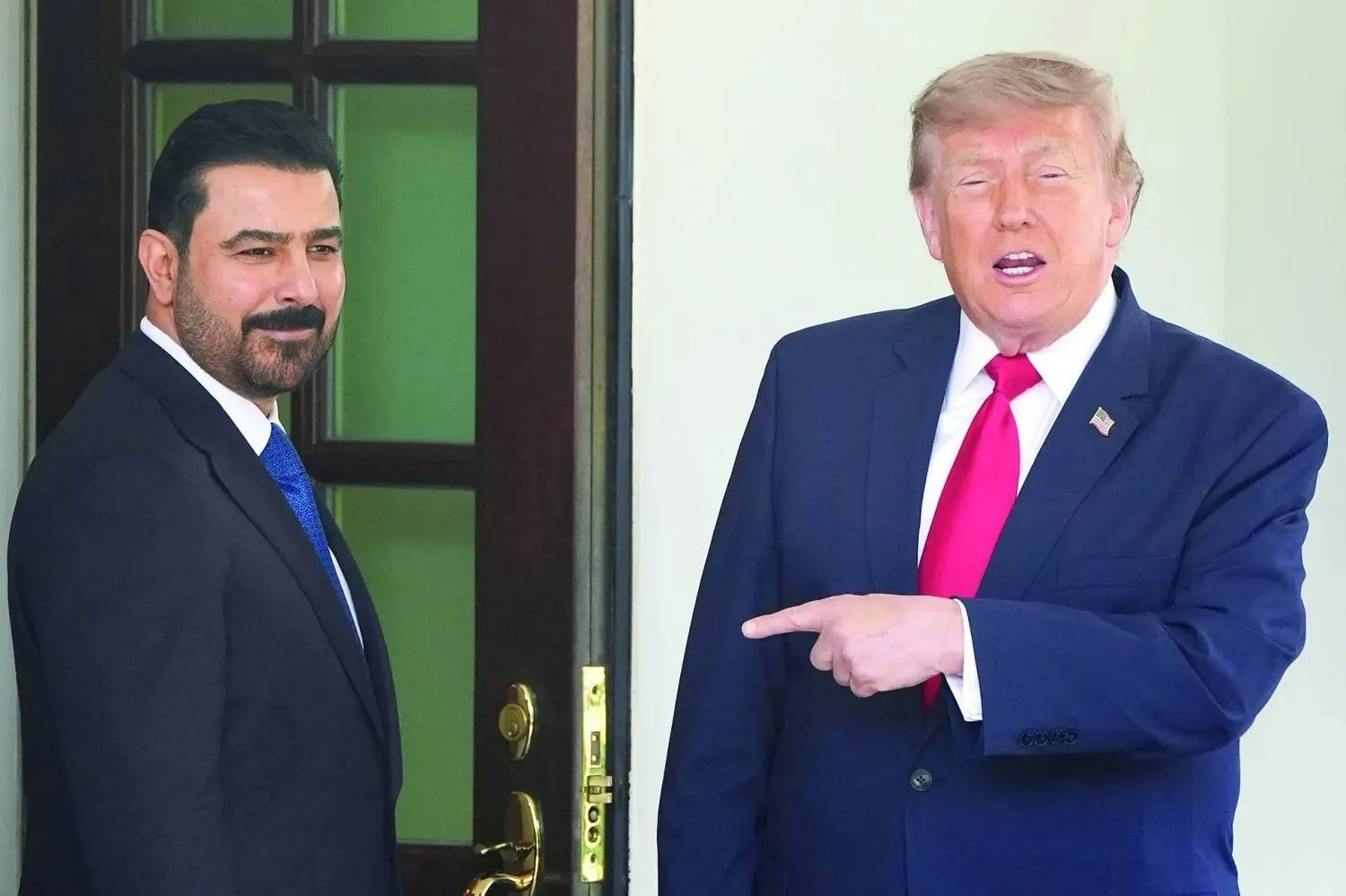
US President Donald Trump welcomes Iraqi Prime Minister Ali al-Zaidi to the White House on Tuesday. (AP)
TT

Trump’s Remarks on Soleimani Spark Debate in Iraq

US President Donald Trump welcomes Iraqi Prime Minister Ali al-Zaidi to the White House on Tuesday. (AP)

Despite US President Donald Trump’s praise for Iraqi Prime Minister Ali al-Zaidi during their White House meeting on Tuesday, remarks about the 2020 killing of Iranian Quds Force commander Qassem Soleimani and former Popular Mobilization Forces (PMF) deputy chief Abu Mahdi al-Muhandis triggered a broad political debate in Iraq.

Greeting al-Zaidi at the White House, Trump described him as “a warrior” and praised the “tremendous chemistry” between them, predicting that the Iraqi premier would remain in office “for a long period of time.”

Turning to the January 2020 US drone strike near Baghdad International Airport, Trump again defended the operation, saying: “And I killed him in my first administration. Had I not, it might be a different story today... I actually think the leaders of Iran were afraid of Soleimani.”

Without mentioning al-Muhandis by name, Trump added: “By the way, a very bad person went with him. They happened to meet at the airport, and a very bad person from Iraq, a leader there, was killed in the same incident.”

He then turned to al-Zaidi with a smile and asked: “So, I don’t know if I did you a favor or not. I’ve never asked you that question before. Maybe you know the answer better than I do.”

Al-Zaidi replied: “At that time, I wasn’t working in politics. This visit is about the future and what we can do together. We’re not concerned with the old past. We’ve had enough of the suffering it caused.”

Munqith Dagher, head of the Independent Institute of Administration and Civil Society Studies (IIACSS) research group, said al-Zaidi had handled the exchange better than many had expected.

Writing on X, he argued that, whether instinctive or the product of media training, the prime minister’s body language and responses spared both himself and Iraq unnecessary embarrassment during one of Trump’s characteristic attempts to put visiting leaders on the spot.

Dagher added that al-Zaidi’s answer could have been even stronger had he delivered it with greater seriousness.

Writer and researcher Adnan Tomeh offered a different assessment, arguing that politics is measured first and foremost by the careful choice of words. He said al-Zaidi could have given a more diplomatic answer that preserved room for maneuver but instead appeared to sidestep the question.

The strongest criticism came from Iran-aligned factions.

Al-Muhandis’ family issued a sharply worded statement accusing Trump of revealing his fear of the consequences of his “crimes,” particularly in Iraq, while rebuking al-Zaidi for distancing himself from the country’s past.

The family also claimed the Washington visit was intended to dismantle the PMF as an “ideological force,” to further US efforts aimed at controlling Iraq’s oil wealth, and to advance calls for disarming armed groups under the slogan of restricting weapons to the state.

Akram al-Kaabi, secretary-general of the US-designated Harakat al-Nujaba, also condemned Trump’s remarks, describing Soleimani and al-Muhandis as “symbols of the resistance.”



Pilot Zone Tests Hezbollah’s Commitment to Withdraw South of the Litani

Israeli soldiers aboard an armored vehicle along the Lebanon border (file photo – Reuters) 
TT

Pilot Zone Tests Hezbollah’s Commitment to Withdraw South of the Litani

Israeli soldiers aboard an armored vehicle along the Lebanon border (file photo – Reuters) 

A proposed pilot zone in South Lebanon has been narrowed to six villages as part of the sixth round of Lebanese-Israeli negotiations held Tuesday and Wednesday in Rome. The plan is intended to test implementation of reciprocal withdrawals by Israel and Hezbollah.

The proposed zone includes Western Zawtar (Zawtar al-Gharbiyeh), Froun, Ghandouriyeh, Qalaouiyeh, Burj Qalaouiyeh, and Srifa. Parts of one village remain under Israeli occupation, while the other five are under Israeli fire control. The area is divided into two sectors: Eastern Zawtar (Zawtar al-Sharqiyeh), north of the Litani River, and the remaining villages south of the river.

Srifa lies about five kilometers from the nearest Israeli ground position in Wadi al-Hujayr. Israeli forces never entered the town after withdrawing to the border security zone in South Lebanon in 1985, before their full withdrawal from the country in 2000.

Lebanese sources familiar with the contacts told Asharq Al-Awsat that the pilot zone remains only a proposal. They said the Lebanese Army has not yet been briefed on the outcome of the negotiations because none of its representatives are participating directly in the talks.

Withdrawal for Withdrawal

The proposal effectively divides the area into two sectors: one where Israeli forces are deployed on the outskirts and another where Hezbollah maintains a presence. Under the plan, both sides would withdraw simultaneously, allowing the Lebanese Army to deploy only after Israeli troops and Hezbollah fighters have vacated their respective positions.

The Litani River runs along the outskirts of Eastern Zawtar, Froun, and Srifa. The Israeli military believes the interconnected deep valleys contain Hezbollah rocket-launching sites, citing the intensive strikes it carried out there during the recent war. Israeli ground forces also conducted incursions into the outskirts of Froun last month.

Ghandouriyeh, Qalaouiyeh, and Burj Qalaouiyeh occupy strategic high ground overlooking villages east of Wadi al-Hujayr that are still occupied by the Israeli military. The three villages lie more than 10 kilometers from the Lebanese-Israeli border.

Hezbollah has not commented on the proposal. Last month, Secretary-General Naim Qassem said that “the ceiling of sovereignty can be achieved by remaining within the framework of the November 27, 2024 agreement, on the basis of areas south of the Litani River only.” He also called for an unconditional Israeli withdrawal and for a comprehensive review of Lebanon’s national security strategy after such a withdrawal.

Lebanese Army Measures

Ahead of technical talks between the Lebanese and Israeli armies, expected Friday under US auspices and facilitation to discuss implementation mechanisms — including an Israeli withdrawal and Lebanese Army deployment — the Lebanese military began field measures in one of the proposed pilot-zone villages.

Local media reported that the army set up a large checkpoint at the entrance to Srifa from Deir Kifa and tightened inspections of vehicles and motorcycles entering the town.

Meanwhile, the Israeli military carried out demolition operations in Beit Yahoun, Bint Jbeil, Khiam, and Kounine, bulldozed roads linking Bint Jbeil to the border town of Maroun al-Ras, and opened fire on residents attempting to inspect orchards near Majdal Zoun and Mansouri.


Hamas and Mediators Reach Broad Agreement on Road Map, Await Israel’s Response

Palestinians mourn victims killed in an Israeli strike on a residential building in central Gaza on Wednesday. (AP)
TT

Hamas and Mediators Reach Broad Agreement on Road Map, Await Israel’s Response

Palestinians mourn victims killed in an Israeli strike on a residential building in central Gaza on Wednesday. (AP)

Hamas and Gaza ceasefire mediators have reached broad agreement on a proposed “road map” during meetings in Cairo, according to two Hamas sources and a Palestinian faction official.

A Hamas delegation led by Khalil al-Hayya left Cairo on Monday evening for Doha to offer condolences following the death of Qatar’s former emir, Sheikh Hamad bin Khalifa Al Thani.

The delegation is expected to travel to Türkiye for talks on mediators’ proposals concerning weapons, other outstanding issues and the future of Palestinian elections.

The discussions will also cover Hamas’ internal leadership election, due to conclude within two weeks after voting was completed in Gaza and the West Bank, with ballots from the movement’s overseas branch still pending.

According to one Hamas source and the Palestinian faction official, negotiators reached broad consensus on nearly all 15 provisions of a road map presented in April by Nickolay Mladenov, the Board of Peace’s High Representative for Gaza, and revised several times since.

They said mediators had developed compromise language for Article 5, governing employees of the Hamas-run administration in Gaza, and Article 8, covering the collection and storage of weapons.

A second Hamas source said 13 of the 15 provisions had been agreed almost in full, while Articles 5 and 8 remained unresolved. He added that partial understandings had been reached on both, but Hamas would first consult its political and military leadership inside and outside Gaza before deciding on the final wording.

All three sources said the meetings brought together mediators from Egypt, Qatar and Türkiye, along with Mladenov and members of his team, including US advisers, as well as Egypt’s intelligence chief, Hassan Rashad.

One Hamas source and the Palestinian faction official described the talks as broadly positive. They said negotiators had agreed on legal formulations concerning government employees that would safeguard their rights while allowing the proposals to be reviewed by legal experts.

On weapons, they said the parties had agreed on language affirming the principle of collecting and storing heavy weapons, while providing further clarification on what constitutes heavy weaponry and how the arrangement would be implemented. The draft also reiterates the dismantling of armed gangs and a simultaneous Israeli withdrawal, in line with language agreed in May.

The two sources said mediators appeared satisfied with the progress and were now awaiting Israel’s response, as well as Mladenov’s position in his capacity as the Board of Peace’s representative.

The sources also emphasized that Hamas had informed mediators, on behalf of the Palestinian factions, that the proposed National Committee for the Administration of Gaza should govern the entire enclave rather than only areas vacated by Israeli forces.

They warned against what they described as Israeli attempts to restrict the committee’s authority in Israeli-controlled Rafah or confine it to designated humanitarian or “safe” zones.

The second Hamas source explained that negotiators had removed language stating that the committee would be responsible only for employees’ rights accruing after it assumed office.

Regarding weapons, he said some provisions had been dropped and replaced with alternative wording, and that a partial understanding had been reached on defining heavy weapons.

However, disagreement remains over the definition of military infrastructure, an issue Hamas plans to discuss during meetings in Türkiye and consultations with its leadership in Gaza before submitting revised proposals to the mediators.

Separately, Hamas official Basem Naim accused Mladenov on Wednesday of favoring Israel following remarks he made after a donors’ conference in Brussels.

Naim disputed Mladenov’s assertion that humanitarian aid flows into Gaza had improved compared with the period before the agreement and accused Israel of continuing military operations despite the ceasefire.

Citing figures from Gaza’s Hamas-run Government Media Office, he said more than 1,100 Palestinians had been killed and over 3,000 wounded, most of them women and children.

He also rejected claims that Hamas had dismissed the road map, saying the movement continues to discuss the proposal and, to its knowledge, it has not yet been presented to Israel. He added that blaming the Palestinian delegation for delays in reaching an agreement reflected a lack of neutrality in the mediation process.


Tunisian Journalist, a Critic of Saied, Sentenced to 1 Year in Prison

Tunisian journalist Haythem El Mekki
TT

Tunisian Journalist, a Critic of Saied, Sentenced to 1 Year in Prison

Tunisian journalist Haythem El Mekki

Prominent Tunisian journalist Haythem El Mekki and critic of President Kais Saied said on Wednesday that he was sentenced to one year in prison over posts he made on social media.

El Mekki, known for his political commentary, was a regular host on Mosaique FM's flagship "Midi Show" before he left the station.

Authorities opened an investigation against him in 2024 under Decree 54 -- a law Saied enacted to combat "false news" -- after he decried poor conditions at a public hospital morgue in the coastal city of Sfax.

A lower court had dismissed the case, but an appeals court handed him the 12-month jail term, he said on Facebook.

The National Syndicate of Tunisian Journalists condemned the ruling in a statement, warning of a "worrying trend" and a "climate of intimidation and self-censorship.”

Mekki has been prosecuted three times since 2023, in each case over comments he had made online or in the media.

Although Mekki has recently distanced himself from the media, he remains active on social networks. He is also a member of the editorial board of Rachma, an independent Tunisian media platform.

Freedom of expression was celebrated as a main achievement of the 2011 uprising that toppled president Zine El Abidine Ben Ali in Tunisia. But since Saied's July 25, 2021 power grab, several NGOs and the opposition have lamented a decline in rights and freedoms.