


Greek Islands Face Drought as Tourist Season Hits

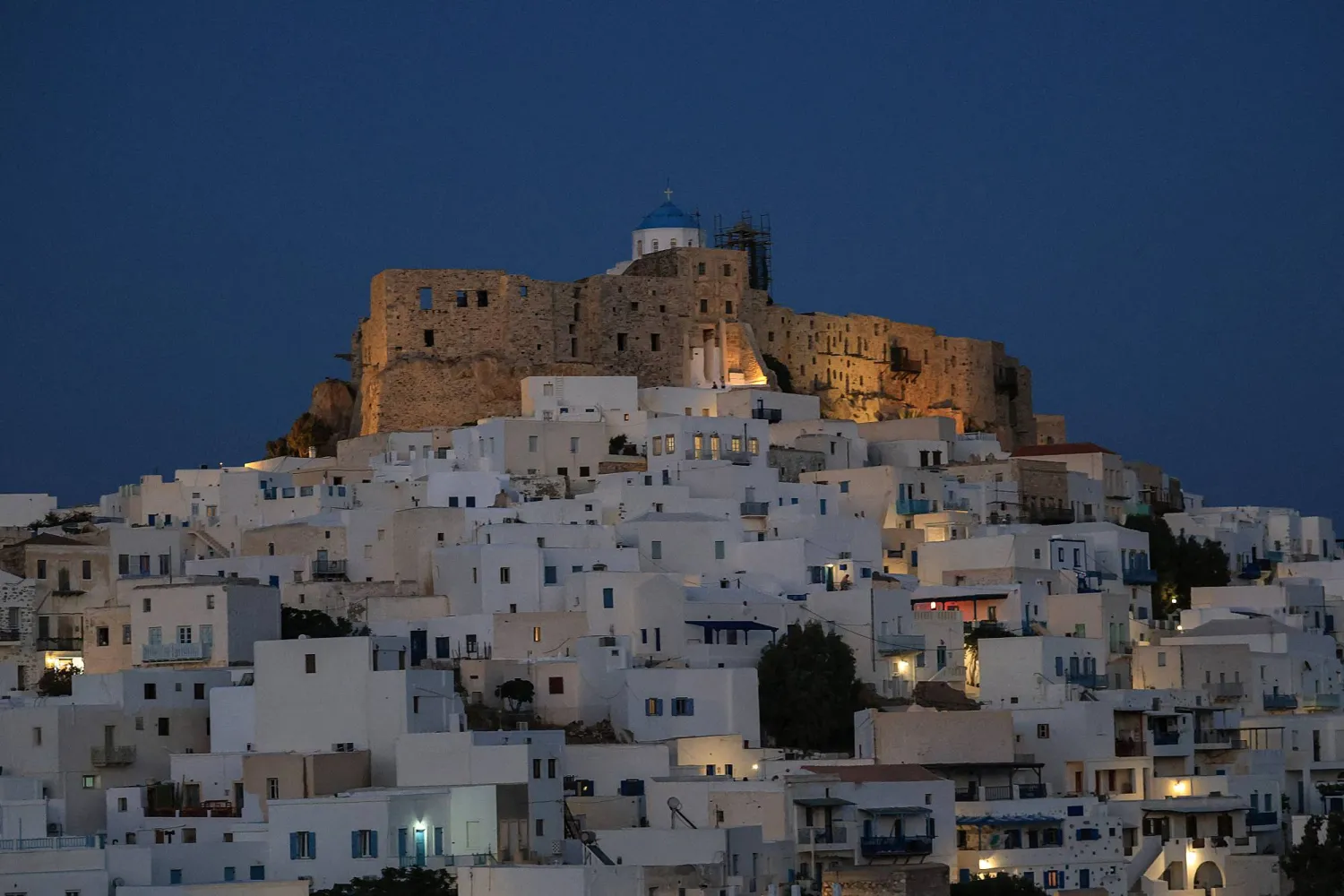
The castle and buildings in the main tourist town on the island, which declared a drought emergency, in Chora, Astypalaia, Greece, July 13, 2026. REUTERS/Louisa Gouliamaki
TT

Greek Islands Face Drought as Tourist Season Hits

The castle and buildings in the main tourist town on the island, which declared a drought emergency, in Chora, Astypalaia, Greece, July 13, 2026. REUTERS/Louisa Gouliamaki

Seven Greek islands in the Aegean Sea have declared drought emergencies this year to preserve water as climate change makes summers hotter and rainfall more erratic.

Now, authorities are wondering if it will rain next year to sustain the thousands of tourists who strain the supply of water just when locals need it most.

The butterfly-shaped island of Astypalaia, which relies on bottled water for drinking, lies east of the mainland and did not benefit from rain in northern and western parts of Greece that gave the country its wettest winter since 2022.

For Astypalaia in the southeastern Aegean, it was the second driest season since 2020, according to data by local authorities, creating dilemmas for officials.

"If we collected all the water dropped throughout the year in a bucket or in a washbowl, it would be 2.5 centimeters deep," said mayor Nikos Komineas, standing near a man-made lake surrounded by dry hills with sparse low scrub, the island's sole water reservoir built in the mid-1990s.

Authorities cut ⁠off farmer Evdokia Palatianou from a man-made lake to save water in April. The vegetables she grows in her orchard withered as she was forced to rely on brackish water pumped from her well.

"Unless it rains, I won't plant anything," said Palatianou, 71, standing next to a dead tree once full of mandarins on the coastal village of Livadi, the island's main fertile region.

The lake supplying water for household use and irrigation in Livadi and to the main tourist town of Chora, the island's capital, now contains some 150,000 cubic meters, a sixth of its storage capacity.

With daily consumption at about 900 cubic meters ⁠in the summer, it would last around five and a half months.

Authorities declared a water emergency in May to fast-track a temporary desalination plant with a daily output of 600 cubic meters for Chora, and blocked irrigation for farmers in Livadi to safeguard the lake's reserves until autumn, Reuters quoted Komineas as saying.

"We did it with a heavy heart, but anyway, thankfully there's this alternative for them," he said, adding that if rain replenishes the Livadi reservoir, they will reconnect the farmers.

A map compiled by the Copernicus European Drought Observatory marked Astypalaia in orange in June, an early sign of emerging drought.

At the seaside village of Analipsi on the island's east, sheep and goat farmers carry in water to fill up tanks or use low-quality water from boreholes.

A desalination plant that supplies tap water there was unable to cover a population that swells to 7,000 from 1,400 in midsummer, so a second, temporary facility was set up in Chora pending ⁠construction of a permanent one ⁠planned for the end of the year.

Dozens of energy-intensive desalination plants are installed on Greek islands. Κomineas said the temporary plant was a fallback for drought, while admitting it was costly.

"A major worry for me was what will happen if there is no rain once again this year," he said.

Some hoteliers on Astypalaia have already taken action to save water. Carolina Alkalai, 42, who operates a hotel on a hillside in Chora, with views of the castle and the Aegean Sea, offers a 5-euro voucher to guests who skip the daily cleaning service.

"Clients have embraced it," she said. She envisioned a second hotel on the island that would incorporate a cistern able to retain rainwater instead of a pool or a jacuzzi.

Environment Minister Stavros Papastavrou has approved 15-million-euros ($17 million) for desalination, grid upgrades and water tanks on nine of Greece's more than 200 inhabited islands, including 1.5 million euros for Astypalaia. In June, he briefed other environment ministers in Luxembourg on water resilience.

"For Greece, water isn't theoretical- it's about security, economic growth and the protection of local communities," he said. The Athens-based National Centre for Scientific Research "Demokritos" says drought could get worse by 2049 as global temperatures rise, exacerbating water scarcity on the vulnerable islands.



What Living in One of the World's Hottest Towns Feels Like

Residents sleep on the platform of a railway station to escape the heat in Banda, northern Indian state of Utter Pradesh, Saturday, June 20 , 2026. (AP Photo/Rajesh Kumar Singh)
TT

What Living in One of the World's Hottest Towns Feels Like

Residents sleep on the platform of a railway station to escape the heat in Banda, northern Indian state of Utter Pradesh, Saturday, June 20 , 2026. (AP Photo/Rajesh Kumar Singh)

Heat at all hours, even in the middle of the night. Long stretches without electricity, meaning some homes can't even use basic fans. And a constant search for relief, like being hosed down with water or sleeping outside.

For many residents of Banda, a town in northern India that has recorded some of the country's highest temperatures, just getting through each day is a challenge.

Global warming, caused mostly by the burning of fuels like gas, oil and coal, is making heat waves across India more frequent and intense. Uttar Pradesh, the state Banda is in, is among those most vulnerable to extreme heat. In 2023, at least 119 people died over several days during a severe heat wave in parts of the state.

In May, temperatures reached 48.2 Celsius (118.8 Fahrenheit), one of multiple times this year that the town recorded the country’s highest temperature for the day. Banda was also the hottest spot on Earth seven times this year, most of them in April, according to climatologist and weather historian Maximiliano Herrera, who tracks global weather extremes. Since then, temperatures have dropped some but are still stifling, particularly as seasonal rains increase humidity.

In June, an Associated Press team went to Banda to report on how people try to cope with the heat throughout the day.

Morning: Heat makes market workers’ jobs tougher Munni Devi and her four sons begin work loading and unloading vegetables when most of the town is asleep.

It’s only 4 a.m., but the temperature is already 30 C (86 F). Workers at Banda's vegetable market are busy unloading tomatoes, jackfruits and other vegetables and transferring them to smaller vehicles for delivery to neighborhood shops.

Devi, 70, says the heat is becoming more intense every year, and this year has been especially bad. The work is physically demanding in any weather. During a heat wave, it can be brutal. But Devi says she and her sons can’t afford to miss a day.

“Everyone feels the heat, but because of our circumstances, we have to bear it,” she says.

At the market, young men wheel carts through narrow lanes. Women sort vegetables on the streets. Devi says many buyers arrive early, hoping to finish shopping before temperatures soar.

Devi and her sons work from early morning until lunch, then return home to recuperate.
She says unreliable power to her home means there is little respite even there. Devi’s grandchildren get sprayed down every day with a water hose to get some relief.

“If there is no power, even the ceiling fans don’t work. Sometimes there is no power for hours,” she says.

Afternoon: Animal lover tries to protect birds from heat impacts As the afternoon sun bakes Banda’s streets, residents who can afford to stay inside do so. But some vegetable sellers and auto rickshaw drivers stay outdoors in hopes of attracting a little more business.

Meanwhile, 70-year-old animal lover Shobharam Kashyap is busy making wooden birdhouses at a workshop in his home.

Kashyap says he and other volunteers have installed over 15,000 birdhouses across the town to give birds respite from an increasingly harsh environment.

Kashyap’s brightly painted birdhouses — many of which are painted green as he says birds seem to prefer that color — have been mounted on trees and walls across Banda.

He has also placed clay water bowls in and near his home to give birds a place for a dip or drink.

Kashyap says he is continuing traditional practices of caring for other animals.

“Our culture has long encouraged feeding birds. Women visiting temples traditionally offer rice. Neither the priest nor the deity consumes it — the birds do,” he says.

Evening: As heat increases, so do hospital admissions Hotter days have brought more patients to the hospital in Banda, one of the bigger medical centers in this region. Those with heat maladies, ranging from fainting to heatstroke, tend to come in the afternoon and evening, filling the corridors and wards.

Patients sit shoulder-to-shoulder on benches. Relatives fan family members with sheets of paper. Hospital staff move between beds carrying intravenous fluids.

Dr. Abhishek Pranayami, the hospital's head doctor, says the hospital sees a surge of patients every summer, "and the number of patients is increasing every year.”

He says they are treating large numbers of people suffering from dehydration, diarrhea, vomiting and abdominal pain — illnesses that become more common as temperatures rise. Some patients recover within days. Others take longer.

“Pressure is quite high on us and the staff,” he says.

Night: Sleeping outdoors or in a rail station to seek a break from heat Even after sunset, Banda remains hot.

When young boys play a game of cricket, they keep their water bottles cool by wrapping them in torn clothes.

At the town’s railway station, families sometimes gather late into the night, hoping the open platforms and occasional breeze will be more comfortable than cramped homes that have absorbed heat all day.

On one such night, dozens are sleeping in the station to avoid the heat. In one spot, several children and adults sleep on blankets spread out on the stone platform with parked train cars a few feet away. Some use bags as pillows. A pile of flip-flops sits inches from their bare feet. Another man stretches out on a bench, with his head on a backpack.

Nearby, several men and women are trying to sleep on blankets near the ticket kiosks, despite the bright lights. Dogs lie between some of the people on the ground, also trying to get relief.

Laborers whose homes are too small and hot to sleep in are sleeping on blankets outside the railway station's entrance, trying their best to get some rest in the hot night. Regardless of the noise of vehicles and passengers entering and leaving the station, laborers and residents are lying on towels and sometimes right on the gravel as the relatively open, breezy roads and pavements near the railway station give them the best chance for some shut-eye.

For parents with little children, the hot night is too uncomfortable for sleep, so they wait in the station, huddled around a smartphone.

The struggle for relief and rest has become a defining feature of summer in cities like Banda.

“Climate change is shifting the average,” says Abhiyant Tiwari, climate and health expert at New Delhi-based NRDC India. “While Banda has always been known for hot summers, what is changing right now is the intensity, the duration and the number of people exposed to dangerous heat conditions.”

High nighttime temperatures are especially worrying because they prevent people from recovering physically from the day’s heat, he says.

The top government official in Banda says authorities have responded by opening cooling centers, distributing hundreds of thousands of oral rehydration kits and monitoring hospitals during heat warnings.

Amit Aasery, the district magistrate of Banda, says officials are studying groundwater levels, soil moisture and vegetation loss while working to improve water supplies and public awareness.

But he says there is only so much they can do.

“What is happening here is a global phenomenon,” he says. “It is because of climate change. We are the recipient of this.”


Natural Sugar Floating in Space Between Stars

Night sky over single tree (AFP) 
TT

Natural Sugar Floating in Space Between Stars

Night sky over single tree (AFP) 

Scientists have found natural sugars floating in interstellar space – and it could fundamentally change the search for alien life.

Researchers spotted erythrulose, found Earth in raspberries and fake tan, towards the middle of our galaxy, according to The Independent.

It could help answer one of the biggest questions about the origins of life on Earth, and how it could have formed elsewhere in the universe.

Sugars are central to living organisms: they are the backbone of the DNA and RNA that makes us up, and help power key biological processes. Researchers also think they would have played a key role in the beginning of life.

But despite that importance, astronomers still do not know how those sugars could have formed, here or elsewhere. Experiments in laboratories, for instance, show that they would not form in the conditions that were around before life was.

Astronomers have previously found sugars on samples from meteorite and asteroids, suggesting that some of them might have come from the primordial molecular cloud that formed our solar system. But no samples had been found in the interstellar medium that sits between stars in space.

Now, researchers have found such a sample towards the molecular cloud known as G+0.693−0.027, which is near the middle of our Milky Way galaxy.

They spotted it using the ultra-sensitive surveys powered by two powerful telescopes.

In data from those telescopes, researchers found data that matched erythrulose when it is measured in a laboratory.

That research also showed that the complex sugar – which is the only possible four-carbon ketone – is vastly more common than similar, less complex three-carbon sugars, of which they found none. “This finding was unexpected, as the prevailing view in astrochemistry is that interstellar molecules grow in size through the sequential addition of carbon atoms”, said Izaskun Jimenez Serra, the lead author on the new work.

That suggests that the some 0.5 and 50 million tons of the sugar could have arrived on Earth during the Late Heavy Bombardment, about 4 billion years ago. In doing so, it might have helped start the development of life on Earth, the researchers said.

The work is published in a new article, ‘Detection of a chiral four-carbon sugar in interstellar space’, published in the journal Nature Astronomy.


Drones, AI and White Paint: Europe Races to Protect Infrastructure from Heat

A vehicle from Oslo Airport’s fire rescue services sprays water onto the runway at the airport, to combat heat, in Oslo, Norway, July 15, 2026. REUTERS/Tom Little
TT

Drones, AI and White Paint: Europe Races to Protect Infrastructure from Heat

A vehicle from Oslo Airport’s fire rescue services sprays water onto the runway at the airport, to combat heat, in Oslo, Norway, July 15, 2026. REUTERS/Tom Little

As Europe's railways buckle under record heat, roads melt and power grids strain, countries are turning to an array of fixes for ageing infrastructure, from drones inspecting tracks and AI-powered sensors to a surprisingly simple tool: white paint.

At Norway's Oslo airport on Wednesday, with temperatures set to hit 30 degrees Celsius (86 degrees Fahrenheit), 10 C above normal for the time of year, workers doused the tarmac with water to keep it cool.

It's a marked shift in a country more used to coping with the cold that reflects how Europe is having to adapt to rising temperatures that are stoking wildfires, causing thousands of excess deaths and putting infrastructure under growing pressure.

"In Norway, the asphalt must withstand both extreme cold and fairly warm temperatures," said Jørn Arvid Remark, operating engineer at Norwegian state-owned airport operator Avinor, adding the airport was testing a new heat-resistant asphalt.

The fire brigade sprays around 9,000 liters of water on key parts of the runway, which can get damaged at high temperatures as it softens under the weight of aircraft, Reuters reported.

Europe's roads and railways, many built decades ago, are increasingly struggling to cope.

Temperatures across Western Europe on Wednesday were 5.5 C above the average for July ⁠15, according to the ⁠Reuters Climate Monitor.

"Our infrastructure is in no way prepared for the extreme weather events that we're going to see," said Chris Dodwell, co-head of sustainability center at Impax Asset Management, adding heatwaves, once rare, were becoming regular events.

A 2025 report by leading central banks estimated that severe weather events, including heatwaves, droughts and floods, could cut euro zone GDP by as much as 4.7% by 2030.

Europe's railways have felt the impact acutely.

An EU report in April found that more than 70% of rail managers were seeing growing disruption from extreme weather. Between 2015 and 2024 weather-related interruptions amounted to the equivalent of one to three years of railway service across the region.

Heat can cause tracks to expand, and points, ⁠signals and power to fail. However, extreme weather triggered by high temperatures can be even more disruptive.

"The most critical issue for rail networks is not the heat itself, but the thunderstorms, strong winds and landslides that often follow heatwaves," said Oliviero Baccelli, a professor at Milan's Bocconi University.

"Italy has already experienced significant disruptions to its railway network, particularly on Alpine routes, as a result of climate-related events."

Northern European countries such as Britain face particular challenges because much of their rail infrastructure was designed for a narrower temperature range than networks in southern Europe.

John Lawrence, chair of the IET Railway Technical Network, said many rail components and systems were "in essence frozen in time".

He added it would be a huge cost to heat-proof entire networks, though operators were exploring more stable sleeper designs and technologies such as AI and drones to "speed up the amount of track that can be inspected and monitored".

Britain's Network Rail has pledged to invest  £2.6 billion ($3.5 billion)  between 2024 and 2029 to help its network withstand increasingly extreme weather.

Not all solutions are hugely expensive, however, with some operators using traditional methods to reflect heat. Stockholm's transport authority spent about 100,000 Swedish crowns ($10,300) painting ⁠sections of metro track white in ⁠May and June to reduce the risk of track buckling.

Martin Wilson, engineering director at French rail equipment manufacturer Alstom, said Europe could learn lessons from transport systems such as the Riyadh Metro and Dubai tram, designed to operate in temperatures above 50C (122F).

"Today's heatwaves are often more intense, more frequent and longer-lasting," he said.

"Rising temperatures are increasingly challenging rail systems across Europe."

Roads face similar pressures.

Engineers say northern European highways were built primarily to withstand damage from freeze-thaw cycles, while southern countries such as Spain use asphalt blends better suited to prolonged summer heat.

Finding the right balance is becoming harder as countries contend with both colder winters and hotter summers.

"They may have to adjust their approach," said José Pablo Sáez Villar of the Spanish Civil Engineers Association, referring to planners and road builders in northern Europe.

Paris transport operator RATP has created a heatwave contingency unit and is preparing a climate adaptation plan by the end of the year.

In Norway, officials say warmer, wetter weather is changing how new infrastructure is designed.

"Roads are going to be made more robust," said Grethe Vikane, head of social development and climate at the Norwegian Public Roads Administration.

"So they can withstand both the challenges already being experienced and the consequences of expected climate change."