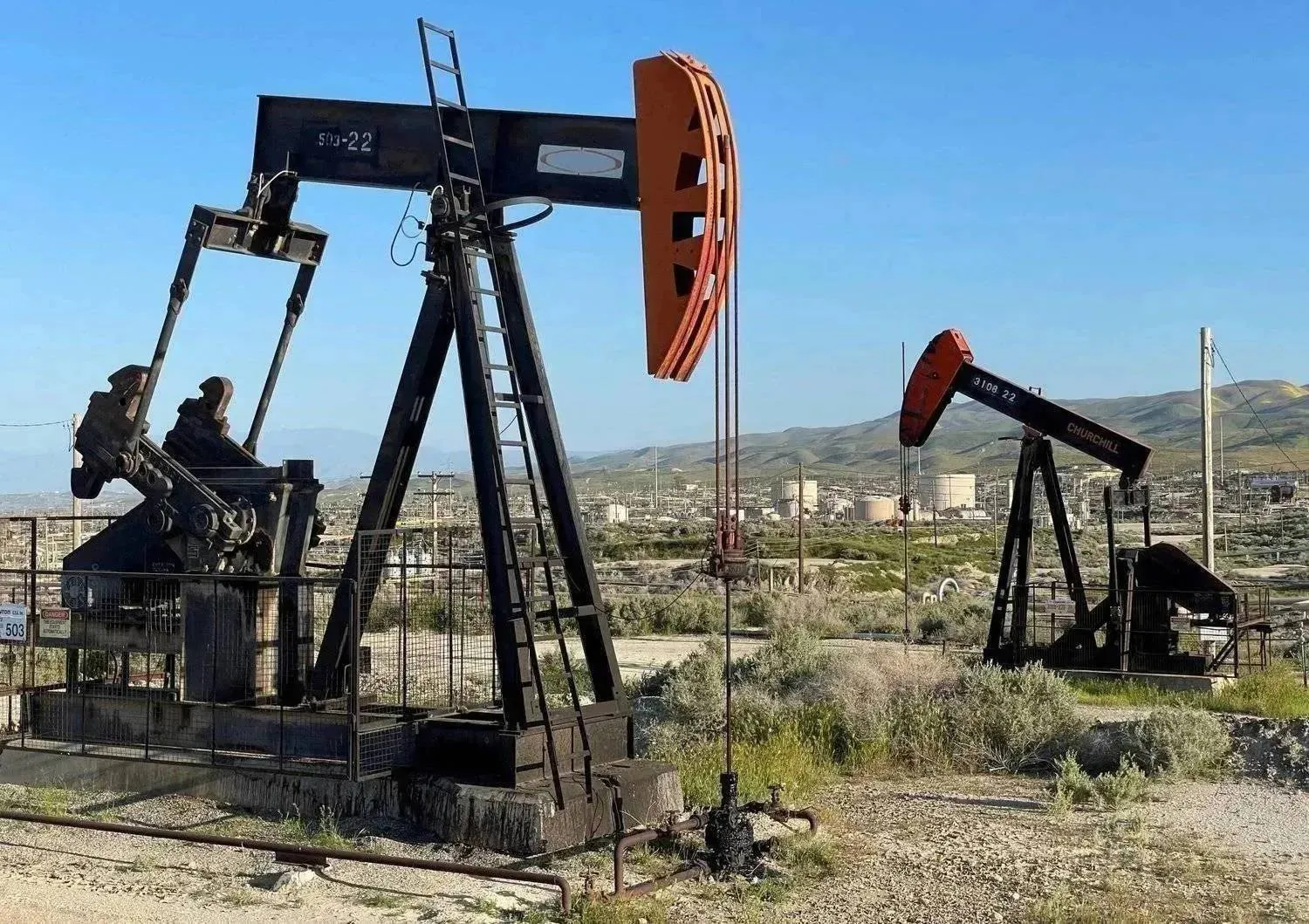
Oil Rises on Renewed US-Iran Hostilities and Threat of Red Sea Closure

Drills operate in an oil field in California (Reuters)
TT

Oil Rises on Renewed US-Iran Hostilities and Threat of Red Sea Closure

Drills operate in an oil field in California (Reuters)

Oil prices rose by more than 2% on Friday after the US and Iran stepped up attacks across the Gulf, with shipping threatened by a potential Red Sea closure on top of the restricted traffic through the Strait of Hormuz.

Brent crude futures rose by $1.77, or 2.1%, to $86 a barrel by 1158 GMT. US West Texas Intermediate futures were up $1.91, or 2.4%, at $80.86.

Both benchmarks have climbed about 13% this week, with Brent on track for a third consecutive weekly gain and WTI set for its second.

Diesel refining margins hit record highs on Friday, with low-sulphur gasoil futures touching $66.25 over Brent crude.

The Middle East is a major diesel exporter and the Hormuz closure, as well as attacks on oil refineries, have tightened fuel markets and bolstered prices globally. The broken truce between the US and Iran has resulted in a drop in oil flows out of the strait.

Iran said it launched fresh strikes on US facilities in the Middle East on Friday, including the first direct attack in Syria, after a sixth straight night of US strikes on Iranian military facilities. US Central Command said on Thursday that American forces had begun a new wave of strikes against Iran to further degrade Iranian military capabilities. "Oil security is still a critical issue," International Energy Agency Executive Director Fatih Birol said on Thursday at a Council on Foreign Relations event in Washington.

"We should be worried, and I am worried, if the situation does not improve in the next few weeks," he said.


Trump Announces Temporary Tariff Relief on Ground Beef Imports

Beef cows gather at the Diamond J Angus Ranch, March 31, 2026 near Mandan, N.D. (AP)
TT

Trump Announces Temporary Tariff Relief on Ground Beef Imports

Beef cows gather at the Diamond J Angus Ranch, March 31, 2026 near Mandan, N.D. (AP)

President Donald Trump announced Friday that the United States would temporarily allow a greater volume of foreign beef imports, in his latest bid to lower costs for American consumers as midterm elections approach.

The US cattle herd has shrunk to its smallest size since the 1950s -- in part due to drought and international competition -- with the diminishing numbers pushing beef product prices higher.

"As we work to rebuild this herd and help our ranchers, for the next 90 days, the United States will allow up to 300,000 metric tons of product for ground beef to be imported with no out of quota tariff," Trump wrote on his Truth Social platform.

The US president did not say which countries would be exporting the beef but added there was a commitment to sell it at 25 percent below market prices.

Steeper beef prices have become a symbol of high living costs in the world's biggest economy, pressing the Trump administration to take steps to bring costs down.

Affordability will be a key issue in November's midterm elections, where Democrats are seeking to wrest control of both houses of Congress from Trump's Republicans.

- 'Disappointed' -

US cattle and rancher groups have been resistant to importing more beef. Responding to the move, Senator Deb Fischer of Nebraska, a major beef-producing state, said she was "extremely disappointed."

"We all want lower grocery prices, but as I've said for months, we cannot do it at the expense of American producers. Flooding the market with foreign beef hurts our livestock industry," said Fischer, a Republican.

The National Cattlemen's Beef Association, a trade group, was similarly downbeat.

"Flooding the market with government-subsidized, below-market beef is not the way to rebuild the American cattle herd," CEO Colin Woodall said. "Today's announcement and other market interventions throw cold water on the prospect of herd expansion and sacrifices long-term stability for short-term messaging."

Responding to the criticism later in the day, Trump offered no details on how the plan would work but insisted he would get beef prices down because "that's what the voters want, and that's what I want."

Last fall, Trump demanded ranchers slash their prices, and he later moved to expand imports of beef trimmings from Argentina to cool ground beef prices.

He has also launched an investigation into the meatpacking industry over the high prices of red meat.

His latest effort comes as American households struggle with stubborn inflation, fueled by an energy crisis linked to the war on Iran.

Trump launched the war alongside ally Israel in late February, with Tehran's retaliatory action virtually blocking the Strait of Hormuz, a vital energy and fertilizer supply route.

This has pushed up fuel, transportation and food costs.

Despite higher beef prices, US consumer demand for meat remains robust.

The US Department of Agriculture estimates total beef consumption this year will hit 29.4 billion pounds, an uptick from 2025.

The American Farm Bureau Federation warned in May, however, that Americans are consuming more beef than US farmers and ranchers can supply.

It added that ranchers need to rebuild the US cattle herd -- or demand would have to cool -- in order for beef prices to fall.

Yet "cattle producers still face substantial uncertainty that clouds herd rebuilding decisions," wrote Bernt Nelson, an economist at the federation.

These include threats to animal health, including the New World screwworm, a flesh-eating parasite.


South Korea to Send First Container Ship Through Arctic Route

The container ship "Panstar Acro" is anchored to load containers at Busan New Port in Busan on August 22, 2026, as the vessel is scheduled to sail to Europe via the Arctic to test the commercial viability of the shipping route opened by melting ice. (AFP)
TT

South Korea to Send First Container Ship Through Arctic Route

The container ship "Panstar Acro" is anchored to load containers at Busan New Port in Busan on August 22, 2026, as the vessel is scheduled to sail to Europe via the Arctic to test the commercial viability of the shipping route opened by melting ice. (AFP)

South Korea was set Saturday to send its first trial container through the Arctic, as the Middle East war rattles global shipping, while environmental groups warned the route could accelerate polar ice melt.

The Middle East conflict, sparked by US-Israeli strikes on Iran in February, has roiled global shipping, sending governments and shipping firms scrambling to seek alternative routes.

Sailing from Busan New Port, the container ship -- the "PanStar Acro" -- will sail to Europe via the Arctic, testing whether a route opened by melting sea ice can be commercially viable.

"The ship will depart at 8 pm (1100 GMT) today unless there are unforeseen circumstances, such as bad weather," an oceans ministry official told AFP on Saturday.

The ship will leave for Felixstowe in Britain, Rotterdam in the Netherlands and Gdansk in Poland before returning, with the voyage expected to take about 45 days, according to the ministry.

The voyage follows that of the Chinese container ship "Dubai Tower", which left the eastern port city of Ningbo for Europe this month, heading north through the Bering Strait before turning west along Russia's Arctic coast.

The usual maritime route between Asia and Europe runs through the Suez Canal, but travelling through the Arctic can cut the journey by around 7,000 kilometers (4,300 miles) and about 10 days, according to the Korea Institute for International Economic Policy.

South Korea's Vice Oceans Minister Nam Jae-hon said the Arctic route was "bound to become an alternative" to Middle Eastern shipping lanes -- as geopolitical risks and technological advances make it increasingly competitive.

Marc Lanteigne, a political science professor at the Arctic University of Norway, said the voyage -- coming soon after China's "Dubai Tower" began its own Arctic journey -- showed the Northern Sea Route (NSR) was becoming normalized as a "secondary maritime transit corridor".

A successful voyage would demonstrate South Korea's interest in "developing alternative shipping sea lanes", he told AFP, with concerns that it could fall behind as Chinese firms expand regular services through the increasingly viable Arctic route.

- Russia issue -

Some experts warn South Korean ships using the Arctic route could risk breaching Western sanctions on Russia -- currently a key security ally of North Korea -- as they would receive Russian navigation and weather services involving payments, albeit small ones.

South Korea's foreign ministry declined to comment when asked by AFP about the concerns involving Russia.

The oceans ministry said this week that "consultations with key relevant countries and agencies" have been completed to "implement administrative procedures necessary" for the voyage.

Vladimir Tikhonov, Korean Studies professor at the University of Oslo, said "strictly speaking, US and EU sanctions are not international law, unlike UN sanctions".

"And with continued uncertainty in the Middle East - itself driven in part by US actions - South Korea may have few alternatives if the Arctic route proves economically viable," he told AFP.

Lanteigne said China's Northern Sea Route ambitions were more politically driven than South Korea's, with Beijing viewing the polar regions as "strategic new frontiers", raising Western security concerns.

Meanwhile, environmental groups warned growing traffic along the shorter NSR could accelerate Arctic sea ice loss already driven by global warming.

Major carriers including CMA CGM, MSC and Hapag-Lloyd have pledged to avoid Arctic shipping routes.

The NSR is believed to be accessible only during the time of year when the ice is melted enough to allow transits without icebreakers.

"The Northern Sea Route has become increasingly viable as the Arctic warms about four times faster than the global average, leading to a sharp decline in sea ice," South Korean environmental group Paran Ocean Citizen Science Center said in a statement last year.

"But making the route commercially viable would require further warming, putting the policy at odds with efforts to combat climate change."


World Bank Projects Lebanon Economy to Contract by 6.4% Due to War

People inspect a damaged building after an Israeli airstrike on the village of Ansar, southern Lebanon, 15 August 2026. (EPA)
TT

World Bank Projects Lebanon Economy to Contract by 6.4% Due to War

People inspect a damaged building after an Israeli airstrike on the village of Ansar, southern Lebanon, 15 August 2026. (EPA)

The World Bank on Friday projected that Lebanon's economy would contract by 6.4 percent this year, as the latest Israel-Hezbollah war derailed the country's efforts at recovery.

Lebanon has been dealing with an unprecedented financial crisis since 2019 and was still reeling from the 2024 Israel-Hezbollah war when the Iran-backed group drew it into the Middle East conflict by attacking Israel in March.

Israel responded with a heavy air campaign and ground invasion that Lebanese authorities say have killed more than 4,300 people.

Due to the war, "real GDP is projected to contract by 6.4 percent in 2026, reflecting the collapse in tourism, weaker consumption, disrupted supply chains, heightened insecurity, and prolonged displacement," the World Bank said in a report.

Inflation is also expected to rise to 17.5 percent this year, according to the report.

The World Bank said Lebanon's economy had strengthened before the latest conflict, with an estimated real GDP growth of 4.2 percent in 2025, "the fastest since the onset of the 2019 financial crisis".

"Advancing reforms -- particularly on banking sector restructuring and fiscal management -- will be critical to restoring confidence, protecting stability, and mobilizing the financing needed for reconstruction and recovery," Dahlia Khalifa, the World Bank's Middle East director, said.

The international community has been demanding that Lebanese authorities enact financial reforms in order to secure much-needed economic aid.

Last week, parliament passed amendments to a bank resolution law aimed at restructuring troubled banks and addressing the country's banking crisis.

The International Monetary Fund welcomed the law, describing it as "a very good step that reflects Lebanon's commitment to aligning its legislation with the best international practices".

Lebanon has been in discussions with the IMF, which said it would resume its meetings in Beirut next month.