


Yemen's Oil Minister to Asharq Al-Awsat: Security Plan to Counter Houthi Threats

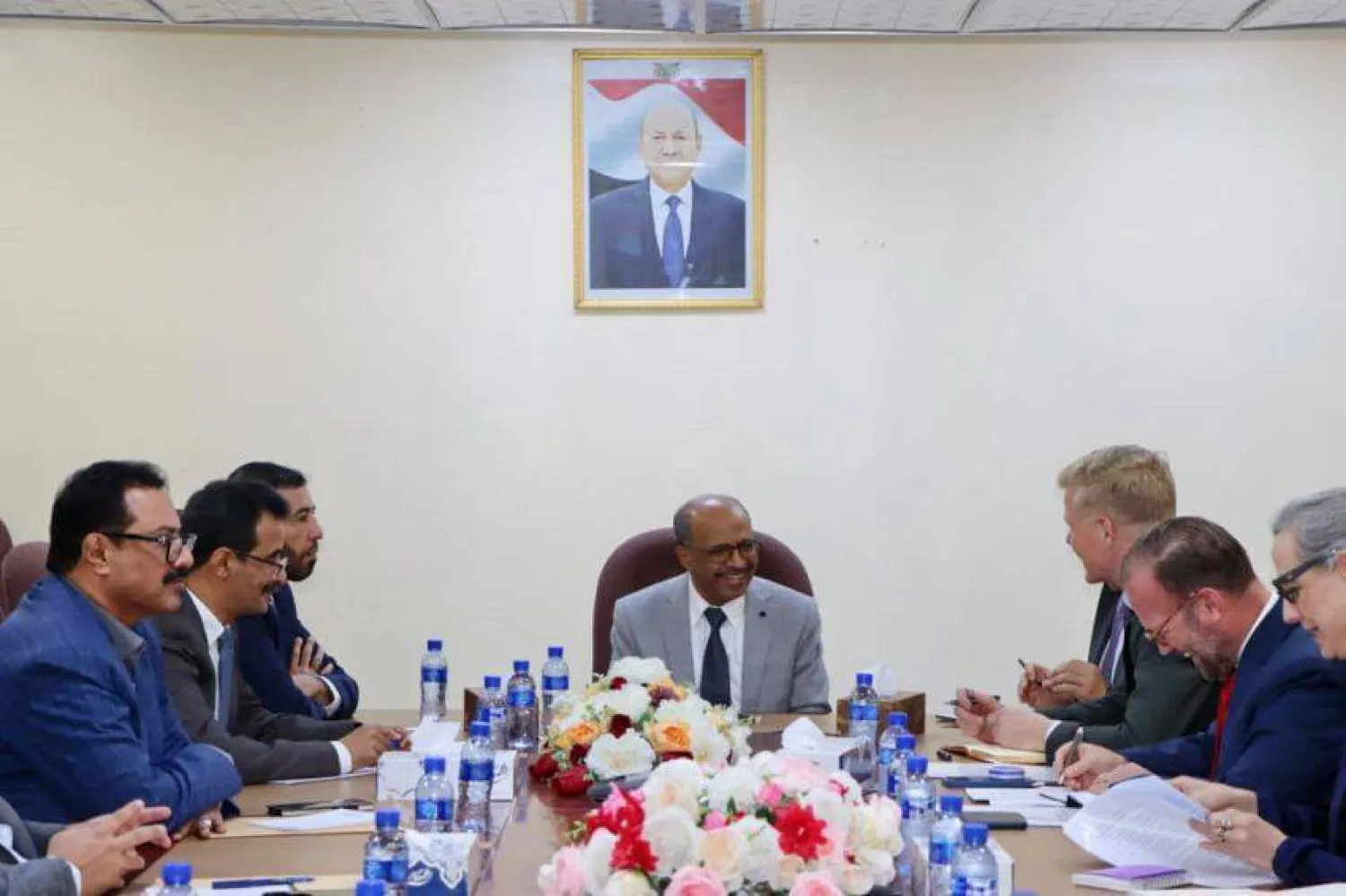
Yemen's Minister of Oil and Minerals, Mohammed Bamqaa, during a previous meeting with the UN special envoy to Yemen (Saba).
TT

Yemen's Oil Minister to Asharq Al-Awsat: Security Plan to Counter Houthi Threats

Yemen's Minister of Oil and Minerals, Mohammed Bamqaa, during a previous meeting with the UN special envoy to Yemen (Saba).

Yemen's Minister of Oil and Minerals Dr. Mohammed Bamqaa affirmed the government's readiness to restore oil operations, noting that the previous suspension of oil exports disrupted government functions, delayed salary payments, and contributed to a decline in public services.

In remarks to Asharq Al-Awsat, Bamqaa revealed that an emergency meeting had been convened with the security and military authorities assigned by Dr. Rashad Al-Alimi, chairman of the Presidential Leadership Council, along with the company holding the export contract. He said a security plan had been put in place to address potential threats, particularly those posed by the Houthis in the Bab el-Mandab Strait.

In a related development, the minister said discussions have continued since President Al-Alimi announced the resumption of oil exports. Those discussions led to a meeting of the Supreme Committee for the Sale and Marketing of Crude Oil, chaired by Prime Minister Dr. Shaya Al-Zindani in his capacity as general supervisor, where a time-bound implementation mechanism was approved to facilitate the process.

"We, in the ministry, have instructed all relevant units, institutions, and national and foreign companies partnering with the state to hold meetings and develop urgent plans covering the technical, financial, and administrative aspects. Teams are already working on these efforts," he said.

Bamqaa said the Ministry of Oil and Minerals is technically prepared and is working to restore operational status. He explained that, in the oil industry, restoring operational status is a technical procedure required after facilities have been shut down for an extended period, during which pipelines are emptied.

"We are currently reactivating the system and are ready to begin exports as soon as we receive official notification from the contracted company in the coming days," he added.

Regarding the expected revenues and their impact on the state budget, Bamqaa said the ministry had submitted projected revenue estimates to the Ministry of Finance so the funds could be directed toward improving essential public services and to improve essential services and ensure the regular payment of public-sector salaries.

"The suspension of oil and gas exports affected the government's performance, disrupted salary payments, contributed to the budget deficit, and led to a decline in public services, with some services being suspended altogether," he said.
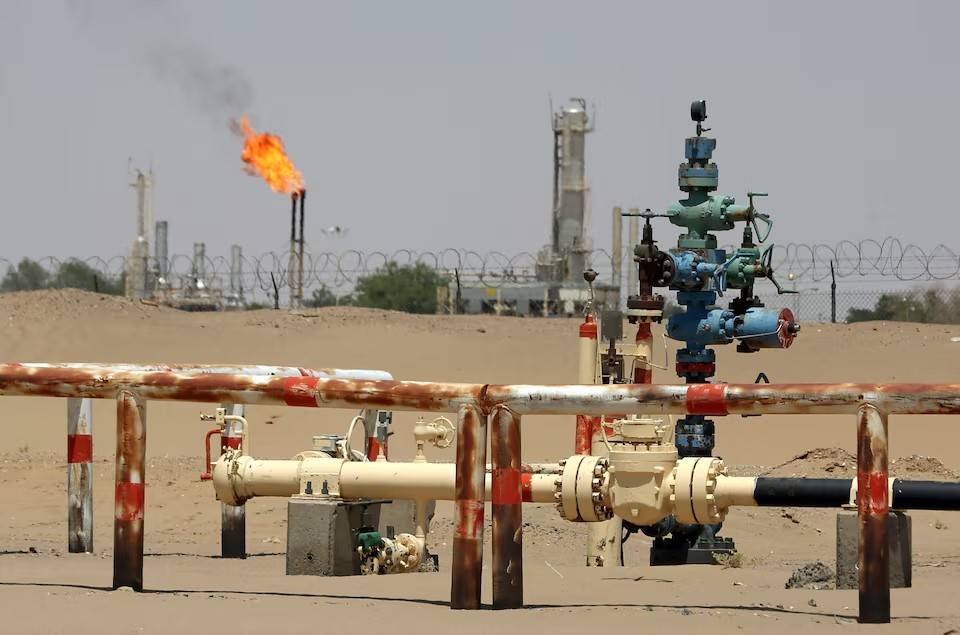
An oil refinery in Yemen (File photo: Reuters).

He also highlighted Saudi Arabia's support, saying that the Saudi Development and Reconstruction Program for Yemen, headed by Ambassador Mohammed Al Jaber and acting under the directives of the Kingdom's leadership, had provided financial assistance that helped sustain salary payments and secure fuel supplies for power plants.

"For these reasons, the decision to resume exports is both important and a national necessity to preserve state institutions," he added.

Asked about his planned visit to Saudi Arabia, Bamqaa said he is fully prepared to make the trip once the relevant authorities set a date. He noted that work is continuing across all fronts in close coordination with the relevant government agencies under the direct supervision of Prime Minister Shaya Al-Zindani.

He added that all departments, units, and directorates within the Ministry of Oil and Minerals had been instructed to maintain the highest level of readiness and complete the tasks assigned to them.

Yemen's oil exports have been almost entirely suspended since October 2022 after Houthi attacks on the Al-Dhabba and Al-Nashima export terminals in Hadramout and Shabwa, depriving the government of one of its main sources of revenue, which accounts for about 70 percent of the state budget.


Israeli Military Operations Paving Way for Battle in South Lebanon

 Smoke rises as Israeli forces demolish homes in Zawtar al-Sharqiyeh, southern Lebanon, Sunday, Aug. 23, 2026. (AP)
Smoke rises as Israeli forces demolish homes in Zawtar al-Sharqiyeh, southern Lebanon, Sunday, Aug. 23, 2026. (AP)
TT

Israeli Military Operations Paving Way for Battle in South Lebanon

 Smoke rises as Israeli forces demolish homes in Zawtar al-Sharqiyeh, southern Lebanon, Sunday, Aug. 23, 2026. (AP)
Smoke rises as Israeli forces demolish homes in Zawtar al-Sharqiyeh, southern Lebanon, Sunday, Aug. 23, 2026. (AP)

Israeli incursions and raids on southern Lebanon are paving the way for a military battle as the army has been striking heights overlooking villages and towns it is occupying. Israel has also been targeting roads and routes that run deeper into Lebanese territory, notably around Bint Jbeil city, security sources told Asharq Al-Awsat.

The operations and raids are focusing on the Ali al-Taher heights in the eastern sector that Israel has been trying to capture for ten weeks. In the central sector, it has been focusing on routes leading to Bint Jbeil and, closer to the coast, it has been carrying out similar incursions and detonations in the towns of Majdal Zoun and al-Mansouri.

The security sources said the operations appear to be paving the way for a military battle. The attacks are targeting all the hills surrounding Ali al-Taher, especially the al-Dabsha and al-Tahra that were occupied by Israel before it withdrew from the South in 2000.

The sources explained that focusing attacks on the hills and destroying houses around Ali al-Taher means that the troops are trying to isolate the entire strategic area from its surroundings.

For the past week, Israeli raids struck under-constructions houses and villas in the Dawhet Kfar Rumman and Nabatieh al-Fawqa areas, located north and southwest of Ali al-Taher respectively. It also continued to blow up houses in Kfar Tebnint that is located directly west of Ali al-Taher.

Israel has also struck Ali al-Taher itself with artillery and phosphorous bombs.

Lebanese media on Sunday said Israel used artillery to hit Mayfadoun and airstrikes hit Nabatieh al-Fawqa and Dawhet Kfar Rumman.

In the central sector, Israeli troops carried out incursions into four unoccupied towns: Beit Yahoun, Baraachit, Hadatha and Aita al-Jabal, all of which lead to Bint Jbeil, which is occupied by Israel.

The sources said a potential military battle in the future will not be limited to Ali al-Taher, but encompass the central sector.

The incursions are covering an area stretching some five kilometers from Baraachit to Hadatha in an attempt to create a buffer zone close to Ali al-Taher and capture areas that overlooking nearby valleys.


Palestinian Authorities Say Israeli Army Kills Teen in West Bank

Mourners carry the body of Palestinian Islam Ajouri, 14, at Rafidia Hospital in Nablus in the Israeli-occupied West Bank, on August 23, 2026. (Photo by JAAFAR ASHTIYEH / AFP)
TT

Palestinian Authorities Say Israeli Army Kills Teen in West Bank

Mourners carry the body of Palestinian Islam Ajouri, 14, at Rafidia Hospital in Nablus in the Israeli-occupied West Bank, on August 23, 2026. (Photo by JAAFAR ASHTIYEH / AFP)

Israel's military killed a Palestinian teenager in the occupied West Bank on Sunday, Palestinian health authorities said, while an Israeli and a Palestinian were wounded in separate incidents.

Israeli gunfire killed Islam Ahmad Maher Ajouri, 14, in the Askar refugee camp where he lived, outside Nablus in the north of the West Bank, the Palestinian health ministry announced.

Mohammed Abu Kashk, head of the Askar camp services committee, told AFP that the teenager was killed by Israeli forces during a raid on the camp.

"There were no clashes or confrontations that would justify shooting a child and killing him," he said.

According to a source from the Palestinian Red Crescent, Ajouri was hit in the chest by live ammunition. He was pronounced dead at Nablus National Hospital.

At his funeral, his uncle Ahmed Mohamed Zamzoum told AFP that the boy went outside during the army raid. "Every time the Israeli forces enter, one or more martyrs are killed," he said.

The Israeli army told AFP it was verifying the information.

In a separate incident, the army said it apprehended a man suspected of stabbing an Israeli earlier on Sunday in Al-Auja, in the central West Bank.

Israeli rescue service Magen David Adom said the 24-year-old victim had "a penetrating wound".

The man was evacuated to a hospital in Jerusalem, and his condition was described as "moderate".

According to the initial findings of the investigation, the victim parked near a shopping center and was "attacked from behind and stabbed in the shoulder", Israeli police said in a statement.

Hani Najum, the head of the Al-Auja village council, told AFP that "the Israeli army raided the village, deployed in its streets" and imposed a curfew.

In a third incident, the army reported that a "terrorist" attempted "to steal a weapon from an IDF soldier" near the Palestinian town of Taybeh, northeast of Ramallah, and that forces opened fire at the man, saying he was "neutralized".

Palestinian sources told AFP that the man, Aws Akram Maatan, from the village of Burqa east of Ramallah, suffered an injury to his foot and was taken to a Jerusalem hospital for treatment.

The head of the Burqa village council, Sayel Kanaan, said in a statement that Maatan had been shot "without justification".

Violence has surged in the West Bank, which Israel has occupied since 1967, since the start of the war in Gaza sparked by Hamas's October 2023 attack on Israel.

Israeli soldiers or settlers have killed at least 1,100 Palestinians since then, according to an AFP tally based on data from the Palestinian health ministry.

Over the same period, at least 48 Israelis have been killed in Palestinian attacks or during Israeli military operations, according to Israeli figures.


Tunisia Says Recovered 11 Migrants' Drowned Bodies

African migrants rescued by the Tunisian coast guard in October (AFP)
TT

Tunisia Says Recovered 11 Migrants' Drowned Bodies

African migrants rescued by the Tunisian coast guard in October (AFP)

The Tunisian national guard said Sunday it recovered 11 bodies from the sea after a boat carrying migrants sank off the country's southeastern coast, with three people still missing.

The boat was carrying 15 people, only one of whom was rescued after it sank some 14 nautical miles off the shore of Zarzis on Friday night.

"Search operations resulted in the recovery of three bodies yesterday and eight bodies today, bringing the total to 11," the national guard said in a statement.

Searches for the three remaining missing passengers were ongoing, it added.

On Saturday night, residents in Ben Guerdane -- the marginalized city near the Libyan border where 14 of the migrants were from -- staged protests, blocking roads and setting tires on fire over the shipwreck.

Tunisia, whose coast is some 145 kilometers (90 miles) from the Italian island of Lampedusa, is a key departure point for migrants seeking to make the perilous journey across the Mediterranean in search of better lives in Europe.

The central Mediterranean crossing is the deadliest migration route in the world, according to the International Organization for Migration (IOM).

The IOM said earlier this month that the number of migrant deaths on the central Mediterranean route had more than doubled in the first four months of 2026 compared to the same period last year.

At least 914 migrants have died or gone missing along the route this year, according to the IOM.

In 2023, Tunisia signed a 255-million-euro ($290 million) deal with the European Union, nearly half of which was earmarked for tackling irregular migration.

The deal, strongly supported by Italy's hard-right government, aimed to bolster Tunisia's capacity to prevent boats leaving its shore.
