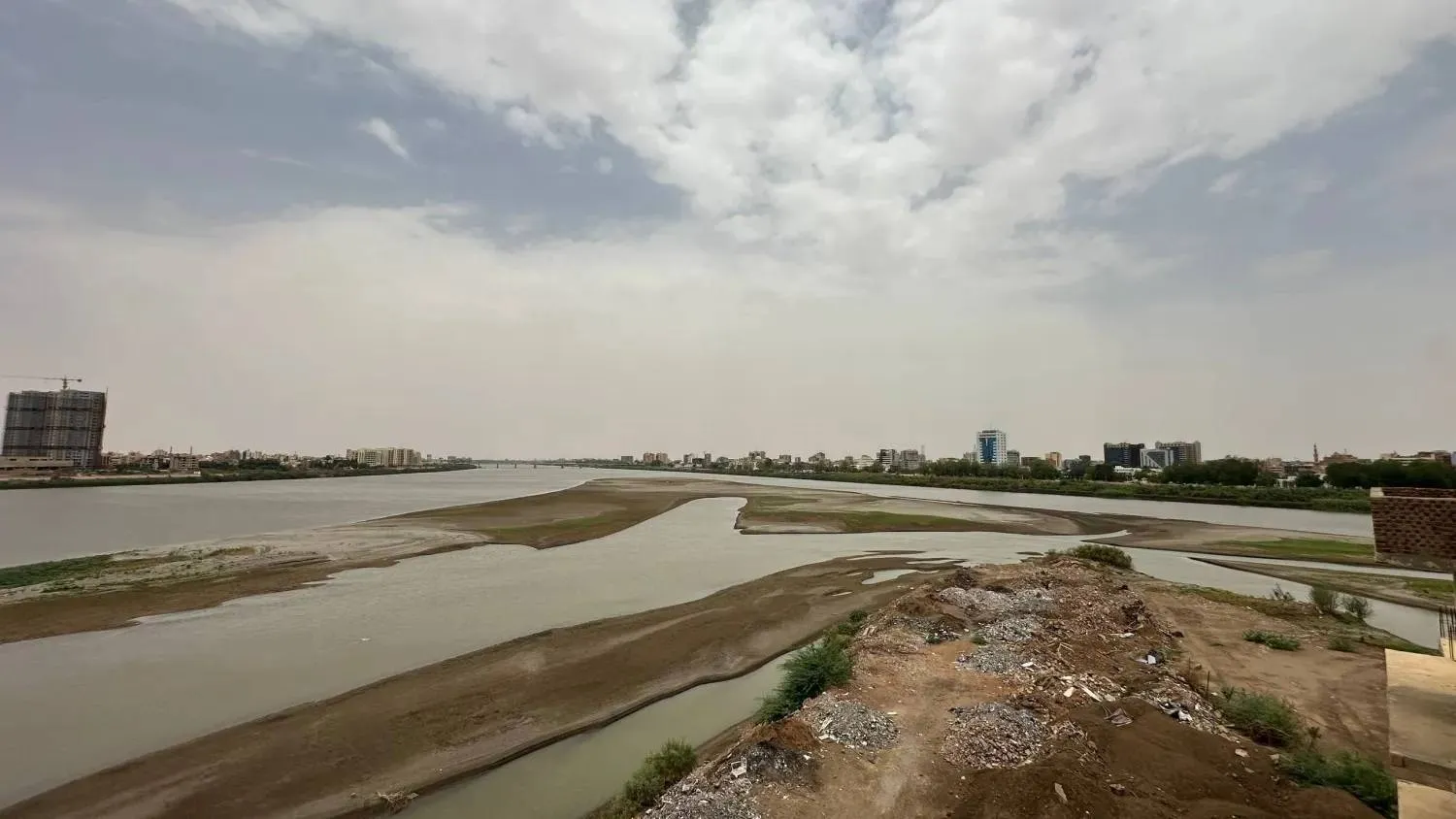

A sudden drop in Nile water levels in Sudan has triggered heated debate over the country’s ability to manage its water resources, as weaker flows have disrupted drinking-water stations and raised concerns about the agricultural season.
The decline comes as war has weakened state institutions and scattered technical personnel working in the irrigation sector.
While much of the attention has focused on Ethiopia’s Grand Ethiopian Renaissance Dam as the main cause of the receding waters, experts and political officials say the crisis is more complex.
They say it is linked not only to water storage and operations at the dam, but also to the management of Sudanese reservoirs, the use of available flows and the level of coordination and data-sharing among Nile Basin countries.
Saif al-Din Hamad, a former head of the technical committee at the Water Resources Ministry, said releases from the Grand Ethiopian Renaissance Dam during the first half of 2026 exceeded Sudan’s actual needs.
The flows ranged from about 520 million cubic meters a day in January to 200 million cubic meters by the end of June, he said.
In an article titled “Questions on the Repercussions of Operating the Grand Ethiopian Renaissance Dam and Its Impact on the 2026 Flood Season”, Hamad said Sudan should have used those flows to store enough water in the Roseires Reservoir to meet irrigation and electricity-generation needs before storage began at the Ethiopian dam in early July.
That did not happen, he said.
“The Grand Ethiopian Renaissance Dam stores about 25 billion cubic meters of water during the rainy season, from July to October, and then releases it gradually during the low-flow period between January and June, while maintaining a strategic reserve to cope with prolonged droughts,” Hamad said.
Administrative changes needed
Hamad said the dam had altered the flow pattern of the Blue Nile.
Large volumes of floodwater are now stored in Ethiopia rather than flowing directly towards Sudan and Egypt’s Aswan High Dam, where it is released during the dry season.
This requires Sudan to adjust the operation of the Roseires and Jebel Aulia reservoirs to the new system, he said.
Hamad said the start of storage at the Ethiopian dam in early July was neither sudden nor unexpected. It had been anticipated under technical arrangements signed by Sudan and Ethiopia in October 2022.
Sudan could have reduced the impact by storing water in advance at Roseires, he added.
Mubarak al-Fadil, head of the Umma Party, said regional media had linked the decline in Nile water levels to the operation of the Grand Ethiopian Renaissance Dam, but that explanation did not reflect the full picture.
He said the main cause was the lack of effective management in the irrigation sector after the Irrigation Ministry was merged with the Agriculture Ministry, as well as the dispersal of technical staff because of the war.
This had affected reservoir operations and water-resource management, he said.
In a post on X, al-Fadil said inflows during the first half of the year would have allowed Sudan to store enough water at Roseires to meet irrigation and electricity needs.
He questioned why the flows had not been managed to ensure water security during such a critical period.
The war and the resulting weakness of state institutions had prevented Sudan from benefiting from the technical arrangements signed with Ethiopia, he said.
Continued fighting was worsening humanitarian crises and threatening food and water security, he added.
Mubarak Ardol, assistant chairman of the Democratic Bloc, also called for the Irrigation Ministry to be restored as an independent institution within the transitional government and for its merger with the Agriculture Ministry to be reversed.
Ardol said fast-moving developments in the Nile water issue required a specialized technical body with the expertise and capacity to manage water resources and coordinate with other countries in the region.
He said the merger had weakened the performance of technical committees and affected dam operations, water-level monitoring and the handling of water-related matters.
Ibrahim Shaglawi, a researcher specializing in development media, told Asharq Al-Awsat that the decline in water levels was partly due to natural factors linked to climate change and the onset of the rainy season in the Ethiopian highlands.
But it was also connected to the change in the Blue Nile’s flow pattern caused by the Grand Ethiopian Renaissance Dam, he said.
Shaglawi said Sudan needed to align the operation of its reservoirs with regional changes and improve the exchange of information on water-storage and release programs and rainfall forecasts.
This would help balance the needs of drinking-water supplies, irrigation and electricity generation, he added.
Ahmed al-Mufti, an international expert and former adviser to the Irrigation Ministry, said operating a reservoir with a capacity of more than 60 billion cubic meters without an agreement with the two downstream countries could lead to sharp fluctuations in water levels, ranging from severe declines to flooding.
Al-Mufti told Asharq Al-Awsat that a binding legal agreement was needed to regulate the filling and operation of the Grand Ethiopian Renaissance Dam, ensure data-sharing and advance notification, and address dam safety and water-security concerns.
He expected Nile water levels to return to normal as the rainy season progressed.
At the same time, he warned that levels could rise rapidly to flood levels if large volumes of water were released without coordination.
Al-Sadiq Sharafi, an irrigation and water-resources expert, told Asharq Al-Awsat that declining water levels before the flood season were normal, but had begun occurring earlier since the construction of the Grand Ethiopian Renaissance Dam.
He said water management had become more complex with the presence of large dams.
Despite their differing explanations, experts agree that securing drinking water and protecting the agricultural season no longer depend solely on water availability.
They also depend on efficient reservoir operations, rapid information-sharing, and technical coordination.
The war, meanwhile, has exposed weaknesses in the management of one of the issues most closely linked to Sudan’s national and food security.