


Türkiye Wants to Join a New Lebanon Security Initiative After UN Mission Ends

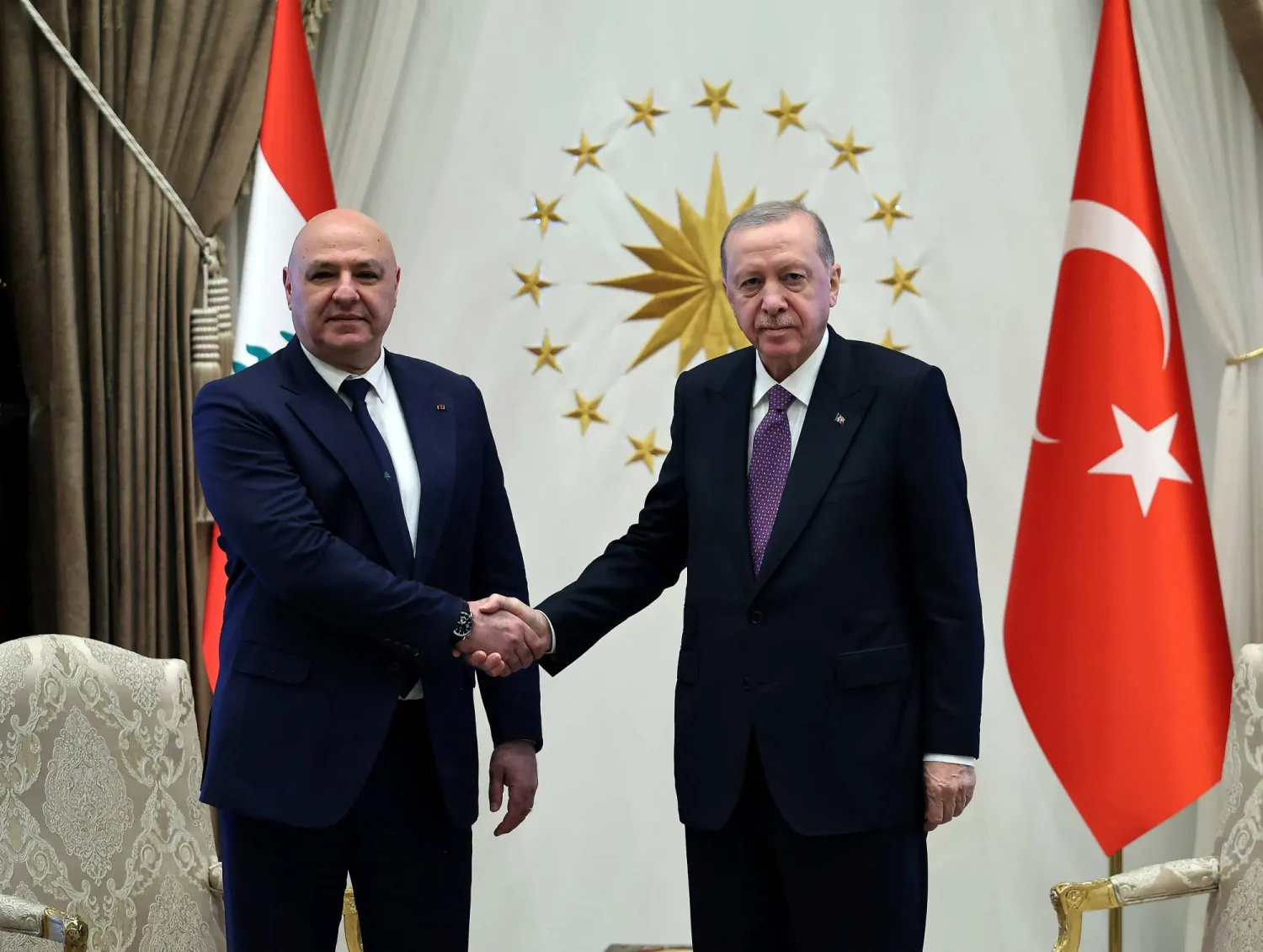
Turkish President Recep Tayyip Erdogan shakes hands with Lebanese President Joseph Aoun during their meeting at the presidential palace in Ankara, Türkiye, July 30, 2026. (Murat Cetinmuhurdar/Turkish Presidential Press Office/Handout via Reuters)
TT

Türkiye Wants to Join a New Lebanon Security Initiative After UN Mission Ends

Turkish President Recep Tayyip Erdogan shakes hands with Lebanese President Joseph Aoun during their meeting at the presidential palace in Ankara, Türkiye, July 30, 2026. (Murat Cetinmuhurdar/Turkish Presidential Press Office/Handout via Reuters)

Türkiye is interested in participating in a new security initiative for Lebanon when the 7,500-member UN peacekeeping mission in the south of the country expires at the end of the year, Turkish President Recep Tayyip Erdogan said during a joint press statement with his Lebanese counterpart on Thursday.

Last year, the UN Security Council voted unanimously to terminate the UN Interim Force in Lebanon (UNIFIL) peacekeeping mission, bowing to demands from the United States and its close ally, Israel. The UN is now considering options to help end the decades-old conflict between Lebanon’s Iran-backed Hezbollah militants and Israel.

“After the withdrawal of the current international force, Türkiye wants to take part in all initiatives that will be launched to support security in the region and ensure Lebanon’s sovereignty,” Erdogan said, speaking alongside Lebanese President Joseph Aoun.

“The end of the mandate of the United Nations Interim Force in Lebanon, UNIFIL, deployed in southern Lebanon, will constitute an important development,” Erdogan stated.

Other countries have voiced an interest in contributing to a UNIFIL successor force, including France and Italy, but it remains unclear what form that force might take and whether it would be under a UN mandate or some other arrangement.

Aoun’s visit to Ankara comes as Lebanon remains in a precarious situation despite a shaky truce that has largely halted the fighting between Israel and Hezbollah.

The latest Israel-Hezbollah war began on March 2 when Tehran-backed Hezbollah launched rockets across the border, days after the US and Israel attacked Iran, triggering an ongoing regional war.

More than 4,000 people have been killed in Lebanon, including hundreds of civilians, and hundreds of thousands displaced. While the fighting has largely cooled in recent weeks, Israeli troops continue to occupy large swaths of southern Lebanon.

On June 26, Israel and Lebanon reached a US-mediated “framework agreement” under which Israeli forces are to withdraw from areas of southern Lebanon they are occupying in exchange for the disarmament of the Hezbollah group.

Aoun said he wants to see the relations between the two countries become “more present and more ambitious” at a “crucial moment in which we are restoring our region and reshaping its future.”

“I am sure that this visit will mark the beginning of a new phase in Lebanese-Turkish relations, with the themes of partnership, trust and joint action,” he said.

Erdogan pledged support to Lebanon’s post-war economic recovery and to support the cash-strapped Lebanese army.

“Of course, our support for the Lebanese Armed Forces will continue in the security context,” Erdogan said.

The Turkish leader urged increased dialogue between Lebanon and Syria, saying it would be “beneficial for both countries.”

US President Donald Trump has repeatedly proposed that Syrian forces should enter Lebanon to fight against Hezbollah, a prospect that has caused alarm in Lebanon although Syrian President Ahmed al-Sharaa has said on several occasions that he has no desire to intervene militarily in the neighboring country.


1,400 Flee Yemen Fighting to Djibouti, Says Minister

Displaced Yemenis rest at a temporary shelter in the Dar Saad district of Aden, Yemen, Saturday, Sept. 12, 2026, after fleeing Houthi attacks in the western coastal cities of al-Khokha and Mokha. (AP Photo/Abdulnasser Alseddik)
TT

1,400 Flee Yemen Fighting to Djibouti, Says Minister

Displaced Yemenis rest at a temporary shelter in the Dar Saad district of Aden, Yemen, Saturday, Sept. 12, 2026, after fleeing Houthi attacks in the western coastal cities of al-Khokha and Mokha. (AP Photo/Abdulnasser Alseddik)

About 1,400 people have fled Yemen for Djibouti due to fighting between government forces and Iran-allied Houthis, Djibouti's minister of economy and finance said Saturday.

Houthi fighters control a large part of northern Yemen, including the capital Sanaa and Hodeida in the west. They have advanced along the coast in just days and on Thursday seized the port city of Mokha.

The Houthis have since taken control of the coastline and islands in the Red Sea, and on Friday tightened their grip on the Bab el-Mandeb Strait, which is vital to global shipping through the Suez Canal.

"1400 #refugees arrived in #Djibouti from #Yemen in just 24 hours," Ilyas Moussa Dawaleh wrote on X.

Located opposite Yemen on the Horn of Africa, tiny Djibouti borders the Bab el-Mandeb Strait at the entrance to the Red Sea from the Gulf of Aden.

Safiya Ibrahim, humanitarian response coordinator for the International Organization for Migration, told AFP that "vulnerable groups such as women and children have reached the shores of Obock, with more expected in the coming days".

According to the United Nations, at least 76,000 people have been displaced in Yemen since July, with the number quadrupling in the last week after the latest fighting.

Last week, Houthi fighters launched a new offensive against Saudi-backed government forces, targeting zones bordering the Bab el-Mandeb Strait.

The waterway has taken on new importance, particularly for Saudi oil exports, since the Strait of Hormuz was blocked by Iran.

Hundreds have been killed in the fighting on both sides.


Yemeni Forces Strike Houthis on Several Fronts

Yemeni soldiers in al-Jawf. (Reuters)
TT

Yemeni Forces Strike Houthis on Several Fronts

Yemeni soldiers in al-Jawf. (Reuters)

Yemeni government forces intensified on Saturday their military operations against the Houthi group on several fronts, carrying out air raids and drone strikes and firing artillery at them in Marib, al-Jawf and Taiz after the militants expanded their control of the west coast, Mokha and areas overlooking the Bab al-Mandeb Strait.

Government strikes focused on Houthi positions in Mokha and the Dhubab district that directly overlooks Bab al-Mandeb. Field sources said the jets struck the Houthis around Mokha port and airport and Jabal al-Nar in an attempt to hamper their military and logistics movements.

Armed forces spokesman Staff Colonel Majid al-Nuzaili had urged civilians to avoid the Taiz-Mokha and Mokha-Dhubab roads until further notice as operations continued in the area.

Government attacks around Mokha port killed several Houthis and destroyed vehicles and weapons used by the group, said al-Nuzaili.

The attacks took place as the government forces were rearranging their deployment in southern Mokha after the battles shifted to east of Bab al-Mandeb near the border of the Lahj province.

In Marib, east of Sanaa, the forces launched air strikes and fired artillery against the Houthis on the southern, western and northern fronts.

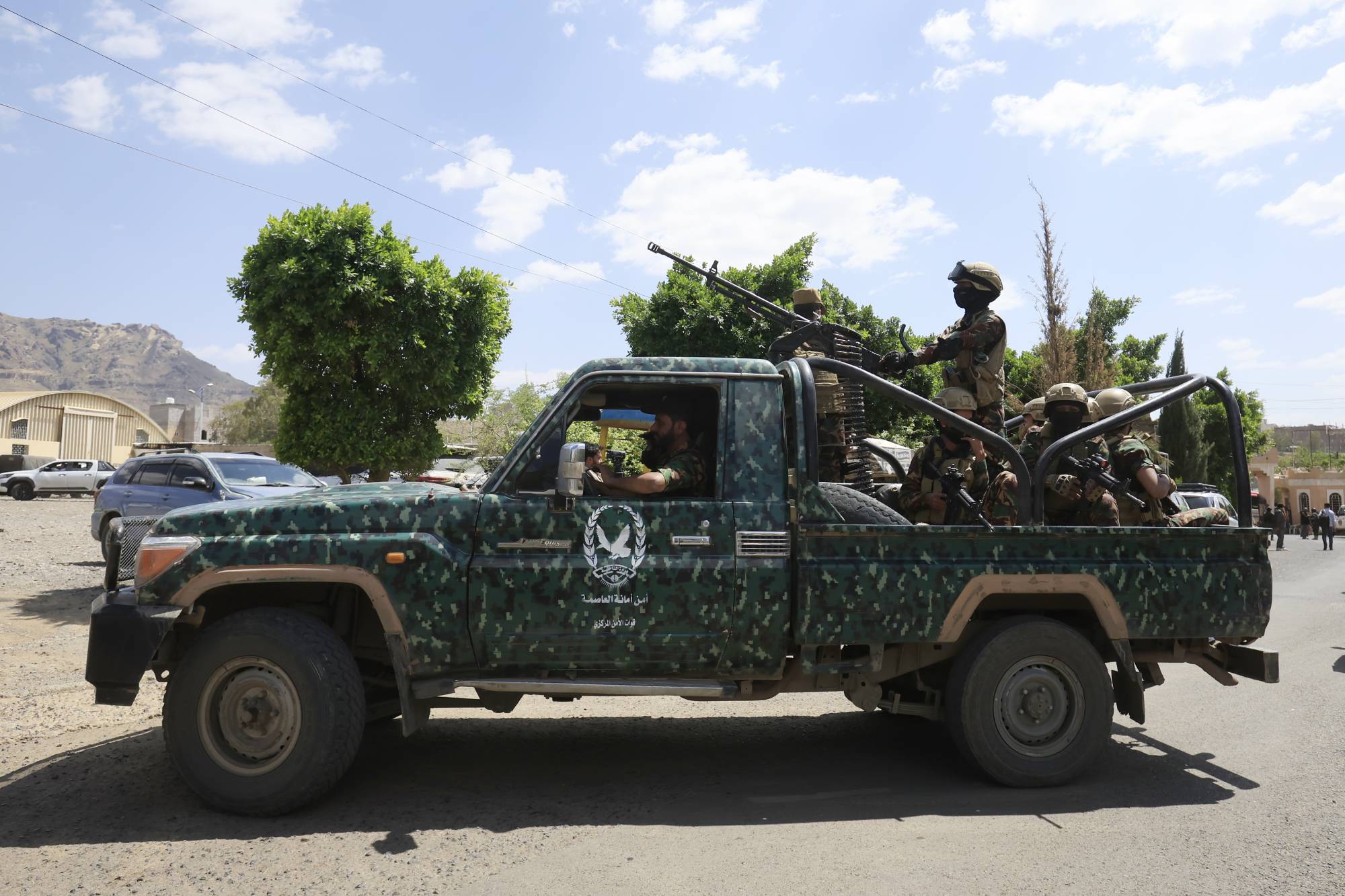
Houthi militants ride on a pick-up truck while on patrol in Sanaa, Yemen, 12 September 2026. (EPA)

Field sources said the Houthis brought reinforcements, including dozens of military vehicles and fighters, from Sanaa to Marib, indicating that the fighting will continue and expand.

Government forces have maintained their defensive and offensive positions in Marib, which has for years been its military stronghold in the conflict against the Houthis.

The militants are seeking to use the latest escalation to open new fronts in the war and ease military pressure off the coast and al-Jawf.

In al-Jawf, the government used air raids and artillery fire to attack the Houthis east of al-Hazm city and kept up their siege against the militants inside the al-Labanat camp for the sixth straight day.

In Taiz, field sources detected Houthi mobilization in the Sameh district and the cities of al-Dimnat and Rahida.

On the border of the Lahj province, the Giants Brigades and Houthis were engaged in fighting around the al-Madaribah district.

Military sources said the brigades repelled the Houthi advance.


Iraq Closes Three Iran Crossings, Pursues Those Behind Attacks on Saudi Arabia

Travelers at the Shalamsheh border crossing between Iraq and Iran after Iraqi authorities ordered its closure as a precautionary measure following the latest drone attacks on Saudi Arabia on September 12, 2026 (Reuters)
TT

Iraq Closes Three Iran Crossings, Pursues Those Behind Attacks on Saudi Arabia

Travelers at the Shalamsheh border crossing between Iraq and Iran after Iraqi authorities ordered its closure as a precautionary measure following the latest drone attacks on Saudi Arabia on September 12, 2026 (Reuters)

Iraq closed three border crossings with Iran on Saturday, officials told AFP, after a drone attack on a Saudi Arabian pipeline that both Riyadh and Baghdad said was launched from Iraq.

An Iraqi security source and a government official told AFP that authorities ordered the closing of three border crossings with Iran.

The security source said the decision was "part of an intelligence effort to track down the perpetrators and prevent their escape... and to hinder the smuggling of drones through these crossings".

Both sources, who spoke on condition of anonymity because they were not allowed to speak to the media, could not specify when the crossings would reopen.

The closed crossings are Shalamsheh in Basra province, al-Shib in Missan and al-Mandali in the central province of Diyala.

Other border crossings with Iran are still open.

A security official said that "security forces found drone launchers near the Iraq-Iran border in the al-Tib" region, a remote part of Missan, close to the al-Shib crossing. A second security source gave the same account.

Military spokesperson Sabah al-Numan said the prime minister had approved "Iran's request to conduct a joint investigation into finding drone launch platforms near the Iraq-Iran border".

The government's security media cell said earlier that authorities "have started administrative and security reorganization operations at several border crossings".

It added that they had stepped up "intelligence activities" to determine "the breaches and violations that took place at these crossings".

It later announced that passengers stranded for hours at two crossings were permitted to pass.
