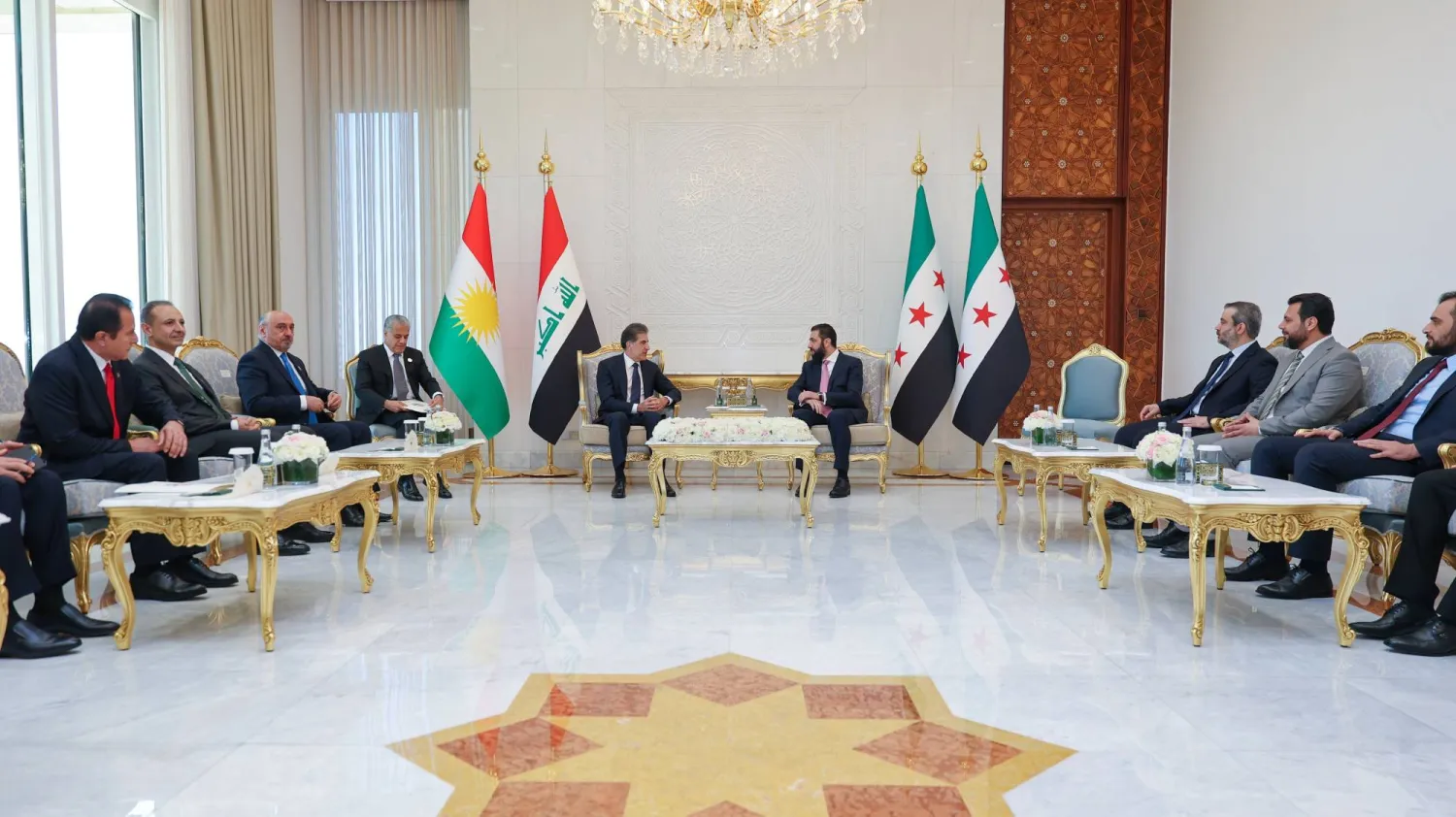
Iraqi Kurdish Leader in Damascus for Talks on Syria Kurds' Deal

Syrian President Ahmed al-Sharaa meets with Iraqi Kurdistan Region President Nechirvan Barzani at the People's Palace in Damascus, accompanied by members of both delegations. (Presidency account)
TT

Iraqi Kurdish Leader in Damascus for Talks on Syria Kurds' Deal

Syrian President Ahmed al-Sharaa meets with Iraqi Kurdistan Region President Nechirvan Barzani at the People's Palace in Damascus, accompanied by members of both delegations. (Presidency account)

Syria's President Ahmed al-Sharaa met Monday with Nechirvan Barzani, leader of Iraq's autonomous Kurdistan region, as official sources told AFP the talks aimed to advance an integration deal between Damascus and Syria's Kurds.

Syrian state news agency SANA said Sharaa received Barzani at the presidential palace in Damascus, in the first visit by the head of Iraq's Kurdistan region since the December 2024 ouster of longtime Syrian ruler Bashar al-Assad.

After clashes between Syrian Kurdish fighters and the new authorities' forces in January this year, the two sides reached a deal to integrate Syrian Kurdish institutions and forces into the state.

During the fighting, Barzani met Kurdish leader Mazloum Abdi, chief of the Kurdish-led Syrian Democratic Force (SDF), in Kurdistan's Erbil in a US-backed meeting.

Sharaa's office said he and Barzani on Monday discussed "strengthening cooperation and coordination, especially economic... in a way that contributes to supporting security and stability".

A Syrian official source told AFP on condition of anonymity that the pair would discuss the January deal and "procedures for integrating" the SDF into the state.

A Syrian diplomatic source, also requesting anonymity, told AFP that the one-day visit would mainly deal with "following up on the agreement between the state and the SDF".

Barzani may also meet Abdi, the diplomatic source added.

The January fighting and subsequent accord shattered Kurdish aspirations for autonomy in swathes of north and northeast Syria which they had controlled for years during the country's civil war, after battles against ISIS.

Damascus and the Kurdish authorities have taken several steps since the deal, including the entry of government forces into the cities of Hasakeh and Qamishli, and transfer of management of Qamishli airport and key oil fields to the state.

Senior Kurdish military official Sipan Hamo was appointed regional assistant defence minister.

But differences between the sides have held up the integration of several SDF brigades into the Syrian army.

The agreement also provided for the return of displaced Syrian Kurds to their areas of origin, though some are still waiting to go back.

Barzani at the time welcomed the January deal and expressed hope it would pave the way for the "protection of the rights of the Kurds... in the forthcoming constitution".


Iraq Pushes Back Deadline for Factions to Disarm

This handout photograph taken and released by the Iraq's Prime Minister Media Office on August 19, 2026 shows Iran's Parliament Speaker Mohammad Bagher Ghalibaf (R) shaking hands with Iraq's Prime Minister Ali al-Zaidi before their meeting in Baghdad. (Iraq's Prime Minister Media Office / AFP)
TT

Iraq Pushes Back Deadline for Factions to Disarm

This handout photograph taken and released by the Iraq's Prime Minister Media Office on August 19, 2026 shows Iran's Parliament Speaker Mohammad Bagher Ghalibaf (R) shaking hands with Iraq's Prime Minister Ali al-Zaidi before their meeting in Baghdad. (Iraq's Prime Minister Media Office / AFP)

A senior Iraqi official pushed back a September 30 deadline for pro-Iran factions to hand over their weapons, without offering an explanation for the move or providing a new date.

Iraq has come under pressure from the United States to rein in armed factions, particularly those close to Iran.

The US and Iran have been at war since February 28, drawing in other countries in the region as well as non-state groups backed by the Islamic republic.

For several months, Iraq's government has stood by its deadline, but on Sunday, the security adviser to the prime minister, Qasim al-Araji, told state media the process would only begin at the end of next month.

"September 30 is the date for the international coalition to depart, not the deadline to hand over weapons," Araji told the Al Iraqiya broadcaster, referring to the coalition of US-led forces.

Government spokesman Haider al-Aboudi had made a similar announcement to local media on Friday, despite announcing in June that factions had until the end of September to disarm.

September 30, he said, was "the date for the international coalition to end its presence, not the deadline for armed factions... Perhaps people are confusing the two."

Since taking office in May, Prime Minister Ali al-Zaidi has pledged to ensure the armed factions that emerged in the years that followed the US-led invasion hand over their weapons to the state.

While some factions have in recent weeks said they would join state institutions, others, in particular those closer to Iran, are refusing.

"The situation is extremely complicated," a government official told AFP, requesting anonymity because he was not authorized to speak on the matter.

"The government is insisting on closing the weapons file; but faction leaders are determined to hold onto their weapons because they believe disarming would serve Israel and the United States."

The most powerful armed factions in Iraq include Kataib Hezbollah, a part of Iran's so-called "Axis of Resistance" against the US and Israel.

Another Iraqi source told AFP that Iran views its proxies in the region, "especially in Iraq, as a source of strength it refuses to give up".


Syria Sentences Assad-Era Top Muslim Cleric to Life Imprisonment

Ahmed Hassoun during proceedings before the Fourth Criminal Court in Damascus. (SANA file photo)
TT

Syria Sentences Assad-Era Top Muslim Cleric to Life Imprisonment

Ahmed Hassoun during proceedings before the Fourth Criminal Court in Damascus. (SANA file photo)

A Syrian court on Monday handed a life sentence to Ahmed Hassoun, the country's former grand mufti under ousted leader Bashar al-Assad, convicting him of crimes including inciting sectarian strife and exploiting his position. 

Hassoun, the 10th Assad-era figure to be sentenced under the new authorities, was Syria's top Muslim cleric for 16 years. 

He was known for his close ties to the former president and frequent appearances alongside him on religious occasions. 

Judge Fakhr al-Din al-Aryan said Hassoun, 77, was guilty of a raft of charges including "inciting civil war and sectarian strife", for which he was jailed for life. 

The cleric was also convicted of "incitement to intentional homicide", "principal complicity in intentional homicide", and "inciting sectarian and racial strife", for which he was handed additional terms ranging from three to 20 years. 

The court also decided to confiscate Hassoun's assets and hand them to the public treasury. 

His sentencing is the first against a religious figure since Syrian authorities began trying Assad-era officials in April. 

On August 11, Syria sentenced Bashar al-Assad, his brother Maher and five other security officials to death in absentia for atrocities committed during Syria's civil war, the first such ruling under the new authorities. 

The former president fled Syria as his government fell in December 2024 and is believed to be in Russia. 

Authorities have also handed death sentences to Atif Najib and Wassim al-Assad, cousins of the former ruler who were tried in person. 

Hassoun, a native of Aleppo whose late father was also an important religious figure, was arrested at Damascus airport in March last year as he tried to flee the country. 

Though he held the post of grand mufti for more than a decade, Hassoun lost the title in 2021 when Syria abolished the position. 

Syria began legal proceedings in April against Bashar al-Assad and other officials accused of atrocities during the civil war, which erupted in 2011 with brutal repression of pro-democracy protesters. 

More than half a million people were killed and millions displaced during the conflict, while tens of thousands disappeared. 


Uganda and Burundi Military Officials Visit Israel to Discuss Gaza Troop Deployment

23 August 2026, Palestinian Territories, Gaza Strip: People check the damage after an Israeli airstrike on a house belonging to the Al-Awwar family, damaging several neighboring homes in the Al-Maghazi camp. Photo: Moiz salhi/dpa
TT

Uganda and Burundi Military Officials Visit Israel to Discuss Gaza Troop Deployment

23 August 2026, Palestinian Territories, Gaza Strip: People check the damage after an Israeli airstrike on a house belonging to the Al-Awwar family, damaging several neighboring homes in the Al-Maghazi camp. Photo: Moiz salhi/dpa

Military officials from Uganda and Burundi visited Israel last week to discuss deploying troops to Gaza as part of an international security force envisioned by US President Donald Trump’s Board of Peace for the fragile ceasefire, according to officials.

A Board of Peace official told The Associated Press that Ugandan officials joined a Burundian military delegation, and that Uganda is finalizing details of its participation after its parliament approved the troop contribution this month, The Associated Press said.

Nothing has been finalized with Burundi, but the official said they look forward to starting the process.

“We shared significant knowledge with one another, and the Burundi representatives expressed interest in our mission,” the official said, speaking on condition of anonymity because they weren’t authorized to discuss talks with potential troop-contributing countries ahead of any agreement.

A Burundian military official told the AP that three other senior military officers led the delegation to Israel and that Burundi appeared intent on joining. The official spoke on condition of anonymity because he was not authorized to speak to the media.

It was not clear what Uganda or Burundi might be offering or what they might receive in return. Spokespersons for their militaries did not respond to requests for comment.

Progress on the international force has been slow

If Burundi moves ahead, the African nations would be the latest to join the international force for Gaza after Morocco, Kosovo, Kazakhstan and Albania made commitments. Uganda has committed around 1,200 personnel, and Morocco has committed up to 500. Kosovo, Kazakhstan and Albania in total have committed around 80.

Indonesia earlier said it was preparing to send 8,000 troops — by far the largest commitment — but put that on hold after the US and Israel attacked Iran.

The 20,000-strong force would be led by US Maj. Gen. Jasper Jeffers. Troops committed remain far short of that goal.

Last month, Trump announced a deal for Hamas to disarm and for Israel to withdraw its forces from Gaza. According to the deal, the International Stabilization Force would be deployed to areas of the Palestinian territory administered by an incoming technocratic committee, and Israeli forces would withdraw.

The force would help monitor the ceasefire, train Palestinian police and secure the delivery of aid, among other tasks.

The ceasefire that took effect in Gaza last October has stalled due to disagreements regarding Israel’s withdrawal from the strip and Hamas’ disarmament. A US delegation met for hours earlier this month with the Hamas leader and then with Israeli Prime Minister Benjamin Netanyahu to press them forward. Hamas has agreed to the new US deal.

Netanyahu has rejected it, saying Israel will not withdraw from any of the roughly 60% of the territory it controls in Gaza until Hamas has been completely disarmed. Even after Netanyahu's meeting with the US team, which included negotiator Jared Kushner, officials offered no concrete commitment by Israel.

Uganda and Burundi have peacekeeping experience from Somalia Paul D. Williams, director of the security policy studies program at The George Washington University, said Uganda and Burundi have gained considerable peacekeeping experience through long-term deployments in Somalia as part of an African Union force resisting the al-Qaida-linked al-Shabab extremist group.

Their countries' leaderships have “shown they are willing to tolerate high numbers of casualties without withdrawing,” he said.

Williams added that, with the mission in Somalia winding down, both countries will be searching for ways to accrue financial and material support for their militaries: “Deploying to Gaza with US support is one way to do that."

A Ugandan military officer with knowledge of the upcoming deployment said troops were being selected to go to Gaza. The officer spoke on condition of anonymity because they weren’t authorized to speak to the press.