Gold Holds Ground with Middle East Turmoil, US Jobs Data in Focus

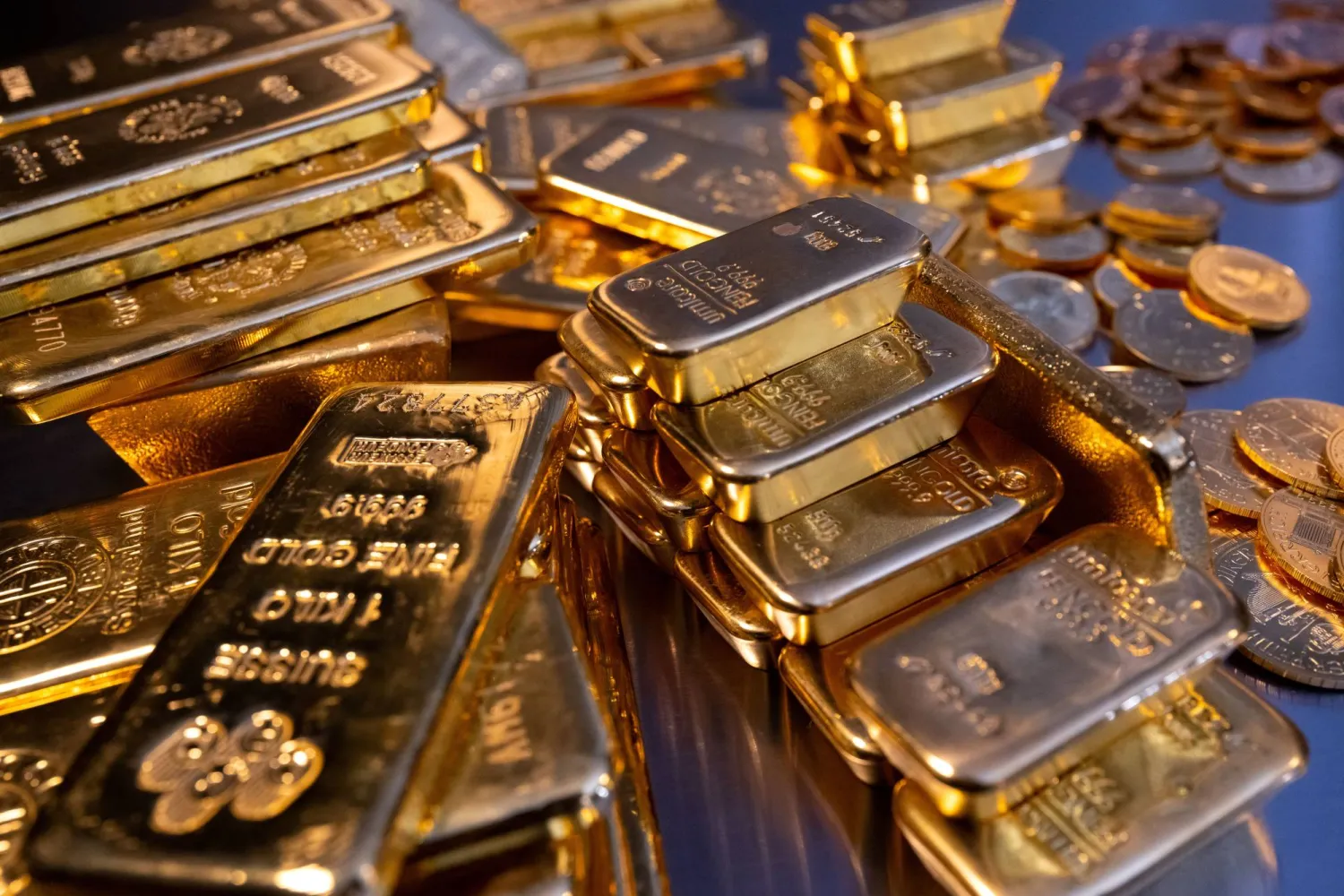
16 March 2023, Bavaria, Munich: Gold bars and coins lie on the table at the Precious metal dealership Pro Aurum. (dpa)
TT

Gold Holds Ground with Middle East Turmoil, US Jobs Data in Focus

16 March 2023, Bavaria, Munich: Gold bars and coins lie on the table at the Precious metal dealership Pro Aurum. (dpa)

Gold nudged higher on Tuesday as investors weighed mixed signals on potential US-Iran talks and awaited a series of US labor market reports for clues on the Federal Reserve's interest rate trajectory.

Spot gold rose 0.2% to $4,061.96 per ounce by 0650 GMT. US gold futures rose 0.7% to $4,118.30.

Reports on the US labor market due this week include job opening data later in the day, ‌the ADP ‌employment report on Wednesday and nonfarm payrolls figures ‌on ⁠Friday.

"Gold is currently ⁠in a consolidation phase. If we see weakness in the job market, it could pressure the US dollar and as a result there will be gains in gold," said Ajay Kedia, director at Mumbai-based Kedia Commodities.

US President Donald Trump said talks with Iran were under way, warning of a "last chance" for Tehran ⁠to sign a good deal, but Iran denied that ‌negotiations were being held or ‌planned.

The conflict has driven up energy costs and stoked inflation fears, ‌which could prompt central banks to raise interest rates to ‌keep price pressures in check.

While gold is seen as an inflation hedge, higher rates tend to weigh on the metal as it yields no interest.

Traders currently price in a 65% chance of a ‌rate hike in September after a divided Fed maintained the status quo at its last policy ⁠meeting.

If bets ⁠for a September rate-hike ease, it will support gold prices, Kedia said.

Federal Reserve Bank of New York President John Williams said he remained optimistic that inflation pressures are on track to ease gradually, but if they don't, the US central bank will not hesitate to respond with rate hikes.

Citi said in a note that it expects gold prices to stagnate or even decline over the next month, before rallying to $4,500 in the fourth quarter and to $5,000 by the first half of next year.

Spot silver gained 1.2% to $58.88 per ounce, platinum firmed 1.3% to $1,648.97 and palladium rose 1.1% to $1,278.38.


Unified Trade, Export Body to Expand Saudi Products’ Global Reach

Containers lined up at a Saudi port (SPA)
TT

Unified Trade, Export Body to Expand Saudi Products’ Global Reach

Containers lined up at a Saudi port (SPA)

The decision to merge the General Authority for Foreign Trade and the Saudi Export Development Authority into a single body, the General Authority for Foreign Trade and Export, aims to strengthen institutional integration and unify efforts to support Saudi exports and expand the presence of Saudi products in global markets.

The cabinet, chaired by Saudi Crown Prince and Prime Minister Mohammed bin Salman bin Abdulaziz, approved the merger and ordered the necessary preparations, with matters requiring regulatory action to be submitted within 180 days.

Prince Abdulaziz bin Salman, minister of industry and mineral resources, will chair the new authority’s board, with the commerce minister serving as deputy chairman.

The move comes as foreign trade assumes growing importance as a driver of economic growth, a means of making Saudi products more competitive and a gateway for domestic businesses to reach broader international markets.

Support for exporters

Consolidating responsibilities and coordinating initiatives is expected to improve efficiency, expand access to foreign markets and develop tools to support exporters, in line with goals to diversify the Saudi economy and increase the contribution of non-oil exports to economic growth.

Specialists told Asharq Al-Awsat that, as merger requirements are completed within 180 days, attention will turn to the new authority’s operations, performance indicators and ability to translate organizational integration into broader export opportunities and lasting gains for the Saudi economy, while supporting the private sector by creating more opportunities for domestic companies.

Small and medium-sized enterprises

Osama bin Ghanem Al-Obaidi, a consultant and professor of commercial law, told Asharq Al-Awsat that the next phase, following the merger of the two authorities, “requires a focus on small and medium-sized enterprises, helping them overcome export challenges and build lasting international trade partnerships.”

It also requires “developing clear performance indicators that measure growth in non-oil exports, track the number of new markets reached by Saudi products and assess how much exporters benefit from the services provided,” Al-Obaidi said.

He said the decision brings together efforts to open markets and enable Saudi products to reach them, “in a step that strengthens their competitiveness and shortens their path to global markets.”

The move “simplifies procedures and facilitates trade by improving integration between the two bodies and developing a unified platform that saves users time and money, strengthening the kingdom’s economic competitiveness and attracting more domestic and foreign investment,” he added.

“In my view, the new authority’s success will be measured by the value it adds to the national economy, rather than simply by the consolidation of organizational structures,” Al-Obaidi said.

“The more institutional integration translates into increased export opportunities, stronger competitiveness for Saudi products and diversified sources of income, the closer this step will come to achieving its economic objectives, supporting Vision 2030 goals and strengthening the kingdom’s position in global trade.”

Strategic dimensions

Economic researcher and technology consultant Fadwa Al-Bawardi said the merger represents a pivotal organizational shift, reflecting the national drive to strengthen trade governance and unify efforts to integrate trade policy with export development.

The decision’s strategic implications extend beyond administrative restructuring, she said. The new body will provide a vital bridge between the opening of global markets and the strengthening of the production capabilities of Saudi contractors and companies.

Investors are seeking more than new sales outlets, Al-Bawardi told Asharq Al-Awsat. They also want to build a strong production base that encourages exports.

She said the new body’s real challenge lies in “overcoming logistical and regulatory obstacles and making Saudi products more competitive in international trade.”

Trade disputes and restrictions

“The competitive presence of Saudi goods and services in global markets does not depend on quality alone,” Al-Bawardi said.

“It also requires an integrated support system that facilitates market access, addresses trade disputes and restrictions, and steps up international promotion initiatives, giving domestic exporters the support they need to compete with confidence and capability.”

She said the true measure of the move’s success would be “the new structure’s ability to translate institutional consolidation into a tangible economic impact, measured by simpler procedures, unified service platforms and faster responses to the needs of businesses and domestic factories, as well as entry into promising markets that expand the presence of non-oil exports.”


Saudi TAQA Expands Int’l Reach From Azerbaijan, Kazakhstan to Syria

A technician monitors TAQA’s field operations. (Company handout)
TT

Saudi TAQA Expands Int’l Reach From Azerbaijan, Kazakhstan to Syria

A technician monitors TAQA’s field operations. (Company handout)

Saudi Arabia’s Industrialization and Energy Services Company (TAQA) is expanding in Azerbaijan, Kazakhstan and Syria as it develops the well solutions and specialized technologies driving its growth.

The company, 54% owned by the Public Investment Fund, uses Saudi Arabia as its main operating hub and launchpad for international expansion.

Chief Executive Adel Al-Ghadhban told Asharq Al-Awsat in exclusive comments during the World Petroleum Congress that TAQA was building its presence in Azerbaijan and Kazakhstan and establishing operations in Syria.

It has set up a legal entity in Azerbaijan and qualified as a supplier to state-owned SOCAR. In Kazakhstan, registration and qualification procedures have begun with several customers.

Cooperation with SOCAR covers opportunities in oil and gas field operations and services, as well as 'well services and technologies,' Al-Ghadhban said.

TAQA has moved into practical steps to establish itself in Azerbaijan, completing incorporation procedures and registering as a qualified supplier.

Asked about project budgets and timelines, he said the memorandum of understanding set a framework for cooperation, separate from any contracts or projects that might follow. TAQA prefers to announce each project once its scope is finalized and commercial arrangements are approved.

The Caspian region and Central Asia offer significant growth opportunities, he said. TAQA’s international strategy targets markets where it can add value and build sustainable businesses, rather than expand for geographic reach alone.

Well solutions drive growth

Well solutions are TAQA’s main growth engine, Al-Ghadhban said. They span drilling, well completion and intervention, well testing, wireline services, cementing, stimulation and early production facilities.

The company performed strongly in 2025 in areas including well testing, completion and wireline services. It also advanced the development and commercialization of drilling, completion and well intervention technologies.

TAQA is integrating its services and technologies to cover multiple stages of a well’s life cycle. The focus is on directing investment toward higher-value services, bringing technologies to market faster and expanding selectively into markets offering profitable, sustainable growth.

Digitalization and innovation

TAQA sees innovation and advanced technologies as pillars of growth, supported by its innovation center in Dhahran Techno Valley and specialized centers developing drilling, completion and well intervention products.

Development starts with identifying customers’ challenges, Al-Ghadhban said. The company then develops, tests and qualifies solutions in the field before turning them into products and technologies that can be scaled commercially.

Its digitalization efforts focus on data, artificial intelligence and automation in research and development projects, working with customers, industry partners and academic institutions.

Technology investments aim to make operations more efficient, improve well performance and reduce time, total costs and operational risks for customers.

TAQA prefers to withhold specific figures for future investment until plans and budgets are approved, he said.

Supply chain resilience

Geopolitical challenges have sharpened TAQA’s focus on resilience, operational discipline and cost competitiveness as it faces pressures on operating costs and supply chains, Al-Ghadhban said.

The company has updated its operating model to clarify responsibilities, speed up decisions and simplify processes. It has also improved the use of assets and resources and strengthened supplier partnerships.

For some product lines, TAQA has diversified its sources of production and research and development to strengthen supply chain resilience and manufacturing efficiency.

Efficiency means more than cutting expenses, Al-Ghadhban said. It also requires improving how work is carried out and capital is allocated, while balancing competitiveness and service continuity with safety, quality and reliability.

About TAQA

Founded in 2003 and headquartered in Dhahran, TAQA provides integrated oil and gas well solutions. Its services include drilling, well completion and intervention, well testing, wireline logging, cementing, hydraulic fracturing and well integrity.

The company operates in more than 20 countries and employs more than 5,500 people. Its portfolio spans drilling, geophysical services and surveying, with companies including Arabian Drilling, the Arabian Geophysical and Surveying Company (ARGAS).



Saudi Arabia Issues 438 Industrial Licenses Worth $1.28 Billion in July

File photo of the Saudi capital Riyadh - File/AAWSAT
TT

Saudi Arabia Issues 438 Industrial Licenses Worth $1.28 Billion in July

File photo of the Saudi capital Riyadh - File/AAWSAT

Saudi Arabia's Ministry of Industry and Mineral Resources issued 438 new industrial licenses in July 2026, representing investments of approximately SAR 4.82 billion ($1.28 billion), while 189 factories began actual production during the same month, with investments totaling SAR 1.95 billion ($520 million), according to data from the ministry's National Industrial and Mining Information Center.

Ministry spokesperson Jarrah Al-Jarrah said the new industrial licenses are expected to create more than 3,708 jobs across various regions of the Kingdom.

He added that the factories that began production in July created 2,807 new jobs, reflecting the continued expansion of Saudi Arabia's industrial base and the growing number of factories entering operation.

The Ministry of Industry and Mineral Resources publishes monthly industrial activity indicators through the National Industrial and Mining Information Center to track new licenses, investment volumes and factories beginning production, as well as developments in the Kingdom's industrial sector.