



World Bank Calls on Developing Countries to Embrace AI for Better Governance

The artificial intelligence AI acronym at the 10th edition of the VivaTech technology startups and innovation fair in Paris, France, June 18, 2026. REUTERS/Gonzalo Fuentes
TT

World Bank Calls on Developing Countries to Embrace AI for Better Governance

The artificial intelligence AI acronym at the 10th edition of the VivaTech technology startups and innovation fair in Paris, France, June 18, 2026. REUTERS/Gonzalo Fuentes

The World Bank on Tuesday called on developing countries to embrace artificial intelligence technology tools to deliver better governance outcomes, warning that they risked being left behind if they failed to do so.

“AI has thrown developing economies a lifeline, and they should seize it,” Indermit Gill, chief economist of the World Bank Group, said as the organization launched its annual World Development Report, according to AFP.

“They do not need large models or big data centers to reap its benefits,” he added, advocating for the adaptation of lower-cost AI tools to local conditions to deliver results in the health, education, justice and agricultural sectors.

Advanced AI models -- largely developed in the United States and China -- offer the ability to quickly analyze data and automate many tasks that otherwise take skilled humans longer to do.

These AI models, however, require huge data centers and large amounts of complex computing power, using massive amounts of electricity and water -- with implications for climate change.

“Developing economies today are in the midst of their weakest average growth performance in three decades,” said a World Bank statement accompanying the report.

“AI could significantly boost that performance before the end of the 2020s while delivering tangible benefits to people,” it added.

The report calls for countries to use AI to “help extend otherwise costly medical, legal, educational, and agricultural services to underserved billions -- doing in a decade what might otherwise take a century.”

Shock After Shock

Lower-income countries have struggled through the 2020s, hit by a series of successive shocks that saw the World Bank earlier this year dub it a “lost decade” for their economic growth.

The Bank has lowered its 2026 global growth forecast to its lowest level since the pandemic, with the economic fallout of the Iran war battering countries around the world.

The shock has hit low-income and developing countries hardest, with Asia the worst-affected region.

The Bank's new report advocates for developing countries to start working with localized AI tools and solutions now, and to invest in electricity generation and distribution; expand access to computing power; and improve the availability of local data.

“The window to get this right is narrow,” said Gaurav Nayyar, director of the report.

“AI presents a once-in-a-lifetime opportunity to solve problems that have resisted solutions for generations,” he added.

For the 6.8 billion people – 83% of humanity -- who live in low-income and developing countries, AI tools will need to be adapted to meet their needs.

The report shares examples of AI applications in governance, such as to increase diabetes screening volumes in Bangladesh, or in reducing costs for Indian farmers through advanced weather forecasts.

The solutions, the report stresses, will need to meet people where they are.

“For example, AI solutions will need to be delivered through voice calls on basic mobile phones for those who cannot read or afford smartphones,” it says.

“Simply importing an AI model does not mean it will work well locally.”

Stark Warning

The report calls for policymakers to also build public trust as they expand AI use.

“Improved public services and better learning outcomes in schools will reinforce trust -- but if AI embeds bias in government decisions or erodes data privacy, that trust will be difficult to recover,” said the statement.

The report delivers a stark warning, too: “AI could widen gaps between countries, increase inequality within them, concentrate market power, weaken trust in public institutions, and create new risks for safety, rights, and social cohesion.”

And while risks to employment in developing countries are low at the moment, it warns that in the long run AI tools could cut off economic mobility by eliminating many of the middle-class jobs that enable it.

The report was written with the aid of several of the world's most advanced AI tools, including offerings from OpenAI, DeepSeek, Google and Anthropic, according to a disclosure.



IMF Says Lebanon Economic Activity to Contract Sharply in 2026 as Conflict Weighs

FILE PHOTO: A view of the International Monetary Fund logo at its headquarters in Washington, D.C., US, November 24, 2024. REUTERS/Benoit Tessier/File Photo
TT

IMF Says Lebanon Economic Activity to Contract Sharply in 2026 as Conflict Weighs

FILE PHOTO: A view of the International Monetary Fund logo at its headquarters in Washington, D.C., US, November 24, 2024. REUTERS/Benoit Tessier/File Photo

The International Monetary Fund said on Friday that Lebanon's economic activity is expected to contract significantly in 2026 ‌as the ‌conflict in ‌the ⁠Middle East and broader ⁠regional security tensions continue to damage economic activity, infrastructure ⁠and living conditions, Reuters reported.

The ‌IMF ‌said inflation ‌remained in ‌the double digits and the country's current account deficit ‌had widened, largely due to higher ⁠energy ⁠costs, while infrastructure damage, internal displacement, and deteriorating living standards had added to economic pressures.


Oil Prices Fall on Easing Fears Over Saudi Supply Disruption

FILE PHOTO: Vessels near the Strait of Hormuz, as seen from Musandam, Oman, September 2, 2026. REUTERS/Stringer/File Photo
TT

Oil Prices Fall on Easing Fears Over Saudi Supply Disruption

FILE PHOTO: Vessels near the Strait of Hormuz, as seen from Musandam, Oman, September 2, 2026. REUTERS/Stringer/File Photo

Oil prices fell 2% on Friday, extending losses for a third straight session as easing concerns over Saudi supply disruptions outweighed anxiety about a widening of conflict across the Middle East.

Brent crude futures fell by $2.14, or 2%, to $102.68 a barrel by 0806 GMT. US West Texas Intermediate futures fell $1.83, or 1.8%, to $100.08, Reuters reported.

Benchmark Brent prices are on track for their first weekly loss in three.

Prices climbed to close to four-month highs earlier in the week after sources said crude loadings ⁠at Saudi Arabia's Red Sea export hub of Yanbu had been suspended and Riyadh cancelled some deliveries to Europe after its East-West pipeline was damaged in an attack last week.

However, prices have cooled since on reports that Saudi Arabia was seeking to restore about half the capacity of its East-West oil pipeline within days.

Saudi Arabia has sold about 60 million barrels of crude from its Gulf port of Ras Tanura inside the Strait of Hormuz for loading via ship-to-ship transfer at the Omani port of Sohar this month and next, multiple trade sources said on Friday.

The rebound in Saudi Aramco's exports from inside the Gulf to between 1 million to 1.5 million barrels per day on average, similar to or slightly higher than August's levels, has cooled global oil prices as it could make up for some of the ⁠volume lost at its port of Yanbu.

Chinese and South Korean refiners are among the top buyers of the spot supplies, while some volumes will be going to India and Japan, said the sources, who spoke on condition of anonymity.

"Recent efforts ‌to restore Saudi export capacity have reduced some of the immediate supply ‌anxiety," said Priyanka Sachdeva, head of market insights at Phillip Nova.


ECB's Lagarde Keeps Door Open to Early Exit

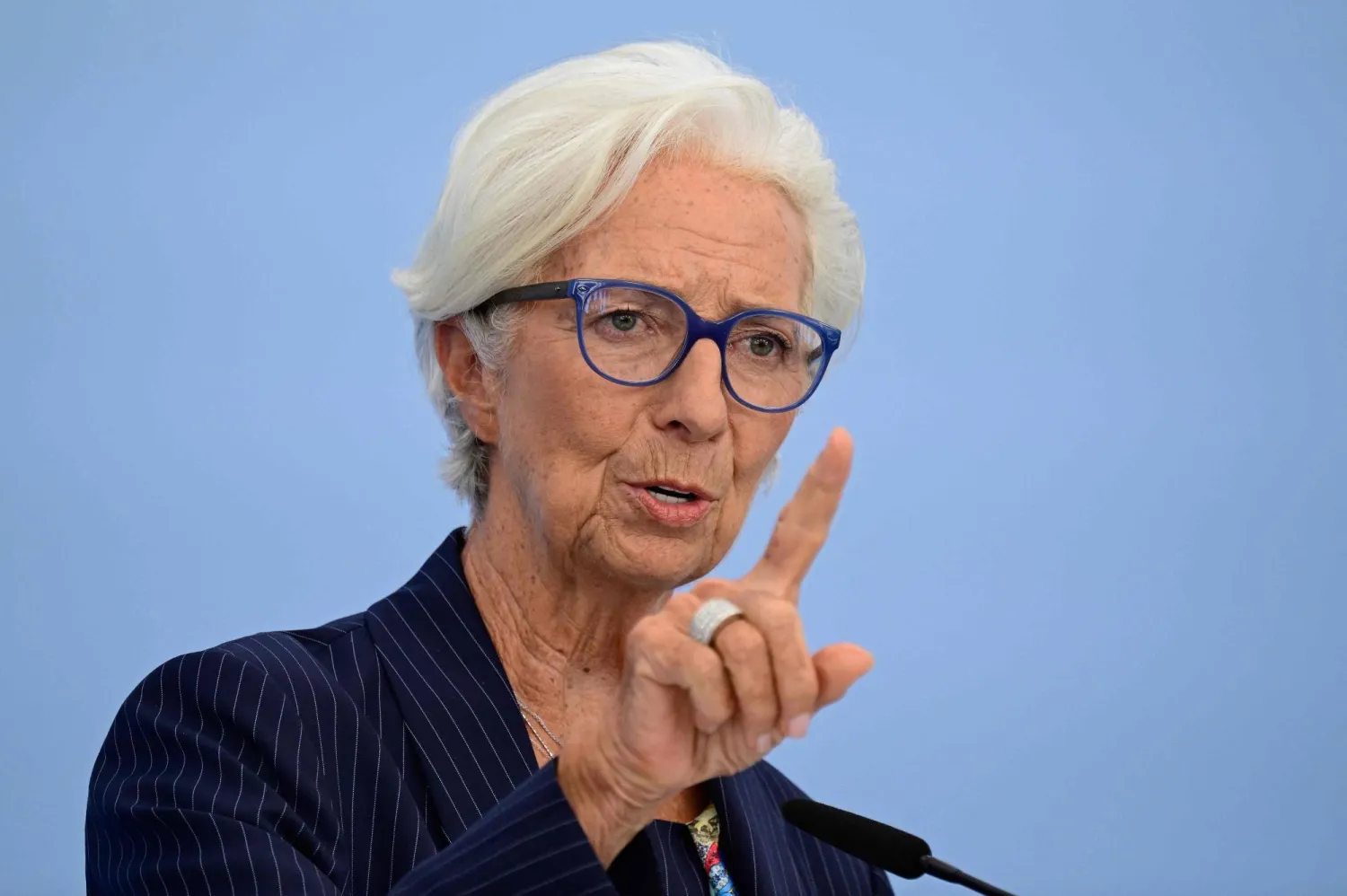
European Central Bank (ECB) President Christine Lagarde addresses a press conference after a meeting of the Governing Council of the European Central Bank (ECB) in Berlin on September 10, 2026. (Photo by John MACDOUGALL / AFP)
TT

ECB's Lagarde Keeps Door Open to Early Exit

European Central Bank (ECB) President Christine Lagarde addresses a press conference after a meeting of the Governing Council of the European Central Bank (ECB) in Berlin on September 10, 2026. (Photo by John MACDOUGALL / AFP)

European Central Bank President Christine Lagarde on Friday kept the door open to leaving her post early, replying "we'll see" when asked if she would remain in the position until her term ends ‌in October 2027.

"I ‌leave in ‌2027," ⁠Lagarde told Irish ⁠national broadcaster RTE in response to a question on rumors of her early resignation that have persisted for most ⁠of this year.

When asked ‌if ‌that meant October 2027, ‌Lagarde replied: "We'll see."

"What I ‌can tell you at this point is that whatever the time, it will be ‌handled in the most professional way as ⁠it should ⁠be," she added.

Sources told Reuters this week that France would back Dutchman Klaas Knot to succeed Lagarde as part of a bargain in which a French candidate would be picked for chief economist.