


South Korea Military: North Korea Fires Ballistic Missile

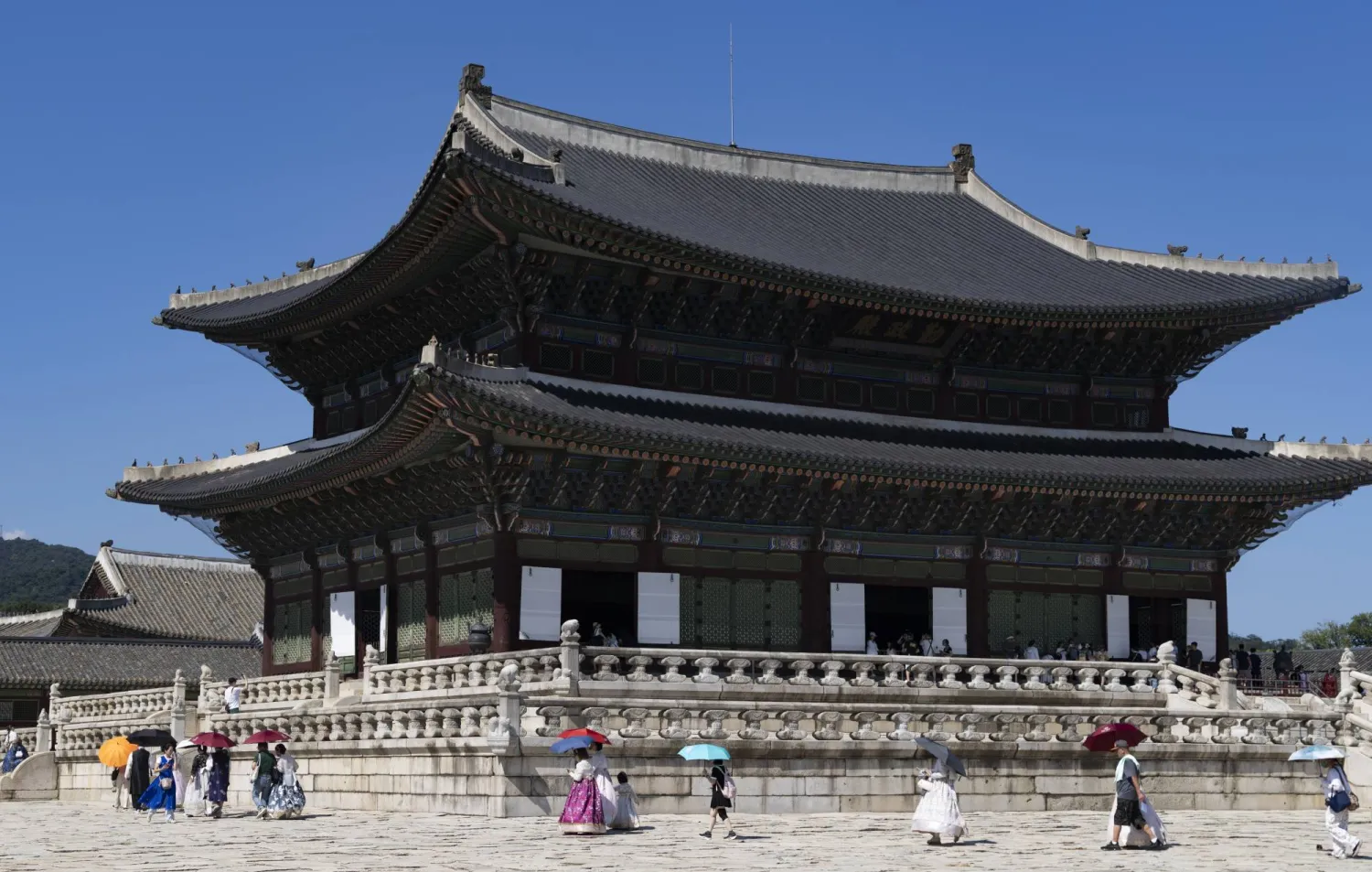
Tourists wearing traditional Korean clothing visit Gyeongbokgung Palace while holding umbrellas to seek relief from the extreme heat in Seoul, South Korea, 06 August 2026. EPA/JEON HEON-KYUN
TT

South Korea Military: North Korea Fires Ballistic Missile

Tourists wearing traditional Korean clothing visit Gyeongbokgung Palace while holding umbrellas to seek relief from the extreme heat in Seoul, South Korea, 06 August 2026. EPA/JEON HEON-KYUN

North Korea fired at least one ballistic missile over the Sea of Japan on Thursday, Seoul's military said, after Pyongyang lambasted Tokyo for beefing up its military stance in the Pacific.

North Korea has repeatedly declared itself an "irreversible" nuclear state since leader Kim Jong Un's 2019 summit with US President Donald Trump collapsed over the scope of denuclearization and sanctions relief.

Tokyo's Defense Minister Shinjiro Koizumi said earlier this week that Japan's military needs to be boosted with a "sense of urgency and crisis", as a new government assessment warned of growing threats from China, Russia and North Korea.

In a statement carried by North Korean state media on Wednesday, Kim Yo Jong -- the powerful sister of leader Kim Jong Un -- said Pyongyang's "leadership will set up additional military options which are obviously due to Japan's transformation".

"Our military detected a short-range ballistic missile launched from the Wonsan area of North Korea at around 5:00 pm (0800 GMT)," South Korea's Joint Chiefs of Staff (JCS) said in a message to news organizations.

The JCS said earlier the missile was launched towards the East Sea, referring to the body of water also known as the Sea of Japan.

Japan's defense ministry also posted on X that "something that may be a ballistic missile has been launched from North Korea."

A separate post shortly afterwards said "there is no longer any impact on the areas around Japan".

Seoul has strengthened surveillance and maintained readiness for possible additional launches while sharing information with its security allies -- the United States and Japan, the JCS said.

North Korea has recently deepened economic and military ties with Russia, supplying troops and munitions for Moscow's war in Ukraine in exchange for financial support, food, energy and military technology, analysts say.

It has also repeatedly branded Seoul -- a security ally of Washington -- its "most hostile" enemy.

According to AFP, Japan's defense ministry declined to comment directly on Kim Yo Jong's Wednesday diatribe but said the country's defense capabilities "remain bare minimum" and "are not meant to threaten other countries".

"Ours isn't the defense meant to wage wars, but to prevent new wars, strictly kept to self-defense and within the scope of our (pacifist) Constitution and international laws," it said in a statement.

Tokyo raised its military expenditure by 9.7 percent to $62.2 billion in 2025 -- equivalent to 1.4 percent of GDP, its highest share since 1958.

China, a key ally of North Korea, has also recently expressed alarm at what it sees as "new militarism" by Japan.

South Korea's dovish President Lee Jae Myung has reversed the stance of his hawkish predecessor since taking power in Seoul in June 2025, offering nuclear-armed Pyongyang talks without preconditions.

The hermetic leadership of North Korea has yet to respond to his repeated offers.
The two Koreas remain technically at war because their 1950-53 conflict ended with an armistice rather than a peace treaty.



House Votes for a Third Time to End the Iran War as Conflict Drags on

 The US Capitol is seen from the Washington Monument, Tuesday, Sept. 15, 2026, in Washington. (AP)
The US Capitol is seen from the Washington Monument, Tuesday, Sept. 15, 2026, in Washington. (AP)
TT

House Votes for a Third Time to End the Iran War as Conflict Drags on

 The US Capitol is seen from the Washington Monument, Tuesday, Sept. 15, 2026, in Washington. (AP)
The US Capitol is seen from the Washington Monument, Tuesday, Sept. 15, 2026, in Washington. (AP)

For a third time, the US House has voted to end the war in Iran, approving a war powers resolution that would halt President Donald Trump's ability to continue military action without congressional approval.

The roll call late Tuesday, 220-204, was similar to earlier efforts this summer, with a few more Republicans joining all Democrats voting to bring an end to the conflict. None of the resolutions have made it to the president's desk, where Trump would almost certainly veto the measure.

“Remember when Donald Trump said that this war would last just a few weeks?” said Rep. Seth Moulton, D-Mass., who served as a Marine during the Iraq War and pushed the resolution forward.

He said it's time for Congress to “actually ask tough questions, as the Constitution directs us to do, rather than be subservient to another warmongering administration.”

Republican Rep. Brian Mast of Florida, the chairman of the House Foreign Affairs Committee, questioned which military resources Democrats would want to remove from the region where he said Iran remains a threat.

Mast said Trump is against “forever wars, and that is what he is ending” — the decades of hostilities from Iran.

“They are a continuous ongoing threat to the United States," Mast said. “Enough is enough.”

Last war powers vote before the midterms

The action is likely the last House vote on the Iran war ahead of the midterm elections, where the conflict overseas is playing a substantial role in the political campaigns. The war that Trump launched Feb. 28 has dragged, with on-again, off-again deadly missile strikes being exchanged and causing havoc in the region for nearly seven months.

Lawmakers are heading home at the end of the week to campaign nearly full-time, with less than 50 days to go before the elections that will determine control of Congress as Democrats try to wrest power from Republicans.

Voters are confronting high prices, particularly for gas at the pumps, as the conflict disrupts the flow of oil resources through the vital Strait of Hormuz.

The Congressional Budget Office said Tuesday that the war has cost more than $38 billion, as of Aug. 1, and is projected to be costing between $2 billion and $3 billion monthly, depending on the intensity of the fighting. The budget office projected inflation will be 0.5 percentage points higher than expected heading into 2027 due to the war.

Trump himself had promised not to involve the US in foreign wars when he won a second term in the White House, and his actions against Iran are weighing on the Republican Party that controls the House and Senate. Most Americans say the war in Iran has not been worth fighting, according to an AP-NORC poll in July.

In the previous House actions, four Republicans voted to halt the war in Iran, but that number rose to seven in Tuesday’s war powers vote, including GOP lawmakers from battleground Iowa, Rep. Zachary Nunn and Rep. Mariannette Miller-Meeks, and retiring Rep. Nancy Mace of South Carolina.

They joined GOP Reps. Tom Barrett of Michigan, Warren Davidson of Ohio, Brian Fitzpatrick of Pennsylvania and Rep. Thomas Massie of Kentucky voting in favor of the war powers resolution, with all Democrats.

War powers being put to the test

Congress has tried repeatedly to alter the trajectory of the war against Iran, but efforts to limit the Trump administration's military action remain a longshot so long as the president is able to fend off or veto the measures.

The House first approved a war powers resolution in June, and followed up with another one in July, all seeking to halt US action in Iran. The Senate on its 10th try also approved a war powers resolution to end the conflict, but GOP senators quickly reversed course the next day after Trump berated them during a closed-door lunch.

While the Constitution gives Congress the authority to declare war, it also gives the president authority as the commander in chief to engage in some military actions. The War Powers Act, created in the aftermath of the Vietnam conflict, sought to put a more specific time limit on the president's power, requiring congressional approval for sustained military actions after 60 or 90 days.

House Speaker Mike Johnson acknowledged at a press conference Tuesday the need to bring gas prices down.

But the Republican speaker said he believes the Iran conflict is entering a “new phase” as allies step up to help stabilize the region. When that happens, he said, “you’re going to see, as the president said, anytime gas prices will go down again, the cost of groceries will as well.”

Johnson said Trump expects the shift after the election, and the speaker added, “I'd love it to happen today.”


China Defense Minister Urges an End to ‘Provocative Acts’ to Open Security Forum

 Chinese Defense Minister Dong Jun delivers the keynote speech at the opening ceremony for the Beijing Xiangshan Forum in Beijing, China September 16, 2026. (Reuters)
Chinese Defense Minister Dong Jun delivers the keynote speech at the opening ceremony for the Beijing Xiangshan Forum in Beijing, China September 16, 2026. (Reuters)
TT

China Defense Minister Urges an End to ‘Provocative Acts’ to Open Security Forum

 Chinese Defense Minister Dong Jun delivers the keynote speech at the opening ceremony for the Beijing Xiangshan Forum in Beijing, China September 16, 2026. (Reuters)
Chinese Defense Minister Dong Jun delivers the keynote speech at the opening ceremony for the Beijing Xiangshan Forum in Beijing, China September 16, 2026. (Reuters)

Chinese Defense Minister Dong Jun urged nations on Wednesday to avoid provocative acts and curb the resurgence of regressive historical trends in remarks likely to be taken as veiled criticism of Japan.

Dong's comments at the Beijing Xiangshan Forum on security come at a time of roiling regional tension over China-claimed Taiwan and the disputed South China Sea waterway, as doubt grows over traditional US security commitments to Asia.

Warning that the world had arrived at a "fragile moment", Dong called for a fresher, more equal approach to resolving international tension, but offered few specifics or direct criticism of rivals.

"We must bear in mind the lessons of history and remain highly vigilant ‌against all latent ‌manifestations of hegemony, militarism and historical revisionism," he said in an opening speech.

"We ‌must ⁠not turn a ⁠blind eye or condone such behavior. By rallying broad-based forces of justice, we must suppress the resurgence of historical dregs and prevent them from exploiting the situation to cause harm."

Ties between China and Japan plummeted last year after Japanese Prime Minister Sanae Takaichi suggested a hypothetical Chinese attack on Taiwan could trigger a Japanese military response.

That spurred Beijing to repeatedly warn that Japan was seeking a return to its militarist past, which included the Japanese occupation of northeast China's Manchuria in 1931 before a full war between the then-Republic of China and Japan.

Some 2,000 military ⁠officers, diplomats and academics from 100 countries are attending the three-day event ‌set to run until Thursday, with delegates including some regional defense ministers, ‌a senior Pentagon official, Russian academics and Taliban representatives.

NO DIRECT CRITICISM OF US OR REGIONAL ALLIES

As some analysts predicted, ‌Dong steered clear of direct criticism of the United States or its regional allies, such as Japan, ‌and appeared to hew closely to long-held Chinese positions.

Dong urged efforts towards a peaceful, multipolar world marked by "partnership rather than alliance, win-win rather than zero sum".

"We must show no leniency towards provocative acts that seek to hijack the overall interests of countries in the region for the sake of personal gain or the interests of particular cliques, and we must work ‌together to rein them in," he added.

The comments come a week before Chinese President Xi Jinping is expected to visit the United States for ⁠a summit with President Donald ⁠Trump.

China views democratically governed Taiwan as its own territory and has ramped up military pressure around the island, including periodically staging war games. Taiwan's government rejects Beijing's claims of sovereignty.

A tightly scripted rival to the more prominent Shangri-La Dialogue in Singapore, which is widely seen as a more freewheeling affair, the forum comes at a time of China's expansion of military diplomacy. This often takes the form of bilateral exercises that military attaches say are slowly growing in complexity.


US Imposes Fresh Sanctions on Tehran

US Treasury Department (Reuters)
TT

US Imposes Fresh Sanctions on Tehran

US Treasury Department (Reuters)

The United States has accused Russia's VTB bank of supporting Iran's efforts to evade sanctions, taking aim at an institution it already blocked over Moscow's invasion of Ukraine in 2022.

In a symbolic move, the US Treasury Department said it has now imposed additional sanctions against VTB Bank for actions “including establishing correspondent relationships with sanctioned Iranian banks.”

The agency warned foreign financial institutions against dealing with VTB, urging them to cut ties immediately.Washington has sought to step up economic pressure on Tehran as the war in the Middle East enters its seventh month since the United States and Israel launched strikes at Iran in late February.

The conflict saw Tehran retaliate by choking off the Strait of Hormuz, a key waterway for energy transit, sending oil prices soaring.

Prices at US gasoline pumps have in turn surged, keeping American households under growing financial pressure weeks ahead of US midterm elections.

Since US Treasury Secretary Scott Bessent vowed an “economic D-Day” on Iran, Washington has imposed sanctions on other institutions including Turkish bank Golden Global.

VTB, however, already faced US sanctions in 2022, with the Treasury Department imposing “full blocking sanctions” on the bank, meaning that its US-held assets would be frozen and inaccessible to the Kremlin.

At the time, the department added that VTB was “one of the largest financial institutions Treasury has ever blocked.”

On Tuesday, Britain, the United States and the Netherlands issued a joint cybersecurity advisory detailing spyware they say is used by Iranian state-linked actors to target dissidents, activists and journalists, according to Reuters.

Britain's National Cyber Security Centre said Iranian state-linked cyber actors had used a spyware family known as “CHOSEN BRICK” to steal emails, messages and other sensitive information through "spear-phishing" campaigns on messaging platforms including WhatsApp and Telegram.

Meanwhile, Iranian media announced on Monday the launch of a new online portal allowing users to report critics living abroad, a move that has sparked concerns over growing surveillance within the Iranian diaspora.

The surveillance system, named “Alaj” (Healing), aims to identify “traitors,” according to the reports. It was officially established to “protect national security.”

“Betraying Iran has a price and carries legal consequences,” the Fars news agency wrote on Monday.According to the reports, Iranians can use the web portal as well as social media channels to report on the alleged traitors. The identity of informants would be kept confidential, the reports said.

How widely the portal will be used in future remains entirely unclear, although there are fears it will lead to increased mistrust within the Iranian diaspora community.

An estimated 4 million people with Iranian citizenship or an Iranian family background live abroad, according to various estimates. Many of them left the country for political reasons.

The reach of the Iranian security apparatus into Europe and the United States has long meant that Iranians abroad can find it difficult to trust one another.