

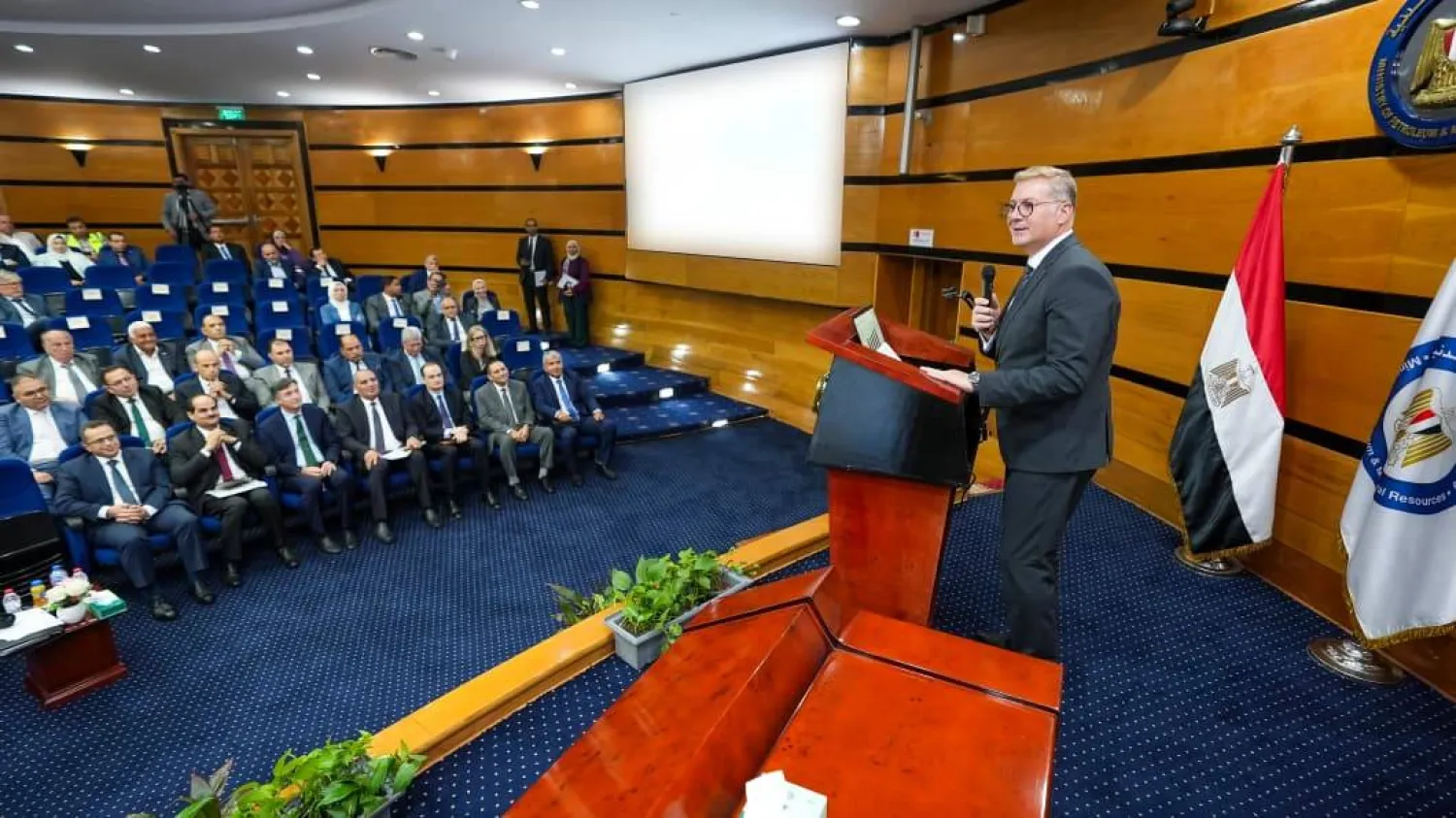

Egypt Opens Bid for 14 Oil and Gas Concessions

Egypt’s Minister of Petroleum and Mineral Resources Karim Badawi announces the round of bidding on Wednesday. (Ministry of Petroleum and Mineral Resources)
TT

Egypt Opens Bid for 14 Oil and Gas Concessions

Egypt’s Minister of Petroleum and Mineral Resources Karim Badawi announces the round of bidding on Wednesday. (Ministry of Petroleum and Mineral Resources)

Egypt’s Minister of Petroleum and Mineral Resources Karim Badawi announced on Wednesday the launch of the 2026 international bid round for crude oil and gas exploration.

The tender features 14 new blocks open to both international and Egyptian companies. The step aims to attract more investment required to support domestic production and achieve the goals of the five-year plan to increase production rates, said a statement by the ministry.

The announcement was made during a meeting between Badawi and the heads and directors of international companies operating in Egypt who are investment partners.

The meeting was held to review current performance developments in production and exploration, and to discuss plans for field exploration, development, and increasing production over the next five years, alongside presenting new investment opportunities.

The bid round, which opened for applications on Tuesday, includes eight blocks affiliated with the Egyptian Natural Gas Holding Company (EGAS) in the Mediterranean, the Nile Delta, and North Sinai.

The deadline for submission for these blocks is scheduled for December 14.

The tender features six blocks affiliated with the Egyptian General Petroleum Corporation (EGPC) in the Gulf of Suez, Sinai, and the Western Desert, with their application deadline set for November 11.

Badawai stressed that through the new bid round, Egypt is offering promising, diverse, and competitive investment opportunities.

A large number of these blocks are located near existing fields and infrastructure, including pipeline networks, processing plants, and export facilities. This proximity will help in lowering development costs and accelerating the connection of new discoveries to production.

The minister added that the offered blocks feature diverse geological targets across both offshore and onshore areas.

This provides attractive opportunities to increase the investments of international companies currently operating in Egypt, while also attracting new global petroleum firms to operate in the country for the first time.




Gold Off Two-month Peak as Traders Seek Inflation Cues

Gold bars and 'sovereign pounds' coins at Bird & Co. in Hatton Garden, London (Reuters)
TT

Gold Off Two-month Peak as Traders Seek Inflation Cues

Gold bars and 'sovereign pounds' coins at Bird & Co. in Hatton Garden, London (Reuters)

Gold edged lower on Thursday, after touching a more than two-month high earlier in the session, as traders paused after a rally fueled by cooling US inflation, with attention turning to an upcoming producer price report for clues to prospects of near-term Federal Reserve rate hikes.

Spot gold fell 0.5% to $4,383.53 per ounce ‌by 0601 GMT, after ‌jumping about 1% to its highest since ‌June ⁠5. US gold futures ⁠for December delivery fell 0.6% at $4,440.80.

"Gold is in consolidation mode today after its post-CPI gains, with near-term expectations of a Fed rate hike being dialed back another notch," said Tim Waterer, chief market analyst at KCM Trade.

"Traders appear content to wait for confirmation from the upcoming PPI data before committing to the next leg higher."

Prices have ⁠risen over 8% so far this month, ‌as traders scale back US interest rate ‌hikes bets amid recent softer economic data.

On the geopolitical front, Iran and ‌the US remain at loggerheads over efforts to agree on a ‌permanent end to the war, according to a senior Iranian source, who said there had been no progress in talks to revive the interim deal agreed in June.

On monetary policy, Fed policymakers are likely ‌to feel little fresh urgency to raise interest rates next month after data on Wednesday showed inflation ⁠cooled on ⁠a year-over-year basis for a second straight month.

The consumer price index rose 3.4% in the 12 months through July, down from 3.5% in June, in line with economists' expectations. Traders are now pricing in only a 40% chance of a hike at the September meeting, down from about 54% seen a week before, according to the CME FedWatch Tool.

Lower rates tend to support gold by lowering the opportunity cost of holding the non-yielding asset.

In other metals, spot silver lost about 0.3% to $65.09 per ounce, having climbed to its highest since June 22 in the previous session.

Platinum lost 0.8% at $1,741.96, and palladium fell 0.9% at $1,357.29.


Oil Eases as Weaker Demand Outlook Counters Mideast Supply Concerns

Oil pumpjacks are pictured in an Ecopetrol oil field in Barrancabermeja, Colombia October 11, 2024. (Reuters)
TT

Oil Eases as Weaker Demand Outlook Counters Mideast Supply Concerns

Oil pumpjacks are pictured in an Ecopetrol oil field in Barrancabermeja, Colombia October 11, 2024. (Reuters)

Oil prices eased on Thursday after gains in previous sessions, as attention turned to expectations of weaker global oil demand this year, while there was no progress on opening the vital Strait of Hormuz.

Brent futures slipped 42 cents, or 0.47%, to $88.56 a barrel by 0405 GMT. US, trimming gains made over the previous six sessions.

West Texas Intermediate (WTI) crude fell 55 cents, or 0.66%, to $82.72, after advancing over the past five sessions.

A senior Iranian source said ‌on Wednesday there ‌had been no progress in talks to revive an interim ‌deal ⁠agreed in June ⁠and define a timeframe to implement it.

"There was little in the way of fresh developments between the US and Iran, with both sides remaining in a deadlock," said ING analysts in a note on Thursday.

"Meanwhile, the latest large drone attack on Russia's Novorossiysk port appears to have spared oil infrastructure, with no reports of damage to oil terminals as of now."

With no change in the prospect of reopening the ⁠Strait of Hormuz, the key factor that had driven prices ‌higher over the past week, attention turned to ‌the demand outlook following a surprise build in US crude stocks and lower consumption forecasts from ‌OPEC and the International Energy Agency.

US commercial crude oil inventories posted their ‌largest weekly gain since January 2023 as exports slumped, data from the Energy Information Administration showed on Wednesday.

Crude inventories rose by 17.4 million barrels to 424.4 million barrels in the week ended August 7, their highest since June 5, the EIA said, compared with analysts' ‌expectations in a Reuters poll for a 1.4-million-barrel draw.

On the same day, the Organization of the Petroleum Exporting Countries ⁠lowered its world ⁠oil demand growth forecast for 2026 to 580,000 barrels per day in its monthly oil market report.

At the same time, the International Energy Agency said it expects a 1.6 million bpd contraction in consumption this year, down from a forecast of 1 million bpd last month, with demand curtailed by higher prices and restricted supply due to the US-Israeli war with Iran.

Still, the deadlocked talks between Iran and the US to end the war in the region have kept a floor under prices.

"The safety situation for navigation in these waters has further deteriorated, forcing vessels to turn off their signals, which reduces transparency in shipping and makes it more difficult for the market to track and assess actual supply levels," analysts at Haitong Futures said in a note.


Dollar Treads Water as Fed Hike Bets Pared on Benign US Inflation

A picture illustration shows US 100 dollar bank notes taken in Tokyo August 2, 2011. (Reuters)
TT

Dollar Treads Water as Fed Hike Bets Pared on Benign US Inflation

A picture illustration shows US 100 dollar bank notes taken in Tokyo August 2, 2011. (Reuters)

The dollar's advance stalled on Thursday after an overall benign US inflation reading overnight spurred traders to pare back bets for a near-term Federal Reserve interest rate hike.

The greenback was little changed against the yen in Asia's afternoon, but remained on course to gain about 1% this week as markets bought back the currency pair following recent joint US-Japan intervention that saw it plummet to a three-month low.

The dollar index, which measures the US currency against the yen and five other major peers, was flat at 99.976 on Thursday, ‌but on course ‌for a 0.4% weekly rise.

US consumer prices increased 0.1% ‌in ⁠July, in line ⁠with economists' expectations, leading money markets to reduce the odds of a September rate hike to 40%, down from 54% a week ago, according to CME Group's FedWatch.

Michael Wan, a currency strategist at MUFG, said the primary dilemma for the Fed now lies in weighing inflation risks against a softening labor market, particularly after the weaker-than-expected July payrolls report released last Friday.

"We think that the FOMC is likely to maintain a restrictive holding pattern in September rather than a pivot towards ⁠a hike," Wan said in a note.

The dollar changed hands at 159.35 ‌yen, close to the 160 level that some market ‌participants see as a line in the sand following the rare joint intervention at the end of ‌July. The action helped pull the exchange rate down from near a four-decade peak close ‌to 164 to 155.20 over the course of three days.

Shusuke Yamada, head of Japan FX/rates research at Bank of America, said investors can only judge the authorities' commitment to defending the yen through dollar-yen price action and the policy response that follows.

"A break above 160 would likely be interpreted as a sign ‌of limited policy resolve, while successful intervention that pushes USD/JPY below 155 would have strengthened perceptions of strong commitment at least until recently," ⁠Yamada said.

"Confidence in Japan's ⁠commitment to defending the yen improved after coordinated intervention with the US on July 31. However, as USD/JPY has rebounded without any intervention over the past week, that credibility appears to have eroded."

The euro was little changed at $1.1525. Sterling edged down 0.04% to $1.3491 ahead of a slew of UK data due later in the day, including GDP.

The Australian dollar eased 0.2% to $0.7048, but was still close to Wednesday's 10-week high of $0.7091. Reserve Bank of Australia Assistant Governor Christopher Kent told a Reuters NEXT Newsmaker event in Sydney that the risks on inflation were very much to the upside and if those risks materialized, rates would have to rise again.

The New Zealand dollar slid 0.4% to $0.5833 after a surprisingly low reading on inflation expectations stirred doubts about the need for aggressive rate hikes. The currency has retreated gradually after hitting the highest levels since early June earlier this month.

Bitcoin was slightly higher at around $63,883.