


Israeli Settlers Divert Palestinian Water to Fill West Bank Pool

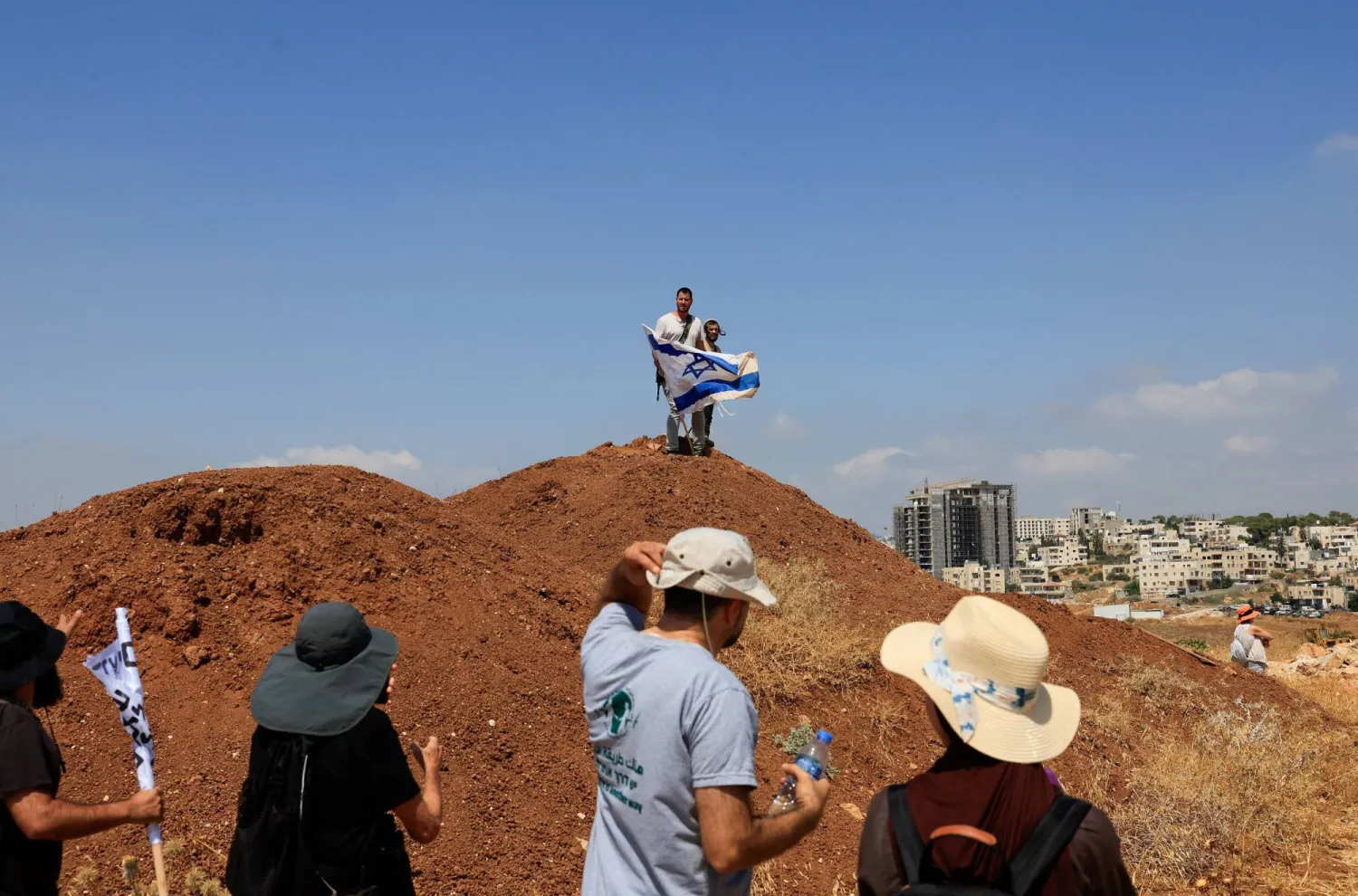
Armed Israeli settlers holding an Israeli flag look on as Palestinian and Israeli activists accompany Palestinian landowners in their property, which is threatened with confiscation by Israeli settlers, in Beit Sahour in the Israeli-occupied West Bank August 14, 2026. REUTERS/Mussa Qawasma
TT

Israeli Settlers Divert Palestinian Water to Fill West Bank Pool

Armed Israeli settlers holding an Israeli flag look on as Palestinian and Israeli activists accompany Palestinian landowners in their property, which is threatened with confiscation by Israeli settlers, in Beit Sahour in the Israeli-occupied West Bank August 14, 2026. REUTERS/Mussa Qawasma

On a searing summer day, Israeli settlers splashed in a West Bank pool created by siphoning off water that had irrigated Palestinian crops, one of many seizures of water resources across the occupied territory.

The spring served as a lifeline for the nearby village of Fasayil in the fertile Jordan Valley, where Palestinians have relied on it for generations for food, employment and to supplement irregular Israeli supplies to their domestic taps, reported Reuters.

"Our water supply remains cut off to this day, depriving us of the water we depend on for our homes, our livelihoods, and our agricultural land," said Saad Nemer, who farms the land.

Israeli settlers seized his irrigation pipeline in June, channeling the water to an ancient pool in an archaeological site. Soon after, settlers advertised it as an Israeli tourist attraction and Israel's far-right finance minister pledged financial support.

"They are now in the process of developing a recreational park around the pool," Nemer said.

SETTLERS STOP PALESTINIAN VILLAGERS APPROACHING

The seizure of the spring at Fasayil is part of a pattern that Palestinians say is designed to make their lives in the West Bank untenable. Israeli settlers have attacked at least 160 water and sanitation sites across the Palestinian territory ‌this year, United Nations data ‌shows.

Nemer's greenhouses and fields would normally be full of eggplant, zucchini and watermelons, but without water he ‌has not been ⁠able to plant ⁠in the scorched land.

"The settlers cutting off our water has caused us losses and has meant that many families will lose their work and their livelihoods," he said.

Nemer said that an employee had been beaten up by settlers and he himself had faced threats for attempting to approach the spring as far back as two years ago.

Yishai Shreiber, 21, an Israeli settler who had come to swim in the pool near Fasayil on an August afternoon, said Palestinians would not now dare approach.

"Now that they see this entire mass of people, all these large groups of Jews coming here to bathe, they are afraid to come here," said Shreiber.

Shreiber said the West Bank belonged to the Jewish people, and that if Palestinians don't want to accept Jewish authority, they should leave.

Nemer showed Reuters a 2025 land ownership document from COGAT, the Israeli military ⁠agency which enforces civilian policy in the occupied territories. He also presented a map drawn for the pre-occupation 1957 registration ‌of his title deeds showing that his land included both the spring and the pool. COGAT and ‌Finance Minister Bezalel Smotrich did not respond to requests for comment.

'WATER WAR' IS PART OF ISRAELI WEST BANK TAKEOVER, PALESTINIANS SAY

Israel's far-right coalition government has overseen massive settlement construction that ‌Smotrich says is aimed at burying the idea of a Palestinian state, which has been recognized by more than 150 of 193 UN member states as ‌encompassing the Gaza Strip and West Bank, including East Jerusalem.

The United Nations and most governments consider the settlements to be illegal under international law related to military occupation. Israel seized the West Bank in the 1967 war, but argues the territory is disputed rather than occupied.

Palestinians have experienced a sharp rise in settler violence, and Palestinian field researcher Fares Foqahaa estimated that settlers had now seized control of 95% of springs in the northern Jordan Valley, displacing communities.

In another West Bank village, Qusra, settlers still besieging three homes on Thursday had ‌also cut off their water and electricity.

Adel Yassin, an official with the Palestinian Authority's water authority, said that settlers target water resources as part of a systematic campaign to force Palestinians off their land.

"I see this as a ⁠water war. It is the silent ⁠bullet that kills Palestinians without a sound," he said, referring to the process of making their livelihoods unsustainable.

ISRAELI ARCHAEOLOGIST SAYS SETTLERS ARE DAMAGING THE SITE

In early June, Eliav Libi, a settler leader targeted with sanctions by Canada and other countries, posted a video showing the pool beginning to fill with water.

He and other settlers say the pool belonged to the biblical-era Jewish king Herod. An archaeologist with the Israeli rights group Emek Shaveh, Alon Arad, said the pool's provenance is unclear.

"We see in many cases the use of archaeology ... to create this feeling that the West Bank is exclusively Jewish," Arad said, adding that the settlers were damaging an archaeological site by filling it with water.

Outside the pool, a billboard advertised a 3 million shekel ($1 million) investment from Smotrich, an architect of settler expansion, who said in a Telegram post the money was for the restoration and development of "Herod's Pools".

The pool and the nearby spring were packed with Israeli families swimming and wading in the water. No Palestinians were present.

One of the few natural springs still available to Palestinians is near the city of Nablus at Wadi al-Badhan. In July, families sat at plastic tables placed in shallow streams picnicking with their feet in the running water.

The springs are located close to Nablus' urban center and had until this year rarely faced incursions from settlers.

Hundreds of settlers descended into the springs earlier this summer, sitting at the plastic tables and walking through the pools, five Palestinians said.

Nizam Fares, the owner of a natural spring park in al-Badhan, said people could no longer enjoy visiting the area.

"People have become scared and jumpy. They come and ask if the settlers are coming or not?" he said.



Death Journey from Kordofan Ends in Hunger in Omdurman

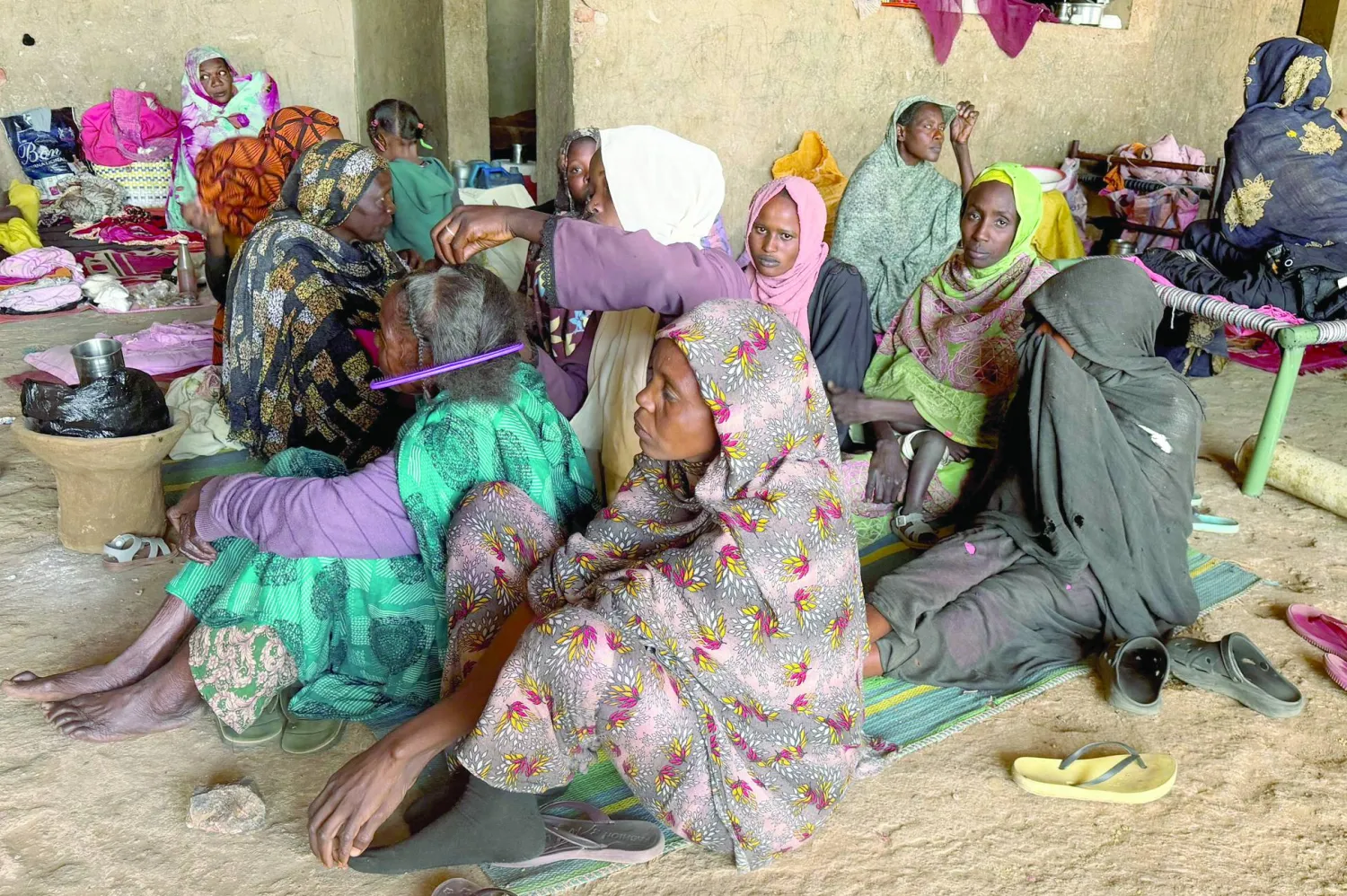
A displaced woman from Dalanj braids her grandmother's hair at a displacement registration center in El Obeid, North Kordofan State, Sudan, January 15, 2026. REUTERS/El Tayeb Siddig
TT

Death Journey from Kordofan Ends in Hunger in Omdurman

A displaced woman from Dalanj braids her grandmother's hair at a displacement registration center in El Obeid, North Kordofan State, Sudan, January 15, 2026. REUTERS/El Tayeb Siddig

A long journey marked by fear, hunger and thirst has been undertaken by large numbers of Sudanese families fleeing cities and towns in North Kordofan state, where fighting has flared again, for Omdurman, the second-largest city in the capital Khartoum.

Families that have lost children, relatives, and perhaps all their possessions have been forced to leave their homes and take difficult routes through mountains and valleys. Some have travelled on foot, while others have relied on animal-drawn carts or trucks. Others have become stranded before reaching safety.

Reports by local and international aid organizations said hundreds of families — with some estimates putting the number at more than 3,000 — have been displaced in recent weeks following a resurgence of military operations in parts of North Kordofan, amid what the reports described as “dire humanitarian conditions”.

After weeks of hardship, the families reached the far western outskirts of Omdurman “hungry and exhausted,” carrying what remained of their belongings and memories of the homes they had left behind.

Others had lost family members along the arduous journey. But reaching Omdurman did not end their ordeal. Displaced families face shortages of food and drinking water and a lack of humanitarian assistance, while cases of diarrhea, fever and infections are spreading among children, turning their escape from the war into an open-ended ordeal with no clear end in sight.

The Arduous Journey

The Sudanese Armed Forces and allied forces are seeking to expand their control in North Kordofan and secure the area around the state capital, El Obeid, while large numbers of the Rapid Support Forces are positioned west and south of the city.

Halima Dhow al-Bait said she fled with her family of nine from the Al-Jamama area of Sodari locality in North Kordofan after they were forced to leave their home at gunpoint.

Her journey took several days aboard cargo trucks and was arduous and exhausting, while some residents and neighbors became stranded in the mountains and among the trees.

“We arrived in Omdurman in a state of extreme exhaustion,” the Sudanese woman told Asharq Al-Awsat. “During the first few days, we received some food supplies, including oil, sugar and flour, but those supplies later stopped.”

Another displaced woman said: “During the journey, three of my children fell ill because of hunger, thirst and the hardships of the road.”

“We left our homes, our property and everything we owned. We left with nothing but the clothes we were wearing,” she said. “Our situation is now extremely difficult, and we are receiving no humanitarian assistance.”

“We saw death with our own eyes”

Sudan’s humanitarian crisis has deepened as a result of the war between the Sudanese army and the Rapid Support Forces, which has continued since April 2023, killing hundreds of thousands of people and displacing about 13 million others as refugees and internally displaced people, according to UN estimates.

Sayedah Khamis, a displaced woman from the town of Al-Jamama, recounted the details of her arduous journey.

“Our journey took about 13 days. At times we travelled on foot, and at others in donkey-drawn carts,” she said.

“We left because of the deteriorating security situation, violations and the looting of civilians’ property,” she added.

The displaced woman described the hardship of the journey and the harsh conditions her family endured throughout those days.

A New Reality

Renewed fighting in Sudan’s Kordofan region has displaced hundreds of families to El Obeid, Khartoum, Kosti and Omdurman. The crisis has also displaced about 200,000 people in North Darfur and a similar number in Blue Nile state.

Mohamed Ali, who was also displaced from Abu Hadid, said armed conflict forced his family to leave the area. They traveled for about two weeks through mountains and valleys, using different forms of transport and sometimes sleeping outdoors in harsh conditions amid insects and disease.

He said they lost several family members along the way and now urgently need food and clean drinking water, particularly as flies have contributed to illnesses among children.

Although the families’ displacement journey to Omdurman may have ended, their hardship continues. They have lost homes, property and relatives, and now face a daily struggle for food, water and healthcare. Their hope of returning home remains on hold until the violence ends, turning their escape from war into an ongoing fight for survival.


Official Leading Trump's Gaza Ceasefire Effort Criticizes Israel for Its Attacks

Peace Council High Representative Nikolay Mladenov (Reuters)
TT

Official Leading Trump's Gaza Ceasefire Effort Criticizes Israel for Its Attacks

Peace Council High Representative Nikolay Mladenov (Reuters)

The official in charge of President Donald Trump's ceasefire plan for Gaza criticized Israel on Wednesday for its attacks on the war-battered Palestinian territory and warned that the alternative to the US proposal is the next war, The Associated Press said.

Nikolay Mladenov, the Board of Peace high representative, insisted to the UN Security Council that Trump's 20-point plan has not stalled and “has moved from the negotiating table to the engineering table.”

The group Hamas has agreed to the proposal’s key provision to disarm and turn Gaza over to civilian rule, he said. But Israel’s ongoing strikes since last October’s ceasefire are still killing Palestinians — though much fewer — and Gazans can’t feel that the conflict is ending, he said.

“After three years of war and 20 years of military operations, I ask, will another strike on a munitions depot stop Hamas from rearming or tightening its grip on Gaza?" Mladenov said. “It will not. It only delays the demilitarization that would happen” and obstructs the transfer to a civilian government.

A recent US deal with Hamas to disarm was seen as a potential breakthrough to end the war, which was sparked by the militant group’s deadly Oct. 7, 2023, attacks in southern Israel. But Israeli Prime Minister Benjamin Netanyahu said his forces won’t withdraw from their current lines in Gaza until Hamas has handed over all its weapons.

Mladenov said that at a meeting he took part in last week with Netanyahu and Jared Kushner, Trump’s son-in-law and adviser, “we went through his government’s concerns one by one and narrowed the areas that still require technical work.”

Israel’s deputy UN ambassador, Noa Furman, reiterated to the Security Council his country’s commitment to Trump’s plan, but stressed that it can’t succeed while Hamas remains armed. He said Israel is working closely with the US to achieve Hamas’ disarmament.

The US ambassador to the UN, Mike Waltz, said concerns about Trump's plan are being addressed and Hamas' disarmament will be judged on its actions.

Mladenov warned of the distance between the roadmap and what’s happening on the ground, and said if war resumes, there won’t be a roadmap to return to or anything left on the ground to rebuild.

“That would not be a setback,” he said. “it would be a point of no return for everyone.”

Mladenov stressed the need for political will to overcome the differences and said there is a choice to be made: “A Gaza disarmed, rebuilt and reconnected to the world. Or a Gaza rearmed, divided and in rubble, with a radicalized generation raised inside it and the next war already on the horizon."

As for the Palestinians, Mladenov said, the Trump plan includes a “credible pathway to a political horizon" and a two-state solution to the decades-old conflict. Netanyahu vehemently opposes a Palestinian state.


Israel Considers Expelling British Officials from Post-war Gaza Headquarters, FT Reports

Palestinians look at a food-aid warehouse damaged in an Israeli airstrike that targeted a nearby house in Deir al-Balah, central Gaza Strip, Wednesday, Aug. 26, 2026. (AP Photo/Abdel Kareem Hana)
TT

Israel Considers Expelling British Officials from Post-war Gaza Headquarters, FT Reports

Palestinians look at a food-aid warehouse damaged in an Israeli airstrike that targeted a nearby house in Deir al-Balah, central Gaza Strip, Wednesday, Aug. 26, 2026. (AP Photo/Abdel Kareem Hana)

Israel is considering expelling British, and possibly other European officials, from the US-led coordination center for ‌post-war Gaza, ‌the Financial ‌Times reported ⁠on Thursday.

The Israeli ⁠government in recent weeks has discussed removing the UK ⁠from the ‌International ‌Gaza Support ‌Center, the multinational ‌headquarters established to monitor the US-brokered ceasefire between ‌Israel and Hamas, the newspaper said, ⁠citing ⁠people familiar with the matter.

Reuters could not immediately verify the FT report.