


Gaza Health Sector Faces Mounting Crises, Risk of Total Collapse

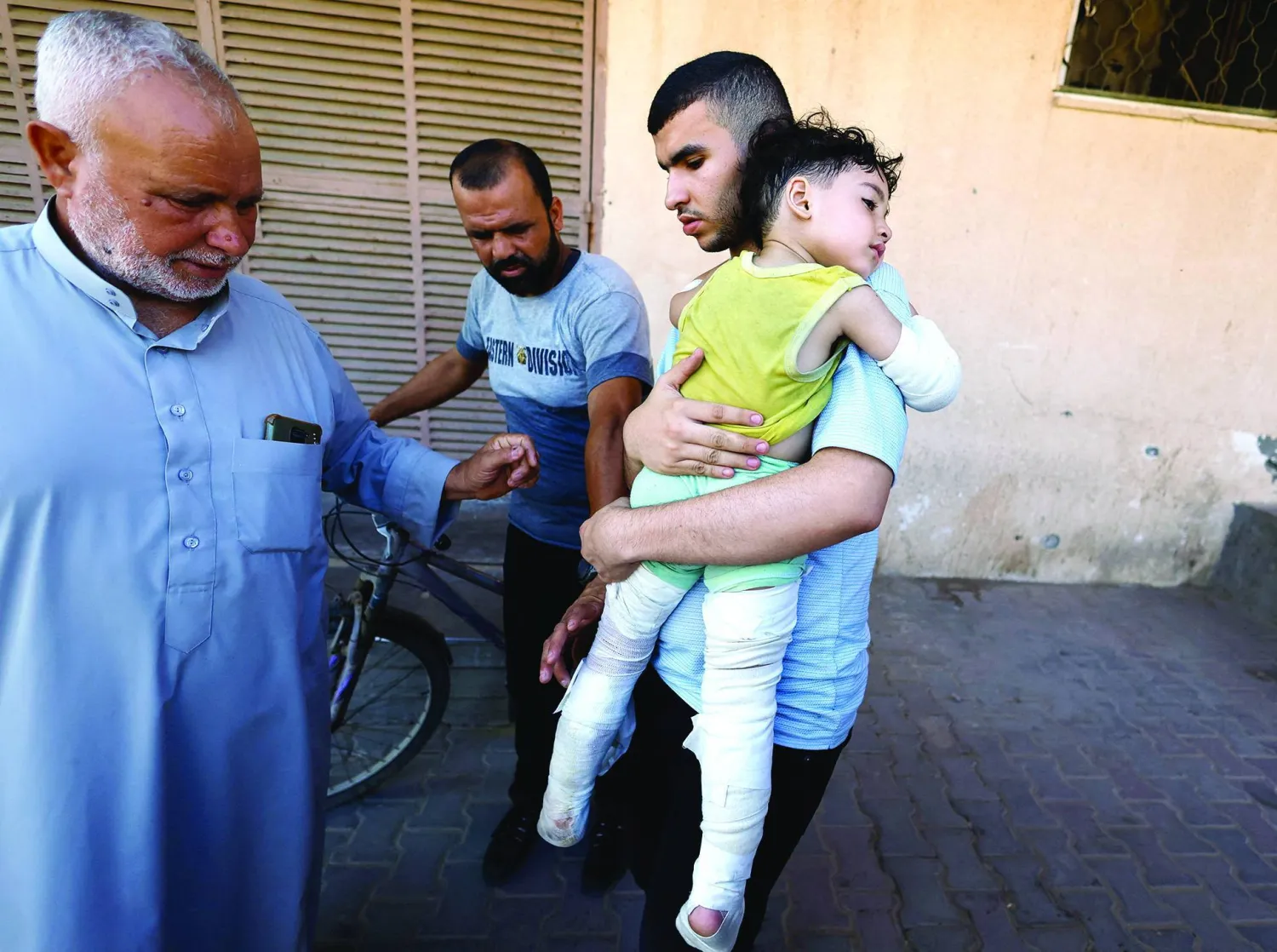
A Palestinian carries a child wounded in an Israeli strike that killed the child’s parents at Al-Aqsa Martyrs Hospital in Deir al-Balah, central Gaza Strip, July 15, 2026 (Reuters) 
TT

Gaza Health Sector Faces Mounting Crises, Risk of Total Collapse

A Palestinian carries a child wounded in an Israeli strike that killed the child’s parents at Al-Aqsa Martyrs Hospital in Deir al-Balah, central Gaza Strip, July 15, 2026 (Reuters) 

Gaza’s health sector is facing a deepening series of crises amid the devastation caused by the Israeli war that followed Hamas’ Oct. 7, 2023 attack.

Israel has not only damaged hospitals through raids and strikes but continues to control the entry of medicines and medical supplies, as well as the departure of patients seeking treatment abroad, further complicating an already dire health situation.

Gaza’s Health Ministry warned Saturday that the operating capacity of the remaining oxygen stations had been fully exhausted and that they were working beyond their limits amid repeated breakdowns.

Only 12 of 34 oxygen stations remain operational, under highly difficult technical and mechanical conditions that make it increasingly hard to meet the needs of health facilities and other service providers. The ministry said just four of 30 oxygen-cylinder filling units remain functional and could stop at any moment because engineering teams lack the means to carry out emergency maintenance.

It warned that the remaining stations risk complete shutdown, threatening oxygen supplies to hospitals and patients receiving care at home. The ministry called for the immediate entry of spare parts and technical equipment, as well as the urgent supply of new oxygen stations.

The crisis is also placing severe pressure on kidney patients. The Hind al-Daghma Dialysis Center at Nasser Medical Complex is treating more than 200 patients from across Gaza amid acute shortages of medical supplies, medicines and equipment.

Riyad Barbakh, head of the dialysis department, said demand was rising as equipment and treatment supplies dwindled, creating harsh conditions that had contributed to patient deaths.

Dialysis sessions are the only barrier between life and death for these patients, Barbakh said, warning that any disruption to supplies or equipment could pose an immediate threat to hundreds of lives.

Cancer patients face similarly grave conditions

Mohammed Abu Nada, medical director of the Gaza Cancer Center, warned of an unprecedented deterioration in the condition of cancer patients, saying severe shortages of essential treatments and restrictions on travel threaten about 11,000 people.

Abu Nada said three cancer patients were dying each day from complications, while about 4,000 patients holding official medical referrals for treatment or diagnosis abroad remained unable to leave because of tight restrictions and continued crossing closures.

He pointed that Gaza lacks radiotherapy entirely and faces severe shortages of chemotherapy, with cancer drugs accounting for 61% of medicines in short supply. The destruction of specialized treatment centers has forced medical teams to make difficult clinical decisions, including performing full mastectomies in some early-stage breast cancer cases because radiotherapy is unavailable and travel abroad remains difficult.

Abu Nada called on international health organizations to urgently provide sufficient and sustainable supplies of chemotherapy and specialized medicines and facilitate the evacuation of patients requiring treatment abroad.

The crisis comes as Israel has failed to implement humanitarian provisions of a recent agreement reached in Cairo, including commitments to repair hospitals and allow medicines and medical equipment into Gaza.

Field tensions have also continued despite a partial reduction in Israeli strikes deep inside the enclave.

Three Palestinians were wounded shortly before noon Saturday, one seriously, in an Israeli drone strike targeting a motorcycle in Deir al-Balah in central Gaza. They were taken to Al-Aqsa Martyrs Hospital.

Israeli artillery also shelled several areas, particularly near the Yellow Line, while major demolitions were reported east of Khan Younis. Israeli vehicles and drones opened fire in several locations, while naval vessels targeted fishing boats operating within one nautical mile of the coast off Gaza City, central Gaza and Khan Younis.


Hamas Delegation in Cairo for Gaza Ceasefire Talks

15 August 2026, Palestinian Territories, Gaza: Tents sheltering displaced Palestinians crowd the beach, as the coastline has become a refuge for thousands displaced from different parts of the Gaza Strip by the war. (dpa)
TT

Hamas Delegation in Cairo for Gaza Ceasefire Talks

15 August 2026, Palestinian Territories, Gaza: Tents sheltering displaced Palestinians crowd the beach, as the coastline has become a refuge for thousands displaced from different parts of the Gaza Strip by the war. (dpa)

A Hamas delegation, chaired by the group’s leader Khalil al-Hayya, is in Cairo Sunday for Gaza ceasefire-related talks with Egyptian officials, the group said.

The talks come as mediators push for the implementation of a roadmap to move forward with US President Donald Trump’s peace plan, which calls for the disarmament of Hamas and other Palestinian groups in Gaza, the withdrawal of Israeli forces from the area as well as handing over power to Palestinian technocrats.

Israel’s Prime Minister Benjamin Netanyahu has rejected Trump’s latest plan to advance the stalled ceasefire in Gaza, saying Israel will not withdraw from any of the roughly 60% of the territory it controls until Hamas has been completely disarmed — something the group controlling the other 40% has long resisted.

It wasn’t immediately clear whether al-Hayya would meet with Trump’s son-in-law and negotiator Jared Kushner, the Board of Peace’s high representative Nickolay Mladenov, or executive board member and former British Prime Minister Tony Blair, who are scheduled to travel to Israel and Egypt this week.


Israel Targets Two Hezbollah Commanders in Saturday’s Strikes

15 August 2026, Lebanon, Nabatieh district: An Israeli warplane carried out an airstrike on a house in a tourist area of Ansar, southern Lebanon, before dawn, completely destroying the building and causing extensive damage to surrounding properties. (dpa)
TT

Israel Targets Two Hezbollah Commanders in Saturday’s Strikes

15 August 2026, Lebanon, Nabatieh district: An Israeli warplane carried out an airstrike on a house in a tourist area of Ansar, southern Lebanon, before dawn, completely destroying the building and causing extensive damage to surrounding properties. (dpa)

Israel’s military said it targeted two Hezbollah commanders in strikes in southern Lebanon on Saturday, in the deadliest attacks since a truce between Israel and Iran-backed Hezbollah went into effect in June.

Lebanon’s Health Ministry and state news agency said at least 11 people were killed in two strikes – one on a home on the edge of Ansar village where seven people died, and another on the village of Deir al-Zahrani, where four were killed.

Israel’s military said early on Sunday morning that the latter strike killed Abu Hassan Alaa, whom it described as a “senior commander” for Hezbollah who had taken part in attacks against Israel’s soldiers in southern Lebanon, as well as led fighters who targeted Israeli soldiers and civilians over several years.

Earlier, Israel’s military had said the strike on Ansar killed Ali Samir Al-Haj Hassan, whom it described as a battalion commander with Hezbollah’s elite Radwan Force unit.

The military said Haj Hassan’s family was with him, but stressed that the family was not targeted.

The United States has been mediating talks between Israel and the Lebanese government.

On Saturday, Lebanese Prime Minister Nawaf Salam criticized Israel’s airstrikes.

The office of Israel’s Prime Minister Benjamin Netanyahu said Hezbollah violated the ceasefire by attacking Israeli soldiers inside Lebanon, seriously wounding three.

It added the military responded by striking the Hezbollah headquarters, which ordered the attack, learning only later that Hezbollah “deliberately put civilians” in that military compound.


US Top Middle East Commander Visits Deployed Aircraft Carrier

This US Navy handout photograph released on August 4, 2026, by US Central Command Public Affairs shows an F/A-18E Super Hornet launching from the flight deck of Nimitz-class aircraft carrier USS Abraham Lincoln on July 31, 2026. (AFP / US Navy / Navcent Public Affairs)
TT

US Top Middle East Commander Visits Deployed Aircraft Carrier

This US Navy handout photograph released on August 4, 2026, by US Central Command Public Affairs shows an F/A-18E Super Hornet launching from the flight deck of Nimitz-class aircraft carrier USS Abraham Lincoln on July 31, 2026. (AFP / US Navy / Navcent Public Affairs)

Adm. Brad Cooper, the top US military commander in the Middle East, visited the USS Lincoln in the Arabian Sea during a 10-day tour in the region that concluded on Saturday, US Central Command said.

The Lincoln arrived in the Middle East in January and has been supporting the US war against Iran, including the blockade on Iranian ports. Its deployment has included a record-setting uninterrupted time at sea of more than 240 days.

Extended deployments of carriers, which can have more than 5,000 sailors and Marines on board, have raised concerns about the impact not only on the ships but on service members.

“History will record this deployment as one of the most operationally intense and consequential of the modern era,” Cooper said of the Lincoln strike group in a statement released Saturday.
