

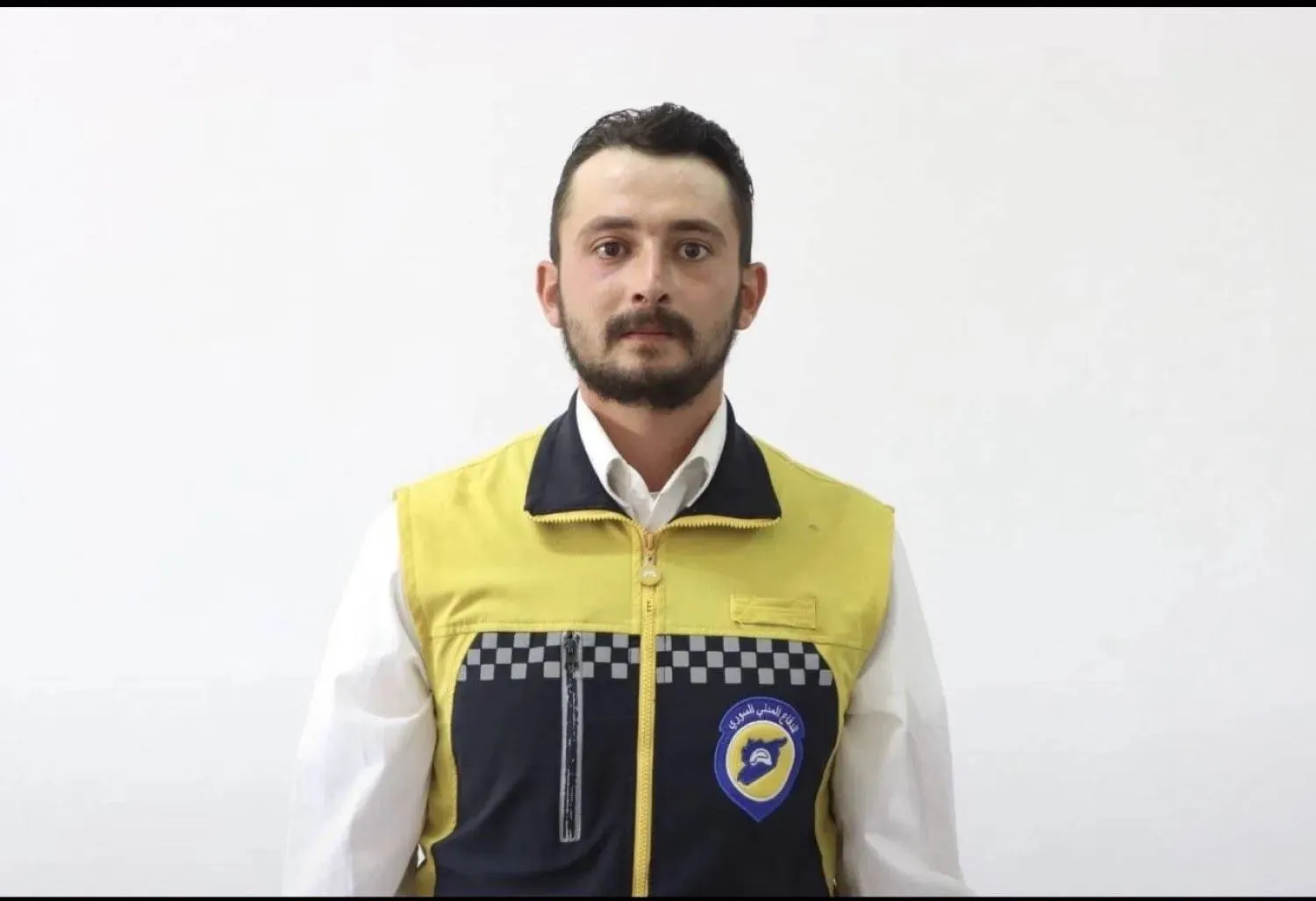

Committee Led by Assistant Interior Minister Investigates Death of Young Man in Syrian Police Custody

Mohammad Ghamira, a Syrian Civil Defense worker who died after mistreatment at a police station in al-Haffah, in the Latakia countryside. (Minister of Emergency and Disaster Management)
TT

Committee Led by Assistant Interior Minister Investigates Death of Young Man in Syrian Police Custody

Mohammad Ghamira, a Syrian Civil Defense worker who died after mistreatment at a police station in al-Haffah, in the Latakia countryside. (Minister of Emergency and Disaster Management)

Syrian authorities have detained seven people in connection with the death of a 29-year-old man who was beaten while in police custody, as two government ministers pledged to hold those responsible accountable once investigations are completed.

Mohammad Hossam al-Din Ghamira died Sunday at Latakia University Hospital from complications of bleeding in the brain and digestive tract after being beaten following his detention at al-Haffah police station in Latakia province.

Interior Ministry spokesman Nour al-Din al-Baba announced that a committee had been tasked with investigating the circumstances of his death. Its work would extend beyond the case to evaluate the performance of police departments across Syria, particularly in the Latakia province.

In comments to the Syrian state news agency SANA on Monday, al-Baba said that the committee would issue recommendations and that citizens would see improvements in police performance in the coming weeks.

The ministry “does not deny its responsibility for this unfortunate incident,” al-Baba acknowledged, while urging that the case be kept within its proper context without exaggeration.

He explained that the committee had arrived in al-Haffah to hear testimony from Ghamira’s family and local residents and had three days to complete its work.

A separate independent and professional medical committee was also formed to conduct a forensic examination of the body.

The Emergency and Disaster Management Ministry reported that Ghamira, one of its employees and a father of two, suffered from hemophilia, a disorder that prevents blood from clotting properly.

According to the ministry, he died from complications of cerebral and gastrointestinal bleeding caused by the beating.

A family source who requested anonymity told AFP that Ghamira had been accused in a financial case and detained for three days before being released for lack of evidence. The source alleged that he was “severely tortured,” causing his health to deteriorate before his death.

Emergency and Disaster Management Minister Raed al-Saleh mourned Ghamira as a “brother, friend and colleague” and confirmed that personnel at the police station accused of beating him had been detained and would face legal action.

“Syrians sacrificed for 14 years to reach a Syria that safeguards their dignity and humanity,” al-Saleh wrote, pledging there would be “no impunity.”

Interior Minister Anas Khattab ordered an investigative committee headed by Maj. Gen. Ahmad Mohammad Latouf, assistant interior minister for police affairs.

Khattab stressed that any violations or abuses by Interior Ministry personnel would be dealt with firmly under established laws and procedures, adding that anyone found responsible would receive “just punishment.”

Ghamira’s uncle, Issam Ghamira, told Al-Ikhbariya television that his nephew died after being struck inside the police station. He recounted that the family had informed the station chief that Ghamira suffered from hemophilia and asked that he not be harmed.

Activists and youths in al-Haffah announced a peaceful protest outside the police station following Ghamira’s burial, demanding disclosure of the circumstances surrounding his death, a transparent and independent investigation, and accountability for anyone found responsible.

Calls have also made for peaceful demonstrations in several other parts of Syria.

According to the Syrian Network for Human Rights, several people have died while in custody since the new authorities took power. In January 2025, state media reported that a detainee died in Homs following “violations” by security personnel, who were subsequently arrested and referred to the judiciary.



Syria Issues Death Sentence to Detained Assad Cousin

Wassim al-Assad during his trial at the Fourth Criminal Court in Damascus, Aug. 18, 2026. (SANA)
TT

Syria Issues Death Sentence to Detained Assad Cousin

Wassim al-Assad during his trial at the Fourth Criminal Court in Damascus, Aug. 18, 2026. (SANA)

A Syrian court on Tuesday issued a death sentence to detainee Wassim al-Assad, a cousin of longtime ruler Bashar al-Assad who was himself sentenced to death in absentia a week ago.

Judge Fakhr al-Din al-Aryan said Wassim al-Assad was convicted of multiple murders and "murder accompanied by torture and brutality... classified as crimes against humanity and war crimes", adding that "he is therefore sentenced to death".

The judge said investigations established that Assad was involved in forming irregular armed groups at the direction of Brig. Gen. Ghiath Dalla. The groups targeted civilian areas in Eastern Ghouta and committed massacres, particularly in Al-Malihah, reported the state news agency SANA.

Al-Aryan said the court established beyond doubt that an armed group affiliated with Assad attacked a shop in Jaramana, stole its contents and abducted its owner because of his opposition to the former regime. The group was also involved in abducting and killing Syrian citizens in several areas.

The court convicted Assad of intentionally killing more than one person and acts of torture constituting crimes against humanity and war crimes. It also ordered the confiscation of his movable and immovable assets in favor of the public treasury.

The verdict was delivered at the court’s sixth hearing after the completion of all stages of the trial and related judicial proceedings. Members of the National Authority for Transitional Justice and representatives of international legal and humanitarian organizations attended.

The Fourth Criminal Court in Damascus had also sentenced ousted ruler Bashar al-Assad and several former officials to death on August 11 after convicting them of crimes including premeditated murder, torture, arbitrary detention and crimes against humanity.


Syria Accuses Israel of Striking Military Airfield

A picture taken on January 21, 2018 shows damaged Syrian air force fighter planes at the Abu Duhur military airport area in Syria's Idlib province. (File/AFP)
TT

Syria Accuses Israel of Striking Military Airfield

A picture taken on January 21, 2018 shows damaged Syrian air force fighter planes at the Abu Duhur military airport area in Syria's Idlib province. (File/AFP)

Syria accused Israel of striking a military airfield in the country's northwest on Tuesday, after a security source told AFP the out-of-service military facility had been hit. 

Israel has been carrying out incursions into Syrian territory since the December 2024 overthrow of longtime ruler Bashar al-Assad, including sending troops into a UN-patrolled buffer zone that separated Israeli and Syrian forces in the Israeli-occupied Golan Heights since 1974. 

It has also hit key military sites including several airfields, according to a Syria war monitor. 

"Israeli occupation aircraft early this morning targeted the runway of the Abu Duhur military airport... with eight strikes," Syrian state television quoted an unidentified military source as saying. 

It added that "the attack resulted in material damage to the airport's infrastructure, without causing casualties". 

Israeli officials have said they intend to keep forces in a "security zone" in southern Syria, where they seek a broader demilitarized zone. 

Damascus has repeatedly condemned incursions in the country's south. 

During a joint press conference with his French counterpart Emmanuel Macron in Damascus last month, Syrian President Ahmed al-Sharaa called for an "active French role" to halt Israeli escalations in his country. 

- 'Violations' - 

Syrian Foreign Minister Asaad al-Shaibani also last month condemned "the continuation of Israeli military actions" and warned that "the unlawful occupation of our land beyond the 1974 line is a direct threat to the security of the region". 

He demanded an "immediate and unconditional withdrawal". 

But last week Israeli Defense Minister Israel Katz said that his country planned to keep troops in Syria. 

Israel captured most of the Golan from Syria in the 1967 Arab-Israeli War and later annexed the areas under its control, in a move not recognized by most of the international community. 

The incursions have been condemned by the United Nations chief as "violations of Syria's sovereignty and territorial integrity". 

Despite tensions between the neighbors, Israel and Syria's new authorities have held several rounds of direct talks and have agreed to establish an intelligence-sharing mechanism. 

Syrian President Ahmed al-Sharaa in June denied that his country sought to intervene militarily in Lebanon where Israel and Hezbollah are at war, after US President Donald Trump suggested Damascus could get involved. 

Hezbollah fought alongside Assad in the country's civil war, making Sharaa and the new authorities who toppled the former leader in 2024 deeply hostile to the group. 

Syria's war shattered the country's infrastructure and pushed millions of people to flee internally and abroad. 


Risk of Escalation in Lebanon as Israeli Military Prepares for ‘Intensified’ Fighting

The rubble and debris of flattened buildings litter the hillside following an Israeli airstrike that targeted a neighborhood in the southern Lebanese village of Nabatieh al-Fawqa on August 15, 2026. (AFP)
TT

Risk of Escalation in Lebanon as Israeli Military Prepares for ‘Intensified’ Fighting

The rubble and debris of flattened buildings litter the hillside following an Israeli airstrike that targeted a neighborhood in the southern Lebanese village of Nabatieh al-Fawqa on August 15, 2026. (AFP)

The confrontation in southern Lebanon is entering a sensitive phase as Israeli military operations continue alongside US-mediated negotiations, while Israel’s Channel 12 has reported that the Israeli military is preparing for the possibility of several days of intensified fighting in Lebanon.

The report has raised questions over whether any escalation would remain contained or spread, although there has been no public indication of a decision to launch a wider war or set a deadline for negotiations.

Channel 12 reported that Israel remains determined to complete its operations in the Ali al-Taher Heights and linked the intensity of military activity to the negotiations. Washington, meanwhile, has reiterated its commitment to the “pilot zones” plan, maintaining that Hezbollah’s disarmament is part of the process.

Retired Lebanese Brig. Gen. Khalil Gemayel told Asharq Al-Awsat that Israeli preparations for several days of fighting did not, in his assessment, mean Israel intends to launch a broader war.

Rather, it wants to settle the battle for the Ali al-Taher Heights, securing a battlefield achievement, he added.

Any expansion of the confrontation would largely depend on the scale of Hezbollah’s response, particularly if it broadened its operations and struck Israeli communities, potentially prompting Israel to widen the fighting, he explained.

Gemayel described Ali al-Taher as a key defensive hub for Hezbollah in southern Lebanon, noting that Israeli forces were attempting to advance gradually along the hills toward sensitive positions, tunnel entrances and underground facilities with the assistance of specialized engineering units.

Hezbollah intervenes locally when Israeli troops approach critical points in its defensive network, he remarked.

Capturing the area could give Israeli Prime Minister Benjamin Netanyahu a military and political achievement while dealing Hezbollah a significant military loss, he noted.

15 August 2026, Lebanon, Nabatieh District: First responders are searching the rubble following an Israeli airstrike on a house in a tourist area of Ansar, southern Lebanon, before dawn, completely destroying the building and causing extensive damage to surrounding properties. (dpa)

Retired Brig. Gen. Naji Malaeb, meanwhile, said Israel’s escalation could be part of an attempt to draw Hezbollah into a response that would provide grounds for widening its operations.

He told Asharq Al-Awsat Israel may have used an incident that caused casualties in the Ali al-Taher Heights as a pretext to expand its operational reach beyond areas it occupies. He questioned whether Israel was attempting to provoke Hezbollah into a response that would allow it to broaden its military campaign.

Malaeb said increasingly forceful rhetoric from Hezbollah and its secretary-general, Naim Qassem, including warnings that Israel would “pay the price,” made that scenario worth considering.

A wider escalation would not necessarily begin with a ground advance. Israel could instead rely heavily on air power and expand its strikes to other areas, he went on to say.

Malaeb warned that expanding the conflict from the south deeper into Lebanon could also bring Iran into the confrontation, particularly if Beirut’s southern suburbs were targeted.

An Iranian response could provide Israel with a pretext to resume attacks on Iran even without US participation, he argued.

On the ground, the United Nations Interim Force in Lebanon (UNIFIL) reported a “significant increase in Israeli military activity in southern Lebanon” over the previous two weeks, recording an average of 137 projectiles a day between August 5 and 16.

Israeli operations continued across several areas. Drones dropped explosives around the Ali al-Taher Heights and Dabsha Hill, while Mansouri came under artillery fire. Strikes and shelling were also reported around Wadi al-Hujeir, Qantara, Aitaroun, Khiam, Hadatha and Mais al-Jabal, while Israeli forces carried out explosions in Bani Hayyan and Majdal Zoun.