


US Debt Hits $40 Trillion as Higher Yields Open New Opportunities for Gulf Investors

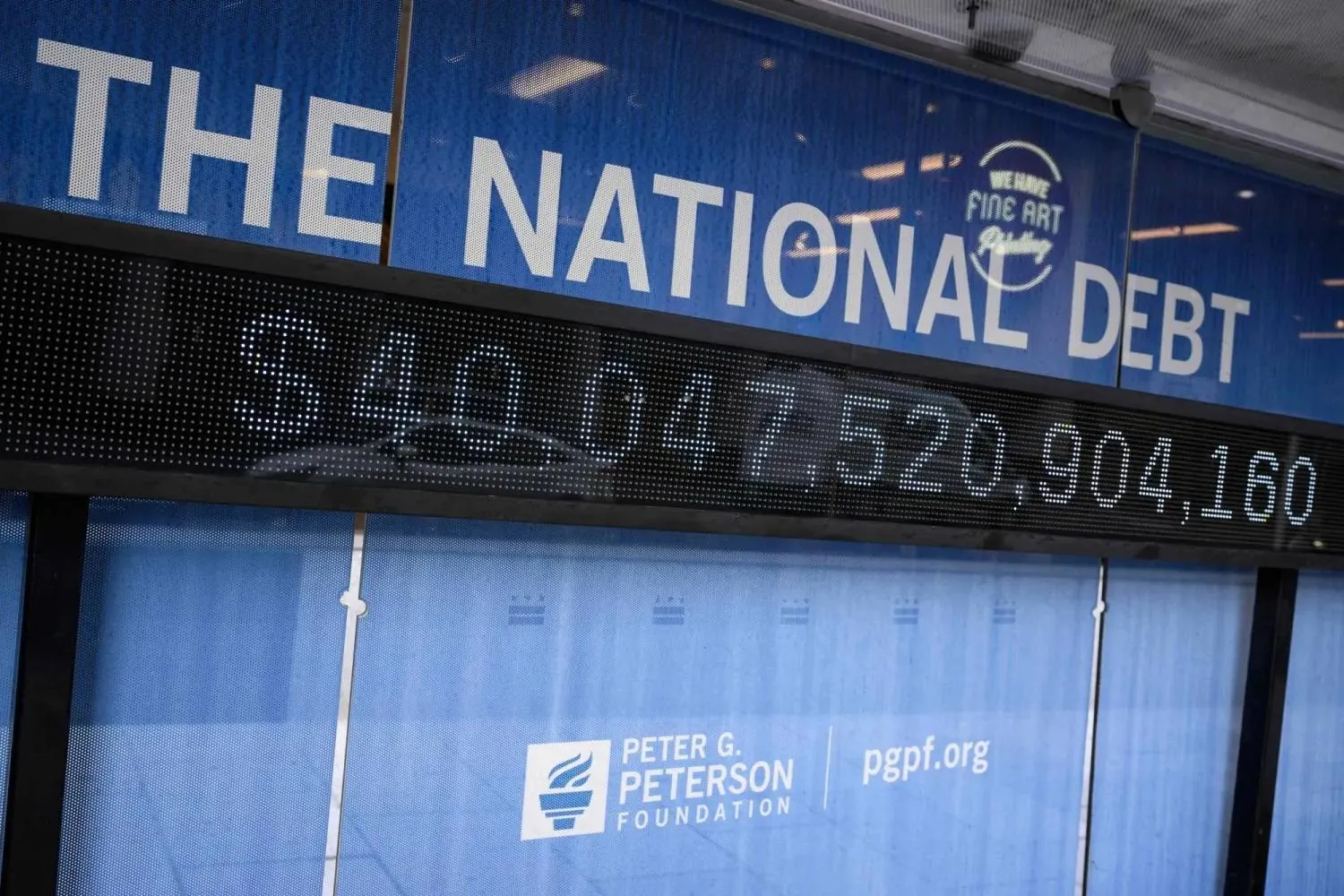
An electronic display in Washington, DC, shows the US national debt on Aug. 19, as federal debt surpassed $40 trillion for the first time. (AFP via Getty Images)
TT

US Debt Hits $40 Trillion as Higher Yields Open New Opportunities for Gulf Investors

An electronic display in Washington, DC, shows the US national debt on Aug. 19, as federal debt surpassed $40 trillion for the first time. (AFP via Getty Images)

As US debt surpasses $40 trillion, Gulf investors are looking beyond the record figure to the broader implications of Treasury yields for capital flows, financing costs and investment strategies.

US assets and the dollar remain central to Gulf portfolios because of the depth of American markets and Gulf currencies’ links to the dollar. At the same time, higher yields are creating opportunities for Gulf sovereign wealth funds to rebalance portfolios and generate stronger returns on new investments.

Economists say the Gulf’s strong financial positions give the region considerable flexibility in navigating shifts in global interest rates. Higher fixed-income yields are also encouraging more diversified strategies spanning bonds, private credit, infrastructure and global equities, alongside growth sectors, such as technology, artificial intelligence and new energy.

Dollar remains central

Abdullah Almeer, assistant professor of economics at King Fahd University of Petroleum and Minerals (KFUPM), said US debt reaching $40 trillion does not pose an “immediate risk” to Gulf dollar-denominated investments, although it increases longer-term structural risks monitored by sovereign wealth funds and central banks.

Almeer told Asharq Al-Awsat that Saudi Arabia holds about $142 billion in US Treasury securities, while the dollar accounts for roughly 57% of global central bank reserves, underscoring its continued central role in the international financial system.

The doubling of US debt from about $20 trillion in 2016 to more than $40 trillion today warrants closer scrutiny of fiscal developments, but does not, for the foreseeable future, diminish the attractiveness of US markets or the dollar’s importance to Gulf economies, he argued.
US dollar bills are seen in front of displayed stock graph in this illustration taken, February 8, 2021. (Reuters)

Higher yields, new opportunities

Persistently high US bond yields could reduce the market value of existing securities and result in valuation losses for some Gulf portfolios.

Almeer does not, however, expect the US economy to default, stressing that American markets retain high levels of liquidity, depth and institutional stability. A large-scale Gulf exit from US assets is therefore unlikely in the foreseeable future.

The main transmission channel to Gulf economies is interest rates. Financing government debt exceeding $40 trillion requires massive Treasury issuance, potentially pushing yields higher, particularly if inflationary pressures persist or oil prices rise.

Saudi Arabia’s riyal peg of SAR 3.75 to the dollar also means its monetary policy is closely tied to US interest rates. A widening rate differential between the two countries could put pressure on the exchange rate and capital flows.

Almeer estimated Gulf financial reserves at about $874 billion, while sovereign wealth fund assets are approaching $5 trillion, giving the region substantial capacity to finance projects and continue attracting investment.

Broader diversification

Rising US debt could encourage Gulf states to further diversify investments toward emerging economies such as India, China and Türkiye, as well as real assets, global infrastructure and fast-growing Asian markets, he added.

Technology, AI and clean energy could also attract a larger share of investment, in line with economic and investment shifts taking place across the region and globally.

Debt figure is not the whole story

Almeer stressed that the $40 trillion threshold does not in itself represent a decisive turning point for the global financial system. Markets focus less on the absolute size of debt than on a country’s ability to finance and service it and maintain investor confidence.

The US still has the world’s largest economy and financial market, while the dollar remains the most widely used currency in international trade and reserves, giving Washington flexibility unavailable to most other economies, he noted.

What makes the figure significant is the accelerating pace of government borrowing and the rising cost of servicing that debt, particularly with interest rates remaining relatively high, he explained.

Economic history also suggests that absolute debt levels are not necessarily the decisive factor in determining crisis risk. Japan, for example, has managed debt exceeding 200% of GDP for extended periods without suffering a sovereign debt crisis, Almeer went on to say.
A Saudi money changer displays Saudi Riyal banknotes at a currency exchange shop in Riyadh, Saudi Arabia July 27, 2017. (Reuters)

Pace of debt growth matters

Mohammed Al-Farraj, Head of Asset Management at Arbah Capital, told Asharq Al-Awsat that the $40 trillion figure should be assessed alongside the pace of debt growth, servicing costs, the annual deficit and markets’ capacity to absorb US Treasury issuance.

He explained that the trajectory does not necessarily signal an imminent threat to Washington’s ability to meet its obligations, but it is reshaping the global investment environment by raising financing costs and altering returns across asset classes.

Higher Treasury yields can reduce the market value of existing bonds while offering better returns on new issues, creating opportunities for investors to rebuild fixed-income portfolios at more attractive levels, he added.

Al-Farraj said the current environment could encourage Gulf sovereign wealth funds to strike a better balance between fixed-income instruments and higher-growth assets, with opportunities in gold, global equities, private credit and infrastructure, alongside more flexible management of US Treasury maturities.

That does not mean abandoning the dollar, but rather adopting more diversified portfolio management while keeping dollar assets at the core of Gulf investment strategies, he remarked.

The main effect of record US debt on the Gulf may therefore be to accelerate the evolution of investment strategies rather than change their direction. The dollar remains pivotal, even as opportunities for Gulf capital expand across bonds, US markets, infrastructure, technology and fast-growing Asian economies.



Saudi Minister Says AIIB Success Measured by Development Impact, Not Financing

Saudi Finance Minister Mohammed al-Jadaan at the 11th annual meeting of the Asian Infrastructure Investment Bank’s Board of Governors (X)
TT

Saudi Minister Says AIIB Success Measured by Development Impact, Not Financing

Saudi Finance Minister Mohammed al-Jadaan at the 11th annual meeting of the Asian Infrastructure Investment Bank’s Board of Governors (X)

Saudi Finance Minister Mohammed al-Jadaan urged the Asian Infrastructure Investment Bank to judge its success by the impact of its projects, saying financing volumes and approvals alone do not show whether the bank is improving services, strengthening institutions, or building economic resilience.

Speaking at the 11th annual meeting of the bank’s Board of Governors, which concluded on Tuesday in Doha, al-Jadaan said the AIIB had built strong foundations in its early years.

Progress on regional connectivity, cooperation and private-sector participation had strengthened its ability to meet member countries’ infrastructure needs, he said.

As the bank expands, progress “should not be measured by financing volumes or project approvals alone, but by development impact,” he said.

Success should mean “better infrastructure services, stronger institutions, greater economic resilience and broader private-sector participation,” al-Jadaan said, as the bank enters its second decade and seeks to expand infrastructure financing and mobilize more private capital.

He called for earlier engagement with member countries to better understand their circumstances, infrastructure gaps and priorities, and for multiyear programs aligned with national strategies.

Al-Jadaan also urged the bank to broaden partnerships with multilateral development banks and international organizations to share expertise, avoid duplicating efforts and mobilize more public and private resources.

He said the bank should remain guided by member countries’ needs, taking account of differences in institutional capacity, fiscal space and levels of infrastructure development.

The Doha meeting, held under the theme “Future Infrastructure: Impact and Innovation,” comes as the bank prepares for a new phase of expansion.

The AIIB has said it aims to nearly double annual financing to about $20 billion by 2030, focusing on infrastructure linked to climate resilience, renewable energy, digital transformation and regional connectivity, while mobilizing more private capital.

Saudi Arabia is a founding member of the AIIB, a multilateral development finance institution established in Beijing in 2016.


African Leaders to Gather in Egypt for Business Summit

Friday's forum is expected to bring together more than 20 heads of state and government representatives in the Mediterranean city of Alamein, alongside business leaders, bankers and development institutions. © KHALED DESOUKI / AFP/File
TT

African Leaders to Gather in Egypt for Business Summit

Friday's forum is expected to bring together more than 20 heads of state and government representatives in the Mediterranean city of Alamein, alongside business leaders, bankers and development institutions. © KHALED DESOUKI / AFP/File

African leaders will meet in Egypt on Friday for a business summit that Cairo hopes will bolster its clout across the continent.

Friday's forum is expected to bring together more than 20 heads of state and government representatives in the Mediterranean city of Alamein, alongside business leaders, bankers and development institutions.

"This is an African platform," Egypt's deputy foreign minister for African affairs Mohamed Abu Bakr Saleh told AFP.

"A country in East Africa should be able to sign an agreement with a country in West, North or southern Africa through this platform."

Saleh said the forum would become a biennial event under an African Union mandate, focusing on infrastructure, trade, agriculture, healthcare, mining, technology and renewable energy.

Officials estimate Egyptian investments across Africa at around $14 billion. Among Egypt's flagship ventures is Tanzania's $3 billion Julius Nyerere Hydropower Project, built by a consortium led by Egyptian companies.

Yet trade within Africa remains limited, totalling just $192 billion in 2023 and only accounting for around 15 percent of the continent's total trade, compared with more than 55 percent in Asia and over 70 percent in Europe.

Africa also attracted about $70 billion in foreign direct investment in 2025, a fraction of the roughly $1.6 trillion invested globally, according to the UN.

"Africa possesses vast resources, but they are still not being exploited to the level we would like to see," Saleh said.

The gathering also takes place against the backdrop of an unresolved dispute between Egypt and Ethiopia over the $5 billion GERD, Africa's largest hydroelectric project.

Ethiopia says the dam, inaugurated last year, is vital for economic growth, while Egypt says it could threaten Nile water supplies without a binding operating agreement.

More than a decade of negotiations have failed to yield a settlement.

"Our position on Egypt's water security has not changed and will not change," Saleh said. "It is an existential issue for Egypt."


US Ban on $1 Billion Worth of Canadian Imports Goes into Effect

Shipping containers in the Port of Montreal, Canada (Reuters)
TT

US Ban on $1 Billion Worth of Canadian Imports Goes into Effect

Shipping containers in the Port of Montreal, Canada (Reuters)

US-Canada relations, already tense, are likely to deteriorate further after the United States went ahead early Tuesday with a decision to ban nearly $1 billion worth of Canadian imports, including dairy products and motorcycles.

The ban amounts to barely a ripple in $880 billion worth of a two-way annual trade between the two northern neighbors. But it marks another ratcheting up of President Donald Trump’s second-term trade war with America’s longtime ally and trading partner.

The import ban “certainly won't do anything to help the trade tensions between the United States and Canada,'' said trade attorney Patrick Childress, a partner at Holland & Knight and a former US trade official.

The latest sparring began over the summer when Trump reached back to a Great Depression law to impose 50% tariffs on about $20 billion worth of Canadian imports, charging that Canada discriminates against US dairy and auto producers. Canada promptly counterpunched with tariffs of 15% and 25%, matching US imports dollar for dollar.

To punish Canada for retaliating against his tariffs, Trump decided to ban a list of Canadian products, effective 12:01 a.m. Eastern time Tuesday.

The economic impact is likely to be minimal. Childress noted that the products on the banned list were already facing Trump’s tariffs. “For a lot of these goods, the 50% was already acting as a de facto ban by making importation from Canada into the United States uneconomical,″ he said.

Jacob Jensen, director of trade policy at the center-right American Action Forum think tank, calculates that the ban would cover $967 million worth of Canadian imports, based on 2025 numbers.

“This marks yet another escalation in the trade war that may result in further retaliation on the Canadian side,” Jensen said. He expects Canadian exporters and US importers “impacted by these bans will be highly motivated’’ to demand that trade officials on both sides find some way to reach a “resolution of this whole ordeal.’’