

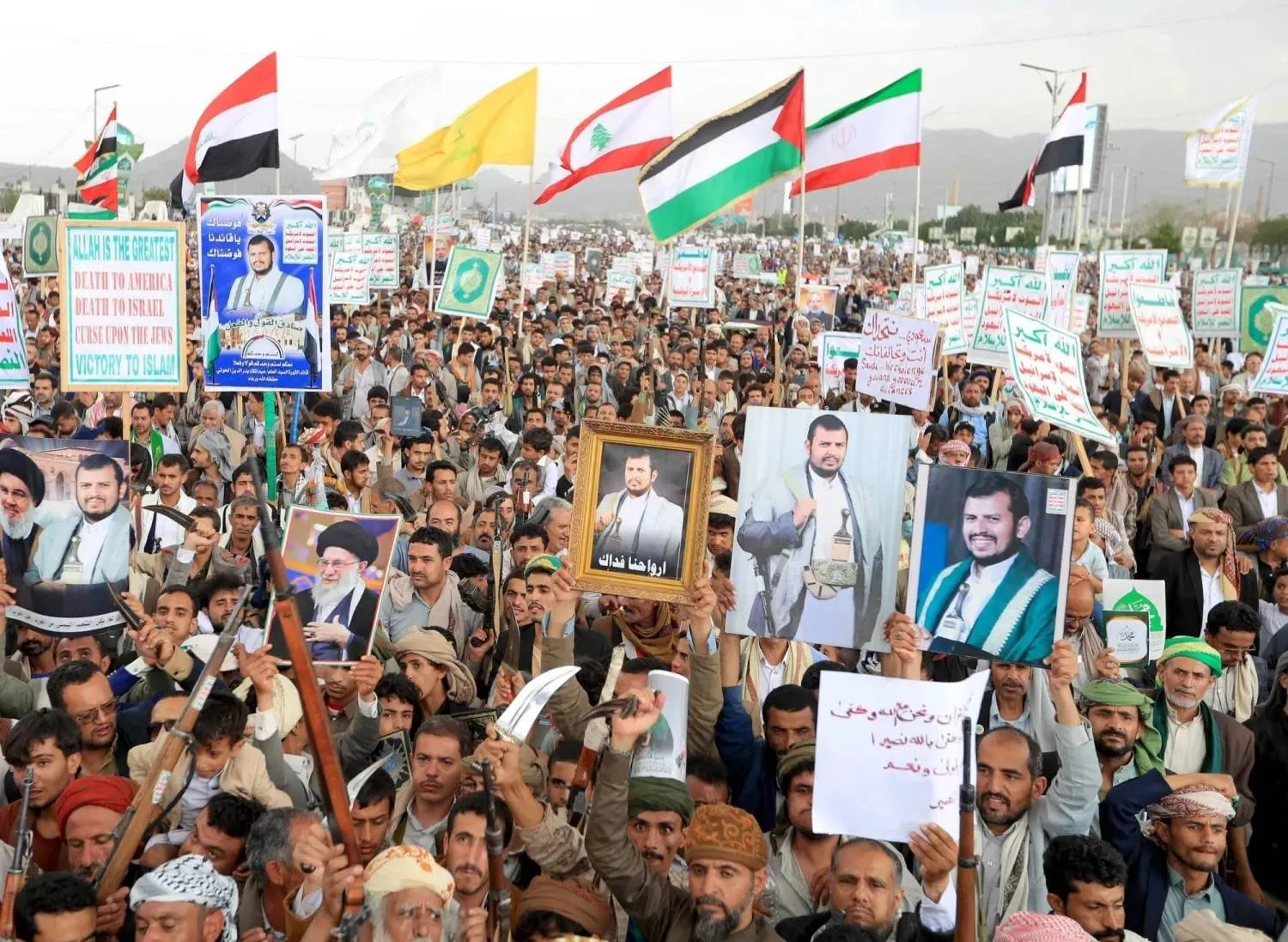

Houthis Tighten Security Grip in Ibb

 A Houthi rally in Sanaa called by the group’s leader in support of land and maritime attacks (AFP) 
 A Houthi rally in Sanaa called by the group’s leader in support of land and maritime attacks (AFP) 
TT

Houthis Tighten Security Grip in Ibb

 A Houthi rally in Sanaa called by the group’s leader in support of land and maritime attacks (AFP) 
 A Houthi rally in Sanaa called by the group’s leader in support of land and maritime attacks (AFP) 

The Iran-backed Houthi group has tightened its security grip on Yemen’s Ibb governorate amid rising tensions and clashes along surrounding front lines, deploying elite units to areas near battlefronts with Taiz, Hodeidah and Al-Dhale.

Local sources told Asharq Al-Awsat that the group had intensified its security presence in Ibb city and areas near the front lines in the west of the governorate, reinforced routes leading to the fronts and imposed tighter surveillance on residents’ movements and communications.

Ibb is strategically important because it lies along supply routes linking Houthi-controlled areas with fronts in Hodeidah, Taiz and Al-Dhale, about 192 kilometers (119 miles) south of Sanaa.

The Houthis have moved the headquarters of the military command covering Ibb, Al-Dhale and Taiz to Damt, east of Ibb, and deployed two elite units known as the Al-Samad Brigades near the front lines, the sources said.

The group sent fighters recruited from Ibb to frontline positions while keeping the two Al-Samad units behind the front to monitor the forces and prevent local fighters from fleeing or retreating during clashes.

According to the sources, the deployment reflects distrust of fighters recruited from the governorate as the Houthis tighten security in cities and towns and along roads leading to combat zones.

Operations Hub

The Houthis have turned eastern Ibb into a center for managing military operations on surrounding fronts while redeploying units near the frontlines.

The moves come amid mounting tensions on several fronts and as the group strengthens its security grip over Ibb, one of its main recruitment and supply areas.

They coincide with the first anniversary of a sweeping arrest campaign in Ibb that targeted more than 115 educators, academics, doctors and engineers, according to local sources.

The campaign lasted more than three months, from late May to October last year. Fourteen detainees have since been released at different times, the latest about a week ago, while the others remain in custody.

Several people wanted by the Houthis remain unable to leave the governorate for government-controlled areas, while around 260 families have managed to flee Houthi-held territory and reach areas under government control.

Siham al-Abab, daughter of educator Sadiq al-Abab, meanwhile revealed that her father’s health had deteriorated after more than a year in Houthi detention, with his family unable to visit him or obtain information about his condition. Her father called several days ago and sounded clearly tired, she said, adding that the family did not know what was wrong with him and could neither see nor check on him.

She added that the call had a profound psychological impact and that her father’s voice remained with her afterward. She had previously described her family’s suffering in his absence, saying he had left behind a small family in need of support while remaining imprisoned without the family knowing what charges he faced.

The Houthis detained Sadiq al-Abab during a sweeping arrest campaign targeting hundreds of people in Ibb, Taiz and Al-Bayda, including doctors, teachers, lawyers, employees and community figures, according to local sources.

Detention Without Legal Process

Zakaria al-Jaberi said his father has been forcibly detained by the Houthis at the Political Security headquarters in Ibb since June 12, 2025.

The family has communicated with him only three times. Its sole permitted visit came more than 11 months after his detention, before further visits were barred.

Al-Jaberi noted that the Houthis had allowed only limited phone calls, leaving the family unaware of his detention conditions or physical and psychological state despite authorities knowing he has health problems.

The family has approached numerous officials and individuals seeking answers or assistance, but was often told that those responsible knew nothing about the case and that the authority handling it was in Sanaa.

Al-Jabri questioned who had ordered his father’s detention, why he had not been referred to prosecutors and why the family had not been informed of the charges or any legal process.

The family does not know “who has the authority to make the decision or who can end this detention,” he underlined, adding that the prolonged detention had taken a heavy psychological and social toll. He said the case reflected the absence of any clear official authority the family could turn to despite repeated appeals to government bodies, civil society organizations and local dignitaries.


Lebanon: Israeli Airstrikes, Demolitions Hit Southern Villages

Smoke rises after Israeli tanks shelled targets in  the municipality of Mais al-Jabal, as seen from Chaqra village, in southern Lebanon, 21 August 2026. EPA/STRINGER
Smoke rises after Israeli tanks shelled targets in the municipality of Mais al-Jabal, as seen from Chaqra village, in southern Lebanon, 21 August 2026. EPA/STRINGER
TT

Lebanon: Israeli Airstrikes, Demolitions Hit Southern Villages

Smoke rises after Israeli tanks shelled targets in  the municipality of Mais al-Jabal, as seen from Chaqra village, in southern Lebanon, 21 August 2026. EPA/STRINGER
Smoke rises after Israeli tanks shelled targets in the municipality of Mais al-Jabal, as seen from Chaqra village, in southern Lebanon, 21 August 2026. EPA/STRINGER

Israeli warplanes carried out a series of strikes on Saturday near the area of Kfar Rumman in southern Lebanon and also struck the vicinity of Ali al-Taher hills.

At dawn, Israeli shelling targeted the town of Mansouri, the outskirts of Buyut al-Siyad and the outskirts of Majdal Zoun in southern Lebanon.

Overnight, Israeli forces carried out extensive demolitions in the villages and towns of Mansouri, Majdal Zoun and Buyut al-Siyad. Reports said not a single house remained undamaged.

Similar Israeli demolitions were reported in Hadatha, Beit Yahoun and Aita al-Jabal, along with machine-gun fire directed toward nearby valleys. Israeli drones also continued to fly over villages and towns in the western and central sectors.


At Least 13 Tunisians Missing after Migrant Boat Sinks off Tunisia

Migrants on a boat waiting for assistance from a rescue vessel in the Mediterranean Sea, July 24, 2025 (Reuters)
TT

At Least 13 Tunisians Missing after Migrant Boat Sinks off Tunisia

Migrants on a boat waiting for assistance from a rescue vessel in the Mediterranean Sea, July 24, 2025 (Reuters)

At least 13 Tunisians are missing after a migrant boat sank off the Tunisian coast while sailing towards Italy, and two people were rescued, the head of a migrant rights group said on Saturday.

The boat set off early on Thursday, Mostafa Abdelkebir, the head of the Tunisian Observatory for Human Rights, told Reuters.

One of the two ‌survivors told ‌rescuers in a local boat ‌they had ⁠been stranded at ⁠sea for hours after their vessel capsized. The second survivor was in critical condition, said Abdelkebir, whose group monitors migration issues.

Tunisia was once a major departure point for migrants crossing the Mediterranean, but departures have fallen sharply over the ⁠past two years amid a crackdown ‌and tighter maritime controls, ‌backed by European funding and modern border-monitoring equipment, particularly ‌from Italy.

Human Rights Watch, Amnesty International and ‌dozens of other human rights and humanitarian groups said in a statement last month that the EU-Tunisia migration deal had fueled and normalized serious abuses against ‌migrants and asylum seekers in Tunisia.

The groups called on the EU to suspend ⁠funding ⁠for migration and border-control activities involving Tunisian security forces.

Tunisia has not commented on the statement but has repeatedly said it is bearing the brunt of a major migration influx. President Kais Saied said in 2023 that the influx was aimed at changing the country's demographic makeup.

The central Mediterranean route is one of the world's deadliest migration routes, used by migrants from Africa and the Middle East seeking to reach Europe, often in overcrowded or unseaworthy boats.


Salam Inspects Military Units South of Litani: No Capable Lebanese State without One Strong Army

Lebanese Prime Minister Nawaf Salam during his visit to South Lebanon on Friday. (NNA)
TT

Salam Inspects Military Units South of Litani: No Capable Lebanese State without One Strong Army

Lebanese Prime Minister Nawaf Salam during his visit to South Lebanon on Friday. (NNA)

Prime Minister Nawaf Salam tied the restoration of state authority in South Lebanon to a broader process extending beyond military deployment to strengthening institutions, restoring services and advancing reconstruction.

During a visit to the Benoit Barakat Barracks in Tyre, Salam stressed that “every position where the army deploys in the South is a place where the state regains its authority.”

“Restoring sovereignty requires building a capable state, and there can be no capable state without one strong army,” he added, arguing that sovereignty restored through security must also be consolidated economically and socially.

One authority

“We want the South, like all of Lebanon, to be under one authority, and Lebanese citizens there to feel safe because they have an army protecting them,” the PM declared, linking lasting stability to the state and its constitutional institutions regaining control over decisions of war and peace.

At the same time, he acknowledged the challenges confronting the military amid continuing Israeli attacks. “True sovereignty is neither taken nor given; it is built,” he emphasized.

Salam reaffirmed his government’s commitment to building a national state faithful to the constitution, describing efforts to strengthen the army as “a strategic choice at the heart of our project to restore the state,” rather than a secondary priority.

The government continues to mobilize Arab and international support to develop the army’s personnel capabilities, improve its equipment and enhance service members’ living conditions, he went on to say.

He described the military as one of the few institutions around which Lebanese citizens remain united.

Addressing troops, Salam urged them to shield the army from political and sectarian divisions.

“Preserve the unity of the army. Do not allow politics to divide you and accept only the constitution and the law as your guide,” he told them, warning against allowing “the evils of sectarianism” to infiltrate their ranks.

Lebanon could emerge from its current predicament only by having “one army, one flag and one state,” he maintained.

Salam also paid tribute to fallen service members, telling their families: “Your sons are not only martyrs of the military institution; they are martyrs of the entire nation.”

Beyond army deployment

“The return of the state to the South is not limited to the deployment of the army, but extends across all sectors, including education, reconstruction and everything else,” he added, reiterating the government’s commitment to providing the military with everything needed to carry out its mission successfully.

He pledged that the state would spare no effort to secure Israel’s complete withdrawal from Lebanese territory, recover prisoners and advance reconstruction.

Defense Minister Michel Menassa similarly framed Salam’s visit as an affirmation of state sovereignty.

“Our visit to the South is not merely an inspection tour. We are here today to reaffirm our unwavering position seeking to restore state sovereignty,” he vowed.

He identified the government’s primary negotiating objective as “the complete withdrawal of the Israeli enemy from Lebanon.”

Menassa praised the army as a symbol of “dignity, sacrifice and loyalty” that brings Lebanese citizens together and safeguards national unity and civil peace.

He also commended its professionalism in carrying out missions despite difficult conditions and pressure.
