
From Wells to Budget: Where Does Libya’s Oil Money Go?

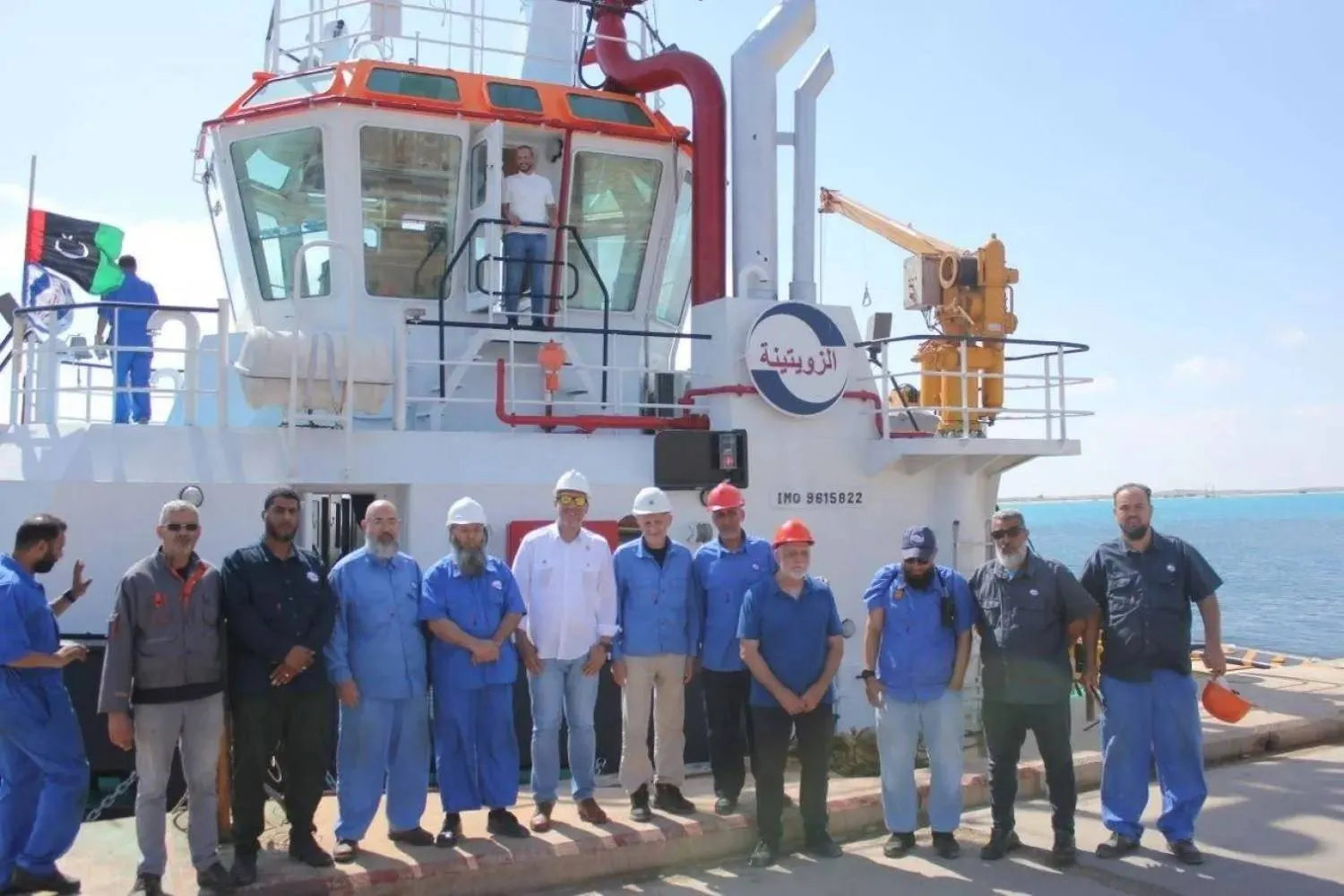
Tugboat Al-Hani begins operations at Zueitina port (National Oil Corporation)
TT

From Wells to Budget: Where Does Libya’s Oil Money Go?

Tugboat Al-Hani begins operations at Zueitina port (National Oil Corporation)

Libya depends on oil for nearly 98% of its income. Yet a central question persists: How are those revenues collected and spent in a country divided between rival governments? And why do Libyans complain of poverty when their country holds Africa’s largest oil reserves and produces and exports about 1.4 million barrels a day?

The process starts with the National Oil Corporation, which collects proceeds from crude oil and gas sales in US dollars and deposits them in accounts at the Libyan Foreign Bank. The money is then transferred to the Central Bank of Libya's accounts in Tripoli, recorded as state budget sovereign revenue, and converted into Libyan dinars.

The dollar trades at 6.36 dinars at the official rate, compared with 9.12 on the parallel market.

The Finance Ministry in Tripoli then issues spending authorizations under approved financial arrangements, after which the central bank releases funds to ministries and other state bodies through the main budget chapters.

Libya’s oil export revenues have swung sharply in recent years, ranging between $18 billion and $22 billion. They rose to about $18 billion in the first half of this year, nearly double the level in the same period last year, according to the Economy Ministry in the interim Government of National Unity.

Libyan oil expert Mohamed al-Shahati attributed the increase during that period to the war involving Iran.

Where is the breakdown?

Economists say Libya’s dependence on oil as its near-exclusive source of income lies at the heart of the crisis.

Ayoub al-Farsi, an economics professor at the University of Benghazi, said Libya showed how excessive reliance on natural resources could turn into a complex financial crisis when combined with political fragmentation and a lack of economic diversification.

“The Libyan economy is a clear example of how excessive dependence on natural resources can become a complex financial crisis,” he said, adding that political fragmentation and the absence of diversification had created conditions that directly affected people’s lives.

Al-Farsi, a member of the Central Bank of Libya’s Monetary Policy Committee, said the economy was built around a rentier-state model that depended almost entirely on oil exports to fund the treasury and provide foreign currency.

That dependence, he told Asharq Al-Awsat, had created deep structural distortions.

Agriculture and industry had been marginalized, the state bureaucracy had expanded to absorb workers into unproductive public-sector jobs, and the country had grown heavily dependent on imports for most consumer goods, he said.

Industrial activity remains limited, largely confined to the private sector and small-scale production. Critics also point to a market dominated by a small number of traders and importers, helping imported goods crowd out local production.

At protests across Libyan cities, the question is often the same: Where is the oil money going? Why are people struggling in an energy-producing country?

Al-Shahati said part of the answer lies in the difference between the value of the oil Libya produces and the amount that actually reaches the state treasury.

“Not every barrel produced in Libya is converted directly into a dollar entering the public treasury, because foreign partners have a share,” he told Asharq Al-Awsat.

Foreign companies have become production partners under various contractual arrangements, he said.

He also pointed to a stark contradiction: Libya produces oil, yet depends heavily on imports of gasoline, diesel, and other petroleum products to meet domestic demand.

That means a growing share of the country’s resources is converted into foreign currency to pay for fuel imports.

Al-Shahati said another problem was the lack of a regularly published, unified, and easy-to-read account that answers basic questions, such as: What was the total value of the oil produced? How much went to foreign partners? How much was exported for the state? How much went to the domestic market? And how much net revenue was actually available for public spending?

“The figures in circulation provide parts of the picture,” he said, “but they do not always show the full flow of revenues from the wellhead to the state’s public accounts.”

Libya’s oil fields are concentrated mainly in the eastern Sirte Basin, which holds about 82% of its oil reserves, as well as in the Murzuq Basin in the southwest and offshore areas along the coast.

Fuel and power crises

Those weaknesses in the oil revenue chain are unfolding as Libya grapples with a severe electricity crisis.

The country has suffered several “blackouts” in recent days, with some areas going without electricity for more than 17 hours a day.

Researcher Ezzedine Mokhtar sees the power cuts as one part of a wider pattern of recurring financial failures, including fuel shortages.

He blamed the hardship facing many Libyans on “corruption” and “unlimited spending” by two rival governments competing for power in the country’s east and west.

He also cited “oil smuggling through Arkenu, whose revenues go to specific individuals rather than the state treasury.”

Mokhtar said Libya’s subsidy system was another core problem, with more than 60% of the country’s budget going to fuel subsidies.

He called on the Tripoli government to phase out those subsidies gradually and to draw up a national plan to develop the workforce.

“We have no industrial skills in anything,” he said. “We import everything — yogurt, dairy products, fruit, vegetables, frozen fish, and even underwear. Everything comes from abroad.”

Libya ranks 10th globally in proven oil reserves, with about 48.3 billion barrels, according to Worldometer.

The UN Panel of Experts said in its latest report on Libya, covering October 2024 to February 2026, that Arkenu had moved at least $3 billion in oil revenues to bank accounts outside Libya between January 2024 and November 2025.

According to the report, Arkenu was established in 2023 as a private company and is indirectly controlled by Saddam Haftar, deputy commander-in-chief of the Libyan National Army. It faces accusations of “oil smuggling.”

Reuters previously investigated the company and concluded, based on shipping documents, London Stock Exchange Group data, and information from Kpler, that some oil revenues were being diverted away from the Central Bank of Libya.

How are revenues distributed?

Oil revenues are distributed across the four main chapters of the state budget, according to experts and economists.

Chapter One, salaries and wages, takes the largest share. It covers public-sector employees across eastern, western, and southern Libya through the unified national identification number system.

Chapter Two covers operating expenses for ministries and public institutions.

Chapter Three covers subsidies, including fuel, water, and electricity.

Chapter Four covers development and projects, including infrastructure, as well as allocations to the National Oil Corporation to sustain and increase production.

Al-Shahati said 26% of oil revenues went toward importing fuel products, equivalent to about $7 billion if crude traded at $70 a barrel.

This year, he said, the figure could rise to between $8 billion and $9 billion because oil prices had climbed above $85 a barrel and the gap between crude prices and diesel and gasoline prices had widened amid shortages.

He also pointed to higher domestic consumption driven by economic growth and a rise in smuggling.

A second problem, al-Shahati said, is the absence of an approved national budget, which would make it possible to determine how spending should be allocated among population groups and regions.

“What is clear is that the main cities control most spending,” he said.

He also pointed to “a large and obvious imbalance” in salaries across Libya’s three regions, job grades, and types of employment.

Those gaps, he said, risk widening financial divisions between social groups.

Even an agreement to unify development spending did not appear to be properly implemented because there were no clear standards and no comprehensive budget.

“There are no criteria for distributing oil revenues,” al-Shahati said. “The distribution process is random and unsustainable.”

Libya fell to 177th out of 182 countries in the 2025 Corruption Perceptions Index, from 173rd out of 180 countries in 2024, reflecting worsening corruption and no tangible improvement over the past two years.

Pressure on the local economy

A report by UN Secretary-General Antonio Guterres on Libya highlighted deep structural strains in the economy, driven by high public spending, near-total dependence on oil and gas revenues, and mounting pressure from food, fuel, and electricity prices.

The report, submitted to the UN Security Council on Aug. 17, covers the period from April 1 to July 28.

Citing the International Monetary Fund, it said Libya’s fiscal deficit reached 30% of gross domestic product last year, while public debt climbed to 146% of GDP.

Inflation also rose into double digits, eroding purchasing power.

The UN report noted unjustified increases in fuel consumption by military and security agencies and the energy sector, as well as repeated double purchasing.

The cost of institutional division

Libya’s political and institutional split and the presence of multiple authorities have made the economic crisis worse, al-Farsi said.

The distortions, he said, were no longer merely structural.

They had created parallel public finances and pushed consumer spending higher to meet the demands of rival authorities, sending salaries and subsidies to unprecedented levels.

Repeated shutdowns of oil fields in previous years, combined with lower actual revenues, pushed financial authorities toward deficit financing and higher public debt, al-Farsi said.

That flooded the market with money without a corresponding rise in domestic production.

Oil revenues reached $21.9 billion in 2025, according to the National Oil Corporation, up from $18.6 billion in 2024, an increase of 15%.

Al-Farsi said the deterioration in public finances had left monetary authorities in a difficult position and forced them into emergency measures to protect reserves and contain the deficit.

The result, he said, was a weaker national currency, liquidity shortages and a collapse in confidence.

Development tools had also been paralyzed.

“Monetary policy shifted from an instrument for stimulating growth and investment into a tool for managing daily crises,” he said.

Why has the crisis not been solved?

Economists point to several reasons.

Al-Shahati put “corruption spreading on an unprecedented scale” near the top of the list.

“Corruption is no longer confined to the margins,” he said. “It has come to dominate the core of public finances in key sectors, obstructing any attempt at reform.”

He also blamed the absence of an institutional vision following the breakdown of middle management, which had once linked fiscal and monetary policy to economic realities and provided unified political backing.

Policies, he said, had become detached from the economy and lost their ability to restore balance.

Conventional reforms that had worked elsewhere would not work in Libya, al-Shahati said, because the country lacked a central political authority capable of building an institutional vision and curbing corruption that had spread through both the state and private sector.

Al-Farsi said Libya could not escape its fiscal and monetary crisis without addressing the roots of the problem.

That meant unifying the management of public finances, curbing government spending, and launching genuine structural reforms that would gradually shift Libya from consuming oil rents to building a diversified economy.

Mokhtar also called on the Tripoli government to develop a strategic plan to make better use of human resources and support small and medium-sized industries.

For him, breaking Libya’s dependence on oil revenues is part of the way out.

Masoud Suleiman, chairman of Libya’s National Oil Corporation, said in media remarks last week that the country needed between $30 billion and $40 billion in investment to develop untapped oil and gas resources.

The corporation, he said, aims to raise production to 2 million barrels a day by 2030.


Where Does Israel’s Destruction of Underground Hezbollah Base Leave the Group?

Destroyed stones on the top of Ali al-Taher ridge, which Israeli forces captured after fighting with Hezbollah and where the Israeli military said it blew up a network of Hezbollah tunnels Thursday night near Nabatieh, southern Lebanon, Friday, Sept. 11, 2026. (AP)
TT

Where Does Israel’s Destruction of Underground Hezbollah Base Leave the Group?

Destroyed stones on the top of Ali al-Taher ridge, which Israeli forces captured after fighting with Hezbollah and where the Israeli military said it blew up a network of Hezbollah tunnels Thursday night near Nabatieh, southern Lebanon, Friday, Sept. 11, 2026. (AP)

Israel's demolition on Thursday of a tunnel network used by Hezbollah as a command center in southern Lebanon, near the border, represents a significant setback for the Iran-backed group.

Experts said that while Hezbollah is far from defeated, the group was now exposed after two fierce wars with Israel in which it suffered major blows including the loss of much of its top leadership and Israel's occupation of parts of southern Lebanon.

- How big of a blow is it? -

A week after capturing the site, the Israeli military on Thursday demolished the tunnels in the Ali al-Taher ridge with huge explosions. The United States Geological Survey reported a 4.1 magnitude tremor in the area.

Hezbollah never acknowledged losing the strategic highland, which lies around 10 kilometers (six miles) from the border with Israel and overlooks the major city of Nabatieh.

The Israeli military previously said that the network comprised tunnels containing dozens of Iranian-made rockets, missiles and drones, as well as other weapons.

Experts say the tunnels, built over two decades, connected a network of villages in the area, and that the Israeli military now had easy access to Nabatieh, where Hezbollah holds sway.

"This is a major loss, they cannot make another (headquarters) like it for decades to come," Khalil Gemayel, a retired Lebanese general told AFP.

"Hezbollah is now exposed in the area around the ridge," he added.

Reacting to the tunnels' destruction on Friday, Israeli Defense Minister Israel Katz said: "Now there is a strong security zone, stronger than ever before, which protects the communities from attack and direct fire, and enables us to maintain control and threaten Hezbollah deep inside the area".

- Is Hezbollah militarily defeated? -

While a significant moment, Gemayel believed that "losing Ali al-Taher does not mean Hezbollah is broken".

Israel occupies a swathe of southern Lebanon, where Hezbollah built a now-dismantled network of tunnels near the border.

The group still maintains its major positions in Iqlim al-Tuffah -- a higher-altitude part of the south further away from Israel -- in the Jezzine highlands elsewhere in the south and in the Bekaa region in Lebanon's east and northeast.

"The facilities present in Iqlim al-Tuffah are bigger than (Ali al-Taher)," according to Gemayel.

But Hezbollah no longer has a weapons supply route through Syria, where the new authorities there are hostile to the group.

Military expert Hassan Jouni also said that "the fact that Hezbollah did not carry out a major operation in Ali al-Taher to defend it is a sign of weakness".

Hezbollah has not claimed any attacks on Israel and its troops since June 20 while Lebanon reports regular, sometimes deadly Israeli strikes despite a months-long truce.

Israel has accused the group of attacks on its troops in that time.

- Where does the group stand now? -

Hezbollah twice sparked wars with Israel in recent years, the first time with its attacks in support of Hamas during the Gaza war, and the second in March in support of Iran.

Jouni said that while "Hezbollah lost a solid, fortified defensive base" when Israel took Ali al-Taher, "it is not a devastating setback".

"It has gone through unprecedented setbacks before the issue of Ali al-Taher, especially with the assassinations and the (Israeli army)'s ability to occupy a vast area" of southern Lebanon, he said.

During these wars, Hezbollah lost several of its top commanders, including its former chief, while an Israeli operation in September 2024 saw hundreds of Hezbollah pagers and walkie-talkies explode, paralyzing the group's communication systems while killing dozens and wounding thousands.

More than 8,900 people have been killed in Israeli attacks since 2023, according to Lebanon's health ministry. Hezbollah does not disclose how many fighters it has lost, but most people killed in the war have been adult men.

On top of these setbacks, Hezbollah is also dealing with a Lebanese president and prime minister who have vowed to disarm it.

The group's weapons have long been a point of contention in the country, with critics accusing it of using them to support Iran's regional agenda to the detriment of Lebanon.

Hezbollah is also facing some scrutiny from its core support base, the Shiite community.

In online petitions posted earlier this month, hundreds of Lebanese public figures, including legal experts and human rights advocates, called for Lebanon's army to be deployed in Nabatieh and Tyre, two of southern Lebanon's largest cities.

"This city does not belong to any political group," said the signatories in the Nabatieh petition, referring to Hezbollah.


Fall of Mokha Leaves Humanitarian Crisis in Its Wake, Threatens Shipping

The Houthi escalation has forced thousands of Yemeni families to flee their homes. (AFP)
TT

Fall of Mokha Leaves Humanitarian Crisis in Its Wake, Threatens Shipping

The Houthi escalation has forced thousands of Yemeni families to flee their homes. (AFP)

Those who had not fled the southwestern Yemeni coastal city of Mokha awoke Thursday to a grim military and humanitarian reality after the Houthi group seized full control of the city and its strategic port and extended its reach toward the Bab al-Mandeb Strait.

As military developments accelerate, threatening international shipping, the humanitarian crisis is worsening, pushing tens of thousands of civilians to the brink.

With little time to consider their options, thousands of civilians in western Taiz and southern Hodeidah were forced to flee after the Houthis carried out raids and arrests in villages and communities they had entered, amid fears of reprisals and reports of looting targeting residents and their property.

Mokha endured a night of panic after residents and wounded fighters were told to evacuate their homes and flee following the Houthis’ announcement that they had seized the Khalid camp and Jabal al-Nar, east of the city. Houthi forces also continued advancing through the Mawza district, which borders the coastal strip to the east, making the city’s encirclement from all sides appear only a matter of time.

Warnings broadcast over loudspeakers and radio communications triggered widespread panic during the first hours of the night and continued into the morning.

Residents described harrowing scenes of thousands of families fleeing villages and areas in western Taiz and southern Hodeidah, some on foot and others in cars or on motorcycles. Some took whatever livestock and possessions they could save.

They told Asharq Al-Awsat that, for many families, displacement was not planned but an urgent flight from fear, forcing them to leave behind their homes, land and livelihoods.

Those unable to leave found themselves trapped amid fear and uncertainty as raids and arrests continued, according to residents, alongside reports of looting and theft.

Confusion and flight

Human rights activist Amina Mohammed told Asharq Al-Awsat that she was preparing dinner for her family when they learned of warnings to evacuate the city.

The news threw everyone in the house into confusion. Initially unable to believe the warnings, they went outside to check and were confronted by scenes of panic, with hundreds of people of all ages running south.

Mohammed and her family immediately returned home, gathered whatever belongings they could and joined the exodus. By sunrise, they had reached Yemen’s interim capital, Aden. The road between Mokha and Aden remained heavily congested until late Thursday.

Medical sources, who fled after the Houthi takeover, said armed fighters stormed hospitals and health facilities as soon as they took control of the city. They detained wounded patients and began questioning them as suspected fighters in an effort to obtain military information.

The fighters also searched records and documents and ordered administrative staff to disclose patients’ medical information.

The sources told Asharq Al-Awsat that doctors, nurses and other hospital workers were also detained and questioned, prompting many medical personnel, who were not on duty during the raids, to flee the city.

The Houthis also carried out a wave of arrests in streets, homes, shops and public facilities, prompting most remaining residents to stay indoors.

Humanitarian shock

Mohammed al-Zaghrouri was saying goodbye to the manager of his new motorcycle spare-parts shop, which he had opened only weeks earlier, and preparing to spend the evening with friends he had met since arriving in Mokha. The manager was heading home to spend the night with his family.

Suddenly, both men changed course and headed for Aden.

Al-Zaghrouri told Asharq Al-Awsat that they were stunned by the sight of frightened residents running through the streets. Within seconds, they realized they too had to join them.

They rushed back to the shop to retrieve whatever cash and small valuables they could carry. Within hours, al-Zaghrouri was driving out of the city with the manager and his family, lamenting the effort and money they had left behind.

Mokha’s fall was more than a military shift. It dealt a severe humanitarian blow reflected in immediate UN assessments.

According to the United Nations Population Fund, escalating fighting in Taiz and along Yemen’s West Coast displaced about 40,000 people. The International Organization for Migration said the sharp escalation had forced more than 18,500 people to flee within days, with the numbers rising by the hour.

The IOM also warned of dangerous “secondary displacement” affecting families that had previously settled in camps in districts, including Hays and Mawza, only to find themselves fleeing fighting once again.

Field reports by rights groups indicated that those escaping faced extremely harsh conditions, with more than 100 families forced to spend the night among rocky outcrops and rugged mountain areas in western rural Taiz without basic necessities.

The displacement coincided with stringent Houthi restrictions that prevented some residents in combat zones from leaving, amid accusations that civilians were being used as human shields.

Pledge to counter terrorist threats

As displacement continues, families who have fled need safety, shelter, food, water and fuel, as well as protection and assistance in reuniting relatives separated during their escape, particularly children and older people.

Separately, local authorities in the interim capital, Aden, and the governorates of Abyan and Lahj issued a joint statement saying the armed forces had overcome the initial shock and confusion, regained their balance and were fully prepared to confront any challenges.

The statement cited broad popular support and public momentum to confront the Houthis and thwart the ambitions of the “Iranian project in the region.”

The authorities said they continued to monitor security conditions and public services, while state institutions remained operational. They pledged to counter terrorist threats, protect citizens and property, and preserve security and stability in coordination with the relevant government, security and military bodies.

They urged residents to remain calm and vigilant, disregard rumors, obtain information from official sources, cooperate with the relevant authorities and report any suspicious movements or activities.


'Second Life': Nepal Tunnel Survivor Recalls Ordeal

A man carrying his belongings walks past a damaged house in the aftermath of flash floods at Trishuli in Nepal's Nuwakot district on September 11, 2026. (Photo by Prakash MATHEMA / AFP)
TT

'Second Life': Nepal Tunnel Survivor Recalls Ordeal

A man carrying his belongings walks past a damaged house in the aftermath of flash floods at Trishuli in Nepal's Nuwakot district on September 11, 2026. (Photo by Prakash MATHEMA / AFP)

For 10 days, Nepali hydropower worker Sanjay Sah survived in darkness inside a flooded tunnel, drinking muddy water and losing all sense of time as he desperately prayed for rescue.

When a disaster response team finally pulled him to safety on September 4, Sah's first question showed how deeply the ordeal had disoriented him, said AFP.

"When I was rescued I first asked, how many days has it been?" Sah, 30, told AFP in an interview, while on his way back home in Saptari district Sunday.

"He said that it has been 10 days. I thought it had been just a few days."

Sah was among hundreds of workers at a series of hydropower projects hit by the catastrophic August 26 flood, triggered by a glacial mountain collapse on the China-Nepal border.

Sah's extraordinary survival was a rare ray of hope after a disaster that killed at least 1,429 people and left more than 5,640 missing, the majority in Nepal.

Struggling to hold back tears as friends and family welcomed him with garlands and a cake, Sah recalled how the disaster struck with stunning speed.

"I was on duty, and then suddenly an unthinkable flood hit us, with tsunami-like waves that were several meters tall," he said.

Workers had received warnings that floodwaters were approaching, but did not get enough time to escape, he said.

"We did get information to stay alert, that a big flood is coming. As much as possible, we tried to be alert and evacuate our friends," Sah said.

"But the water did not give us much time... we shut down everything, and tried to rescue and evacuate our friends."

Within minutes, however, the tunnel was engulfed by raging waters.

The sheer scale of the flood was unlike anything witnesses had seen before, with the government pointing the finger at the dire impact of rising global temperatures on Nepal's Himalayan mountains.

- 'Divine energy' -

Separated from his colleagues, Sah found himself stranded with little idea whether anyone would ever reach him.

His Hindu faith helped carry him through the days of darkness and isolation.

"I survived because of my deep belief and confidence," he said.

"I was chanting Maha Mantra (Hindu prayers), and the divine energy I received because of that allowed me to not be scared or despair," he said.

"I was able to stay there."

With no clean water to drink, he survived on whatever he could find.

"There was water, but it was muddy," he said. "I only had that."

The darkness and isolation might have been overwhelming, but Sah was not entirely alone.

Another trapped worker, Kabir Maharjan, 45, had survived nearby.

"We were separated but speaking to each other."

The ability to hear another human voice offered a lifeline to Sah.

Eventually, after days of excavation and painstaking rescue efforts, search teams broke through to the trapped men and brought them out alive.

Sah's wife, Lakshmi Kumari Sah, said she never gave up hope of seeing her husband again.

"God has helped us, we had our hopes," she said, holding her daughter in her arms.

Sah, who spent several days recuperating in a Kathmandu hospital, says he has mixed emotions.

"I am happy, but I feel sad too," he said. "I was able to get a second life, to survive there. But many of our friends were there."

As rescuers continue searching through the tunnels, Sah urged authorities not to abandon the effort.

One Chinese worker was rescued on September 5, the day after Sah -- but no signs of life have been heard since.

"I hope the government continues its search and rescue. It is possible there might still be someone alive," he said.

"Or they will be able to find bodies of friends who have passed away and hand them over to their families."