


Uganda and Burundi Military Officials Visit Israel to Discuss Gaza Troop Deployment

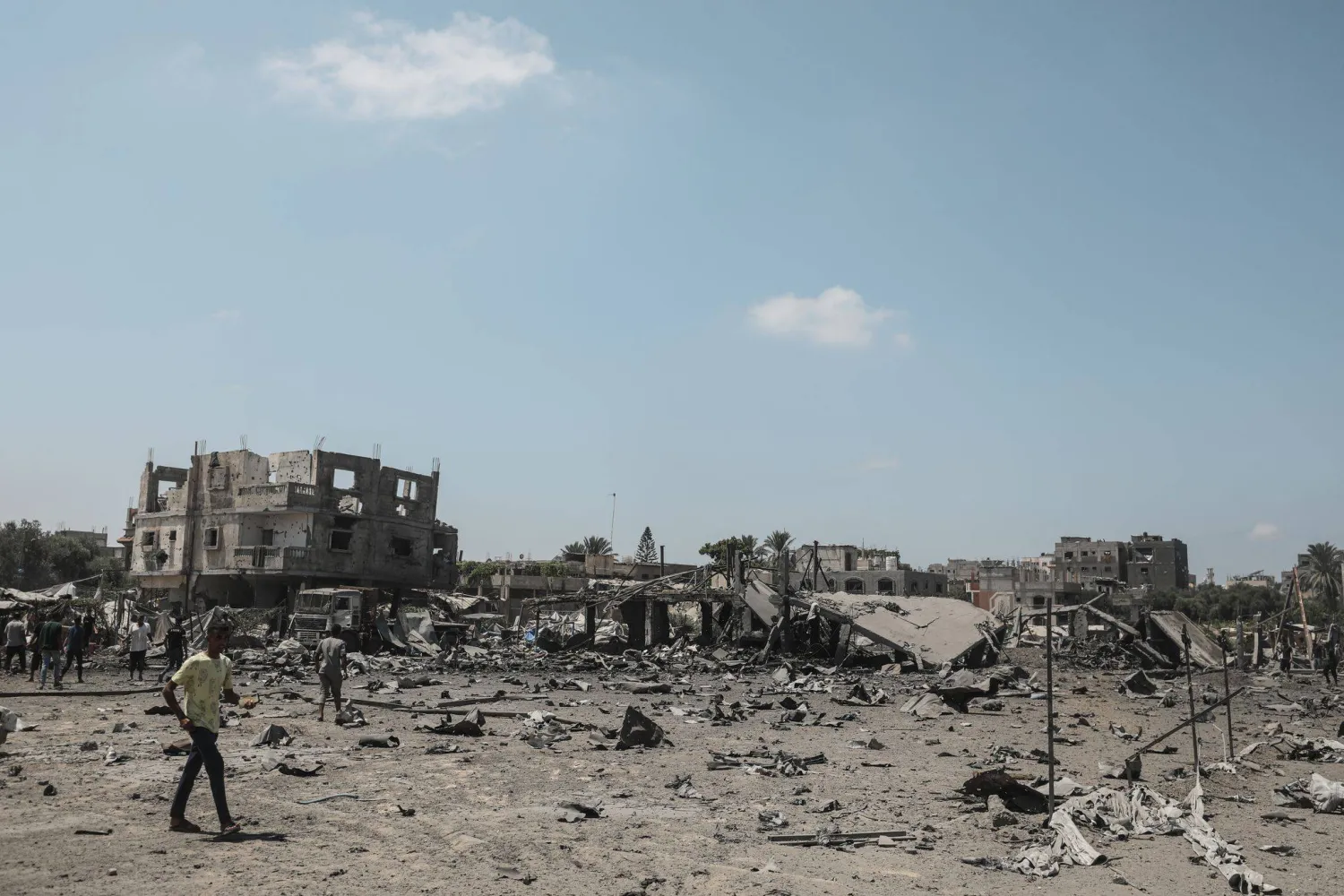
23 August 2026, Palestinian Territories, Gaza Strip: People check the damage after an Israeli airstrike on a house belonging to the Al-Awwar family, damaging several neighboring homes in the Al-Maghazi camp. Photo: Moiz salhi/dpa
TT

Uganda and Burundi Military Officials Visit Israel to Discuss Gaza Troop Deployment

23 August 2026, Palestinian Territories, Gaza Strip: People check the damage after an Israeli airstrike on a house belonging to the Al-Awwar family, damaging several neighboring homes in the Al-Maghazi camp. Photo: Moiz salhi/dpa

Military officials from Uganda and Burundi visited Israel last week to discuss deploying troops to Gaza as part of an international security force envisioned by US President Donald Trump’s Board of Peace for the fragile ceasefire, according to officials.

A Board of Peace official told The Associated Press that Ugandan officials joined a Burundian military delegation, and that Uganda is finalizing details of its participation after its parliament approved the troop contribution this month, The Associated Press said.

Nothing has been finalized with Burundi, but the official said they look forward to starting the process.

“We shared significant knowledge with one another, and the Burundi representatives expressed interest in our mission,” the official said, speaking on condition of anonymity because they weren’t authorized to discuss talks with potential troop-contributing countries ahead of any agreement.

A Burundian military official told the AP that three other senior military officers led the delegation to Israel and that Burundi appeared intent on joining. The official spoke on condition of anonymity because he was not authorized to speak to the media.

It was not clear what Uganda or Burundi might be offering or what they might receive in return. Spokespersons for their militaries did not respond to requests for comment.

Progress on the international force has been slow

If Burundi moves ahead, the African nations would be the latest to join the international force for Gaza after Morocco, Kosovo, Kazakhstan and Albania made commitments. Uganda has committed around 1,200 personnel, and Morocco has committed up to 500. Kosovo, Kazakhstan and Albania in total have committed around 80.

Indonesia earlier said it was preparing to send 8,000 troops — by far the largest commitment — but put that on hold after the US and Israel attacked Iran.

The 20,000-strong force would be led by US Maj. Gen. Jasper Jeffers. Troops committed remain far short of that goal.

Last month, Trump announced a deal for Hamas to disarm and for Israel to withdraw its forces from Gaza. According to the deal, the International Stabilization Force would be deployed to areas of the Palestinian territory administered by an incoming technocratic committee, and Israeli forces would withdraw.

The force would help monitor the ceasefire, train Palestinian police and secure the delivery of aid, among other tasks.

The ceasefire that took effect in Gaza last October has stalled due to disagreements regarding Israel’s withdrawal from the strip and Hamas’ disarmament. A US delegation met for hours earlier this month with the Hamas leader and then with Israeli Prime Minister Benjamin Netanyahu to press them forward. Hamas has agreed to the new US deal.

Netanyahu has rejected it, saying Israel will not withdraw from any of the roughly 60% of the territory it controls in Gaza until Hamas has been completely disarmed. Even after Netanyahu's meeting with the US team, which included negotiator Jared Kushner, officials offered no concrete commitment by Israel.

Uganda and Burundi have peacekeeping experience from Somalia Paul D. Williams, director of the security policy studies program at The George Washington University, said Uganda and Burundi have gained considerable peacekeeping experience through long-term deployments in Somalia as part of an African Union force resisting the al-Qaida-linked al-Shabab extremist group.

Their countries' leaderships have “shown they are willing to tolerate high numbers of casualties without withdrawing,” he said.

Williams added that, with the mission in Somalia winding down, both countries will be searching for ways to accrue financial and material support for their militaries: “Deploying to Gaza with US support is one way to do that."

A Ugandan military officer with knowledge of the upcoming deployment said troops were being selected to go to Gaza. The officer spoke on condition of anonymity because they weren’t authorized to speak to the press.


Iraq Rejects Syrian Request to Repatriate 4,000 Suspected ISIS Detainees

Members of the Iraqi border forces patrol along a concrete wall on the Iraqi-Syrian border, in the town of al-Baghuz in the Al-Qaim district of western Iraq, on January 21, 2026. (AFP)
TT

Iraq Rejects Syrian Request to Repatriate 4,000 Suspected ISIS Detainees

Members of the Iraqi border forces patrol along a concrete wall on the Iraqi-Syrian border, in the town of al-Baghuz in the Al-Qaim district of western Iraq, on January 21, 2026. (AFP)

Iraq has rejected Syria's request to repatriate thousands of suspected ISIS members transferred from Syrian detention centers to Iraqi custody earlier this year, a senior Iraqi security official said on Wednesday.

Iraqi National Security Advisor Qasim al-Aboudi said that a meeting had been held recently between Syria, Iraq and the United States to discuss the fate of the prisoners.

Al-Aboudi said Syria had requested that the 4,000 Syrian prisoners be handed over to be tried in Syria, but Iraq refused. Iraq has repatriated about 50 Syrian detainees who were determined not to be ISIS members, he told The Associated Press, while the Syrian prisoners remaining in Iraq include about 400 who are believed to be high-level members of the extremist group.

“Iraq is conducting investigations, and anyone proved to have committed crimes in Iraq will be tried under Iraqi law,” he said.

Some prisoners could later be transferred to their home countries to complete their sentences, he said.

Syria did not immediately respond to requests for comment.

More than 5,700 prisoners with alleged ISIS ties — including some 4,000 Syrians — were transferred from northeast Syria to Iraq after fighting broke out in January between Syrian government forces and the Kurdish-led Syrian Democratic Forces, which had long guarded the detention centers where they were held.

Some ISIS-linked prisoners managed to flee during the chaos of the clashes, and there were fears that a larger-scale escape would take place. While the extremist group lost control of the territory it once seized in Iraq and Syria years ago, its cells still periodically carry out attacks in both countries.

The discussions about the prisoners' fate come as the United States has ended a 12-year mission to fight ISIS in Iraq, with the last US troops withdrawing from the country last month.

Al-Aboudi said Iraq has asked for financial support from the US and other countries taking part in the global coalition against ISIS to help with the costs of housing the prisoners.

“Iraq asked for an allocation of $500 million. The coalition promised support, but Iraq is still waiting,” he said.

A US defense official and the office of Tom Barrack, the US envoy to Syria and Iraq, referred questions about the prisoners to Iraqi and Syrian authorities.

Many of the prisoners transferred to Iraq had been held in Syria for years without charges. Rights groups have raised concerns about detention conditions in both countries.


Arab Parliament President Stresses Houthi Attacks on Saudi Arabia Pose Direct Threat to Regional Security

Arab Parliament President Stresses Houthi Attacks on Saudi Arabia Pose Direct Threat to Regional Security
TT

Arab Parliament President Stresses Houthi Attacks on Saudi Arabia Pose Direct Threat to Regional Security

Arab Parliament President Stresses Houthi Attacks on Saudi Arabia Pose Direct Threat to Regional Security

President of the Arab Parliament Mohammed bin Ahmed Al-Yamahi stressed that repeated terrorist attacks by the Houthi militia against Saudi Arabia and its civilian and oil facilities pose a direct threat to regional security.

During his speech at the 153rd Assembly of the Inter-Parliamentary Union in Arusha, United Republic of Tanzania, Al-Yamahi addressed Iranian attacks that targeted several Arab countries and threatened civilians, infrastructure, and vital facilities, SPA reported.

He also discussed regional escalation and related threats to the security of Arab countries. He called on the international community to move beyond condemnation and take measures to protect states and their sovereignty and compel the parties to respect international law.


Sudan’s Burhan Rules Out Talks with RSF or ‘Any Other Party’

Wreckage of a drone allegedly used in an attack on Damazin (activists’ Facebook pages). 
TT

Sudan’s Burhan Rules Out Talks with RSF or ‘Any Other Party’

Wreckage of a drone allegedly used in an attack on Damazin (activists’ Facebook pages). 

Sudan’s army chief Abdel Fattah al-Burhan has reiterated his refusal to negotiate with the paramilitary Rapid Support Forces (RSF) or “any other party,” vowing to continue military operations despite renewed US efforts to secure a political settlement.

His remarks came after Massad Boulos, US President Donald Trump’s senior adviser for Arab and African affairs, announced that he had met Burhan in Egypt earlier this week.

Meanwhile, a drone attack on Damazin, the capital of Blue Nile state, killed four women and wounded dozens of civilians, according to a Sudanese human rights group.

Addressing residents of Amri locality in Northern state on Tuesday, Burhan declared: “There will be no negotiations with the rebels or with any other party,” without specifying whom else he meant.

“We are a state of institutions. Decisions on negotiations, peace and war are therefore made by the Security and Defense Council,” he added, according to a statement from the Sovereignty Council’s media office.

Burhan, who heads the Sovereignty Council and commands the armed forces, reaffirmed his determination to continue what he described as efforts to defeat and eliminate the rebellion.

He also praised Amri residents for supporting the army and the Popular Resistance, reiterating the military’s commitment to what it calls the “Battle of Dignity.”

Deadly drone attack

Hours after Burhan’s remarks, Emergency Lawyers, a volunteer human rights organization, reported that drones belonging to the RSF had struck civilian sites in Damazin early Wednesday.

The strikes hit homes and a mosque, killing four women in the Al-Hijra neighborhood and wounding dozens of civilians, the group alleged.

Its statement provided no further details about the wounded or how it had established responsibility for the attack.

Emergency Lawyers warned against continued attacks on civilian sites, stressing that deliberately targeting them constitutes a serious violation of international humanitarian law.

The organization demanded an end to the attacks and accountability for those responsible, urging all parties to the conflict to respect civilian protections and avoid endangering lives.

Neither the army nor the RSF issued a comment, although platforms aligned with the paramilitary group reported that the drones had targeted the homes of the finance and information ministers.

In a separate statement, Damazin Technical College condemned a two-drone attack on its campus, reporting damage to classrooms, administrative offices, laboratories, and other infrastructure.

Diplomatic efforts

Burhan’s rejection of negotiations came less than a day after Boulos announced that he had attended a lunch hosted by Egyptian President Abdel Fattah al-Sisi in New Alamein, on the sidelines of an African Union coordination meeting, where he met the Sudanese leader.

In a post on X on Monday, Boulos reaffirmed Washington’s commitment to working with regional and international partners toward a political settlement that would help end Sudan’s war and alleviate the country’s humanitarian suffering.

He emphasized US support for Sudan’s unity, sovereignty and territorial integrity.

According to Boulos, the diplomatic efforts aim to restore security and stability, begin reconstruction and development, and facilitate a transition to a civilian-led government through an inclusive national dialogue owned and led by the Sudanese people.

In a television interview last September, Boulos maintained that Washington engaged with both sides in Sudan’s conflict without formally recognizing either.

He also stressed that his meetings with Burhan did not constitute recognition of the Sudanese government.

However, in his latest X post, Boulos referred to Burhan by his official title, “Chairman of Sudan’s Transitional Sovereignty Council,” wording that some interpreted as tacit recognition.

Boulos has argued that maintaining contact with both warring parties is essential to reaching a peaceful settlement and facilitating humanitarian aid deliveries.

His remarks followed a Sept. 22 statement by US State Department spokesperson Tommy Pigott, who declared that neither the Sudanese army nor the RSF and their leaders represented a legitimate constitutional government of Sudan.

Pigott also affirmed Washington’s readiness to work with partners committed to peace.

The diplomatic exchanges coincided with Washington’s refusal to grant Burhan a visa to attend the United Nations General Assembly meetings in New York.

Reuters reported at the time, citing a Sudanese diplomatic source and a Western analyst, that Burhan’s participation had been made conditional on his acceptance of a 90-day truce proposed by Boulos. The US State Department declined to comment.
