

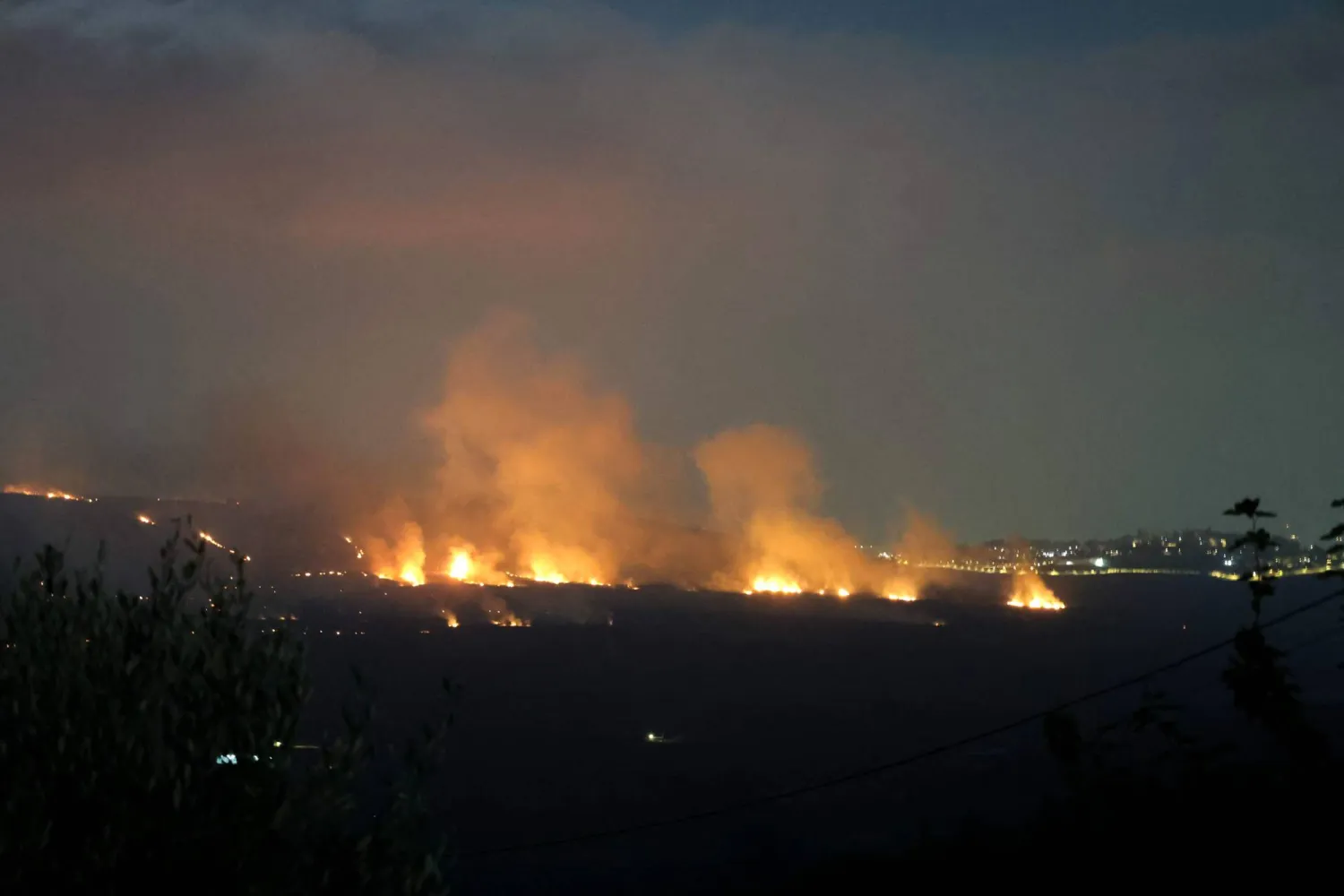

Lebanon Accuses Israel of Burning Forest, Farmland in South

Smoke rises from fires ignited by Israeli shelling that targeted the plain of Marjeyoun in southern Lebanon on August 25, 2026. (AFP)
TT

Lebanon Accuses Israel of Burning Forest, Farmland in South

Smoke rises from fires ignited by Israeli shelling that targeted the plain of Marjeyoun in southern Lebanon on August 25, 2026. (AFP)

As extreme heat fuels wildfires worldwide this summer, Lebanese officials and residents have accused Israel's military of systematically sparking blazes that have burnt swathes of forest and farmland in the country's south.

In the village of Chaqra, Haidar Qoteish, 36, says he has watched fires devour fields and orchards in his hometown of Houla, just five kilometers (three miles) away but under Israeli military control.

"They've burnt everything. You can see the fields are all black," the father of four told AFP by telephone.

"Those whose land they didn't burn, they've bulldozed," he said. "It's a great loss, and there's nothing we can do."

Lebanon's governmental National Council for Scientific Research (CNRS) says Israeli military activity has caused 160 square kilometers of land, half of it agricultural, to go up in flames since hostilities between Israel and Hezbollah began in October 2023.

The latest bout of fighting flared in March when the Iran-backed group drew Lebanon into the Middle East conflict by attacking Israel, triggering massive Israeli airstrikes and a ground invasion.

An AFP photographer this month saw multiple fires raging in south Lebanon, mostly inside Israel's self-declared occupied "security zone", which runs around 10 kilometers (six miles) deep inside Lebanese territory along the border.

- 'Scorched earth' policy -

Despite a lull in hostilities since June and an Israel-Lebanon deal that month, Israel still bombs the south and has been demolishing border villages.

Lebanon's Prime Minister Nawaf Salam has accused Israel of pursuing a "scorched-earth policy" in the south.

The Israeli army told AFP's Jerusalem bureau it "is aware of the potential environmental impact of its operations", which it said are "conducted while taking precautionary measures to mitigate harm to civilians and the environment".

Hussein Fakih, the head of the civil defense agency for the Nabatieh region, said that since July his teams have observed fires both inside and adjacent to areas where Israeli troops are stationed.

He told AFP the blazes had been sparked by Israeli "bombs and drones" and sometimes incendiary phosphorous shells and cluster munitions.

In Kfar Shouba, which abuts Israel's "security zone", mayor Qassem al-Qadri said an Israeli attack this month sparked a fire that spread across a broad area of "mostly forest".

He said residents desperately tried to fight the blaze themselves while waiting for the Israeli army to grant firefighters access to the area, in accordance with a ceasefire monitoring mechanism.

They only got the green light "the following day when the fire had burnt everything", said the civil defense's Fakih.

Kfar Shouba residents with property close to Israeli positions are afraid to take fire prevention measures like clearing undergrowth, the mayor said.

"They talk about the 'security zone' but... we don't know where its (exact) boundaries are," Qadri added.

"We feel like the whole area is under Israeli control."

- 'Ecocide' -

Environment Minister Tamara Elzein has condemned what she called "ecocide" in the south, accusing Israel's army of "deliberately" burning swathes of Lebanese land.

CNRS director Chadi Abdallah told AFP "fires were limited to the border strip" during the 2023-2024 hostilities, but have broadened since the conflict reignited this year.

He accused the Israeli army of "systematically burning land" and of "trying to create a buffer zone devoid of homes, people and the natural environment".

"During the previous war, around 8,500 hectares (85 square kilometers) of land was burnt," Abdallah said, while this year, "the Israelis have burnt around 7,500 hectares", including 350 hectares after the June deal.

CNRS satellite imagery showed formerly green areas that have now disappeared due to fires, as well as Israel's bulldozing and uprooting of vegetation.

Lebanon's state-run National News Agency this month said Israeli forces had uprooted 600 olive trees in one southern village alone.

Lebanese environmental group Green Southerners says it has recorded widespread damage to forest, woods and farmland since 2023.

This month, it warned that "major nature reserves in southern Lebanon have also been subjected to extensive and repeated destruction".

In Chaqra, Qoteish lamented the environmental losses.

"Demolished homes maybe can be rebuilt in a year, but trees don't grow back" so quickly, he said.



WFP Ramps up Response in Yemen as Hunger Fears Escalate, Official Says

 Displaced Yemenis carry water at Al-Firdaws camp in Ras Imran, on the western outskirts of Aden, Yemen, Monday, Sept. 21, 2026. (AP)
Displaced Yemenis carry water at Al-Firdaws camp in Ras Imran, on the western outskirts of Aden, Yemen, Monday, Sept. 21, 2026. (AP)
TT

WFP Ramps up Response in Yemen as Hunger Fears Escalate, Official Says

 Displaced Yemenis carry water at Al-Firdaws camp in Ras Imran, on the western outskirts of Aden, Yemen, Monday, Sept. 21, 2026. (AP)
Displaced Yemenis carry water at Al-Firdaws camp in Ras Imran, on the western outskirts of Aden, Yemen, Monday, Sept. 21, 2026. (AP)

The acting ‌chief of the World Food Program on Monday said the agency was ramping up its response to the escalating crisis in Yemen, where Houthi fighters seized the country's Red Sea coast, displacing tens of thousands of people.

Nearly 700 people have been killed and thousands injured, according to the UN, as the group made their advance. More than 120,000 Yemenis have fled their homes within Yemen, and thousands more by boat across the Red Sea to Africa.

"We are stepping up. We have supported around 60,000 people with hot meals and food commodities and we ‌are building up ‌our pipeline to respond to hundreds of thousands ‌more," ⁠WFP Acting Executive Director ⁠Carl Skau told Reuters during the United Nations General Assembly in New York.

The escalation in Yemen comes as more than 18 million people, roughly half the population, face acute food insecurity and some 2.2 million children under age 5 are acutely malnourished, according to the WFP data.

Camps for the displaced are "already overstretched and our operations there are underfunded," Skau ⁠said. "People are not eating enough, there is no ‌healthcare, and these are the places where ‌you now see tens of thousands of newly arrived people with nothing, and ‌having had their lives disrupted."

The surge by the Iran-backed group ‌this month extended the wider Middle East conflict to a new theater and further threatened global energy supplies, resulting in a spike in oil prices, upending maritime trade in the region.

"Ninety percent of the food in Yemen is ‌imported. So when ports are not working or when airports are not working, that's having an impact ⁠on food security ⁠in Yemen," said Skau, who recently visited the country.

Skau also warned that the agency was unable to operate in the Houthi-controlled areas as the group continues to occupy UN offices after it confiscated its assets and detained dozens of UN staff.

"Our offices in the north are occupied by the Houthi de facto authorities, and our assets are still confiscated, so under such circumstances it's very difficult for us to operate," said Skau.

The Swedish diplomat said the organization, the largest UN agency by budget, was severely underfunded and forced to cut back on life-saving aid. He said he would push for more funding at the diplomatic jamboree with nearly 130 heads of state visiting New York this week.

The World Health Organization says 680 people were killed or injured across Yemen over the course of a week as fighting between the Houthis and government forces continues.

WHO said on Monday in a post on X that 164 people were killed and 516 injured between Sept. 13 and Sept. 18. This brings the total number of casualties since Aug. 6 to 3,672, including 674 deaths and 2,998 injuries.

Lahj province in southwestern Yemen is currently an active front line where 58 deaths and 226 injuries were reported within six days, according to the UN agency.

The fighting has so far displaced 129,438 people across seven provinces, the International Organization for Migration said.

The IOM said in an update Monday that people escaping the conflict inside the country were forced from their homes in only a few weeks, with many already fleeing more than once.


Lebanon Needs International Force After Peacekeepers Leave, PM Tells UN Chief

16 February 2026, Lebanon, Beirut: Lebanese Prime Minister Nawaf Salam is pictured during a meeting at the Prime Minister's office. (dpa)
TT

Lebanon Needs International Force After Peacekeepers Leave, PM Tells UN Chief

16 February 2026, Lebanon, Beirut: Lebanese Prime Minister Nawaf Salam is pictured during a meeting at the Prime Minister's office. (dpa)

Lebanese Prime Minister Nawaf Salam told United Nations chief Antonio Guterres on Monday that Lebanon needed a UN-sponsored international force to stay in the country's south after the current UN peacekeeping mandate expires.

The UN Interim Force in Lebanon (UNIFIL), which currently counts around 7,500 peacekeepers from 46 countries, has acted as a buffer between Lebanon and Israel since 1978.

But under US pressure, the UN Security Council voted last year to halt the force's mandate at the end of this year.

Meeting Guterres at the UN headquarters in New York, Salam "stressed the importance of maintaining an international presence under the umbrella of the United Nations in the south in the post-UNIFIL phase", according to a statement from the premier's office.

This should be in a way that "ensures the continuation of the functions of monitoring, reporting and liaison, contributes to preserving stability, and supports the process of extending the Lebanese state's authority over all its territory", Salam added, according to the statement.

UNIFIL's looming departure comes as Israel maintains troops in a self-declared "security zone" occupying around 10 kilometers (six miles) deep inside south Lebanon along the border.

Israel launched heavy airstrikes and a ground invasion after Hezbollah drew Lebanon into the Middle East war in March by attacking Israel in support of the group's backer Iran.

Last week, Lebanese President Joseph Aoun told AFP that Lebanon wanted a new force, European or otherwise, to prevent a security vacuum after the peacekeepers depart, but that "the best and most optimal option remains extending UNIFIL's mandate".

The creation of a new force to succeed UNIFIL was also on the agenda of a meeting last week in Paris between Aoun, French President Emmanuel Macron and King Abdullah II of Jordan.

France and Italy have said they want to set up a multinational coalition to succeed UNIFIL.

In a June report, Guterres said peacekeepers would be needed after UNIFIL's mission expires.

Salam also told Guterres that around 329,000 people are still displaced in Lebanon since the latest conflict erupted, urging support for the humanitarian response.


Analysts: Bab al-Mandab Tests Limits of Saudi-Iranian Reconciliation

Beijing faces a difficult challenge in ensuring Tehran fulfills its commitments under the agreement with Saudi Arabia, according to analysts. (SPA)
TT

Analysts: Bab al-Mandab Tests Limits of Saudi-Iranian Reconciliation

Beijing faces a difficult challenge in ensuring Tehran fulfills its commitments under the agreement with Saudi Arabia, according to analysts. (SPA)

More than three years after Saudi Arabia and Iran signed their agreement in Beijing, brokered by China, the reconciliation between Riyadh and Tehran is facing one of its most difficult tests, amid accusations that Iran is supporting armed groups in Yemen and Iraq that have targeted Saudi Arabia, and as the Houthis move toward the Bab al-Mandab Strait, raising concerns over the Kingdom's security and navigation in the Red Sea.

AFP reported, citing two Houthi military sources, that experts from Iran's Revolutionary Guard Corps had visited the Bab al-Mandab area, the port and airport of Mokha, and the Jabal al-Nar camp east of the city. The sources said the experts had supervised the digging of tunnels in the mountains overlooking Mokha and the Bab al-Mandab Strait and had discussed installing radars near Mokha and on Zuqar Island in the southern Red Sea.

Analysts who spoke to Asharq Al-Awsat said the latest developments not only test Tehran's commitment to its pledges, but also put China's role under scrutiny. The issue is no longer limited to maintaining diplomatic relations between Saudi Arabia and Iran, but also concerns the agreement's ability to curb sources of indirect threats and prevent armed groups from being used to pressure countries in the region.

Riyadh and Tehran signed an agreement in Beijing under Chinese sponsorship to resume diplomatic relations after a break of nearly seven years.

Bab al-Mandab: A Serious Test for the Agreement

Dr. Abdulaziz bin Sager, Chairman of the Gulf Research Center, said the Beijing Agreement, signed in March 2023, was based on three main components: restoring diplomatic relations after seven years of estrangement, reactivating bilateral cooperation agreements, and respecting the sovereignty of states and noninterference in their internal affairs. He described the third component as "the most important and most sensitive."

In an interview with Asharq Al-Awsat, bin Sager said Iran's actions through the Houthis near the Bab al-Mandab Strait "represent a serious test of the Saudi-Iranian agreement" because they violate both its provisions and its spirit, which was based on building trust. He added that the commitments should not be limited to Iran's direct actions, but should also cover the conduct of groups linked to the Iranian Revolutionary Guard Corps.

"There is no meaning to any agreement with Iran that does not cover the actions of its regional proxies that threaten regional and international security," he said, considering support for the Houthis or incitement to threaten the Kingdom's security a "blatant violation" of the commitment to respect sovereignty and refrain from interference.

Abdulaziz Al-Shaibani, a researcher and adviser on Chinese and Asian affairs, takes a different view. He said Iranian actions near the Bab al-Mandab Strait test the Beijing Agreement but do not mean that it has collapsed. The agreement was designed primarily to restore relations and open channels for dialogue, not to end the rivalry between Riyadh and Tehran or establish a strategic partnership between them.

The Proxy Policy

Saudi political analyst Dr. Khalid Al-Habbas said the militia policy is one of Tehran's most important tools for expanding its regional influence. He said the Iran Revolutionary Guard Corps supports, trains, and organizes these groups, enabling them to play roles that serve Iranian objectives when needed.

Al-Habbas places the latest Houthi moves, as well as the earlier activities of Iran-aligned factions in Iraq, within the context of growing military and economic pressure on Tehran and its efforts to open alternative fronts of pressure. He said moves toward the Bab al-Mandab Strait could threaten maritime navigation, drive up energy prices, and disrupt supply chains.

Dr. Khalid cautioned against relying on Houthi pledges not to target ships, saying that the experience of the Red Sea since late 2023 has demonstrated otherwise. He stressed that protecting maritime navigation "is an international responsibility, not one that falls on the Kingdom alone," given the global importance of the waterway.

According to Al-Habbas, Saudi Arabia, while remaining committed to resolving disputes peacefully and keeping the door to diplomacy open, has the right to defend itself under Article 51 of the United Nations Charter. It also has the right to "demand that Iran comply with the terms of the agreement and review it in light of the extent to which Tehran has honored its commitments."

Has the Testing Period Ended?

Dr. Samir Salha, a professor of international law and international relations at Istanbul University, takes a more forceful position. "We have moved beyond the question of testing the understandings. It is clear that the Iranian side has departed from their spirit and begun pursuing a regional policy different from what it had pledged," he said.

He added that the central question is no longer simply whether Tehran is complying, but who is arming the Houthis, training them, and directing their operations.

"The threats appear Houthi on the surface, but at their core they are Iranian," he said, arguing that the mobilization of Iran-aligned groups in Yemen, Iraq, and Lebanon reflects an Iranian priority that has not changed despite the restoration of relations with Riyadh.

In Salha's assessment, Saudi Arabia will not base its options solely on waiting for China to act. Instead, it will continue exploring strategic alternatives to ensure its security while keeping the diplomatic track open, a process he said has already begun in recent months.

Beijing: Opening the Way Is Not Enough

The analysts agree that China has significant tools for influencing Iran, given the depth of their economic, political, and military ties. But they say Beijing is being called upon to move from its symbolic role as sponsor of the agreement to a more decisive role in monitoring its implementation.

Bin Sager said Beijing "is capable of verifying Iranian conduct that violates the agreement," but tends to favor ambiguity and avoids taking decisive positions when crises do not directly affect its national security. What is needed now, he said, is a clear mechanism for verifying Tehran's compliance and restraining its proxies.

Salha, meanwhile, said China faces a difficult choice between simply protecting its relationship with Iran and defending its broader interests with the Gulf states and the trade routes that pass through the Red Sea. "This is primarily a test for Iran, but secondarily a test for Beijing," he said.

"Beijing faces a difficult, sensitive, and delicate situation. There have been positive indications in its positions and political messages toward Iran recently, but betting that Tehran will accept and heed what Beijing says is difficult," he added.

Dr. Samir noted that "Beijing succeeded in opening the way for a new test in Saudi-Iranian relations, but it now needs to go further if it wants to protect its interests and relations with the Gulf states."

Al-Shaibani, for his part, said Beijing tends to favor diplomacy and avoid direct intervention, and is not expected to decisively side with either party. He concluded that the future of the agreement will depend on China's ability to keep dialogue open and contain crises, while Saudi Arabia retains the right to protect its security and interests through its own capabilities and regional partnerships.