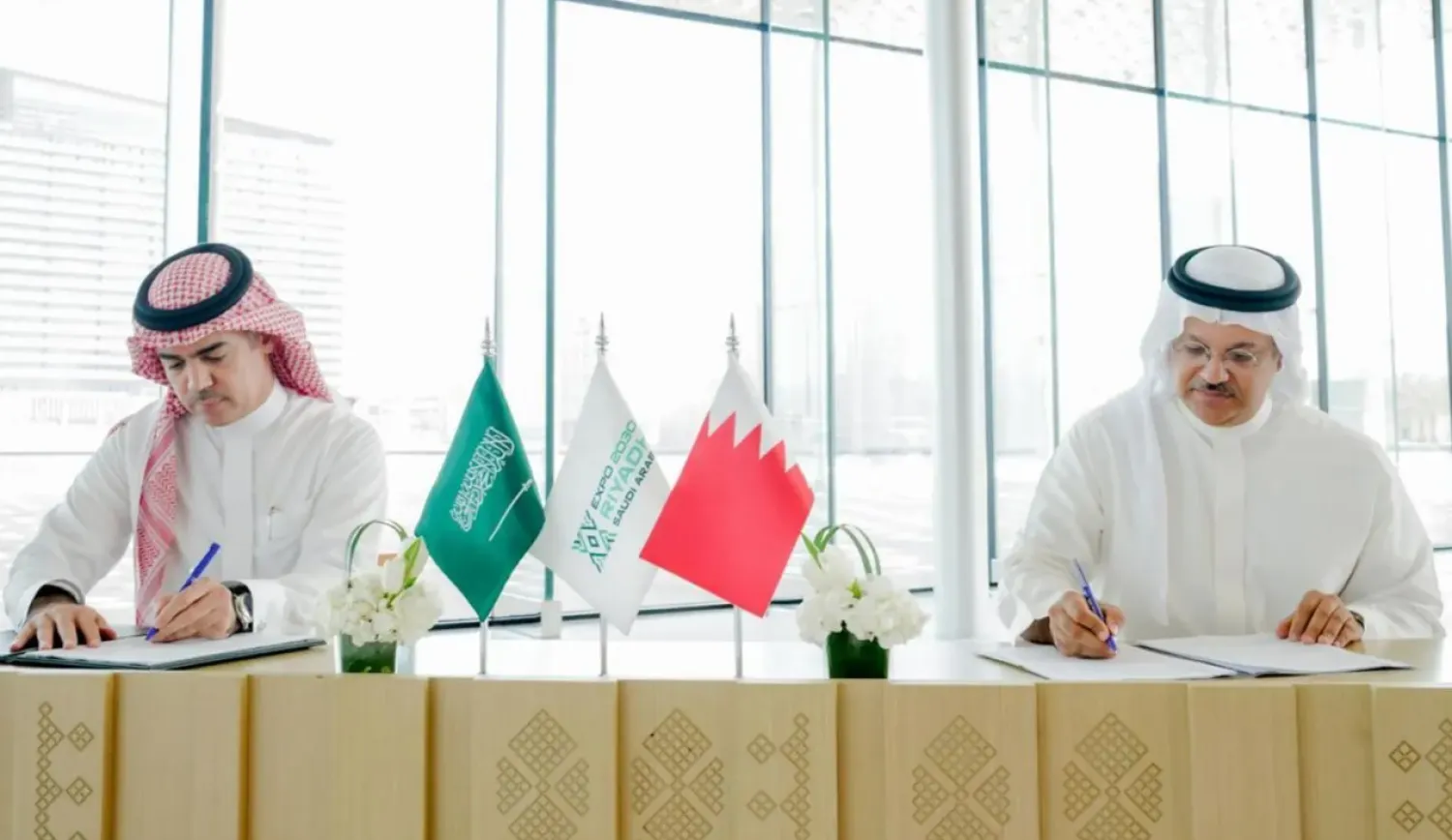
Bahrain Signs Participation Contract for Expo 2030 Riyadh

More than 145 countries have confirmed their participation in Expo 2030 Riyadh - SPA
TT

Bahrain Signs Participation Contract for Expo 2030 Riyadh

More than 145 countries have confirmed their participation in Expo 2030 Riyadh - SPA

The Kingdom of Bahrain has signed its Participation Contract for Expo 2030 Riyadh, marking a new phase in preparations for its participation in the World Expo.

The agreement provides the formal framework for Bahrain’s participation in Expo 2030 Riyadh, enabling preparations to advance across the key organizational and operational aspects of its presence throughout the six-month event, including the development of its pavilion, programs, and visitor experiences.

Expo 2030 Riyadh Chief Executive Officer Talal Al-Marri and Bahrain Authority for Culture and Antiquities President Sheikh Khalifa bin Ahmed Al Khalifa signed the agreement in Manama, SPA reported.

Al Khalifa commented: “Bahrain’s participation in Expo 2030 Riyadh reflects the deep-rooted fraternal and historic ties between the Kingdom of Bahrain and the Kingdom of Saudi Arabia, as well as the growing cooperation between the two countries across a wide range of fields.”

He added: “The signing of the Participation Contract marks an important milestone in Bahrain’s preparations for Expo 2030 Riyadh and reflects the Kingdom’s commitment to playing an active role in this global event. Bahrain looks forward to presenting a participation that showcases its identity, achievements and future aspirations, while further strengthening its presence on the international stage. We aim to deliver a comprehensive national presence that reflects the significance of the event and the global platform it provides for cultural and knowledge exchange and building partnerships.”

Al-Marri said: “The signing of Bahrain’s Participation Contract marks an important step in the preparations for Expo 2030 Riyadh and reflects the growing momentum as participating countries move from confirming their participation to delivering what they will bring to Riyadh in 2030. As Participation Contracts are signed, Expo 2030 Riyadh is increasingly taking shape through the pavilions, programs and experiences that participating countries will bring to visitors. We look forward to working closely with the Bahrain team in the next phase and to seeing a distinctive participation come to life – one that reflects Bahrain’s vision, culture and ambitions, while enriching the overall Expo 2030 Riyadh experience.”

The signing of Bahrain’s Participation Contract marks an important milestone in its journey toward Expo 2030 Riyadh, moving its participation from the confirmation and preparation stage into planning and implementation. Bahrain is also expected to develop a sustainable pavilion designed to remain beyond the six-month event and become part of the Global Village, a key component of Expo 2030 Riyadh’s enduring legacy.

More than 145 countries have confirmed their participation in Expo 2030 Riyadh, with formal Participation Contracts beginning to follow as preparations advance. This includes the recent signing of France’s Participation Contract last month in Paris, on the sidelines of the visit of His Royal Highness Prince Mohammed bin Salman bin Abdulaziz Al Saud, Crown Prince and Prime Minister, to France.

The international momentum builds on the recent signing of the SEE Agreement between the Kingdom of Saudi Arabia and the Bureau International des Expositions (BIE), which establishes the legal and administrative framework governing the participation of countries and international organizations. It also reflects the tangible progress across the broader preparations for Expo 2030 Riyadh.

Development of the Expo site, infrastructure, and construction works continues at pace, alongside advances in operational planning and the development of distinctive experiences that will help shape the event and enrich the visitor journey.

Expo 2030 Riyadh will take place from October 1, 2030, to March 31, 2031 under the theme “Foresight for Tomorrow.” The six-month event is expected to bring together more than 200 official participants and welcome 42 million visitors. Through national pavilions, cultural programming, innovation, and immersive experiences, Expo 2030 Riyadh will provide a global platform for international collaboration and exchange.


‘Nomura’ to Asharq Al-Awsat: Bond Yields Reshape Region’s Cost of Capital

Traders work on the floor of the New York Stock Exchange during morning trading on September 02, 2026 in New York City. (Getty Images/AFP)
TT

‘Nomura’ to Asharq Al-Awsat: Bond Yields Reshape Region’s Cost of Capital

Traders work on the floor of the New York Stock Exchange during morning trading on September 02, 2026 in New York City. (Getty Images/AFP)

Global debt markets are entering a new era of higher borrowing costs, with US, Japanese and British bond yields climbing to levels not seen in years amid three overlapping pressures: inflation fueled by oil prices, ballooning fiscal deficits and rising government borrowing needs.

As investors reassess the risks of holding long-term debt, the repercussions are spreading to regional markets through higher financing costs for governments and companies. This is placing Gulf economies under a fresh cost-of-capital test, although they have stronger financial buffers than many emerging markets.

In an exclusive assessment for Asharq Al-Awsat, Tarek Fadlallah, chief executive officer of Nomura Asset Management Middle East, said the latest jump in bond yields had a temporary component linked to geopolitical tensions and oil prices.

“But it also reveals a deeper shift in debt markets, amid growing concerns that elevated yields could prove more persistent because of chronic fiscal deficits and increasing borrowing needs in major economies,” he said.

Fadlallah’s assessment comes as global bond markets undergo a broad repricing, with yields on major government debt rising as concerns over energy-driven inflation converge with widening fiscal deficits and growing borrowing requirements.

In the United States, the 10-year Treasury yield approached 5% after rising by more than 80 basis points since the beginning of March, while the 30-year yield surpassed levels not seen in nearly 19 years. In Japan, the 10-year government bond yield exceeded 3% for the first time since 1996, while its British counterpart climbed to 5.268%, its highest level since June 2008.

Tarek Fadlallah, chief executive officer of Nomura Asset Management Middle East. (LinkedIn)

These moves are particularly significant because they point to a change in how debt-market risks are priced, with investors focusing increasingly on long-term fiscal prospects rather than only on central banks’ next policy decisions. That means borrowing costs could remain elevated even if some short-term pressures subside, placing public finances and debt sustainability under greater market scrutiny.

Bond markets showed early signs of stabilizing on Thursday, with the US 10-year Treasury yield easing to about 4.77% and its Japanese counterpart falling back below 3%. Yields, however, remained elevated compared with their levels before the latest sell-off, leaving open the question of whether the recent turbulence represents a temporary correction or the start of a deeper shift in global borrowing costs.

The surge in yields coincided with growing global attention to borrowing costs and public debt, which have emerged among the economic and financial issues under discussion within the G20. Finance ministers and central bank governors have been examining the implications of tighter financing conditions for the global economy and financial markets. This reflects how the bond issue has broadened beyond market movements into a wider economic and financial concern involving fiscal sustainability, the trajectory of inflation and major economies’ capacity to shoulder mounting debt burdens.

These concerns have also coincided with International Monetary Fund warnings that rising bond yields in advanced economies are increasing borrowing costs worldwide and putting greater pressure on financial markets, as global public debt approaches 100% of gross domestic product and progress in bringing down inflation loses momentum in several economies.

Energy shocks and rising investment linked to artificial intelligence are adding new sources of pressure on inflation and growth.

A passerby walks past a stock market indicator board in Tokyo, Japan, 02 September 2026. (EPA)

Is the rise temporary or the start of a new yield regime?

Fadlallah said the most important shift in the bond market was the move away from pricing based on short-term monetary policy expectations toward a reassessment of the risks involved in holding long-term debt, with investors demanding higher returns to compensate for duration, inflation and fiscal risks.

US debt lies at the heart of this equation after the national debt exceeded $40 trillion - a development Fadlallah described as “a clear reminder of the scale of the fiscal challenge facing the world’s largest bond market.”

“With long-term bonds leading the sell-off, markets are repricing what governments must pay to finance their needs, not merely what central banks determine through short-term interest-rate decisions,” he said.

The consequences of this shift extend beyond debt markets. US Treasuries serve as the main pricing benchmark for what is known as the “risk-free asset,” meaning that higher Treasury yields raise the discount rate used to value a broad range of assets, from equities to sovereign and quasi-sovereign bonds worldwide.

5% puts equities to the test

This equation is particularly important for US equities as the 10-year Treasury yield approaches 5%, a level investors view as a psychological threshold that could prompt some to shift their portfolios away from riskier assets and toward bonds.

The developments follow a strong US corporate earnings season, potentially shifting investors’ attention gradually from company results to broader economic and financial variables, led by yields, inflation and monetary policy.

Equity valuations also remain relatively high. The S&P 500’s forward price-to-earnings ratio stood at about 19.7, down from 22.2 at the beginning of the year but still above its historical average of about 16.

For Fadlallah, the combination of fiscal concerns, higher yields, elevated asset valuations and concentrated investment portfolios presents an important test for equities.

The market response has so far remained relatively limited, he said, “but the coming weeks will be crucial in determining whether investors can absorb higher yields or whether the pressure will trigger a broader shift toward reducing risk.”

Traders work on the floor of the New York Stock Exchange during morning trading on September 02, 2026 in New York City. (Getty Images/AFP)

Japan: The end of cheap money?

The significance of the yield surge is not limited to the US and Europe. Fadlallah said the more profound development could come from Japan, which for nearly three decades has played a central role in supplying low-cost capital to global markets.

With the 10-year Japanese government bond yield reaching 3%, the equation is becoming more complicated for investors accustomed to borrowing cheaply in yen and investing the proceeds in higher-yielding assets abroad through what is known as the “carry trade.”

“The era of near-zero Japanese yields may be approaching its end, potentially changing the direction of global capital flows,” Fadlallah said.

“Higher domestic yields in Japan could make Japanese assets more attractive to hold while reducing the appeal of borrowing in yen to finance investments in overseas markets.”

A trader talks on the phone during a bond auction on a trading floor in Madrid July 5, 2012. (Reuters)

Gulf faces higher borrowing costs, but has buffers

These developments have a “direct” impact on Gulf economies because most regional currencies are pegged to the US dollar. This transmits the effect of higher US yields to the borrowing costs of governments and companies, both in domestic markets and when issuing debt internationally.

Fadlallah said this would raise the cost of financing projects and refinancing existing debt.

“But it does not eliminate the region’s ability to continue pursuing its investment and economic diversification plans, given its oil revenue, financial buffers and strong sovereign positions,” he added.

Higher financing costs do not necessarily mean a decline in Gulf investment.

“But they will make efficient capital allocation and the economic returns generated by projects more important, with priority given to investments capable of delivering sustainable returns and benefiting from the strong fiscal and sovereign positions that give regional states greater room to maneuver,” he noted.

Will the yield surge subside?

Despite the structural shift in some of the bond market’s driving forces, Fadlallah does not believe yields are destined to keep rising in a straight line.

He said the fastest scenario for reversing the current surge “would be an easing of geopolitical tensions and a decline in oil prices, which would reduce the risk premium and calm inflation expectations.”

“A sharp fall in equity markets, data confirming that inflation has returned to a clear downward path, or coordinated intervention by central banks” could also “drive investors back toward bonds and push yields lower,” he stressed.

The greater risk, according to Fadlallah, is that large fiscal deficits and mounting borrowing needs become a permanent reality.

“This would mean markets may have to live with ‘higher for longer’ yields, not only because of monetary policy but also because investors will demand greater returns in exchange for financing heavily indebted governments,” he explained.

The current sell-off may therefore be more than a temporary episode in the interest-rate cycle. It could mark the beginning of a broader repricing of the cost of global capital - an equation that will shape equities, bonds and investment, as well as Gulf economies entering this phase from a position of greater strength but not insulated from the worldwide rise in borrowing costs.


Egypt Plans $3 Billion Bond Issuances in 2026-27

Central Bank of Egypt building (The AP)
TT

Egypt Plans $3 Billion Bond Issuances in 2026-27

Central Bank of Egypt building (The AP)

Egypt's cabinet said on Thursday it had approved a plan to raise around $3 billion through international bond issuances in the financial year 2026-27.

The bond program includes conventional and innovative bonds as well as credit-guaranteed Panda bonds, with execution subject to investor demand and market conditions, the cabinet statement read, Reuters reported.

The cabinet said the finance ministry raised $4 billion across four issuances in financial year 2025-26.

Those included sovereign sukuk, social bonds and African Development Bank-guaranteed Samurai bonds, along with the re-opening of outstanding bonds, as part of a strategy to cut external debt and diversify funding sources, it added.


Saudi Arabia’s Energy Sector Diversifies Its Growth Drivers

__AFP_Saudi and Foreign investors stand in front of the logo of Saudi state oil giant Aramco during the 10th Global Competitiveness Forum
TT

Saudi Arabia’s Energy Sector Diversifies Its Growth Drivers

__AFP_Saudi and Foreign investors stand in front of the logo of Saudi state oil giant Aramco during the 10th Global Competitiveness Forum

The performance of Saudi Arabia’s energy sector is no longer tied solely to oil price movements. Financial results for the first half of 2026 showed an increasing diversity in the drivers of performance, with companies listed on the Saudi Exchange (Tadawul) benefiting from improved activity in maritime transport, refining, petrochemicals, and energy-related services, alongside the continued financial strength of Saudi Aramco.

This diversification was clearly reflected in the companies’ combined results, with profits surging 39 percent in the first half to $66.9 billion (SAR 250.9 billion), compared with $48.2 billion (SAR 180.6 billion) in the same period of 2025, an increase of $18.75 billion (SAR 70.3 billion).

The improvement was not limited to the first six months. In the second quarter alone, the sector recorded a 49.7 percent increase in profits to $33.8 billion (SAR 127 billion), compared with $22.6 billion (SAR 84.8 billion) in the same quarter a year earlier. Revenue also rose 24 percent to $128 billion (SAR 480.35 billion), compared with $103.37 billion (SAR 387.65 billion).

More Than One Growth Driver

These figures reflect the expanding value chain of Saudi Arabia’s energy sector. Benefits from the oil cycle are no longer limited to production and sales, but have extended to transport, refining, petrochemicals, and supporting services.

Mohamed Hamdy Omar, CEO of G World, told Asharq Al-Awsat that the most notable aspect of the sector’s first-half results was not the increase in profits itself, but the multiple growth drivers behind this performance. This reflects the expanding value chain of the Kingdom’s energy sector.

He explained that the first driver was higher oil, refined product, and chemical prices, along with improved margins. This was reflected directly in Saudi Aramco’s results, even as some sales volumes declined.

The second driver is energy-related transport and logistics services, with Bahri providing a clear example. The company benefited from higher global freight rates and increased operational activity, particularly in oil transportation, sending its first-half profit up 420 percent to SAR 4.8 billion ($1.28 billion), compared with SAR 940 million ($250.6 million) during the same period in 2025.

In the second quarter alone, Bahri’s profit rose to about SAR 2.75 billion ($733.3 million), benefiting from strength in the maritime transport market and increased demand for tankers. This demonstrates that economic value in the energy sector is generated not only by the price of a barrel, but also by the supply chain and related services.

The third driver is improved operational efficiency and refining and petrochemical margins. This was particularly evident in the performance of Rabigh Refining and Petrochemical Co. (Petro Rabigh), which returned to profitability in the first half, recording about SAR 4 billion ($1.07 billion), compared with a loss of nearly SAR 2 billion in the same period of the previous year.

In the second quarter, the company posted a profit of SAR 2.66 billion ($709.3 million), compared with a loss of SAR 1.37 billion ($365.3 million) in the second quarter of 2025. The improvement was supported by higher plant operating rates, increased sales volumes, improved refined and petrochemical product margins, and lower financing costs.

Omar said these developments demonstrate that Saudi Arabia’s energy sector has become more integrated, bringing together production, refining, petrochemicals, drilling, services, transport, and logistics. As a result, the factors affecting its results have become more diverse than simply movements in oil prices.

Aramco... The Largest Driver

Despite the broadening sources of growth, Aramco still accounts by a wide margin for the largest share of the sector’s combined results. The company reported net profit of SAR 241.6 billion ($64.4 billion) in the first half of 2026, up 33.3 percent from SAR 181.3 billion ($48.3 billion) in the same period of the previous year. It therefore accounted on its own for about 96 percent of the total profits of the six companies included in the results, which amounted to about SAR 251 billion ($66.9 billion).

This means that diversification in performance drivers has become more apparent, but it has not yet resulted in a fundamental change in the concentration of results around the sector’s largest company.

Structural Improvement or Temporary Cycle?

Omar said interpreting the results requires distinguishing between sustainable structural improvement and cyclical or exceptional factors that contributed to amplifying growth rates during the first half. In his assessment, part of the improvement reflects ongoing structural changes, particularly as the Kingdom expands its energy infrastructure, increases investment in gas, refining, and petrochemicals, and develops production, transport, and energy-related service capabilities.

In this context, Aramco continues to develop a range of projects that strengthen its long-term revenue base, including increasing production at the Zuluf field, expanding the Fadhili Gas Plant, and advancing development phases at the Jafurah field.

However, the record growth rates posted by some companies should not be assumed to continue at the same pace.

Omar noted that Bahri’s significant second-quarter improvement was largely linked to higher global freight rates, geopolitical conditions, and increased demand for tankers. It would therefore be unrealistic to regard current growth rates as permanently repeatable.

Part of this also applies to Petro Rabigh, as the comparison is with the second quarter of 2025, which was affected by comprehensive scheduled maintenance that lasted about 60 days and led to lower production and sales. Therefore, part of the growth currently recorded is attributable to the low comparison base, rather than solely to new organic growth.

Divergence Within the Sector

Not all energy companies are moving in the same direction, reflecting differences in the nature of their activities and sources of income. ADES faced pressures related to the suspension of some rig operations, while Arabian Drilling swung to a loss in the second quarter, at a time when transport and refining companies benefited from more supportive operating and market conditions.

This divergence means that the sector’s overall positive picture does not indicate that all of its components have improved to the same degree. The strength of the combined results must also be viewed in light of the heavy concentration in Aramco.

What Awaits the Sector in the Second Half?

Omar expects Saudi Arabia’s energy sector to maintain a strong level of performance during the second half of 2026, but rules out a repeat of the growth rates recorded during the first six months.

This outlook is based on the continuation of several supportive factors, foremost among them strong energy prices and refined product margins, along with ongoing disruptions to supply chains and maritime transport, as well as major investment projects within the Kingdom.

At the same time, the geopolitical factor remains a double-edged sword for the sector. Continued disruptions could sustain an oil price premium and support freight rates and the margins of some products, but any rapid easing could lead to lower freight rates, narrower refining margins, and lower prices for some energy products.

Omar therefore believes that the real test for the sector over the next two quarters will not be revenue growth alone, but the quality and sustainability of that growth, and companies’ ability to preserve their operational gains independently of exceptional factors.