Diplomatic, Military Push for Lebanon in Paris

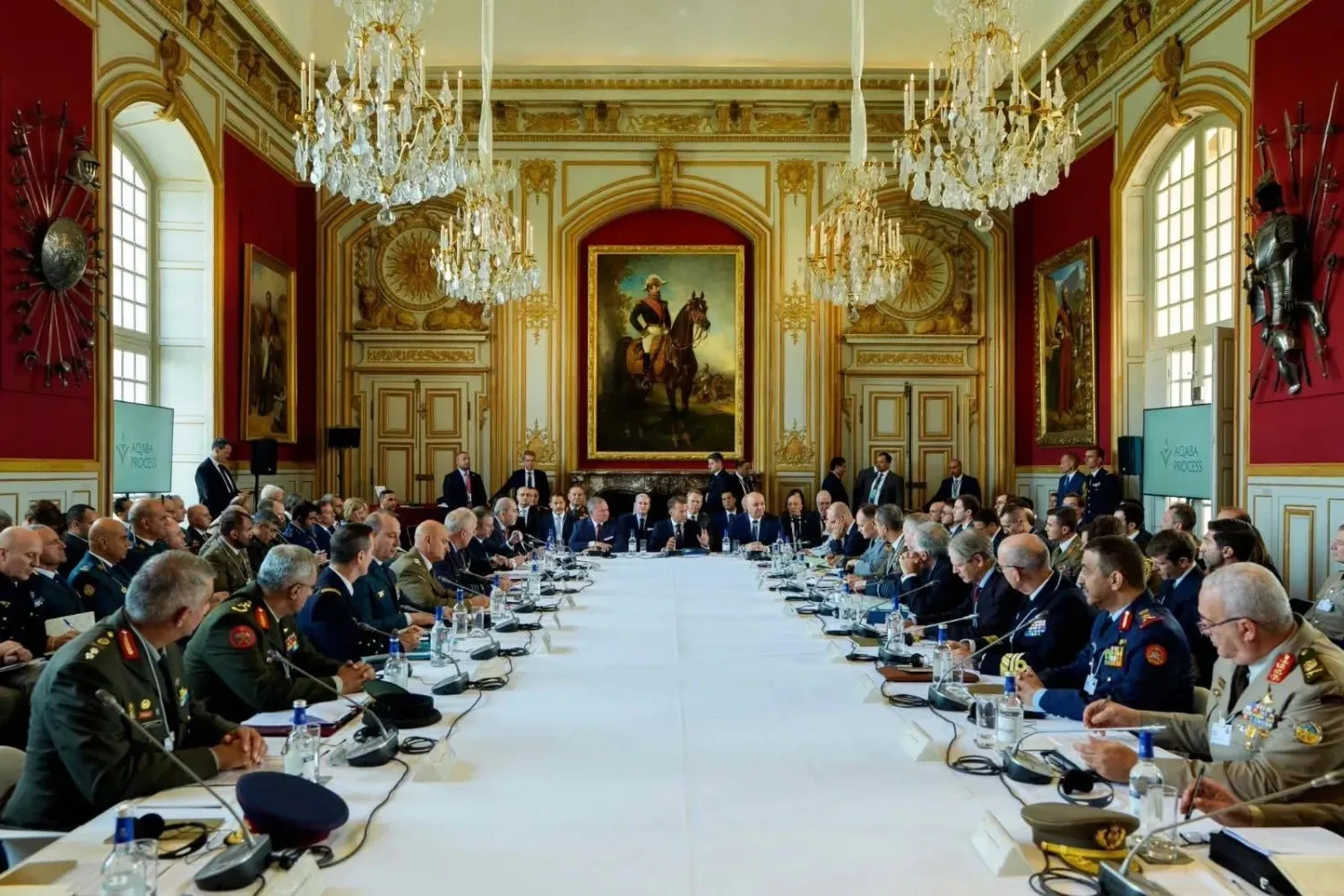
Group photo of participants in a meeting to support the Lebanese Armed Forces in Paris on Thursday (French president’s account)
TT

Diplomatic, Military Push for Lebanon in Paris

Group photo of participants in a meeting to support the Lebanese Armed Forces in Paris on Thursday (French president’s account)

Senior officials and military officers gathered in Paris on Thursday to discuss support for the Lebanese Armed Forces and security services.

French President Emmanuel Macron first met Lebanese President Joseph Aoun at the Elysee Palace before the two joined Jordan’s King Abdullah II for a trilateral summit at Les Invalides.

The three leaders later opened a technical-military meeting attended by military commanders, chiefs of staff and senior officers from 17 countries and organizations.

“Paris is today the place where our partners are coming together to strengthen Lebanon’s sovereignty and enable it to fully ensure its own security,” Macron wrote on X.

“A Lebanon at peace offers renewed hope for the entire Middle East. A sovereign and stable Lebanon is a decisive step toward peace and stability across the region.”

“Together with the Lebanese president and the king of Jordan, and in close coordination with the United States, Saudi Arabia and our international partners, we support the Lebanese Armed Forces, which are indispensable to asserting the authority of the Lebanese state throughout its territory,” he added.

Turning to wider regional tensions, Macron argued that “diplomacy and dialogue alone” could end an escalation with no prospect of resolution.

He reiterated France’s solidarity with Jordan and condemnation of Iranian attacks, while stressing the importance of freedom of navigation through the Strait of Hormuz, the Red Sea and the Bab al-Mandab Strait.

Regional Dimension

Aoun revealed measures taken by the state and urged support for its armed forces as an investment in regional security and stability.

King Abdullah’s participation, within the framework of the Aqaba Process, gave the meeting a broader regional dimension.

According to Lebanon’s National News Agency (NNA), citing presidential sources, the three leaders discussed the “dangerous regional situation” and stressed the need to intensify international efforts toward comprehensive and sustainable de-escalation. They also discussed developments in Gaza, the West Bank and Jerusalem.

Aoun stressed the interconnected nature of regional security and called for a common regional security strategy based on joint energy projects and economic, security and political cooperation.

The Lebanese president also sought to put behind him a period of strained relations with France, thanking Macron for France’s support for Lebanon and its efforts to strengthen state authority, sovereignty and official institutions.

He praised Macron’s efforts, in cooperation with the Italian prime minister, to find an alternative to UNIFIL to prevent a security vacuum in South Lebanon, and called for broader economic and energy cooperation, including the resumption of oil and gas exploration in Lebanese blocks.

‘A Moment for Decision’

Aoun painted a bleak picture of conditions in South Lebanon because of Israeli attacks and practices, but said the country now had an opportunity based on “a clear determination to rebuild the state and its institutions and move forward with the reforms the country needs.”

He said the goal was to establish “a strong state and effective institutions,” with the army and security services playing a central role.

While emphasizing the importance of the state’s monopoly on weapons, Aoun insisted that this was “first and foremost a Lebanese choice and a Lebanese interest.”

He also defended negotiations with Israel, warning that agreements succeed not merely by being signed but by being respected and implemented by all parties.

He called on Lebanon’s “friends and partners” to help ensure the full implementation of what had been agreed and to treat Lebanon’s sovereignty and territorial integrity as a principle “not subject to selectivity.”

Aoun detailed the army’s responsibilities, including extending state authority, maintaining security and stability, preventing border violations and combating smuggling. He also highlighted the role it would be expected to assume after UNIFIL’s mission ends to prevent a security vacuum.

“There can be no strengthening of state authority without strong, effective military and security institutions present throughout Lebanese territory,” he underlined.

The Lebanese president called for concrete results from the preparatory meeting, including a roadmap and clear timetable for an international conference to support the army and Internal Security Forces, as well as a long-term approach to assisting Lebanon’s security institutions.

He pledged “full transparency and accountability” and said the Lebanese state would assume a growing share of financing its security institutions.

“Invest in the success of the Lebanese state and in the stability of the region,” Aoun concluded. “This is a moment for decision, not a moment for waiting.”


Yemeni Army Holds Positions Around Taiz, Advances in Al-Jawf

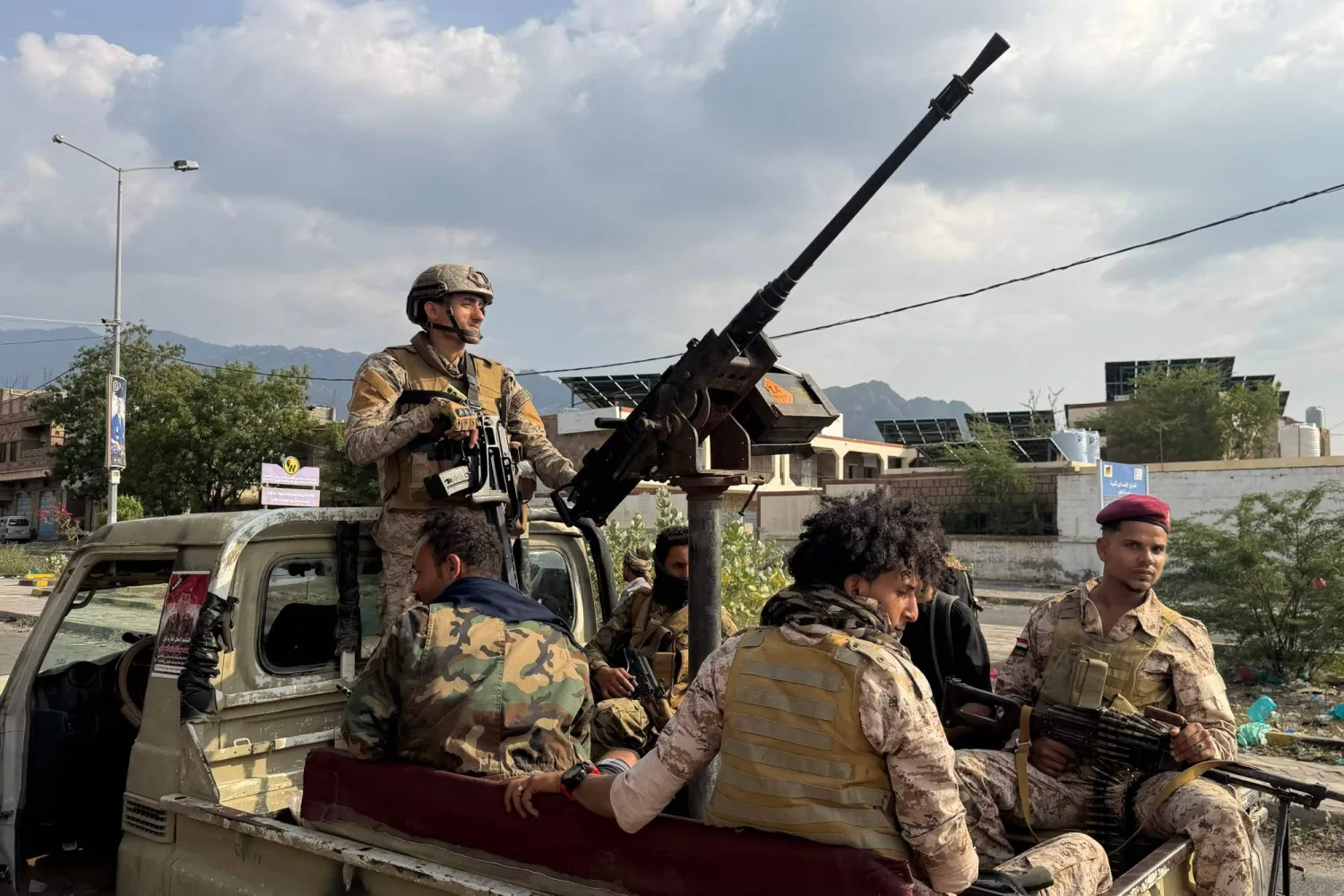
Yemeni government fighters ride on the back of a truck during battles at the Jabal Han front west of the city of Taiz on October 21, 2026. (Photo by AFP) /
TT

Yemeni Army Holds Positions Around Taiz, Advances in Al-Jawf

Yemeni government fighters ride on the back of a truck during battles at the Jabal Han front west of the city of Taiz on October 21, 2026. (Photo by AFP) /

Yemeni government forces have held their positions on the front lines around the besieged city of Taiz, repelling a fierce Houthi attack on the Al-Aqrud front southeast of the city with support from the Popular Resistance. Meanwhile, government forces recaptured military positions and strategic high ground east of Al-Hazm, the capital of Al-Jawf Governorate, in a battlefield development aimed at advancing toward the city.

While government forces maintained their defenses in Taiz and made gains in Al-Jawf, the Houthis expanded their military operations toward Al-Maqatirah district in northern Lahj Governorate. Despite airstrikes and significant losses, the group seized the historic Al-Maqatirah Castle and advanced into key areas and high ground, including the Al-Nafaq area and positions overlooking the Hayjat Al-Abd mountain pass, following fierce clashes with government troops.

According to local sources, government forces, supported by the Giants Brigades and Nation's Shield Forces, still control large parts of the district. They have repelled attacks and destroyed columns of Houthi reinforcements at the foot of the mountain pass and in the Wadi Souq Al-Rubou area.

Government troops continue to launch counterattacks to recapture positions seized by the Houthis, while deploying additional reinforcements and tribal fighters to confront the group's advance.

Clashes south and southeast of Taiz are concentrated on the Al-Aqrud and Kahlan fronts, as well as in Al-Dhabab west of the city.

Government forces, backed by the Popular Resistance, repelled a fierce Houthi assault on the Al-Aqrud front amid continuing clashes and airstrikes targeting Houthi concentrations in these areas.

On Sunday, airstrikes extended to areas in Dhamar and Hodeidah governorates, including Bajil district. Houthi positions in Hayjat Al-Abd and along the Al-Sahi road southwest of Taiz were also targeted as part of the air operations accompanying the ground battles.

Meanwhile, the Houthi offensive remained concentrated on Al-Maqatirah district in northern Lahj, where the group seized the historic Al-Maqatirah Castle and advanced into Al-Nafaq and several elevated positions overlooking the Hayjat Al-Abd mountain pass.

Strategic Importance of Al-Maqatirah

These developments carry significant military implications because of the location of the Al-Maqatirah mountains and castle, which overlook the Hayjat Al-Abd and Al-Karbah roads, two vital routes connecting Taiz with southern Yemen.

Control of the castle allows forces to monitor movements around these corridors and threaten traffic passing through them, raising concerns about further military restrictions on roads leading to Taiz and deepening the isolation of a city already suffering under a Houthi siege.

The strategic importance of these heights extends beyond securing local roads. Controlling them opens the way for an advance toward Tur Al-Bahah district and provides an elevated vantage point overlooking Al-Anad military base in Lahj Governorate.

Because of its mountainous location, Al-Maqatirah also serves as strategic depth for routes connecting to the western coast and the Bab Al-Mandab Strait.

Control of its high ground would help secure lines of advance, reduce the risk of flanking maneuvers, and influence troop movements and supply routes across the area extending toward Ras Al-Arah, south of the Bab Al-Mandab Strait.

Battlefield Gains in Al-Jawf

In a parallel development, Yemen's armed forces, represented by the First Emergency Division, announced the recapture of military positions and strategic high ground east of Al-Hazm following fierce battles that forced Houthi fighters to flee their positions around the Duhaidha Mountains.

The forces said they seized weapons and ammunition depots abandoned by the Houthis and destroyed military vehicles and armored combat vehicles.

They added that dozens of Houthi fighters were killed or wounded in the clashes, while others were captured.

On the administrative and military front, Yemen's Presidential Leadership Council issued two presidential decrees on Sunday appointing Major General Hussein Al-Ajji Ali Al-Awadhi as governor of Al-Bayda Governorate and Major General Ameen Ali Al-Akimi as governor of Al-Jawf Governorate. Al-Akimi was also appointed commander of the Al-Jawf Military Axis.


What Does the End of MINURSO Mean for the Future of Western Sahara?

A United Nations Security Council meeting titled "Maintenance of international peace and security" at UN headquarters in New York City, US, October 29, 2026. REUTERS/Jeenah Moon
TT

What Does the End of MINURSO Mean for the Future of Western Sahara?

A United Nations Security Council meeting titled "Maintenance of international peace and security" at UN headquarters in New York City, US, October 29, 2026. REUTERS/Jeenah Moon

Russia has plunged the Western Sahara dispute into an unprecedented geopolitical impasse after vetoing an amended US-drafted resolution at the United Nations Security Council that sought to fundamentally reshape the longstanding regional conflict.

Although the US draft secured the support of 11 council members, Russia's unexpected veto blocked its adoption.

Washington responded swiftly, using its own veto to block a rival Russian draft resolution that proposed a conventional technical extension of the UN mission's mandate without altering its underlying structure.

The diplomatic confrontation between the two powers prompted Morocco's King Mohammed VI to announce, in an urgent statement issued by the Royal Cabinet, the closure of the chapter on the United Nations Mission for the Referendum in Western Sahara (MINURSO) after 35 years of operations.

The king also called for the issue to be removed entirely and permanently from the Security Council's agenda, describing the existing framework as outdated and ineffective on the ground.

Competing legal frameworks and the legacy of Resolution 2797

At the heart of the dispute between Washington and Moscow are competing legal and institutional frameworks that each side has sought to establish, a confrontation that began taking shape with the adoption of Security Council Resolution 2797 on Oct. 31, 2025.

That resolution marked a significant shift by endorsing Morocco's autonomy proposal as the basis for negotiations.

The latest US draft sought to build on Resolution 2797 by establishing expanded autonomy as the exclusive and definitive framework for resolving the dispute, removing references to a referendum from the UN framework and reducing the mission's military component ahead of its eventual administrative dissolution.

Russia, by contrast, sought to halt that process, which Washington had pursued under the framework established by Resolution 2797.

Moscow's permanent representative to the United Nations objected to what he described as an attempt to override existing balances, while Russia introduced an alternative resolution proposing to extend MINURSO's mandate until Oct. 31, 2027.

The Russian proposal would have retained the mission's name and traditional responsibilities, leaving room for broader interpretations of the political process that could accommodate all parties, including Algeria and the Polisario Front.

What does the shift mean for the parties and their allies?

The change in the international approach to Western Sahara is reshaping the calculations of regional and international powers involved in the dispute.

For Morocco's international allies, the Security Council deadlock presents a new reality.

Major European capitals, including Paris and Madrid, now face pressure to translate their political support for Morocco's autonomy initiative into direct bilateral and economic partnerships with Rabat, rather than relying primarily on diplomatic negotiations and votes at the United Nations.

Moroccan diplomacy has increasingly favored that approach as an alternative to the UN-led framework.

Meanwhile, countries supporting the traditional UN approach, including African governments aligned with Algeria, face a different set of challenges.

Although Russia's veto succeeded in blocking the US attempt to rewrite the legal framework governing the dispute, it also shifted greater responsibility for maintaining stability to regional actors.

Regional alliances may therefore have to reconsider their strategies in dealing with a Morocco seeking to exercise full sovereignty over the territory without UN monitoring, and a Polisario Front searching for alternative diplomatic channels to compensate for the loss of the Security Council framework.

What next for regional stability after the institutional vacuum?

The region is entering a new phase in the management of the Western Sahara dispute following the expiration of MINURSO's mandate without renewal.

The absence of a renewed mandate threatens to end the mission's longstanding role as an international third-party observer monitoring the lines of contact and ceasefire arrangements.

Without that UN framework, the parties could face fewer institutional and diplomatic constraints, leaving developments on the ground increasingly dependent on their respective positions on sovereignty and territorial control.

Morocco views the mission's absence as an opportunity to end what it considers a temporary arrangement and proceed with the administration and development of the territory it claims as its own, without the restrictions associated with UN monitoring and reporting.

The Algeria-backed Polisario Front, meanwhile, faces the prospect of losing a central UN platform through which it has pursued its demand for a referendum on self-determination.

The institutional shift could move the dispute away from the Security Council's negotiating chambers and toward developments on the ground and direct bilateral diplomacy.

The future of stability and sovereignty in North Africa would then depend increasingly on the measures taken by the parties themselves and the regional and international alliances supporting them.


Lebanese Concern Over 'Third War' Despite Hezbollah Assurances

Lebanese President Joseph Aoun inspects military units deployed in Zawtar al-Gharbiya, southern Lebanon (File photo: Lebanese Presidency)
TT

Lebanese Concern Over 'Third War' Despite Hezbollah Assurances

Lebanese President Joseph Aoun inspects military units deployed in Zawtar al-Gharbiya, southern Lebanon (File photo: Lebanese Presidency)

Lebanese President Joseph Aoun is standing firm on negotiations as the "only path" out of the country's crisis after two wars between Hezbollah and Israel.

But the threat of a third war continues to loom large, despite fresh assurances from Hezbollah that it would stay out of any new confrontation involving Iran, the United States and Israel.

Aoun has heard such promises before. He received similar assurances ahead of the second war last March, only for Hezbollah to reverse course following the assassination of Iranian Supreme Leader Ali Khamenei.

Mindful of a Lebanese proverb warning against repeating a failed experience, Aoun is taking the latest assurances with caution. He is equally wary of a tentative dialogue recently opened with Hezbollah.

The president fears a third war could devastate southern Lebanon, particularly the Shiite community, following warnings delivered to him and other Lebanese officials.

The latest came in a telephone call with US Secretary of State Marco Rubio, who warned that Hezbollah's entry into any new conflict "would have devastating consequences."

Elections deepen negotiating deadlock

Two elections have cast a long shadow over Lebanon's negotiations with Israel: one in the United States, the sole official sponsor of the talks, and another in Israel.

Concessions from Israel were difficult to secure even under a strong government. Now, inconclusive election results in Israel threaten to prolong the negotiating deadlock.

Washington has yet to set a date for another round of political or military talks, awaiting a clearer picture of Israel's political landscape.

But Beirut does not see the impasse as proof that negotiations have failed.

Aoun continues to confront critics of his approach with a simple question: What is the alternative?

He insists negotiations remain the only way to protect Lebanon and offer its people a measure of hope after the devastating crisis they have endured.

The latest round of military-level talks in the United States underscored the deadlock.

Israeli representatives declined to respond to several Lebanese proposals, saying they needed to consult their political leadership. The talks ended without clear results.

Yet a Lebanese official source told Asharq Al-Awsat that the outcome should not be viewed as a failure.

The US side, the source said, was impressed by the Lebanese military delegation's presentation of the army's achievements, contradicting the Israeli side's initial portrayal of its performance. Israeli representatives eventually acknowledged those achievements.

The source said US General Joseph Clearfield explicitly praised the Lebanese army's presentation.

In the small village of Zawtar al-Gharbiya alone, the army carried out more than 1,200 operations to remove ammunition, weapons and military infrastructure after Israeli forces withdrew, the source said.

The village was among the "pilot zones" designated under an arrangement that was never completed because of Israel's failure to cooperate.

Dispute over who verifies disarmament

A dispute over who should verify that the pilot zones are free of weapons remains a key obstacle to resuming negotiations.

Two proposals are on the table, and neither has won agreement.

Israel wants a non-governmental organization (NGO) to carry out the verification, an option Lebanon rejects.

Lebanon instead wants the task assigned to the UN Truce Supervision Organization, whose observers have been stationed in the country since 1949. Israel opposes that proposal.

Aoun defends the army

Aoun has also moved to defend the Lebanese army against mounting criticism, praising its performance and warning against campaigns targeting an institution he considers a guarantee of national security.

Such attacks do little to strengthen domestic stability, he has told visitors, but they will not derail the army's national mission.

The president maintains that the military has "no independent position or agenda of its own" and acts strictly on instructions from the political leadership.

That includes its refusal to open direct channels with the Israeli military.

Aoun said he personally ordered the army not to establish such contact because "it is still far too early" to discuss it.

"Under the current circumstances, direct communication is impossible while the Israeli army occupies our territory and attacks it every day," he said.

Hezbollah explosives stir controversy

A Lebanese official source has played down the uproar over explosives seized by Lebanese security forces in an operation involving Hezbollah members, describing the controversy as excessive.

The case "has followed its legal course. If further steps are required once the investigations are completed, we will take them," the source said.

The remarks appeared to allude to the possibility of referring the case to Lebanon's Judicial Council.

The source stressed that the seizure was hardly unprecedented.

The Lebanese army had carried out two similar operations earlier in the week, followed by a fourth. Previous seizures had also taken place across the country, including in the Bekaa Valley, southern Lebanon and Beirut, without provoking comparable controversy.

Such operations will continue in line with the Lebanese state's commitment to ensuring that weapons remain exclusively under state control, the source said.

The source also rejected reports that Washington had pressured Beirut over the seized explosives.

During his call with Aoun, Rubio merely asked whether reports that the explosives would be returned to Hezbollah were true, the source said.

He raised no other details and requested no additional action.