Houthi Pressure Isolates Taiz from Its Southern Countryside Amid Fierce Resistance

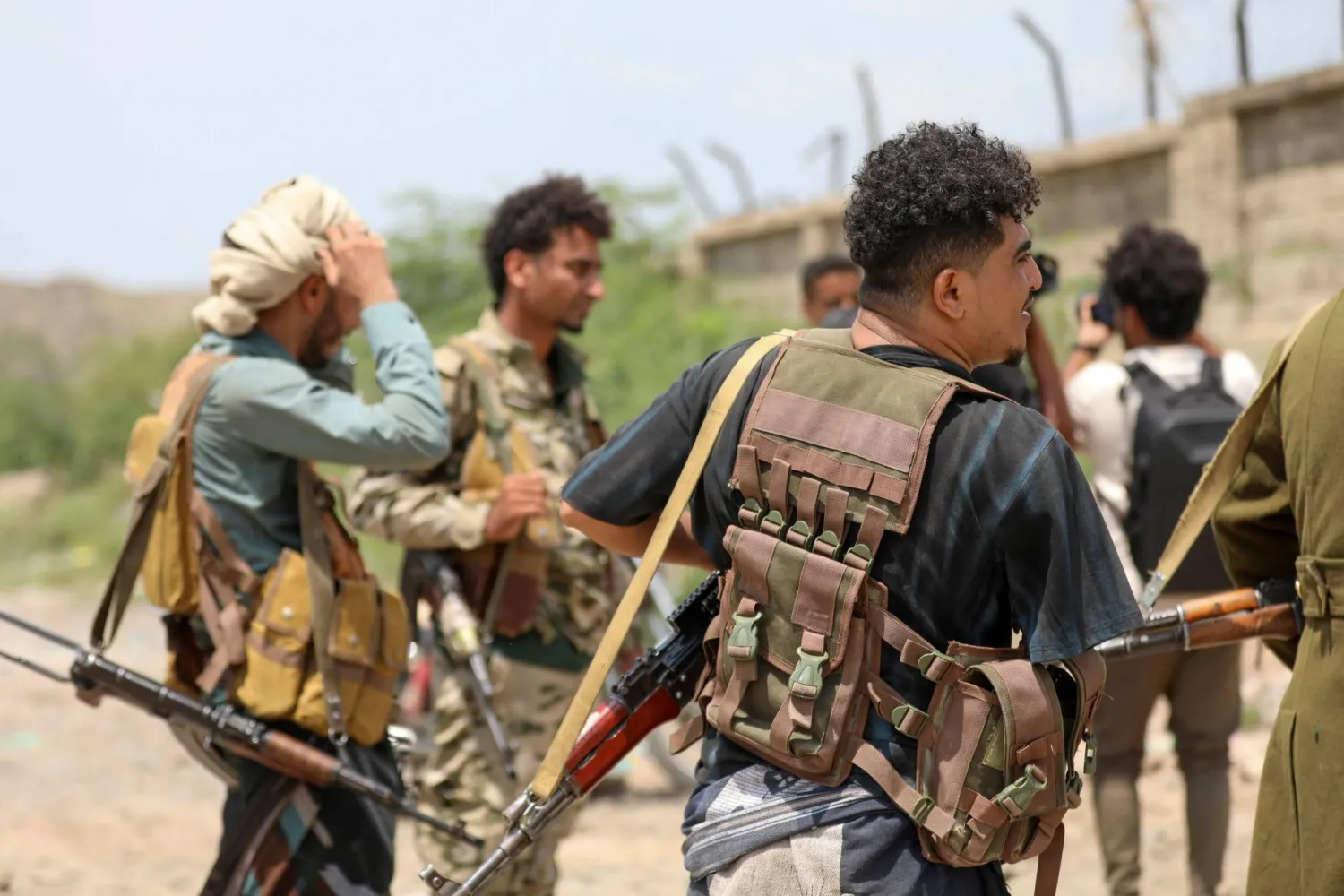
Yemen government soldiers gather near the Jabal Han front, west of the city of Taiz, (Photo by AHMAD AL-BASHA / AFP)
TT

Houthi Pressure Isolates Taiz from Its Southern Countryside Amid Fierce Resistance

Yemen government soldiers gather near the Jabal Han front, west of the city of Taiz, (Photo by AHMAD AL-BASHA / AFP)

The Iran-aligned Houthi group has deployed its full weight in the southwestern countryside of Taiz to seize the main roads linking the city with its southern rural areas and cut lines of communication toward Lahj province and the city of Aden. Government forces, backed by popular resistance, are meanwhile engaged in fierce fighting to halt the advance, alongside airstrikes targeting the group's reinforcements and military capabilities.

The front has gained particular importance as the Houthis continue to push forces into new areas in southern Taiz. Reports said the group took control on Sunday of the areas of Al-Safiya and Al-Barkani and cut the road linking Al-Turbah, the administrative center of Al-Shamayatayn district in the south, with Taiz city to the north. This would isolate the latter from the liberated areas of Lahj and Aden.

The front nevertheless remains open to intense fighting, amid indications that the Houthis are determined to maintain pressure along this axis. Field sources warned of the risks posed by continued attacks and the need for immediate reinforcements for government forces in the area.

Alongside the fighting in the southwestern countryside, government forces and popular resistance had made gains on several Taiz fronts, regaining control of the areas of Al-Maqarm and Al-Zakira in Al-Shamayatayn district, south of the province, following fierce clashes with the Houthis. The Houthis subsequently regained control of the areas.

Government forces on the southeastern front, with support from fighters from Sama district, also took control of Sama Fort before advancing toward the strategic Jabal Al-Jaasha after securing Jabal Sama Fort.

Sources said the operations resulted in significant human and material losses among the Houthis, including dozens killed or wounded, while a number of the group's militants fled the areas of confrontation. Fighting also continued, according to the same sources, on the Jabal Habashi and Al-Kadaha fronts.

On the Jabal Han and Hadhran front, west of Taiz city, fierce clashes broke out and ended, according to the Taiz Military Axis, with the defeat of the attacking forces and the killing of the Houthi commander who led the attack on government positions at Jabal Han.

257 Operations in One Day

At the same time as the ground fighting, government forces intensified operations against Houthi positions and movements across several fronts.

Yemeni Armed Forces spokesman Colonel Majid Al-Nazili said the forces carried out 257 precision strikes against Houthi positions, movements, and military capabilities using fighter aircraft, drones, artillery, missiles, and rocket launchers.

He said the operations covered Sanaa, Midi in Hajjah, Baqim in Saada, and fronts in Al-Jawf, Marib, Al-Bayda, and Lahj, with the operational focus on the Taiz fronts. He said the targets included command and control centers, gatherings, mobilization sites, combat reserves, as well as weapons and ammunition depots and military supply lines and means of transport.

According to Al-Nazili, the operations resulted, based on preliminary field estimates, in at least 700 Houthi militants being put out of action and the destruction of 170 combat vehicles and military assets. He said this had a direct impact on the group's combat capabilities and limited its ability to continue attacks against civilians in their homes and villages.

The Yemeni Armed Forces had also announced, in a separate development, that they had carried out 97 precision strikes against Houthi military reinforcements on the Tor Al-Baha front and the Taiz axis.

Al-Nazili said the operations involved fighter aircraft, drones, artillery, missiles, and snipers, resulting in 260 group members being put out of action and 44 military vehicles and means of transport and supply being destroyed or disabled.

The air force also announced strikes against Houthi targets in Sanaa and Saada, while the armed forces had earlier announced an attack against Houthi military targets in the capital, Sanaa.

These figures bring Houthi losses to nearly 6,000 killed or wounded over the course of a week, according to successive statements by the Yemeni Armed Forces.

Mobilization and State of Alert

The developments on the ground in Taiz coincided with the government and armed forces moving to a higher level of military mobilization and preparedness.

The Ministry of Defense and the General Staff launched a general mobilization and public call to arms, in implementation of directives from Presidential Leadership Council Chairman Rashad Al-Alimi.

The announcement came during an expanded meeting chaired by Defense Minister Lieutenant General Taher Al-Aqili in Aden. General Staff Chief and Joint Operations Commander Lieutenant General Sagheer bin Aziz participated by video link from Marib, alongside the deputy defense minister, the deputy chief of staff, and heads of military departments and directorates.

Al-Aqili said the ministry had taken practical measures to implement the general mobilization and public call to arms, activate human resources and reserve mobilization channels, organize reception centers, and task the relevant authorities with beginning their assigned duties.

The Yemeni defense minister affirmed that the armed forces were carrying out their duty to defend the country and its sovereignty, defeat the Houthis, and restore state institutions, stressing military discipline and command, the mobilization of resources, and the integration of efforts.

For his part, bin Aziz said the declaration of general mobilization represented a national decision requiring an organized transition to the highest levels of preparedness, the unification of efforts and capabilities, improving the efficiency of the armed forces, and strengthening their ability to carry out their duties.

He stressed the need to complete the inventory of personnel, equipment, and requirements, organize call-up and reinforcement operations, raise levels of discipline and readiness, strengthen training and qualification, and work to build an integrated military and community effort.

Amid the intensifying fighting, the chief of staff held calls with military and field commanders in Taiz, including Major General Yousef Al-Sharaji, a member of the Supreme Military Committee and commander of the Taiz front; Major General Khaled Fadel, commander of the Taiz Military Axis; Major General Abdulaziz Al-Majidi, chief of staff of the axis; and Taiz Resistance Commander Rashid Shamsan.

Bin Aziz received briefings on the course of operations and the field situation across the province's various fronts. He praised the people of Taiz for their support for the armed forces and their initiative to participate in the fighting.

He affirmed that the armed forces across the various fronts and sectors stood alongside the forces fighting in Taiz, praising what he described as the fighters' efficiency and combat capabilities, as well as the performance of the fighter aircraft and drones.


Syria, Türkiye Hold Talks to Expand Cooperation Across Sectors

Syrian Foreign Minister Asaad al-Shaibani and his Turkish counterpart Hakan Fidan during a joint press conference in Ankara. (SANA via Anadolu)
TT

Syria, Türkiye Hold Talks to Expand Cooperation Across Sectors

Syrian Foreign Minister Asaad al-Shaibani and his Turkish counterpart Hakan Fidan during a joint press conference in Ankara. (SANA via Anadolu)

Syrian Foreign Minister Asaad al-Shaibani and his Turkish counterpart Hakan Fidan pledged on Tuesday to deepen bilateral ties and expand cooperation across various sectors, while calling for an end to Israeli attacks on Syria and respect for its sovereignty and territorial integrity.

The two ministers stressed the need to uphold the 1974 Disengagement Agreement to bolster regional stability.

Their remarks came at a joint press conference in Ankara following talks on strengthening the Syrian-Turkish partnership and addressing regional issues of mutual concern.

Shaibani said discussions covered bilateral relations, regional developments and the final steps toward establishing and activating a joint higher committee, reported Syria’s state news agency SANA.

He said the growing partnership between Damascus and Ankara was already yielding tangible results.

Shaibani cited the completed rehabilitation of the Aleppo-Birecik electricity interconnection line, with plans to boost its capacity to 500 megawatts, and the launch of direct flights from Damascus to Antalya and Izmir.

Work is also accelerating to rehabilitate border crossings, with the Qamishli-Nusaybin crossing expected to reopen soon.

"At the strategic level, we discussed ways to strengthen cooperation in training and capacity building and enhance coordination in combating terrorism and organized crime, based on the principle of Syrian state sovereignty over its entire territory," Shaibani said.

Rail, energy projects

Shaibani said Syria and Türkiye's strategic location as a vital corridor between Europe and the Gulf placed a shared responsibility on both countries.

The two sides agreed to accelerate a railway project linking Türkiye through Syria to Jordan and Gulf states.

Talks also focused on digital connectivity as "essential infrastructure for supporting trade and investment," alongside efforts to draft a strategic framework for linking regional electricity and gas networks.

Water security was another priority, with the ministers discussing ways to ensure "fair and stable water releases into the Euphrates River that meet farmers' needs," SANA quoted Shaibani as saying.

Trade nears $3.7 billion

Shaibani said bilateral trade approached $3.7 billion in 2025, surging more than 40% and moving the two neighbors closer to their shared target of $10 billion.

Efforts are underway to ease Syrian products' entry into Turkish markets and establish a legal framework to protect investors, facilitate financing and streamline visa procedures.

The two countries are also working to create conditions for the voluntary, sustainable and dignified return of Syrian refugees, he added.

Syria, Türkiye align on regional security

Turning to regional developments, Shaibani reaffirmed Syria's solidarity with Gulf countries over Iranian attacks targeting them since February, declaring Gulf security an integral part of Syria's national security.

He said Damascus and Ankara shared a commitment to a negotiated settlement that would end the wars and safeguard freedom of navigation through international waterways, particularly the Hormuz and Bab al-Mandeb Straits.

"A recovering Syria today stands as a strong bulwark against chaos and a bridge for trade and stability linking the Gulf with Türkiye and Europe," Shaibani said.

He described Syria's stability as the cornerstone of Middle East stability and Türkiye as an indispensable partner in achieving it.

Shaibani also announced that Syria's embassy in Ankara was expected to open early next month.

Fidan: Israel seeking to destabilize Syria

For his part, Fidan said relations between Türkiye and Syria were "deepening and growing stronger," pointing to the completion of numerous healthcare and education projects in Syria.

He reaffirmed Ankara's commitment to supporting Damascus across all sectors.

Fidan said the talks covered the full range of bilateral relations, including security and defense, and reiterated the importance of respecting Syria's sovereignty and territorial integrity.

He also stressed the need to strengthen Syria's capacity to clear remnants of war left by the former regime.

Fidan accused Israel of seeking to destabilize Syria, urging it to halt attacks on Syrian territory and comply with the 1974 Disengagement Agreement.


Ibb Records Highest Number of Cancer Cases in Yemen

A cancer treatment center in Ibb receives five to 10 new cases daily. (Local media)
TT

Ibb Records Highest Number of Cancer Cases in Yemen

A cancer treatment center in Ibb receives five to 10 new cases daily. (Local media)

Health fears are mounting in Yemen’s Houthi-controlled Ibb governorate, 192 kilometers south of Sanaa, as cancer cases are rising at an alarming rate, with five to 10 new cases recorded daily.

Residents are demanding an investigation into the surge amid growing concerns that it may be linked to crops irrigated with untreated sewage.

According to the National Cancer Control Foundation, based in the Houthi-controlled capital Sanaa, its Al-Amal Oncology Center in Ibb receives between five and 10 new confirmed cancer cases a day, raising alarm over the health situation.

The concerns come amid worsening environmental conditions across Yemen since the outbreak of the conflict. Weak government oversight and soaring energy and fuel costs have driven farmers on the outskirts of major cities, including Ibb, to irrigate crops with untreated sewage.

While no official scientific findings have established the direct causes of the surge, residents suspect a link to vegetables irrigated with sewage over the years.

Since the Houthis coup, the indiscriminate use of banned pesticides and chemical fertilizers has spread, turning the country's food supply into a source of serious health concerns.

Houthis accused of neglect

Residents estimate that around 60% of Yemeni cancer patients traveling to Egypt for treatment come from Ibb governorate.

They accuse the Houthis of turning a blind eye to agricultural practices that contaminate their food and failing to take decisive action to stop them.

Residents told Asharq Al-Awsat that the authorities had done little beyond directing a local university to hold a discussion on the issue, without taking practical steps to address the use of contaminated water for irrigation.

Meanwhile, cancer patients face worsening conditions at Al-Amal Oncology Center, where growing numbers arriving from across the governorate are straining already limited resources.

Medical sources told Asharq Al-Awsat that the center was under mounting pressure from rising patient numbers, while patients and their families struggled with treatment costs and difficulties obtaining essential medicines and medical services.

The sources said Ibb had recorded 9,000 cancer cases, the most across the country.

Despite its limited resources, the center's medical staff strive to provide free diagnostic and treatment services, including medical consultations, laboratory tests, chemotherapy, inpatient care and medication, as well as psychological support for patients.

Residents demand action

Medical sources warn that the center’s ability to sustain these services is increasingly at risk as patient needs outpace available support.

Residents are demanding urgent investigations into the rise in cancer cases, testing of water sources used to irrigate crops and tighter oversight of farms and markets. They are also calling for greater support for Al-Amal Oncology Center to strengthen its capacity to provide free treatment.

The plight of cancer patients in Yemen has deepened amid the collapse of the public healthcare system and the suspension of international support for dozens of medical facilities.

This has left charitable and community-run facilities, such as Al-Amal Oncology Center, as the only line of defense for thousands of impoverished patients unable to afford treatment abroad or costly chemotherapy drugs, amid unpaid salaries and deteriorating living conditions.


Yemen Intensifies Houthi Offensive as Parliament Approves Terrorism Law

Smoke rises after an airstrike on a Houthi position in Taiz. (Military media)
TT

Yemen Intensifies Houthi Offensive as Parliament Approves Terrorism Law

Smoke rises after an airstrike on a Houthi position in Taiz. (Military media)

Yemen is stepping up its military and legal campaign against the terrorist Houthi militia, with fighting raging across Taiz, Marib and Al-Jawf and airstrikes intensifying against the group's positions and military capabilities. Parliament also approved a law designating it a terrorist organization and criminalizing its activities, funding and arms supplies.

In the latest fighting, government forces backed by Popular Resistance fighters repelled a Houthi attack on their positions in Al-Shaqab, in southeast Taiz, where clashes and attacks by both sides have continued for weeks.

Government operations continued in northern Marib and southeastern Al-Jawf, backed by warplanes, drones and artillery under Operation Dawn of Yemen, with the military reporting hundreds of strikes on Houthi positions, fortifications, command centers and military equipment.

The Yemeni armed forces said they carried out 661 strikes in recent hours, including 15 airstrikes, 526 field artillery strikes, 53 drone strikes and 67 rocket launcher strikes, hitting Houthi troop concentrations, fortifications, weapons positions and military vehicle movements.

Colonel Majed al-Nuzaili, the armed forces' spokesperson, said the strikes killed or wounded 173 Houthi field commanders and fighters, destroyed or disabled 71 military vehicles and pieces of equipment, and destroyed forward command-and-control centers, observation posts and fortifications.

He said government troops were engaged in direct combat from northern Marib to southeastern Al-Jawf, targeting Houthi firing positions and combat formations deployed to the front lines.

Airstrikes also hit Houthi concentrations and fortifications in the Al-Alam sector of eastern Al-Jawf, as well as military equipment southeast of Al-Hazm.

In Taiz, government forces and Popular Resistance fighters continued to repel Houthi attacks across the province, including a fresh assault on Al-Shaqab.

The military said operations would continue on all fronts, with precautions taken to protect civilians and civilian infrastructure.

Yemen's Chief of the General Staff and Commander of Joint Operations, Lieutenant General Sagheer bin Aziz, briefed parliament on the fighting across multiple fronts, saying the Houthis had suffered heavy losses in personnel and equipment.

Bin Aziz said breaking the siege of Taiz must top the national military campaign's priorities, calling it essential to restoring state institutions, ending the coup, easing residents' suffering and restoring their rights to life, freedom and movement.

Parliament approves terrorism law

Alongside the military campaign, Yemen's parliament unanimously approved a law designating the Houthis a terrorist organization and criminalizing their activities and financing after two days of debate.

The legislation will be submitted to Rashad al-Alimi, chairman of the Presidential Leadership Council.

The vote followed a review by a special parliamentary committee chaired by Deputy Speaker Mohsen Basura, with parliamentary bloc leaders, the constitutional committee and government representatives taking part. Lawmakers then debated and voted on the bill article by article.

The law comprises 55 articles across nine chapters, classifying the Houthis and all their political, military and civilian formations as a terrorist organization. It sets out offenses, penalties and legal measures to prosecute those implicated in the group's violations and cut off its funding and arms supplies.

It bans the promotion of hereditary and sectarian supremacy and criminalizes the seizure of state powers, sieges and starvation of cities, attacks on civilians, public facilities, private property and roads, and the planting of landmines.

It also criminalizes attacks on international shipping and essential infrastructure, including water, electricity, healthcare and transportation services.

The law imposes penalties for recruiting, training and arming individuals, including the death penalty in specified cases, and establishes procedures to trace, seize, freeze and confiscate funds, assets and property linked to the Houthis and affiliated entities.