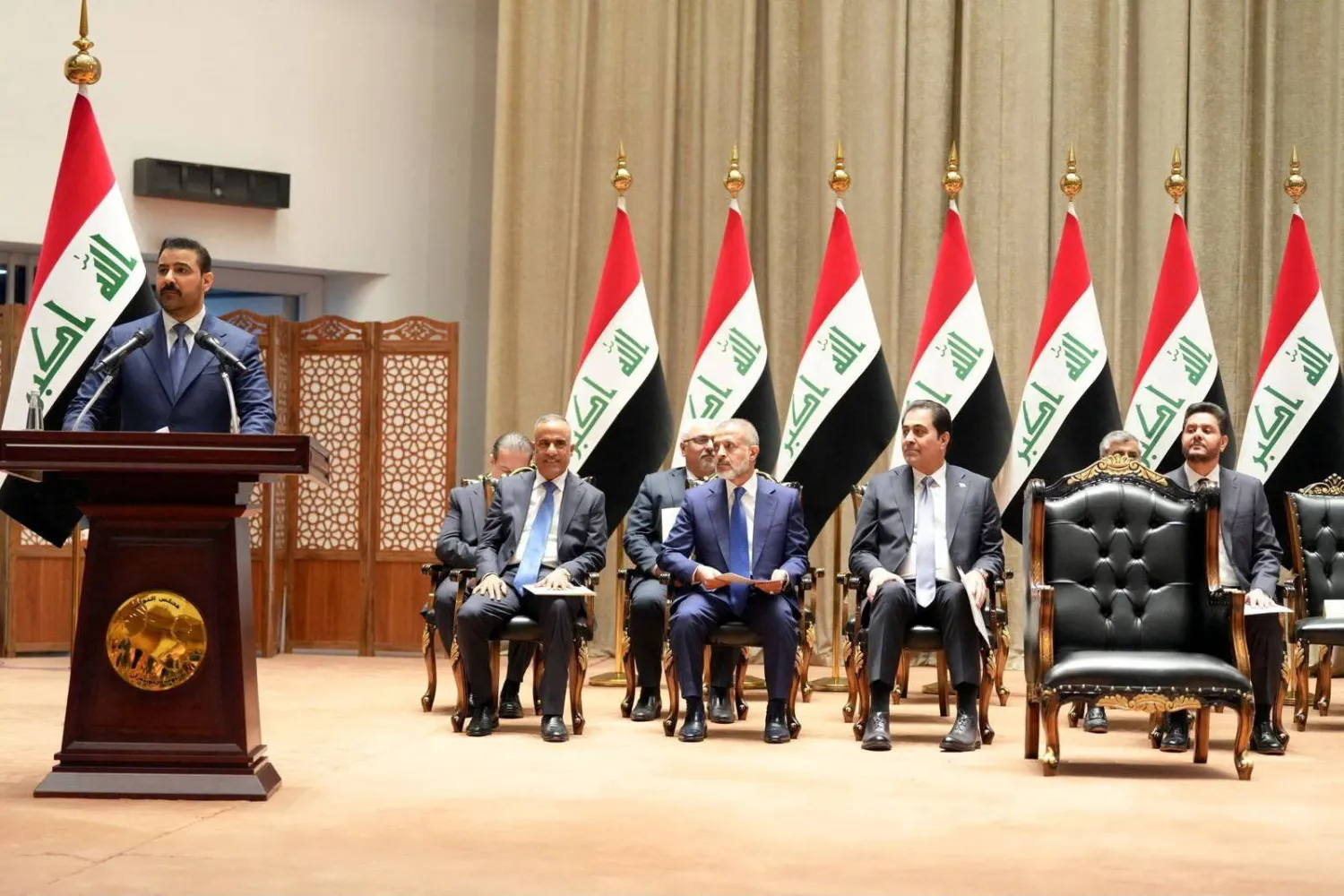

Iraq's parliament voted Thursday to appoint ministers to previously vacant Cabinet posts and complete the country's government, including a deputy prime minister who is under US sanctions.
Laith al-Khazali, appointed to that post, is the brother of Qais al-Khazali, leader of the Iran-backed Asaib Ahl al-Haq armed faction. Laith al-Khazali was arrested by US forces in 2007 over allegations related to an attack targeting American forces in Karbala in January of that year, which resulted in the deaths of five US soldiers.
He was released from US custody in June 2009. In 2019, the US Treasury Department imposed sanctions on him, citing his leadership role in Asaib Ahl al-Haq and allegations involving human rights abuses as well as the 2007 attack.
His appointment to a senior government position raises questions about its potential implications for relations between Baghdad and Washington. Iraqi Prime Minister Ali al-Zaidi was backed by US President Donald Trump when he took the post and has strong relations with Washington, but he has also sought to maintain relations with Iran.
Past Iraqi governments have also sought to balance relations with Washington and Tehran, but the balancing act has become more difficult since the US and Iran went to war on Feb. 28.
There was no immediate official statement from the US on the appointment.
Republican US Rep. Joe Wilson wrote on X that al Khazali “is a designated terrorist and Iranian puppet whose militia AAH killed Americans and Iraqis.”
“He is no better than ISIS, maybe even worse,” Wilson said. "It is outrageous but sadly not shocking that he has been appointed deputy PM of Iraq.”
The parliament also appointed two other deputy prime ministers, as well as a new interior minister, defense minister, planning minister, minister of higher education and scientific research, and culture minister.
The other Cabinet posts had been appointed five months earlier.
Al-Zaidi said in a statement that with the vacant posts filled, “we are embarking on a phase of accelerated, diligent work” and pledged to "move forward in implementing our government’s priorities and program, and in fulfilling the aspirations of all Iraqis.”
He said the government had worked over the past several months amid complicated domestic and international circumstances, noting that the war in the region had imposed exceptional economic challenges on Iraq, in addition to security challenges.
Al-Zaidi has vowed to fight corruption and strengthen Iraq's sovereignty, both by completing the withdrawal of US forces from the country and by disarming non-state armed groups.
Some of the most powerful factions have said they have no intention of giving up their weapons, although Asaib Ahl al-Haq is one of a handful that have agreed to hand over their arms.