


Chinese Grand Prix Could Deliver Drama to F1 and Slow Verstappen’s Victory March 

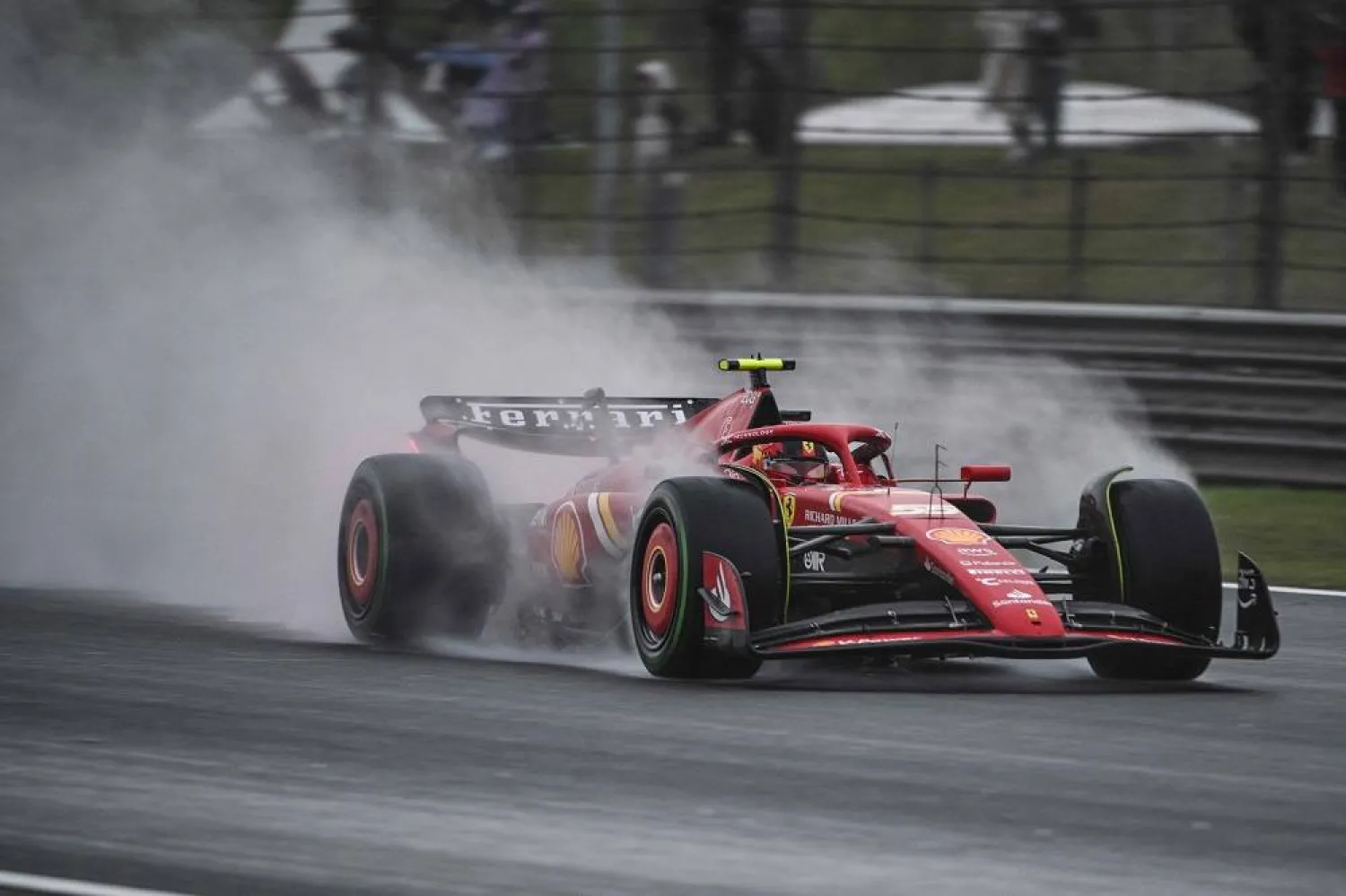
Ferrari's Spanish driver Carlos Sainz Jr drives during the sprint qualifying session ahead of the Formula One Chinese Grand Prix at the Shanghai International Circuit in Shanghai on April 19, 2024. (AFP)
TT

Chinese Grand Prix Could Deliver Drama to F1 and Slow Verstappen’s Victory March 

Ferrari's Spanish driver Carlos Sainz Jr drives during the sprint qualifying session ahead of the Formula One Chinese Grand Prix at the Shanghai International Circuit in Shanghai on April 19, 2024. (AFP)

The Chinese Grand Prix could deliver some much-needed drama to Formula One, meaning Red Bull's Max Verstappen can't be penciled in as the almost-certain winner on Sunday.

The three-time world champion has won 22 of the last 26 GPs and three of the first four this season. Only brake failure in Australia kept him from possibly sweeping the first four races.

"It's got the probability of throwing up quite a few variables and, perhaps, some unexpected results," Red Bull principal Christian Horner said Friday. "I think it's going to be all action."

Here's why.

The track is a slight unknown. This is the first F1 race in China in five years, scratched from the calendar by the COVID-19 pandemic. The last was won in 2019 by Mercedes' Lewis Hamilton.

It's also the season's first with a Saturday sprint race, which means Friday's practice session was the only one of the weekend.

But the biggest unknown is the state of the racing surface, which has had a thin "seal coating" applied — described as liquid asphalt. Drivers have repeatedly said it looks like it's been painted. And tire supplier Pirelli said it wasn't fully aware of the changes heading into the race.

Though hard to draw any firm conclusion, Friday's practice kicked up some unusual names at the top.

Lance Stroll of Aston Martin had the quickest time (1 minute, 36.302 seconds), followed by Oscar Piastri of McClaren. Verstappen and teammate Sergio Perez were Nos. 3-4 followed by two Haas drivers — Nico Hulkenberg and Kevin Magnussen.

China’s first F1 driver Zhou Guanyu was 11th in practice in a Sauber.

Charles Leclerc hinted on Thursday about Ferrari closing the gap on Red Bull.

They didn't in Friday’s practice. Leclerc and teammate Carlos Sainz were 13th and 14th.

"Everything we expected in terms of uncertainty is happening and hopefully this will mean that we have an entertaining event here in China with some action and some opportunities," McLaren team principal Andrea Stella said.

He said there was reduced tire grip in the practice session, and tires showed heavy wear from the unfamiliar surface.

Drivers spoke two weeks ago at the Japanese GP about their disquiet over the sprint in China. The track is located about 40 kilometers (25 miles) northwest of central Shanghai, visible on the distant horizon through a hazy smog on Friday.

Horner accepted the concern but noted the Shanghai circuit is a known quantity, hosting races since 2004.

"We have a lot of historic data from this circuit," he said. "It’s not like turning up at a brand new venue and having to learn all over again."

SPRINT QUALIFYING Lando Norris of McLaren won the pole for Saturday’s sprint race, running in a rainy session with drivers struggling to control their cars.

Norris’ qualifying lap in the third session was 1 minute, 57.940 seconds. The times in the rain on Friday were about 20 seconds slower than when qualifying began under dry conditions.

Norris will start from the pole with Hamilton alongside. Fernando Alonso of Aston Martin will start on the second row with Verstappen. Row 3 has Sainz and Perez.

Asked what the race conditions would be on Saturday, Norris replied: "No clue."

"It was getting wetter and wetter," Norris said. "I was aquaplaning quite a bit."

The F1 sprints are about one-third the length of the regular GP. The top eight drivers earn points — eight for first place, seven for second, six for third, and so on.

Qualifying was slowed by off-and-on rain that got more persistent as the session went on. Leclerc went off and hit a retaining wall and appeared to damage a front wing during one of his laps.

Many of the cars struggled for grip including Verstappen, who went off the track on one of his laps.

The sprint will be followed later Saturday with qualifying for Sunday's race.

DRIVERS' SHUFFLE Horner was asked Friday if Red Bull was close to confirming its driver lineup for next season. Verstappen, of course, is on a long-term contract. The question is over Perez, whose contract expires after this season.

Reports persist that Ferrari's Sainz is a possibility. His seat at Ferrari will be taken next year by Hamilton who is leaving Merdeces. Sainz is also reportedly in talks with Audi, which will take over Sauber for the 2026 season,

"We’re in a situation where we’re very happy with our two drivers," Horner said. "We don't need to make a final decision about the lineup until pretty much later in the year."



Algeria’s Luca Zidane Doubt for World Cup After Jaw Fracture

Luca Zidane. (AFP)
Luca Zidane. (AFP)
TT

Algeria’s Luca Zidane Doubt for World Cup After Jaw Fracture

Luca Zidane. (AFP)
Luca Zidane. (AFP)

Algeria goalkeeper Luca Zidane is a doubt for the World Cup after suffering a jaw and chin fracture while playing for his club Granada in Spain's second tier.

The son of former France great Zinedine Zidane was taken off with a concussion after colliding with an opponent during his team's 4-2 home defeat by Almeria on Sunday.

The 27-year-old is expected to miss the rest of the season and could be out for even longer if he needs surgery.

"The player, in consultation with the club's medical staff, will decide in the coming hours on the course of treatment to be followed," said the club in a statement late Monday.

Luca Zidane is Algeria's first-choice goalkeeper and their back-up options Anthony Mandrea and Melvin Mastil are also currently out injured.

Algeria's World Cup campaign begins on June 16 against reigning champions Argentina.


A Bird Leaves Nothing Behind: The Lesson Behind Japan’s World Cup Stadium Cleanups

Japan supporters clean the stands at the end of the World Cup group E football match between Germany and Japan, at the Khalifa International Stadium in Doha, Qatar, Wednesday, Nov. 23, 2022. (AP)
TT

A Bird Leaves Nothing Behind: The Lesson Behind Japan’s World Cup Stadium Cleanups

Japan supporters clean the stands at the end of the World Cup group E football match between Germany and Japan, at the Khalifa International Stadium in Doha, Qatar, Wednesday, Nov. 23, 2022. (AP)

If there's one country guaranteed to clean up at the World Cup, it's Japan.

Literally.

Scenes of Japanese football fans sweeping stadiums and picking up trash after a match first drew public attention in France in 1998 — Japan's first appearance in the World Cup.

The tradition has continued every four years. It happened at the World Cup in Qatar in 2022, and it's certain to continue when Japan opens play in June with group games in Arlington, Texas, and Monterrey, Mexico.

The cleanup astonishes non-Japanese who might be accustomed to leaving stadiums and stepping over half-eaten food, shredded paper wrappers, and cups — empty or with liquid dribbling out.

At the World Cup in Russia in 2018, Japanese players famously cleaned the dressing room after a loss and left a thank-you note in Russian. In 2022, fans left thank-you notes on rubbish bags written in Arabic, English and Japanese.

Why do Japanese behave this way? It's not that complicated. Beginning in elementary school, students are socialized to behave this way — in the classroom, in the school yard or on a playing field.

“Japanese sports fans at world events who clean up the stadium are behaving much the same way they did when they learned how to enjoy sports as school boys and girls,” Koichi Nakano, who teaches politics and history at Sophia University, told The Associated Press.

There is a phrase in Japanese that explains it.

“Tatsu tori ato wo nigosazu.”

The literal translation is: “A bird leaves nothing behind.”

Rendered in English the message is: “Return it the way you found it.”

Many Japanese elementary schools don’t have janitors, so the clean-up work is left to students. Office workers often dedicate time to sprucing up their areas.

Also, there are relatively few trash containers in public spaces in Japan, so people take their waste home with them. This keeps the sidewalks cleaner, saves the cost of emptying trash cans, and keeps away vermin.

“The way most ordinary soccer fans experience soccer at school is no different from other sports, and the emphasis is not just on physical education but also on moral education as well,” Nakano added.

Collective vs. the individual

Raised in Germany, Barbara Holthus is the deputy director of the German Institute for Japanese Studies in Tokyo. A sociologist, she agrees it's prudent not to put Japanese on a pedestal. Japan, like any country, has its own challenges and shortcomings.

“An academically sound explanation is that people in Japan just happen to be socialized different,” she told The AP. “If you grew up with a certain way of how things are being done, you apply that to even cleaning up a stadium afterwards.”

At work here is also the Japanese concept of “meiwaku,” which implies not causing trouble or annoying others. From the Japanese point of view, leaving rubbish piled up in a stadium would be a bother to others.

Japan is a relatively crowded place, and greater Tokyo alone has about 35 million people, almost the population of the entire state of California. People need to get along.

“Japanese learn early on that you don't want to inconvenience other people,” Holthus said.

She said the focus is often on the collective, compared with the West where the emphasis is on the individual and individual rights.

“You don’t want to bother people. It goes to all areas of life in Japan,” Holthus added. “We are raised (in the West) that we don’t have to clean up after ourselves in public spaces because there is going to be some kind of public service doing that.”

And because Japanese people have received widespread praise for the clean-up, the behavior has been reinforced.

“Now that the media has latched onto the story and lavished praise on Japanese fans, they have made it a point of pride to display those values and norms,” Jeff Kingston, who teaches history at Temple University in Japan, wrote in an email.

A Japanese tradition

The clean-up tradition is not limited to football’s marquee tournament. The same thing happened last year at the Under-20 World Cup in Chile as Japanese fans cleaned up after a match. And even more recently last month at Wembley Stadium in London where Japan defeated England 1-0 in an international friendly.

“It’s one of our traditions,” said Toshi Yoshizawa, who was leading the cleanup in Chile. “We grew up with the teaching that we should leave a place cleaner than when we arrived.”

William Kelly, an emeritus professor of anthropology at Yale University and a specialist on Japan, said the tradition is linked to football more than other sports. He speculated it's tied to the establishment of Japan's professional football league more than 30 years ago.

“It (the J-League) was trying to distinguish itself from baseball by emphasizing teams’ community embeddedness and commitment,” Kelly wrote in an email. “Soccer fans felt, and feel, more a part of the club and its stadium.”


Riyadh to Host Joshua vs. Prenga Showdown in July

Boxing - Jake Paul v Anthony Joshua - Kaseya Center, Miami, Florida, US - December 19, 2025 Anthony Joshua after winning his fight against Jake Paul. (Reuters)
TT

Riyadh to Host Joshua vs. Prenga Showdown in July

Boxing - Jake Paul v Anthony Joshua - Kaseya Center, Miami, Florida, US - December 19, 2025 Anthony Joshua after winning his fight against Jake Paul. (Reuters)

Chairman of the Board of Directors of Saudi Arabia’s General Entertainment Authority Turki Alalshikh announced the return of British boxer Anthony Joshua to the ring in “The Comeback,” scheduled for July 25 in Riyadh.

The 36-year-old Joshua will fight Kristian Prenga, an Albanian with 20 victories and one loss.

Joshua’s last fight was a knockout victory over YouTuber Jake Paul on Dec. 19. Ten days later, he was injured in a car crash in Nigeria that killed two of his friends.

“It’s no secret I’ve taken some time to consolidate and rebuild to be ready for stepping back into the ring,” Joshua said in a Matchroom statement, “and today is the next step on that journey.”

In the statement, Joshua said the fight with Prenga is the first in a “multi-fight deal."

The event forms part of the Kingdom’s continued hosting of major international boxing matches, further cementing Riyadh’s status as a premier destination for global sports and entertainment.

The bout will be broadcast live worldwide on DAZN.