


No World Records Have Been Set at the Olympic Pool

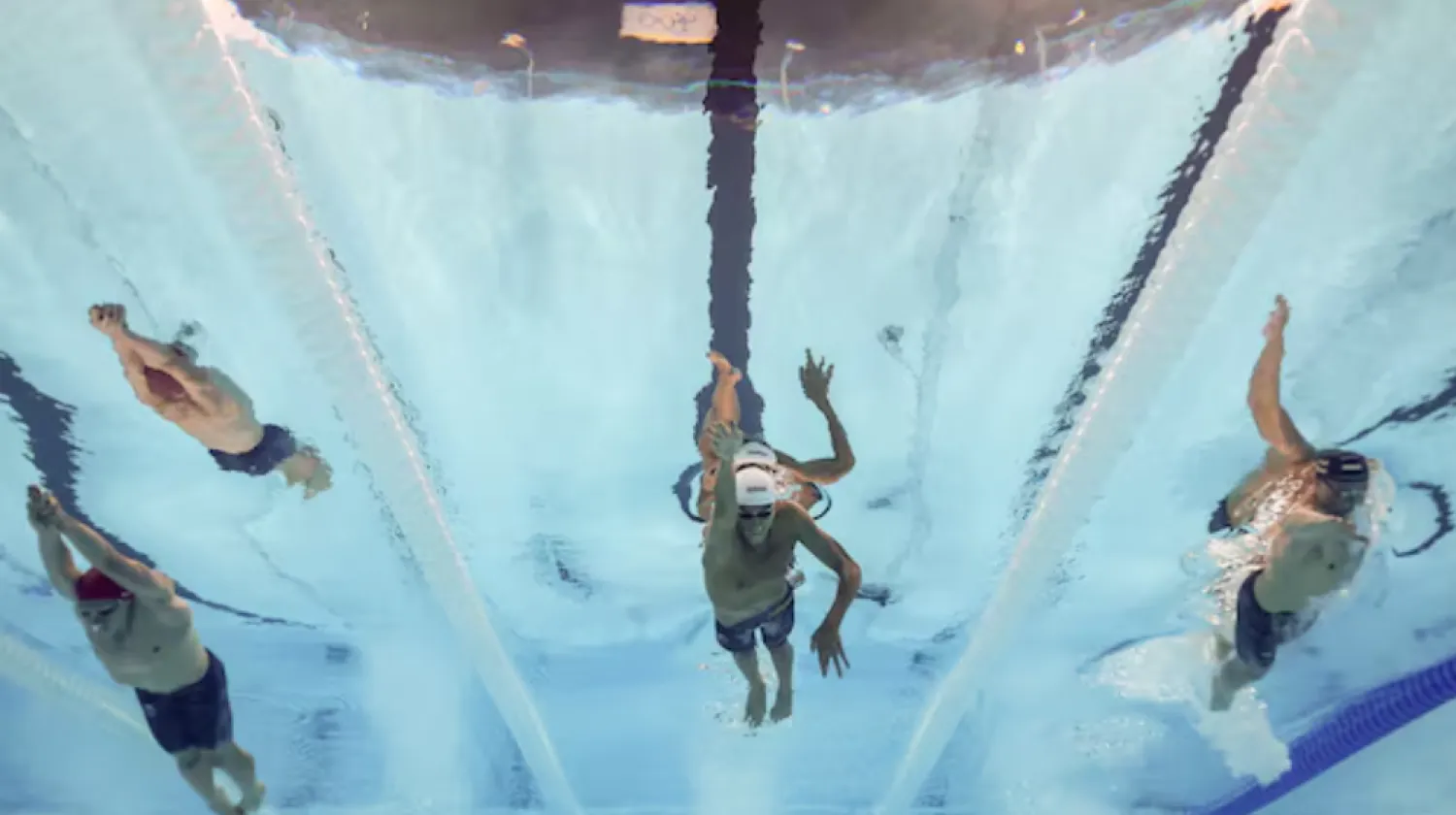
Paris 2024 Olympics - Swimming - Men's 200m Freestyle Final - Paris La Defense Arena, Nanterre, France - July 29, 2024. David Popovici of Romania, Luke Hobson of United States and Duncan Scott of Great Britain in action. REUTERS/Marko Djurica Purchase Licensing Rights
TT

No World Records Have Been Set at the Olympic Pool

Paris 2024 Olympics - Swimming - Men's 200m Freestyle Final - Paris La Defense Arena, Nanterre, France - July 29, 2024. David Popovici of Romania, Luke Hobson of United States and Duncan Scott of Great Britain in action. REUTERS/Marko Djurica Purchase Licensing Rights

The atmosphere for Olympic swimming is electrifying.

The times? Not so much.

Through the first four days of competition in the portable pool at La Defense Arena, no world records were set. It's becoming more and more apparent that a truly extraordinary performance will be required to take down an existing standard, The AP reported.

The culprit for the slower-than-expected times appears to be a pool that is slightly shallower than the optimal depth, which allows a couple of extra rows of prime deck-side seats to remain in use but creates more waves and turbulence rolling up to the surface.

“I’ve heard the rumblings, but at the end of the day we’re here to race,” American star Katie Ledecky said. “We’re all fast swimmers. We make the pool as fast as we want it to be. I’m not really thinking about it.”

Going forward, World Aquatics has mandated a minimum depth of 2.5 meters (8.2 feet) for swimming and water polo events, such as the portable pool that will be installed inside SoFi Stadium for the 2028 Los Angeles Games.

But when the Olympics were awarded to Paris, the temporary facility was approved under previous guidelines that allowed for a depth of 2.2 meters (7.2 feet).

For perspective, a 3-meter (9.8 feet) pool is considered the optimal depth. At the US trials in Indianapolis, where the portable pool installed in Lucas Oil Stadium was around 2.8 meters (9.1 feet), two world records were set.

No complaints about the atmosphere Torin Koos, a spokesman for World Aquatics, noted that five Olympic records were set through the first 15 events at La Defense Arena.

Indeed, no one is griping much. Everyone is competing under the same conditions, so it's not like anyone has an advantage. For the most part, the favored swimmers are coming out on top.

“I try not to pay attention to it just because we’re all in the same pool," said American Katie Grimes, who claimed a silver in the 400-meter individual medley. "I mean, regardless if it’s a slow pool or not, it’s not going to affect just one person. It’s affecting everybody.”

Everyone has raved about the raucous setting, more than 15,000 strong for every session in an indoor stadium that is normally used by the famed rugby club Racing 92. The crowds are loud and boisterous, especially when French star Leon Marchand dives in the water.

“It doesn’t matter whether I’m racing here in in Paris or at a local country pool in South Australia,” Aussie sprinter Kyle Chalmers said. “It’s all about winning that race in the pool. Everyone has the same opportunity. Everyone has a lane. We’re all swimming in the same pool. It’s not like some people are sending their times in from the trials or anything like that.”

Maybe it's the pressure of the moment Chalmers doesn't believe the pool is entirely to blames for the slower-than-expected races.

“There’s a lot of pressure and expectation that people put on themselves,” he said. “A lot of people haven’t swam in the Olympics before. I think the nervous energy of having like (15,000 fans) in the stadium is crazy. I personally love it, but I think people do definitely crack under that pressure.”

Many swimmers are slower at the Olympics Still, the times are a bit jarring.

Summer McIntosh blew away Grimes and the rest of the field in the 400 IM, but the 17-year-old Canadian went more than three seconds slower than her world-record showing at her country's Olympic trials in May.

David Popovici of Romania captured gold in the men's 200 freestyle with a time of 1 minute, 44.72 seconds, the slowest by an Olympic champion in that event since Pieter van den Hoogenband at the 2000 Sydney Games.

Then there's Nicolò Martinenghi of Italy, whose gold-medal time of 59.03 in the 100 breaststroke would not have been good enough to claim a medal of any color at the last two Summer Games. It was the slowest winning performance since Japan's Kosuke Kitajima two decades ago at the Athens Olympics.

A look back at previous Olympics At least one swimming world record has been set at every Olympics in the post-World War II era, and it's common for multiple marks to fall.

A whopping 23 world records were set at the 2008 Beijing Games, when the sport was in the midst of the rubber-suit revolution. The following year, at the world championships in Rome, a staggering 43 marks were established, leading the world governing body to impose strict new rules governing body coverage and fabrics.

Since then, the pace of world records has returned to more customary levels, with several marks from those 2009 worlds still on the books. But it's generally assumed that most everyone will be at their best when an Olympic year rolls around, which usually leads to a spirited assault on the record list.

Nine world records were set at London in 2012, eight more fell at the 2016 Games in Rio de Janeiro, and a half-dozen were broken at the pandemic-delayed Tokyo Games three years ago, when swimmers competed in a mostly empty arena because of COVID-19 restrictions.

The lack of fans hasn't been an issue in Paris, where the cacophony of a large arena filled to the rafters with passionate supporters has given everyone an extra push.

Not quite enough to call for a rewrite to the record book, but Chalmers and others don't really seem to mind.

“It doesn’t matter about times,” the Aussie said. “It’s about getting your hand on the wall first and winning the race. The times are never really all that remembered.”



Alcaraz Withdraws from Wimbledon with Wrist Injury

Tennis - Wimbledon - All England Lawn Tennis and Croquet Club, London, Britain - July 14, 2024 Spain's Carlos Alcaraz poses for a picture with the trophy after winning his men's singles final against Serbia's Novak Djokovic. (Reuters)
TT

Alcaraz Withdraws from Wimbledon with Wrist Injury

Tennis - Wimbledon - All England Lawn Tennis and Croquet Club, London, Britain - July 14, 2024 Spain's Carlos Alcaraz poses for a picture with the trophy after winning his men's singles final against Serbia's Novak Djokovic. (Reuters)

Carlos Alcaraz's hopes of regaining his Wimbledon title have been dashed with the two-time champion announcing Tuesday he is withdrawing as he recovers from a wrist injury.

"My recovery is going well and I'm feeling much better, but unfortunately I'm still not ready to play, I am obliged to withdraw from both Queen's and Wimbledon," said Spaniard Alcaraz, who lost to world number one Jannik Sinner in last year's final.

"These are two really special tournaments for me and I'll miss them a lot. We'll keep working to come back as soon as possible."

Alcaraz sustained the injury during the first round of the Barcelona Open and subsequently pulled out of tournaments in Madrid and Rome and then Roland Garros, where he is the reigning two-time champion.

The world number two became the youngest man to complete the career Grand Slam in January with his triumph at the Australian Open. The 23-year-old holds a 22-3 record this season and also won a title in Doha.

Wimbledon will be only the third Grand Slam that Alcaraz has missed since making his main draw debut at the 2021 Australian Open.

Alcaraz's injury has stopped him continuing his exciting rivalry with Italian Sinner, 24, who is firm favorite to triumph in Paris and London.


Guardiola Set for Emotional Man City Farewell After Era-Defining Decade

Manchester City's Spanish manager Pep Guardiola poses with the trophy on the pitch after the English FA Cup final football match between Chelsea and Manchester City at Wembley stadium in London, on May 16, 2026. (AFP)
TT

Guardiola Set for Emotional Man City Farewell After Era-Defining Decade

Manchester City's Spanish manager Pep Guardiola poses with the trophy on the pitch after the English FA Cup final football match between Chelsea and Manchester City at Wembley stadium in London, on May 16, 2026. (AFP)

Pep Guardiola is expected to take charge of Manchester City for the final time on Sunday, drawing the curtain down on a decade that has reshaped not only his club but English football itself.

When the Catalan arrived in 2016, he was already regarded as one of the game's great innovators. What followed was something even more profound: a transformational reign that turned City from wealthy contenders into the defining team of an era.

Ten years on, Guardiola leaves City having won 15 major trophies, not including the UEFA Super Cup and Club World Cup.

His trophy cabinet includes six Premier League titles -- including a record four in a row -- and the club's first Champions League crown, a haul that places him among the most successful ‌managers in English ‌football history.

This season alone, he has guided City to both the League ‌Cup ⁠and FA Cup ⁠titles, and pushed Arsenal right to the wire in the Premier League race.

His final match, expected to be Sunday's league game against Aston Villa, will close the book on a story of dominance, reinvention and influence that extended far beyond results.

And the Etihad Stadium crowd will surely soak up every second, singing their tribute song to their beloved manager: "We've got . . . Guardiola!" to the tune of The Dave Clark Five's "Glad All Over".

Guardiola's legacy at City is measured not just in silverware but in the scale of control his teams exerted. At their peak, ⁠they amassed points totals previously unimaginable, winning four straight league titles between ‌2021 and 2024 and forcing rivals into near-perfection just to keep ‌pace.

In 2023, they completed the treble, joining Manchester United's 1999 side as the only English teams to hoist the ‌league, FA Cup and Champions League trophies in the same season.

GAME CHANGER

The 55-year-old is credited with changing ‌the game by imposing a level of control and technical precision rarely seen in English football, turning City into the benchmark for how the game could be played.

His teams did not simply win; they dominated by keeping the ball, dictating tempo and suffocating opponents through positional play and relentless pressing.

Beyond the results, fans will surely miss Guardiola's entertaining, ‌restless presence. Usually dressed in his favored knit jumpers and smart trousers, he prowls the technical area, arms cutting through the air as he ⁠points, waves and barks instructions.

Frustration ⁠flashes quickly, sometimes with a sharp kick at a cooler. He has been known to cushion stray balls with a deft touch of a foot, or turn and encourage the crowd to cheer.

He frequently speaks to opposing players on the pitch after matches, to offer tactical tips or praise a performance.

City's players have praised his impact and marveled at his relentless quest for excellence.

"He changed the way I see football," City captain Bernardo Silva said after Saturday's FA Cup win.

"That winning mentality is nothing like I've ever seen," defender John Stones added.

For all the tactics, Guardiola's greatest legacy will have been cultural. He made style the norm and forced the Premier League to evolve around it.

If Sunday indeed ends his tenure, his influence will not fade.


Stuttering Sabalenka Seeks to Set Down Marker at Roland Garros

 Belarus' Aryna Sabalenka returns the ball to Romania's Sorana Cirstea during their match at the Italian Open tennis tournament in Rome, Saturday, May 9, 2026. (AP)
Belarus' Aryna Sabalenka returns the ball to Romania's Sorana Cirstea during their match at the Italian Open tennis tournament in Rome, Saturday, May 9, 2026. (AP)
TT

Stuttering Sabalenka Seeks to Set Down Marker at Roland Garros

 Belarus' Aryna Sabalenka returns the ball to Romania's Sorana Cirstea during their match at the Italian Open tennis tournament in Rome, Saturday, May 9, 2026. (AP)
Belarus' Aryna Sabalenka returns the ball to Romania's Sorana Cirstea during their match at the Italian Open tennis tournament in Rome, Saturday, May 9, 2026. (AP)

Aryna Sabalenka looked unbeatable when the clay-court season got underway last month, but now as the world number one arrives in Paris for her latest tilt at winning Roland Garros, her dominance of the women's game has started to show cracks.

The four-time Grand Slam champion still holds more than 1,000 ranking points on her closest challengers but foremost on her mind over the next fortnight will be going one better than her runner-up finish last year in the French capital, when she lost in three sets to Coco Gauff.

If her aims ahead of the tournament, which starts on Sunday, mirror that of her men's counterpart, Jannik Sinner who is also hunting a first title on the red dirt in Paris, Sabalenka's stranglehold over her competitors is suddenly a lot less dominant than the Italian's.

When Sabalenka swept to the Sunshine Double at the WTA 1000 hardcourt events in Indian Wells and Miami in March, she had then won three of the four tournaments she had played in this season -- the only blight on that record being a three-set defeat to Elena Rybakina in the Australian Open final.

And as she jetted into Madrid for the start of the European clay swing on a 15-match winning streak, it had seemed little would stand in her way to claiming a fourth career title at the Caja Magica as she began preparations for the French Open.

But a quarter-final exit at the hands of 30th seed Hailey Baptiste put paid to the Belarusian's ambitions in Spain, before she followed that up by crashing out of the Italian Open against a resurgent Sorana Cirstea in the third round, after which she said she felt like "my body was limiting me from performing on the highest level".

"I guess we never lose; we only learn, so it's OK," Sabalenka mused after exiting a 1000 tournament at the round-of-32 stage for the first time since February 2025.

With the 28-year-old top seed now looking uncertain on the clay, the draw again appears to be wide open.

- 'Big battles' -

Rybakina, who beat Sabalenka in last season's WTA Finals decider and then in Melbourne in January to claim her second major title, will be one of the main contenders despite having never progressed beyond the last eight at Roland Garros.

The Kazakh world number two is the player who has arguably enjoyed the best season on the tour this year, barring Sabalenka, and last month won indoor on the clay in Stuttgart but similarly had disappointing runs in Madrid and Rome.

Iga Swiatek, the erstwhile "queen of clay", has of late shown glimpses of the form that took her to world number one and four Roland Garros titles in the early 2020s.

Since her last triumph in Paris two years ago, the 24-year-old has struggled to find consistency but will be hoping her new collaboration with Rafael Nadal's former coach Francisco Roig can help her re-find her best tennis on the surface she had for so long dominated.

Defending champion Gauff will certainly not cede her title lightly and the world number four enters the fray on the back of a strong run in Rome, which ultimately ended in defeat at the final hurdle to the in-form Elina Svitolina.

The 31-year-old Ukrainian has won two titles already this year, including a first 1000-level crown in eight years at the Italian Open, and will certainly fancy a deep run in Paris, after reaching the final eight for the fifth time in her career last year.

"(Winning Rome) gives me a lot of confidence. Gives me a good look at Roland Garros," Svitolina said.

"But... There are really tough players. You cannot underestimate (them). You need to be ready for the first-round matches, big battles. Everybody's there to beat you."

Alongside Svitolina, Madrid Open winner Marta Kostyuk, rising starlets Mirra Andreeva, Iva Jovic and Victoria Mboko, as well as Amanda Anisimova will be dark horses for a maiden Grand Slam title.