


Bizarre Red Cards: Gueye Joins List Including Zidane, Simunic and Hazard After Slapping Own Teammate

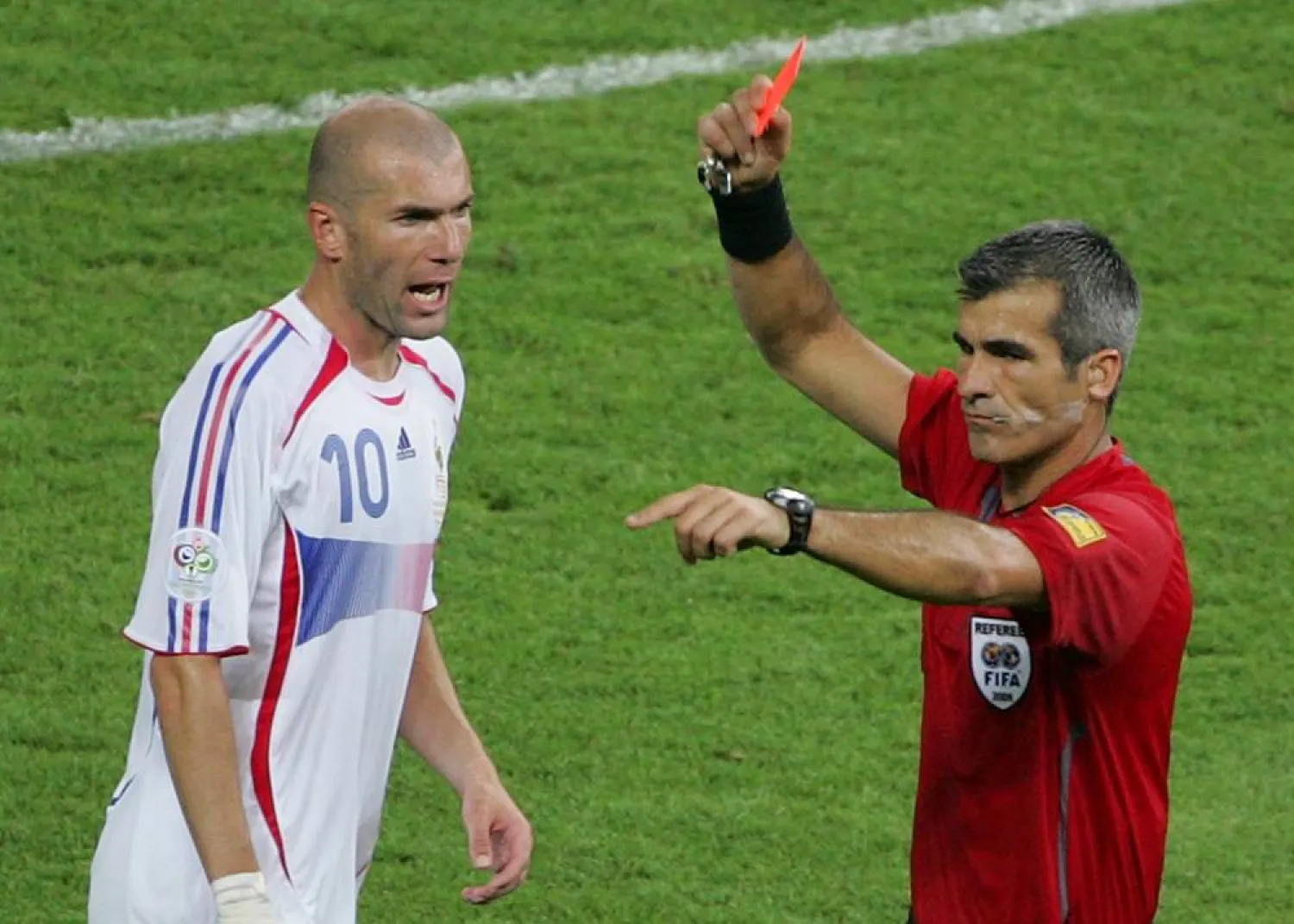
Referee Horacio Elizondo shows the red card to France's Zineidine Zidane during the final of the soccer World Cup between Italy and France in the Olympic Stadium in Berlin, on July 9, 2006. (AP)
TT

Bizarre Red Cards: Gueye Joins List Including Zidane, Simunic and Hazard After Slapping Own Teammate

Referee Horacio Elizondo shows the red card to France's Zineidine Zidane during the final of the soccer World Cup between Italy and France in the Olympic Stadium in Berlin, on July 9, 2006. (AP)

Idrissa Gueye’s sending-off for Everton for slapping his teammate in the face during a Premier League game joins the list of football's most bizarre red cards.

Here are a few others:

Zidane's headbutt

Arguably the most famous red card in football happened in the World Cup final and to one of the game’s greatest ever players. It was during extra time in the 2006 title match between France and Italy when French star Zinedine Zidane received some insults from opponent Marco Materazzi off the ball. Zidane turned toward Materazzi, approached him and planted his head into the top of the Italy defender’s chest, knocking him to the ground.

The incident appeared to have been missed by the on-field referee but after a few minutes of confusion — during which the fourth official might have seen a replay on a TV monitor — Zidane was shown a red card in what was already his last ever match before retirement. France went on to lose the final on penalties. It has long been speculated since that it was the first ever — unofficial — video review, more than a decade before the introduction of the VAR system ahead of the 2018 World Cup.

Three yellow cards

Croatia center back Josip Simunic’s red card in the same 2006 World Cup was less “wow” and more “what?” During a wild 2-2 draw between Croatia and Australia, Simunic was shown a second yellow card in the 90th minute by English referee Graham Poll. However, Poll didn’t then follow it up with a red card and the game continued — only for Simunic to collect another booking, for dissent, after the final whistle and finally get a red. Simunic looked bemused and Poll didn’t officiate in another game that tournament. He later said he thought he had shown the second yellow card to an Australia player and not Simunic, who was born in Australia and spoke with an Australian accent.

Hazard and the ball boy

Eden Hazard was best known for his weaving runs during his trophy-laden time at Chelsea from 2012-19 but there was also an unusual red card thrown in there. In an English League Cup match in 2013, Chelsea was in need of two late goals against Swansea when the ball went out of play and into the possession of a ball boy. He covered the ball with his body as Hazard approached. In an attempt to retrieve the ball, Hazard initially tried to grab it with his hands but then aimed a kick under the ball boy’s body. The boy writhed around in agony, holding his ribs and even complaining to the referee. Whether Hazard connected with the ball or the ball boy’s ribs didn’t matter — he was sent off. No action was taken against Hazard after the boy was interviewed by police.

Mistaken identity

It wasn’t just the 6-0 scoreline that provided the farcical element to Arsenal’s heavy Premier League beating at Chelsea in 2014. In the 15th minute, Arsenal midfielder Alex Oxlade-Chamberlain blatantly handled the ball in the penalty area while making a diving save to tip away a shot by Eden Hazard. Oxlade-Chamberlain escaped any sanction — but only because referee Andre Marriner chose instead to show the red card to defender Kieran Gibbs. Oxlade-Chamberlain was seen saying “it was me” to Marriner but the referee ignored protests, while his assistants also failed to spot the mistake. Marriner later admitted, via a statement, to making a mistake.

Newcastle scrap

The confrontation involving Gueye and Keane was nothing compared to the brawl between then-Newcastle teammates Lee Bowyer and Kieron Dyer during a Premier League game against Aston Villa in 2005. The pair squared up away from the ball, grabbed each other around the neck, and started throwing punches late in the second half. It needed the intervention of other Newcastle players and Villa midfielder Gareth Barry for Bowyer and Dyer to be separated. Both were shown red cards and that reduced Newcastle to eight players, because the team had already had a man sent off.



Sudan Dream of AFCON Glory as Conflict Rages at Home

 Sudan's players pose for the team picture before the Africa Cup of Nations group E soccer match between Algeria and Sudan in Rabat, Morocco, Wednesday, Dec. 24, 2025. (AP)
Sudan's players pose for the team picture before the Africa Cup of Nations group E soccer match between Algeria and Sudan in Rabat, Morocco, Wednesday, Dec. 24, 2025. (AP)
TT

Sudan Dream of AFCON Glory as Conflict Rages at Home

 Sudan's players pose for the team picture before the Africa Cup of Nations group E soccer match between Algeria and Sudan in Rabat, Morocco, Wednesday, Dec. 24, 2025. (AP)
Sudan's players pose for the team picture before the Africa Cup of Nations group E soccer match between Algeria and Sudan in Rabat, Morocco, Wednesday, Dec. 24, 2025. (AP)

When war broke out in Sudan in April 2023, Ammar Taifour was in a training camp with his club Al Merrikh in Khartoum.

"I just remember the surprise, the shock of the first gunshots. It was very surprising," the 28-year-old midfielder with the Sudan team at the Africa Cup of Nations tells AFP.

"Then in the days after that there were power cuts and constant gunshots. It was just unbelievable.

"I just pray for peace and for everyone who's in this situation to be safe and make it out."

Taifour, who was born in the United States, is among the lucky ones. He says he is "grateful and blessed" that family members in Sudan were able to leave the country.

Goalkeeper Mohamed Al Nour, meanwhile, had to deal with the anguish of his brother being taken prisoner by the paramilitary Rapid Support Forces.

"Luckily I have not lost any members of my family but my brother was taken prisoner for nine months by the RSF before being released," says Al Nour.

"We have experienced terror, people being killed. We just hope things improve."

The war that erupted close to three years ago between the country's army and its former allies the RSF has had a devastating impact on the population.

Tens of thousands of people have been killed and 11 million driven from their homes in what the UN has declared "the world's worst humanitarian disaster".

Despite that backdrop, Sudan's national football team qualified for the ongoing AFCON in Morocco and on Sunday they beat Equatorial Guinea 1-0 in Casablanca.

It was just their second win at the Cup of Nations in 18 matches across six tournament appearances since they lifted the trophy in 1970.

They play Burkina Faso in their final group game on Wednesday and do so with the pressure off because they are already assured of progressing to the last 16.

That is a remarkable achievement regardless of the current off-field context, given Sudan have only once made the knockout stages at an AFCON since 1970 -- they reached the quarter-finals in 2012.

- 'Big responsibility' -

"It's a big honor," says Taifour. "But also we have big expectations and we want to make it as far as possible and even to win the tournament, make our country happy."

"Obviously it's a big responsibility. I think each one of us as individuals, we know the situation that's going on, we all can relate to it, we all have someone involved.

"So whatever we can do to help, whatever we can do to bring some happiness, we try our best to do so."

Al Nour, also known by his nickname Abooja, adds: "Of course the team has been impacted. Everyone has just tried to get through this period but it has been difficult with the tension all over Sudan."

"In the end our results on the pitch are what make the people happy and boost their morale."

The impact of the conflict on Sudanese football has been enormous, leading to the domestic championship being halted and the country's two biggest clubs going into exile.

Al Hilal and Al Merrikh of Omdurman played in the Mauritanian league last season. A domestic elite league did make its return in July, but now the two rivals are playing in Rwanda.

Some players have moved to different countries like Taifour, who departed Al Merrikh for Libya and is now plying his trade in Tunisia.

Despite that the national team has flourished under Ghanaian coach Kwesi Appiah.

They qualified for the competition at the expense of Ghana and put in some good showings in their World Cup qualifying group, beating the Democratic Republic of Congo and drawing with Senegal en route to finishing third.

In August they got to the semi-finals of the African Nations Championship -- a competition for locally-based players -- and they also appeared at the recent FIFA Arab Cup in Qatar.

"We have tried to use every match as preparation and to build chemistry within the group," says Taifour.

Al Nour, meanwhile, describes Appiah as "an exceptional person. We have learned a lot thanks to him."

It has all led to this, with Sudan now building towards a Cup of Nations knockout tie this weekend and hoping to put smiles on the faces of supporters back home.


Prince Abdul Mohsin Airport Receives First Dakar Rally 2026 Arrivals

This comes as part of ongoing preparations to host the global sporting event - SPA
TT

Prince Abdul Mohsin Airport Receives First Dakar Rally 2026 Arrivals

This comes as part of ongoing preparations to host the global sporting event - SPA

Prince Abdul Mohsin bin Abdulaziz International Airport in Yanbu has received the first arrivals of competitors participating in the Dakar Rally 2026, as part of ongoing preparations to host the global sporting event.

Cluster2 Airports, the operator of Prince Abdul Mohsin bin Abdulaziz International Airport, stated that arrivals will continue from December 28 to December 31, with approximately 17 flights, both private and commercial, designated for the arrival of competitors and participating teams, SPA reported.

The process is being handled with a high level of operational readiness and full coordination among the relevant authorities.

Cluster2 Airports affirmed that operational and service preparations at the airports have been completed to ensure smooth passenger movement and the provision of high-quality services to participating delegations, reflecting the efficiency of the affiliated airports and their ability to accommodate major international events.


Knee Injury for Shaheen Shah Afridi Forces Early Exit from Big Bash League

Pakistan’s ODI’s team captain Shaheen Shah Afridi attends a press conference, in Rawalpindi, Pakistan, on Nov. 10, 2025. (AP Photo/Anjum Naveed, File)
TT

Knee Injury for Shaheen Shah Afridi Forces Early Exit from Big Bash League

Pakistan’s ODI’s team captain Shaheen Shah Afridi attends a press conference, in Rawalpindi, Pakistan, on Nov. 10, 2025. (AP Photo/Anjum Naveed, File)

A knee injury has forced fast bowler Shaheen Shah Afridi to return home after playing four games for Brisbane Heat in the Big Bash League.

“Due to an unexpected injury; I have been called back by the PCB and will have to take a rehab. Hopefully, I will be back in the fields soon,” Afridi wrote on X on Tuesday.

Afridi limped off the field when he picked up the injury on his right knee while bowling against Adelaide Strikers last Saturday, The AP news reported.

Apparently the Pakistan Cricket Board has called back Afridi as a precautionary step with T20 World Cup due to start from February 7.

“I’m massively thankful to the Brisbane Heat team and fans for showering me with immense love and support,” Aridi said, while adding: “Meanwhile, I will be cheering for the amazing team.”

Afridi had a challenging short stint at Brisbane Heat where he picked up just two wickets in four matches at an expensive economy rate of 11.19. In his first game of the season he was removed from the attack in the 18th over when he bowled to waist-high full tosses to Melbourne Renegades’ batters Tim Seifert and Oliver Peake.

It is not the first time that Afridi has hurt his right knee. He sustained an injury on that knee while fielding during a test match in Sri Lanka in 2022 that also ruled him out from the early stages of the T20 World Cup in Australia.

He returned at the later stages of the tournament, but again picked up injury on the same knee during the death overs of the final against England that let the title match slip away from Pakistan.

Pakistan didn’t name Afridi for next month’s three-match T20 series in Sri Lanka as a rotation policy, but he remains one of the key players for the T20 World Cup to be jointly hosted by Sri Lanka and India.