

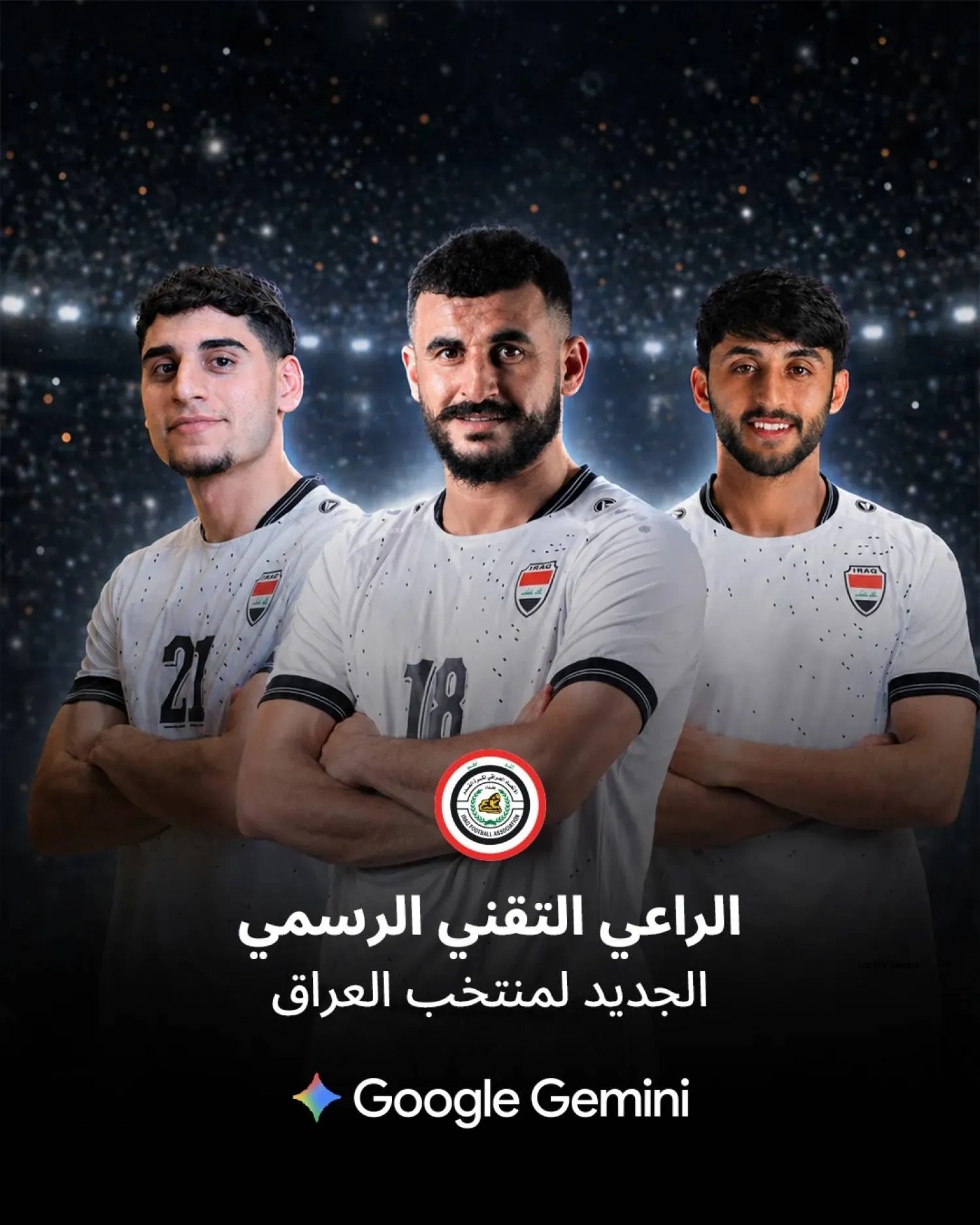

Google Gemini Enters Arab Football Stands, From Sponsorship to Fan Experience

Google chose Gemini as the official technology sponsor of Iraq and Morocco’s national football teams (Google)
TT

Google Gemini Enters Arab Football Stands, From Sponsorship to Fan Experience

Google chose Gemini as the official technology sponsor of Iraq and Morocco’s national football teams (Google)

Technology sponsorship in sports is no longer just a logo on a billboard or an advertising campaign around matches. As artificial intelligence moves into content creation and fan engagement, technology sponsors are trying to redefine the relationship between fans and their teams.

Google has chosen Gemini, its AI-powered assistant, as the official technology sponsor of Iraq’s and Morocco’s national football teams, in a regional partnership aimed at using AI tools to develop the digital fan experience.

According to the announcement, the partnership will use Gemini to bring teams closer to fans by improving digital communication, creating interactive content, and offering new ways to engage with players and teams.

But the significance of the move goes beyond linking Google’s name to two Arab teams with large fan bases. It raises a broader question: can AI turn fans into partners in shaping the experience, rather than passive consumers of content?

Beyond the logo

Najeeb Jarrar, Google’s regional marketing director for the Middle East and North Africa, told Asharq Al-Awsat that describing Gemini as a “technology sponsor” does not mean another advertising placement. It means “integrating technology as an essential part of the football experience.”

Jarrar said Gemini would become an interactive tool for fans, especially through experiences linked to content generation.

The first features fans are expected to see include creating supporter images through Nano Banana’s text-to-image tool, composing stadium chants and motivational music with Lyria’s text-to-music model, and receiving real-time analysis and match-related predictions.

That moves the sponsorship beyond traditional advertising. Fans are not just watching a prepared message. They are using tools to create images, music, or other content in support of their national team.

The bet is that AI can add a personal layer to fandom. Instead of a single campaign for everyone, a fan could ask Gemini to create an image showing their support, a motivational song, or a simple explanation of a tactical idea that emerged during a match.

Jarrar said the difference between this kind of experience and traditional sponsorship is that the latter offers “static and one-way content,” while Gemini provides a “fully personalized interactive experience.”

The fan as content creator

Under this model, the fan becomes part of the content cycle. The role is no longer limited to watching a video or sharing a ready-made post. Fans can request content that matches their language, team, emotional moment, or even their name.

Jarrar said a fan could ask Gemini to explain a complex tactical plan used in a match, or write a customized chant for the “Atlas Lions” or the “Lions of Mesopotamia.”

But that level of engagement will not happen simply because the tool exists. Google plans to launch a marketing campaign showing fans how to use different Gemini models to generate images, music, video, and text.

The company will also provide ready-made templates, which Jarrar described as “ready templates,” containing selected and tested prompts from Google’s team. The aim is to help fans who may not know how to write precise AI prompts.


That matters because many AI tools do not fail because their capabilities are weak. They fail because it is hard to turn them into a clear, everyday experience for ordinary users. Ready templates can lower the first barrier to engagement, especially in a broad fan base where users are not expected to know how to write prompts or understand AI models.

Products and platforms

The expected experience will not be limited to the Gemini app. Jarrar said Google is working to offer fans a distinctive experience before and during the football season over the next three months.

One example is allowing users to try selected prompts that generate images and videos, as if they were on the pitch with the Iraqi and Moroccan teams.

These formats are expected to appear on Google pages and on the pages of the Iraqi Football Association and the Royal Moroccan Football Federation. Google will also introduce users to features available through other products, including Google Search and YouTube, to create a more integrated experience that brings together content, search, video, and AI.

This opens the door to a new model of sports sponsorship, one in which the technology presence is not confined to a single platform. A fan may search for information, watch content on YouTube, use Gemini to generate an image, song, or summary, and then share it on social media.

In that sense, sponsorship becomes more like an integrated digital structure around the team than a seasonal campaign.

Arabic dialects

Language is the central challenge in an experience aimed at Iraq and Morocco. Arab fans do not speak in a single linguistic register, and sports content depends heavily on local expressions, belonging, and emotional tone.

Iraqi dialect and Moroccan darija carry strong and distinctive expressions of support. Content that sounds artificial or overly formal could feel detached from the stands.

Jarrar said Gemini’s advanced models had been trained to understand different Arabic dialects “with high accuracy,” including Iraqi dialect and Moroccan darija.

He said Gemini would rely on understanding the cultural and sporting context around the game in both countries, so it can respond in “natural, enthusiastic language that is close to the hearts of local fans,” while maintaining the accuracy of sports information.

But the test will come in real use. The challenge is not just translating words. It is understanding cultural references, players’ names, team histories, fan sensitivities, and the accepted tone in a competitive sports setting. Language, therefore, is not a side issue. It is central to judging the experience.

Accuracy and limits

Using AI in football raises two immediate questions: accuracy and safety. If a fan asks for analysis, a prediction, or a historical fact, the system should not produce false information. If a fan asks for supporter content, it should not slide into fanaticism, offensive speech, or political content.

Jarrar said Google is committed to responsible AI principles and that Gemini models include built-in safety filters to prevent the generation of hate speech, sports fanaticism, or political content.

Regarding sports information and match analysis, he said the model would be linked to official, reliable data sources, including data issued by football associations and accredited sports statistics providers, to ensure accurate results and analysis.

That makes the experience more complex than generating an image or a short text. The closer AI gets to match information, players, and predictions, the greater the need for trusted sources and clear lines between analysis, speculation, and entertainment.

The Arab sports environment also requires linguistic and cultural sensitivity, especially when fan enthusiasm overlaps with competition and national identity.

Beyond fan engagement

Although the partnership begins with fans, Jarrar said Gemini’s potential could extend to the work of the football associations themselves.

He said the partnership could strengthen “commercial and marketing value” by helping media offices draft press releases, translate them instantly into multiple languages, plan digital content schedules, and improve accessibility for people with disabilities through text-to-speech and speech-to-text tools.

AI could also analyze fan engagement data to help marketing departments make better decisions, Jarrar said. He added that Google would continue exploring different opportunities with football associations in the Arab world, suggesting that practical uses inside sports institutions may develop gradually after the first fan-focused experiences are launched.

That path could matter for associations managing large audiences across several platforms and languages. The challenge is no longer just publishing a statement or designing a post. It is building a continuous content cycle around the team, measuring engagement, personalizing messages, and reaching fans at home and abroad.

Testing the value

The final question is whether AI will add real value or simply another layer to the digital experience.

Jarrar acknowledged that this is the first time Google has supported football associations in the Arab world in this way, and said the company is “very excited about the upcoming results.”

He said the aim is to develop the digital fan experience, allowing supporters to cheer for their teams through images, video, or music as if they were on the pitch, even when they cannot travel or attend matches in person.

The role of technology, he said, is to “bring fans closer to the teams, and the teams closer to the fans,” while monitoring digital engagement across platforms in the coming period.

In that sense, the partnership is an early test of how AI can enter Arab sports. Its success will not be measured only by how many images, songs, or clips fans produce. It will depend on whether these tools make fans feel closer to their teams, and whether football associations can use technology to improve communication, rather than simply add to the digital noise around matches.



Alcaraz Withdraws from Wimbledon with Wrist Injury

Tennis - Wimbledon - All England Lawn Tennis and Croquet Club, London, Britain - July 14, 2024 Spain's Carlos Alcaraz poses for a picture with the trophy after winning his men's singles final against Serbia's Novak Djokovic. (Reuters)
TT

Alcaraz Withdraws from Wimbledon with Wrist Injury

Tennis - Wimbledon - All England Lawn Tennis and Croquet Club, London, Britain - July 14, 2024 Spain's Carlos Alcaraz poses for a picture with the trophy after winning his men's singles final against Serbia's Novak Djokovic. (Reuters)

Carlos Alcaraz's hopes of regaining his Wimbledon title have been dashed with the two-time champion announcing Tuesday he is withdrawing as he recovers from a wrist injury.

"My recovery is going well and I'm feeling much better, but unfortunately I'm still not ready to play, I am obliged to withdraw from both Queen's and Wimbledon," said Spaniard Alcaraz, who lost to world number one Jannik Sinner in last year's final.

"These are two really special tournaments for me and I'll miss them a lot. We'll keep working to come back as soon as possible."

Alcaraz sustained the injury during the first round of the Barcelona Open and subsequently pulled out of tournaments in Madrid and Rome and then Roland Garros, where he is the reigning two-time champion.

The world number two became the youngest man to complete the career Grand Slam in January with his triumph at the Australian Open. The 23-year-old holds a 22-3 record this season and also won a title in Doha.

Wimbledon will be only the third Grand Slam that Alcaraz has missed since making his main draw debut at the 2021 Australian Open.

Alcaraz's injury has stopped him continuing his exciting rivalry with Italian Sinner, 24, who is firm favorite to triumph in Paris and London.


Guardiola Set for Emotional Man City Farewell After Era-Defining Decade

Manchester City's Spanish manager Pep Guardiola poses with the trophy on the pitch after the English FA Cup final football match between Chelsea and Manchester City at Wembley stadium in London, on May 16, 2026. (AFP)
TT

Guardiola Set for Emotional Man City Farewell After Era-Defining Decade

Manchester City's Spanish manager Pep Guardiola poses with the trophy on the pitch after the English FA Cup final football match between Chelsea and Manchester City at Wembley stadium in London, on May 16, 2026. (AFP)

Pep Guardiola is expected to take charge of Manchester City for the final time on Sunday, drawing the curtain down on a decade that has reshaped not only his club but English football itself.

When the Catalan arrived in 2016, he was already regarded as one of the game's great innovators. What followed was something even more profound: a transformational reign that turned City from wealthy contenders into the defining team of an era.

Ten years on, Guardiola leaves City having won 15 major trophies, not including the UEFA Super Cup and Club World Cup.

His trophy cabinet includes six Premier League titles -- including a record four in a row -- and the club's first Champions League crown, a haul that places him among the most successful ‌managers in English ‌football history.

This season alone, he has guided City to both the League ‌Cup ⁠and FA Cup ⁠titles, and pushed Arsenal right to the wire in the Premier League race.

His final match, expected to be Sunday's league game against Aston Villa, will close the book on a story of dominance, reinvention and influence that extended far beyond results.

And the Etihad Stadium crowd will surely soak up every second, singing their tribute song to their beloved manager: "We've got . . . Guardiola!" to the tune of The Dave Clark Five's "Glad All Over".

Guardiola's legacy at City is measured not just in silverware but in the scale of control his teams exerted. At their peak, ⁠they amassed points totals previously unimaginable, winning four straight league titles between ‌2021 and 2024 and forcing rivals into near-perfection just to keep ‌pace.

In 2023, they completed the treble, joining Manchester United's 1999 side as the only English teams to hoist the ‌league, FA Cup and Champions League trophies in the same season.

GAME CHANGER

The 55-year-old is credited with changing ‌the game by imposing a level of control and technical precision rarely seen in English football, turning City into the benchmark for how the game could be played.

His teams did not simply win; they dominated by keeping the ball, dictating tempo and suffocating opponents through positional play and relentless pressing.

Beyond the results, fans will surely miss Guardiola's entertaining, ‌restless presence. Usually dressed in his favored knit jumpers and smart trousers, he prowls the technical area, arms cutting through the air as he ⁠points, waves and barks instructions.

Frustration ⁠flashes quickly, sometimes with a sharp kick at a cooler. He has been known to cushion stray balls with a deft touch of a foot, or turn and encourage the crowd to cheer.

He frequently speaks to opposing players on the pitch after matches, to offer tactical tips or praise a performance.

City's players have praised his impact and marveled at his relentless quest for excellence.

"He changed the way I see football," City captain Bernardo Silva said after Saturday's FA Cup win.

"That winning mentality is nothing like I've ever seen," defender John Stones added.

For all the tactics, Guardiola's greatest legacy will have been cultural. He made style the norm and forced the Premier League to evolve around it.

If Sunday indeed ends his tenure, his influence will not fade.


Stuttering Sabalenka Seeks to Set Down Marker at Roland Garros

 Belarus' Aryna Sabalenka returns the ball to Romania's Sorana Cirstea during their match at the Italian Open tennis tournament in Rome, Saturday, May 9, 2026. (AP)
Belarus' Aryna Sabalenka returns the ball to Romania's Sorana Cirstea during their match at the Italian Open tennis tournament in Rome, Saturday, May 9, 2026. (AP)
TT

Stuttering Sabalenka Seeks to Set Down Marker at Roland Garros

 Belarus' Aryna Sabalenka returns the ball to Romania's Sorana Cirstea during their match at the Italian Open tennis tournament in Rome, Saturday, May 9, 2026. (AP)
Belarus' Aryna Sabalenka returns the ball to Romania's Sorana Cirstea during their match at the Italian Open tennis tournament in Rome, Saturday, May 9, 2026. (AP)

Aryna Sabalenka looked unbeatable when the clay-court season got underway last month, but now as the world number one arrives in Paris for her latest tilt at winning Roland Garros, her dominance of the women's game has started to show cracks.

The four-time Grand Slam champion still holds more than 1,000 ranking points on her closest challengers but foremost on her mind over the next fortnight will be going one better than her runner-up finish last year in the French capital, when she lost in three sets to Coco Gauff.

If her aims ahead of the tournament, which starts on Sunday, mirror that of her men's counterpart, Jannik Sinner who is also hunting a first title on the red dirt in Paris, Sabalenka's stranglehold over her competitors is suddenly a lot less dominant than the Italian's.

When Sabalenka swept to the Sunshine Double at the WTA 1000 hardcourt events in Indian Wells and Miami in March, she had then won three of the four tournaments she had played in this season -- the only blight on that record being a three-set defeat to Elena Rybakina in the Australian Open final.

And as she jetted into Madrid for the start of the European clay swing on a 15-match winning streak, it had seemed little would stand in her way to claiming a fourth career title at the Caja Magica as she began preparations for the French Open.

But a quarter-final exit at the hands of 30th seed Hailey Baptiste put paid to the Belarusian's ambitions in Spain, before she followed that up by crashing out of the Italian Open against a resurgent Sorana Cirstea in the third round, after which she said she felt like "my body was limiting me from performing on the highest level".

"I guess we never lose; we only learn, so it's OK," Sabalenka mused after exiting a 1000 tournament at the round-of-32 stage for the first time since February 2025.

With the 28-year-old top seed now looking uncertain on the clay, the draw again appears to be wide open.

- 'Big battles' -

Rybakina, who beat Sabalenka in last season's WTA Finals decider and then in Melbourne in January to claim her second major title, will be one of the main contenders despite having never progressed beyond the last eight at Roland Garros.

The Kazakh world number two is the player who has arguably enjoyed the best season on the tour this year, barring Sabalenka, and last month won indoor on the clay in Stuttgart but similarly had disappointing runs in Madrid and Rome.

Iga Swiatek, the erstwhile "queen of clay", has of late shown glimpses of the form that took her to world number one and four Roland Garros titles in the early 2020s.

Since her last triumph in Paris two years ago, the 24-year-old has struggled to find consistency but will be hoping her new collaboration with Rafael Nadal's former coach Francisco Roig can help her re-find her best tennis on the surface she had for so long dominated.

Defending champion Gauff will certainly not cede her title lightly and the world number four enters the fray on the back of a strong run in Rome, which ultimately ended in defeat at the final hurdle to the in-form Elina Svitolina.

The 31-year-old Ukrainian has won two titles already this year, including a first 1000-level crown in eight years at the Italian Open, and will certainly fancy a deep run in Paris, after reaching the final eight for the fifth time in her career last year.

"(Winning Rome) gives me a lot of confidence. Gives me a good look at Roland Garros," Svitolina said.

"But... There are really tough players. You cannot underestimate (them). You need to be ready for the first-round matches, big battles. Everybody's there to beat you."

Alongside Svitolina, Madrid Open winner Marta Kostyuk, rising starlets Mirra Andreeva, Iva Jovic and Victoria Mboko, as well as Amanda Anisimova will be dark horses for a maiden Grand Slam title.
