


US Supreme Court Upholds Law Banning TikTok If It’s Not Sold by Its Chinese Parent Company

A person live streams to their TikTok followers as the high justices rule to uphold a ban on the video-sharing app TikTok in the TikTok vs. Merrick Garland case in Washington, DC, USA, 17 January 2025. (EPA)
TT

US Supreme Court Upholds Law Banning TikTok If It’s Not Sold by Its Chinese Parent Company

A person live streams to their TikTok followers as the high justices rule to uphold a ban on the video-sharing app TikTok in the TikTok vs. Merrick Garland case in Washington, DC, USA, 17 January 2025. (EPA)

The Supreme Court on Friday unanimously upheld the federal law banning TikTok beginning Sunday unless it's sold by its China-based parent company, holding that the risk to national security posed by its ties to China overcomes concerns about limiting speech by the app or its 170 million users in the United States.

A sale does not appear imminent and, although experts have said the app will not disappear from existing users' phones once the law takes effect on Jan. 19, new users won't be able to download it and updates won't be available. That will eventually render the app unworkable, the Justice Department has said in court filings.

The decision came against the backdrop of unusual political agitation by President-elect Donald Trump, who vowed that he could negotiate a solution and the administration of President Joe Biden, which has signaled it won't enforce the law beginning Sunday, his final full day in office.

Trump, mindful of TikTok’s popularity, and his own 14.7 million followers on the app, finds himself on the opposite side of the argument from prominent Senate Republicans who fault TikTok’s Chinese owner for not finding a buyer before now. Trump said in a Truth Social post shortly before the decision was issued that TikTok was among the topics in his conversation Friday with Chinese leader Xi Jinping.

It’s unclear what options are open to Trump once he is sworn in as president on Monday. The law allowed for a 90-day pause in the restrictions on the app if there had been progress toward a sale before it took effect. Solicitor General Elizabeth Prelogar, who defended the law at the Supreme Court for the Democratic Biden administration, told the justices last week that it's uncertain whether the prospect of a sale once the law is in effect could trigger a 90-day respite for TikTok.

“Congress has determined that divestiture is necessary to address its well-supported national security concerns regarding TikTok’s data collection practices and relationship with a foreign adversary,” the court said in an unsigned opinion, adding that the law “does not violate petitioners' First Amendment rights.”

Justices Sonia Sotomayor and Neil Gorsuch filed short separate opinions noting some reservations about the court's decision but going along with the outcome.

“Without doubt, the remedy Congress and the President chose here is dramatic,” Gorsuch wrote. Still, he said he was persuaded by the argument that China could get access to “vast troves of personal information about tens of millions of Americans.”

Some digital rights groups slammed the court’s ruling shortly after it was released.

“Today’s unprecedented decision upholding the TikTok ban harms the free expression of hundreds of millions of TikTok users in this country and around the world,” said Kate Ruane, a director at the Washington-based Center for Democracy & Technology, which has supported TikTok’s challenge to the federal law.

Content creators who opposed the law also worried about the effect on their business if TikTok shuts down. “I’m very, very concerned about what’s going to happen over the next couple weeks,” said Desiree Hill, owner of Crown’s Corner mechanic shop in Conyers, Georgia. “And very scared about the decrease that I’m going to have in reaching customers and worried I’m going to potentially lose my business in the next six months.”

At arguments, the justices were told by a lawyer for TikTok and ByteDance Ltd., the Chinese technology company that is its parent, how difficult it would be to consummate a deal, especially since Chinese law restricts the sale of the proprietary algorithm that has made the social media platform wildly successful.

The app allows users to watch hundreds of videos in about half an hour because some are only a few seconds long, according to a lawsuit filed last year by Kentucky complaining that TikTok is designed to be addictive and harms kids' mental health. Similar suits were filed by more than a dozen states. TikTok has called the claims inaccurate.

The dispute over TikTok's ties to China has come to embody the geopolitical competition between Washington and Beijing.

“ByteDance and its Chinese Communist masters had nine months to sell TikTok before the Sunday deadline,” Sen. Tom Cotton, R-Ark., wrote on X. “The very fact that Communist China refuses to permit its sale reveals exactly what TikTok is: a communist spy app. The Supreme Court correctly rejected TikTok’s lies and propaganda masquerading as legal arguments.”

The US has said it’s concerned about TikTok collecting vast swaths of user data, including sensitive information on viewing habits, that could fall into the hands of the Chinese government through coercion. Officials have also warned the algorithm that fuels what users see on the app is vulnerable to manipulation by Chinese authorities, who can use it to shape content on the platform in a way that’s difficult to detect.

TikTok points out the US has not presented evidence that China has attempted to manipulate content on its US platform or gather American user data through TikTok.

Bipartisan majorities in Congress passed legislation and Biden signed it into law in April. The law was the culmination of a yearslong saga in Washington over TikTok, which the government sees as a national security threat.

TikTok, which sued the government last year over the law, has long denied it could be used as a tool of Beijing. A three-judge panel made up of two Republican appointees and a Democratic appointee unanimously upheld the law in December, prompting TikTok’s quick appeal to the Supreme Court.

Without a sale to an approved buyer, the law bars app stores operated by Apple, Google and others from offering TikTok beginning on Sunday. Internet hosting services also will be prohibited from hosting TikTok.

ByteDance has said it won’t sell. But some investors have been eyeing it, including Trump’s former Treasury Secretary Steven Mnuchin and billionaire businessman Frank McCourt. McCourt’s Project Liberty initiative has said it and its unnamed partners have presented a proposal to ByteDance to acquire TikTok’s US assets. The consortium, which includes “Shark Tank” host Kevin O’Leary, did not disclose the financial terms of the offer.

McCourt, in a statement following the ruling, said his group was “ready to work with the company and President Trump to complete a deal.”

Prelogar told the justices last week that having the law take effect “might be just the jolt” ByteDance needs to reconsider its position.



AI ‘Agent’ Fever Comes with Lurking Security Threats

05 March 2026, Berlin: The letters "AI" for Artificial Intelligence are displayed on a wall during the opening of the Google AI Center Berlin. (dpa)
TT

AI ‘Agent’ Fever Comes with Lurking Security Threats

05 March 2026, Berlin: The letters "AI" for Artificial Intelligence are displayed on a wall during the opening of the Google AI Center Berlin. (dpa)

Artificial intelligence "agents" promise to save users time and energy by automating tasks, but the growing power of systems like OpenClaw is setting cybersecurity experts on edge.

Powered by a wave of hype, OpenClaw today claims more than three million users worldwide.

The system allows users to create so-called agents, tools based on a large language model (LLM) like OpenAI's ChatGPT or Anthropic's Claude that can carry out online tasks.

"We've moved from an AI you could talk with via a chatbot to an agentic AI, which can take action... the threat and the risks are definitely much greater," said Yazid Akadiri, principal solutions architect at Elastic France, an IT security company.

In an article titled "Agents of Chaos" that has yet to be peer-reviewed, a 20-strong team of researchers studied the behavior of six AI agents created with OpenClaw.

They spotted a dozen potentially dangerous actions executed by the systems, from deleting an email inbox to sharing personal information.

Many users have posted similar stories of OpenClaw mishaps online.

"When you deploy agents, you have no control over what they'll do, and when you try to look at what they're doing, you'll find them going far beyond the limits you set," said Adrien Merveille, an expert at the Check Point cybersecurity agency.

And the security gaps are not limited to the agents' own mistaken actions.

To carry out useful work, the tools need access to personal accounts for email, calendars or search engines -- drawing the attention of cyberattackers.

- 'Delete your database' -

AI agents are likely to become top targets for hackers as their use spreads, said Wendi Whitmore, chief security intelligence officer at cybersecurity firm Palo Alto Networks.

"As soon as (attackers) are inside an environment, (they're) immediately going to the internal LLM (agent) that's being used and using that then to interrogate the systems for more information."

Palo Alto's Unit 42 research division said in early March that it had found traces of attempted attacks in the form of hidden instructions for agents added to websites.

One such command ordered any agent who might read it to "delete your database".

Other cybersecurity firms and researchers have warned that attackers could gain access to agents via so-called skills -- downloadable files that users can add to their systems to give them new abilities.

Among such files freely available for download, some include hidden instructions for malicious actions like exfiltrating data.

OpenClaw creator Peter Steinberger says he is well aware of the risks.

"I purposefully didn't make it simpler so people would stop and read and understand: what is AI, that AI can make mistakes, what is prompt injection -- some basics that you really should understand when you use that technology," he told AFP in March.

Whitmore argued that expecting users to create their own guardrails for agents is "pretty unrealistic".

"People are going to adopt innovation and really see what it's capable of before they ask the questions about, 'how do I secure my own data?'," she predicted.

"That's going to cause some significant challenges in terms of data breaches in 2026."


Humanoid Robots Race Past Humans in Beijing Half-Marathon, Showing Rapid Advances

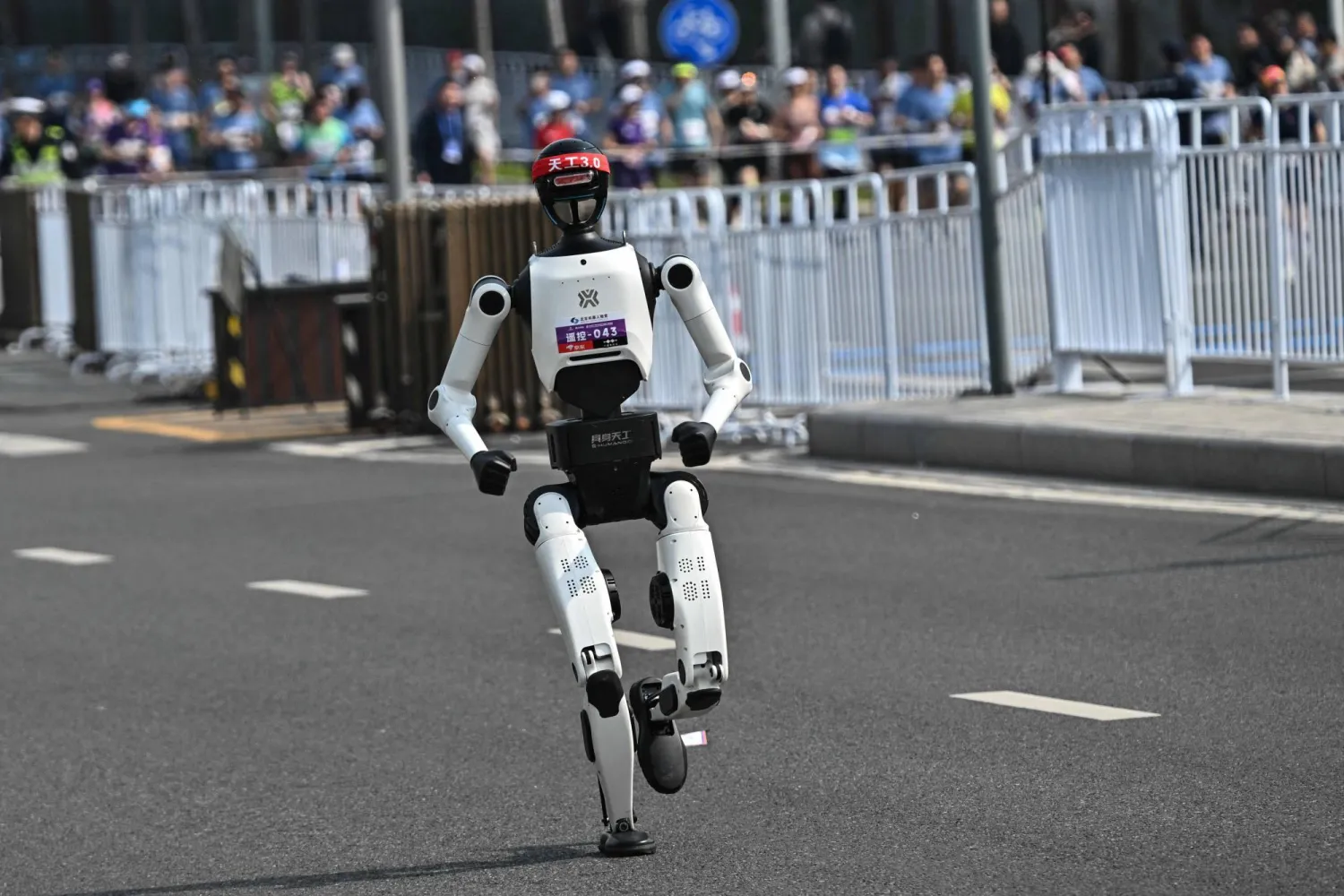
 A robot runs in the second Beijing E-Town Half Marathon and Humanoid Half Marathon in Beijing on April 19, 2026. (AFP)
A robot runs in the second Beijing E-Town Half Marathon and Humanoid Half Marathon in Beijing on April 19, 2026. (AFP)
TT

Humanoid Robots Race Past Humans in Beijing Half-Marathon, Showing Rapid Advances

 A robot runs in the second Beijing E-Town Half Marathon and Humanoid Half Marathon in Beijing on April 19, 2026. (AFP)
A robot runs in the second Beijing E-Town Half Marathon and Humanoid Half Marathon in Beijing on April 19, 2026. (AFP)

Dozens of Chinese-made humanoid robots showed off their fast-improving athleticism and autonomous navigation skills as they whizzed past human runners in a half-marathon race in Beijing on Sunday, highlighting the sector's rapid technical advances.

The race's inaugural edition last year was riddled with mishaps, and most robots were unable to finish. Last year's champion robot recorded a time of 2 hours 40 minutes, more than double the time of the human winner of the conventional race.

This year's contrast was stark. Not only had the number of participating teams increased from 20 to more than 100, but several robot frontrunners were noticeably faster than professional athletes, beating the human winners by more than 10 minutes.

Unlike last year, nearly half of the robot entrants navigated the tougher terrain autonomously instead of being directed by remote control during the 21-km (13-mile) race. The robots and ‌12,000 men and ‌women ran in parallel tracks to avoid collisions.

The winning robot, developed by Chinese ‌smartphone ⁠brand Honor, finished ⁠the race in 50 minutes and 26 seconds, several minutes faster than the half-marathon world record set by Ugandan runner Jacob Kiplimo in Lisbon last month.

Teams from Honor, a Huawei spin-off, took the three podium spots, all self-navigated and posting world-record-beating times. Du Xiaodi, an Honor engineer on the winning team, said its robot was in development for a year, fitted with legs 90 to 95 cm (35 to 37 inches) long to mimic elite human runners and liquid cooling technology used in its smartphones.

Du said the sector remained in a nascent phase, but he was confident humanoids would eventually reshape many industries, including ⁠manufacturing.

"Running faster may not seem meaningful at first, but it enables technology transfer, ‌for example, into structural reliability and cooling, and eventually industrial applications," Du ‌said.

ROBOTICS IMPROVEMENTS

Spectators largely viewed the variety of humanoids of different sizes and gaits on display as evidence of China's improvements in ‌robotics.

"The humanoid robots' running posture I saw was really quite impressive... considering that AI has only been developing for ‌a short time, I'm already very impressed that it can achieve this level of performance," said Chu Tianqi, a 23-year-old engineering student at Beijing University of Posts and Telecommunications.

"The future will definitely be an AI era. If people don't know how to use AI now, especially if some are still resistant to it, they will definitely become obsolete," he said.

Another spectator, 11-year-old schoolboy Guo Yukun, ‌said after watching the race, he was inspired to pursue a university degree in robotics in the future.

Guo said he takes regular classes in robotics theory and ⁠programming at his elite Beijing ⁠school, and is part of his school's team for the International Olympiad in Informatics, a global programming competition for high schoolers.

ECONOMICALLY VIABLE APPLICATIONS

While economically viable applications of humanoid robots mostly remain in a trial phase, the half-marathon's showcasing of these machines' physical prowess highlights their potential to reshape everything from dangerous jobs to battlefield combat.

However, Chinese robotics firms are still struggling to develop the AI software that would enable humanoids to match the efficiency of human factory workers.

Experts said the skills on display during the half-marathon, while entertaining, do not translate to the widespread commercialization of humanoid robots in industrial settings, where manual dexterity, real-world perception and capabilities beyond small-scale, repetitive tasks are crucial.

China is seeking to become a global powerhouse in this frontier industry, and it has enacted a wide range of policies from subsidies to infrastructure projects to cultivate local firms.

The country's most-watched TV show, the annual CCTV Spring Festival gala, in February showcased China's push to dominate humanoid robots and the future of manufacturing.

That included a lengthy martial arts demonstration where over a dozen Unitree humanoids performed sophisticated fight sequences waving swords, poles and nunchucks in close proximity to human children performers.


Cisco to Asharq Al-Awsat: AI Boosts Wireless Network Value in Saudi Arabia

Cisco report shows wireless networks in Saudi Arabia are no longer just connectivity infrastructure, but a driver of business growth toward 2030 (Shutterstock)
TT

Cisco to Asharq Al-Awsat: AI Boosts Wireless Network Value in Saudi Arabia

Cisco report shows wireless networks in Saudi Arabia are no longer just connectivity infrastructure, but a driver of business growth toward 2030 (Shutterstock)

A new report by Cisco shows wireless networks in Saudi Arabia are no longer just a connectivity layer. They are a direct driver of performance and growth.

The study draws on responses from 6,098 decision-makers and technical specialists across 30 markets, including 106 organizations in the Kingdom, giving its local findings added weight in tracking shifts in digital work environments.

Networks create value

The numbers point to a clear shift. More than 83% of organizations in Saudi Arabia reported improved customer engagement after investing in wireless networks, while 78% saw gains in operational efficiency. Some 75% cited higher employee productivity, and 67% reported a positive impact on revenue.

The findings show organizations are treating wireless networks as a business driver, not a background support layer.

Tarik Al-Turki, director of solutions engineering at Cisco Saudi Arabia, said companies now expect wireless networks to do far more than connect users. They are being pushed to support artificial intelligence workloads, the Internet of Things, hybrid work, real-time collaboration, and always-on customer experiences.

Wireless networks, he said, have become a “strategic platform” that enables flexibility, innovation, and the scaling of digital services, in line with Saudi Arabia’s accelerating digital transformation.

Rising operational strain

The gains come with mounting pressure. The report highlights what Cisco calls the “AI paradox in wireless networks”, where artificial intelligence boosts returns but also raises complexity, security risks, and talent challenges.

All surveyed organizations in Saudi Arabia said wireless operations have grown more complex. Around 63% still spend most of their time fixing issues after they occur, while 86% reported visibility gaps that hinder effective Wi-Fi troubleshooting.

Al-Turki said the problem is not just scale, but how networks are run. Many organizations still rely on manual, reactive approaches, while modern wireless environments demand proactive management, AI-driven automation, and end-to-end visibility.

Modernization, he said, is not only about spending more, but about rethinking how networks are managed.

Security risks escalate

Security is a major concern. In Saudi Arabia, 84% of organizations said they faced at least one wireless-related security incident in the past 12 months.

About 60% reported financial losses, with 51% of that group saying losses exceeded $1 million. Some 35% said breaches involving IoT or operational technology devices caused disruptions.

These figures show wireless security is no longer a theoretical risk, but a direct operational and financial threat.

Al-Turki said vulnerabilities are expanding with the growth of AI, IoT, and operational technology. More connected devices mean a wider attack surface, especially in distributed and critical environments.

He said the challenge is compounded by limited visibility, uneven security enforcement, and unmanaged or weakly protected devices. He also warned of growing concerns over automated and AI-driven cyberattacks, which increase both the speed and complexity of threats.

Traditional perimeter-based security, he said, is no longer enough. Organizations need models built on segmentation, continuous monitoring, identity-based access, and rapid response.

Talent gap widens

The talent shortage is another pressure point. The report found 91% of organizations in Saudi Arabia struggle to hire specialized wireless networking professionals.

The impact is clear. Around 40% reported higher operating costs, while another 40% cited lower morale. Some 28% said the skills gap is limiting innovation.

The report noted that many specialists are shifting toward AI and cybersecurity roles, intensifying competition for talent needed to manage modern wireless environments.

Al-Turki said the gap reflects a deeper shift. Wireless teams are no longer focused only on connectivity, but must also handle automation, security, AI-driven operations, IoT and operational technology, and user experience.

The market, he said, lacks hybrid skill sets capable of operating across these areas. More advanced organizations treat wireless expertise as a long-term strategic capability, not a narrow technical role.

AI, solution and risk

The report does not present AI only as a source of complexity. It can also reduce it, if used within a clear operating model.

Al-Turki said AI adds value by reducing manual work, improving visibility, and shifting teams from reactive fixes to proactive management. That includes earlier detection of issues, faster root-cause analysis, improved network performance, and actionable insights before users are affected.

This matters given that 63% of organizations still rely on reactive processes, while 86% face visibility gaps.

Returns depend on execution

Al-Turki warned that adopting AI without a clear model can backfire, creating more tools, alerts, and complexity.

The report suggests AI’s value lies in how it is used, not simply in deploying it. Poor integration can turn a tool meant to simplify operations into a source of noise.

He said simplifying operations, strengthening security, and building skills are interconnected priorities that must move together.

The broader picture is clear. Wireless investments are delivering gains in engagement, efficiency, productivity, and revenue, but environments are becoming harder to manage, more exposed to risk, and more dependent on specialized skills.

Returns, the report shows, depend not just on connectivity and speed, but on an organization’s ability to turn wireless infrastructure into a stable, secure, and scalable platform.

In Saudi Arabia, wireless networks now underpin connected work environments, AI applications, IoT systems, and customer-facing digital services. They have moved from technical infrastructure to a core driver of performance.

But the report makes clear that deployment alone is not enough. Organizations must simplify operations, strengthen protection, and build the skills needed to manage networks that are now central to growth, resilience, and competitiveness.