


TikTok Establishes Joint Venture to End US Ban Threat

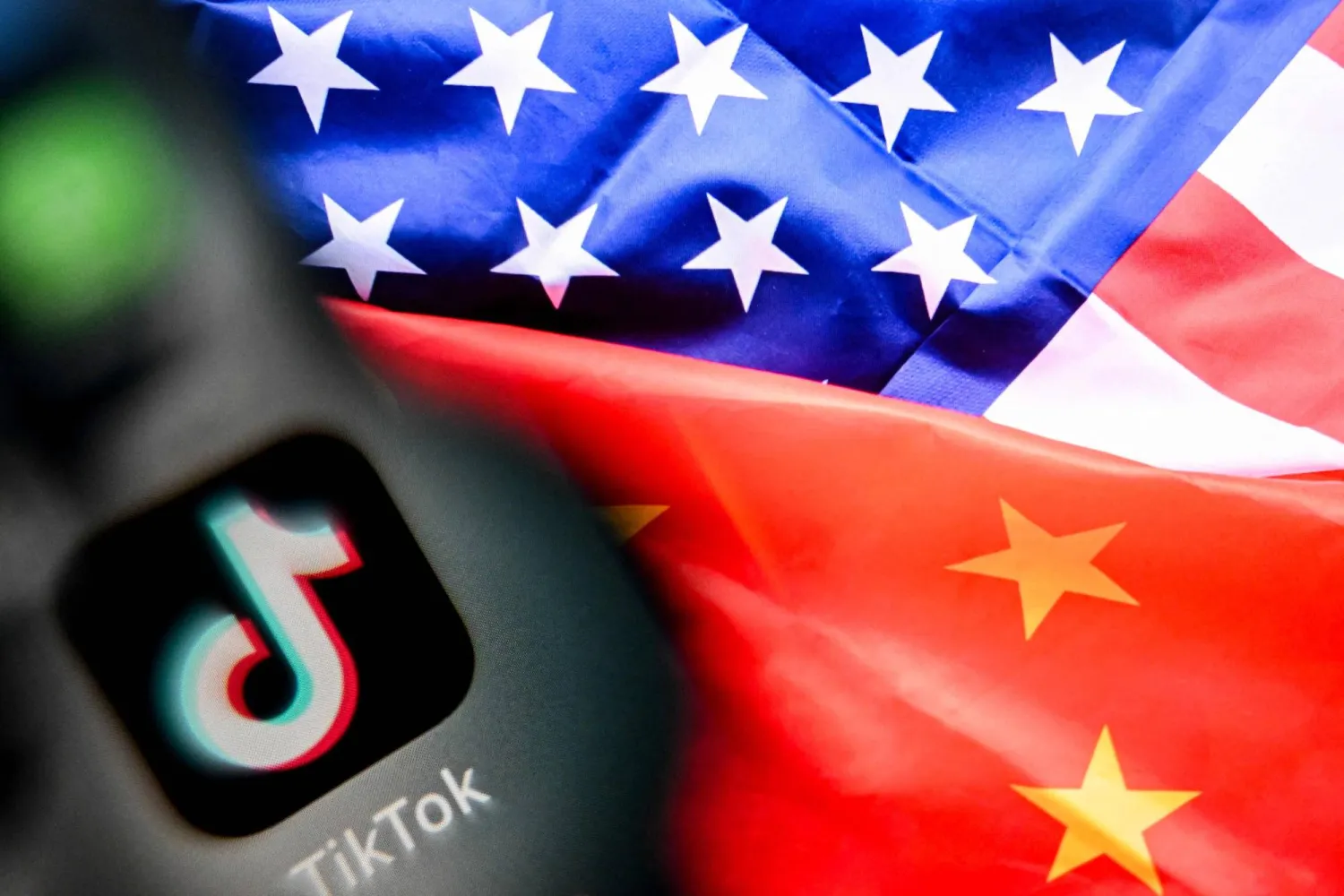
(FILES) A photo taken on April 10, 2025 shows the Chinese social networking service TikTok's logo on a smartphone screen (L) and US and China flags combo illustration on a laptop screen in Frankfurt am Main, western Germany.  (Photo by Kirill KUDRYAVTSEV / AFP)
(FILES) A photo taken on April 10, 2025 shows the Chinese social networking service TikTok's logo on a smartphone screen (L) and US and China flags combo illustration on a laptop screen in Frankfurt am Main, western Germany. (Photo by Kirill KUDRYAVTSEV / AFP)
TT

TikTok Establishes Joint Venture to End US Ban Threat

(FILES) A photo taken on April 10, 2025 shows the Chinese social networking service TikTok's logo on a smartphone screen (L) and US and China flags combo illustration on a laptop screen in Frankfurt am Main, western Germany.  (Photo by Kirill KUDRYAVTSEV / AFP)
(FILES) A photo taken on April 10, 2025 shows the Chinese social networking service TikTok's logo on a smartphone screen (L) and US and China flags combo illustration on a laptop screen in Frankfurt am Main, western Germany. (Photo by Kirill KUDRYAVTSEV / AFP)

TikTok announced Thursday it has established a majority American-owned joint venture to operate its US business, allowing the company to avoid a ban over its Chinese ownership.

The video-sharing app is a global digital entertainment powerhouse but its mass appeal and links to China have raised concerns over privacy and national security.

The TikTok USDS Joint Venture LLC will serve more than 200 million users and 7.5 million businesses while implementing strict safeguards for data protection and content moderation, the company said.

The new structure responds to a law passed under US President Donald Trump's predecessor Joe Biden that forced Chinese-owned ByteDance to sell TikTok's US operations or face a ban in its biggest market, said AFP.

Trump welcomed and claimed credit for the deal, but also thanked Chinese President Xi Jinping for approving it.

"I am so happy to have helped in saving TikTok!" Trump said in a post on Truth Social late Thursday.

"It will now be owned by a group of Great American Patriots and Investors, the Biggest in the World, and will be an important Voice."

"I would also like to thank President Xi, of China, for working with us and, ultimately, approving the Deal," he added.

- Cybersecurity audit -

ByteDance retains a 19.9 percent stake in the joint venture -- keeping its ownership below the 20 percent threshold stipulated by the law.

Three investors -- Silver Lake, Oracle and Abu Dhabi-based AI investment fund MGX -- each hold 15 percent stakes. Oracle's executive chairman Larry Ellison is a longtime Trump ally.

Other investors include Dell Family Office, affiliates of Susquehanna International Group and General Atlantic.

The joint venture will retain decision-making authority over trust and safety policies and content moderation for US users.

But TikTok's global entities will manage international product integration and commercial activities including e-commerce and advertising.

Under the arrangement, US user data will be stored in Oracle's secure cloud environment, with cybersecurity audited by third-party experts and adhering to federal standards, TikTok said.

Jasmine Enberg, co-CEO of Scalable, a media company focused on the creator economy, said TikTok users would be relieved by the deal but that there were "still big questions about how this will all play out."

"Behind the scenes, TikTok is likely working hard to assure advertisers it will remain business as normal," she told AFP.

"While the need for users to download a new app seems unlikely, brand partners will want to know that their TikTok strategies won't be disrupted."

- Ellison in spotlight -

The joint venture will be governed by a seven-member, majority-American board including TikTok CEO Shou Chew and executives from investment firms.

TikTok executive Adam Presser was appointed CEO of the new entity, with Will Farrell serving as chief security officer.

The 2024 law came as US policymakers, including Trump in his first presidency, warned that China could use TikTok to mine Americans' data or exert influence through its algorithm.

But Trump, crediting the app for his appeal with young voters, delayed enforcement through successive executive orders, most recently extending the deadline to January 22.

The deal largely confirms an outline announced to staff by Chew last month.

In September, one-time venture capitalist and Vice President JD Vance said the US entity would be valued at about $14 billion but it would ultimately be up to investors to determine pricing.

That month, Trump said a new venture had been agreed with China and would meet the law's requirements.

Trump specifically named Ellison, one of the world's richest men, as a major player in the arrangement.

Ellison has returned to the spotlight through his dealings with Trump, who has brought his old friend into major AI partnerships with OpenAI.



Software Companies Fight Back Against Fears that AI Will Kill Them

Software Companies Fight Back Against Fears that AI Will Kill Them
TT

Software Companies Fight Back Against Fears that AI Will Kill Them

Software Companies Fight Back Against Fears that AI Will Kill Them

Oracle's Mike Sicilia is the latest software CEO to wade in to the debate on whether artificial intelligence tools that heavily automate human tasks will mean the demise of his industry. His verdict was a resounding "no."

"You've all heard ... that new companies coding quickly using AI will spell the death of SaaS (software as a service)," he told analysts on a conference call on Tuesday. "I don't agree with that at all. I do think that AI tools and their coding capabilities would be a threat if we weren't adopting them, but we are, and very rapidly."

Sicilia was responding to Wall Street concerns that new AI tools can now perform some of the tasks that traditional software companies' products were built for, such as organizing customer information or guiding people through business processes.

Those worries led to a nearly $1 trillion rout in software stocks last month after heavyweight AI startup Anthropic introduced AI plugins for its Claude Cowork agent, a digital assistant that can automate such tasks. CEOs of software companies have since used their post-earnings conference calls to fight back.

Sicilia also laid out a case that Oracle was ahead of its smaller rival Salesforce, saying his company was using AI to actually build new products and automate full business processes, not just add AI features on top of existing tools.

Salesforce, for its part, has offered a different defense, with CEO Marc ⁠Benioff last ⁠month telling analysts that his company will outlast any so-called SaaS-pocalypse, a term for last month's share rout that hit software-as-a-service companies.

Benioff brought in Salesforce customers who positioned Salesforce as a company that has transformed itself into an enterprise platform that builds, deploys and governs those AI agents, using the company's mountains of proprietary customer and sales-process data. Even Jensen Huang, an AI pioneer and the CEO of chipmaker Nvidia , last month dismissed fears that AI would replace software and related tools, calling the idea "illogical."

UNIQUE DATA IS THE BEST DEFENSE

Oracle predicted on Tuesday that the AI boom would power its revenue for several quarters to come, sending its shares up 10% on Wednesday. The company owns deep enterprise data across finance, supply chain and human resources, which is hard for AI to replicate.

Oracle offers cheaper, efficient cloud systems and a database that ⁠can run on any major cloud, said Rebecca Wettemann, CEO of technology research firm Valoir. "That flexibility gives customers choice - and that’s a powerful position to be in as the AI ecosystem evolves," she said.

Nearly a dozen tech analysts and investors surveyed by Reuters said the owners of years of exclusive financial, legal, design, or technical data likely have the best defense.

"Proprietary data is the deepest moat by far," said James St. Aubin, chief investment officer at Ocean Park Asset Management.

In the case of Salesforce, while startups are nibbling away at the company's dominance in the customer-relationship software sector, its software remains deeply embedded in corporate systems, with its real-time data platform managing more than 50 trillion records. It is also trying to reinvent itself as an AI-agent company through its Agentforce service - still a small business.

Some analysts said Salesforce is also hard to replace because businesses have spent years building their day-to-day operations around the company's products and the cost of switching away is high.

But AI is beginning to erode that barrier, making it easier to generate code and build applications with far less human effort and expense.

While businesses experiment with isolated AI tools, Salesforce has built a comprehensive system that helps it stand out, said Madhav Thattai, executive vice president of Salesforce AI, adding ⁠that the company benefits from decades of ⁠enterprise experience.

Oracle did not return emails seeking comment.

NOT ALL IS DOOM AND GLOOM

But concerns about the demise of traditional software companies have lingered, and analysts said not all data is equal.

Employee data and payroll company Workday has plenty of data, but analysts said its core products run on HR and payroll data, which tend to follow uniform, industry-standard formats. That means an AI company can more easily learn from or replicate tools built on that kind of data.

Workday brought back its founder, Aneel Bhusri, as CEO last month to lead the company "in the rapidly evolving AI era."

But the company's shares have declined by more than a third this year, hitting more than a five-year low last month after a sluggish sales forecast. Bhusri said last month that Workday systems embed two decades of business processes that AI cannot replicate.

"AI, for all of its incredible capabilities, is probabilistic by nature," he told analysts on the post-earnings conference call. "It reasons, predicts and recommends based on patterns and likelihoods. Maybe it will eventually become a state machine - a system that follows the same steps and gets the same result, every time - but it is not there today."

Asked for a comment for this story, a Workday spokesperson referred Reuters to Bhusri's comments on the call.

Some analysts believe the enterprise software industry will prove more resilient than valuations currently indicate, arguing that higher productivity brought by AI could spur hiring and growth.

"I would not write the obituary for some of these companies just yet because there is an opportunity for them to reinvent themselves with AI," Ocean Park's Aubin said.


Meta Unveils Plans for Batch of In-house AI Chips

Mark Zuckerberg outside the court where he testified in a landmark trial (Reuters)
TT

Meta Unveils Plans for Batch of In-house AI Chips

Mark Zuckerberg outside the court where he testified in a landmark trial (Reuters)

Meta Platforms on Wednesday unveiled a roadmap of four new chips that the company is making in-house, as it rapidly expands its data centers.

Like many big tech companies such as Alphabet and Microsoft, Meta has invested heavily in building a team that can design chips in-house in addition to purchasing off-the-shelf products made by Nvidia and Advanced Micro Devices.

Making chips designed to tackle the specific types of data crunching Meta requires can lead to designs that use less energy and at a better cost.

The new chips are part of the company's Meta Training and Inference Accelerator (MTIA) program and the first of the new chips called the MTIA 300 is in use powering the company's ranking and recommendation systems. The other three will be rolled out this year and in 2027, with the final two chips, the MTIA 450 and 500 being designed to perform inference, the process when an AI model such as the one that powers the ChatGPT app responds to customer queries and requests.

"We see inference demand exploding at the moment and that's what we're currently focused on," Yee Jiun Song, Meta's vice president of engineering, said in an interview.

Meta has had some success with inference chips but has struggled with its long-time ambitions to make a generative AI training chip, capable of building the large models that power AI apps.

Beginning with the MTIA 400, which the company says is on the path to being used in its data centers, Meta has designed an entire system around the chips, which is roughly the size of several server racks and includes a version of liquid cooling.

The company plans to release the new chips at six-month intervals because it is rapidly expanding the number of data centers it uses to run apps like Instagram and Facebook, Song said.

"That is the reality of how quickly our infrastructure is being built out," Song said.

The company said in January it expects capital spending of between $115 billion and $135 billion this year.

Meta contracts Broadcom to help with some elements of the designs, though Song did not specify which chips. The company uses Taiwan Semiconductor Manufacturing Co to fabricate the processors.

In February, Meta signed big deals with Nvidia and AMD to buy tens of billions of dollars worth of chips.


SDAIA Unveils Logo for Saudi Arabia's Year of Artificial Intelligence 2026

The logo integrates symbolism in its elements
TT

SDAIA Unveils Logo for Saudi Arabia's Year of Artificial Intelligence 2026

The logo integrates symbolism in its elements

The Saudi Data and AI Authority (SDAIA) has launched the official logo for the Year of Artificial Intelligence 2026, after it was approved by the Cabinet.

This move underscores the Kingdom’s commitment to advancing artificial intelligence, reinforcing its role as a global hub in data and AI, and highlighting key achievements in this cutting-edge sector.

The logo integrates symbolism in its elements: the palm tree signifies the national emblem and the Kingdom’s cultural heritage, while the letters ‘AI’ highlight the technological and innovative aspects central to promoting digital inclusion as part of Vision 2030.

The palm tree’s green color symbolizes the Saudi flag and the Kingdom’s national identity, while the accompanying blue color represents digital technology and the Kingdom’s progression toward advanced technological development.

The logo is accompanied by the official hashtag for the Year of Artificial Intelligence: #SaudiAIYear.