


Chinese Firms' Involvement in 5G Network May Deter Investors, EU Warns Vietnam

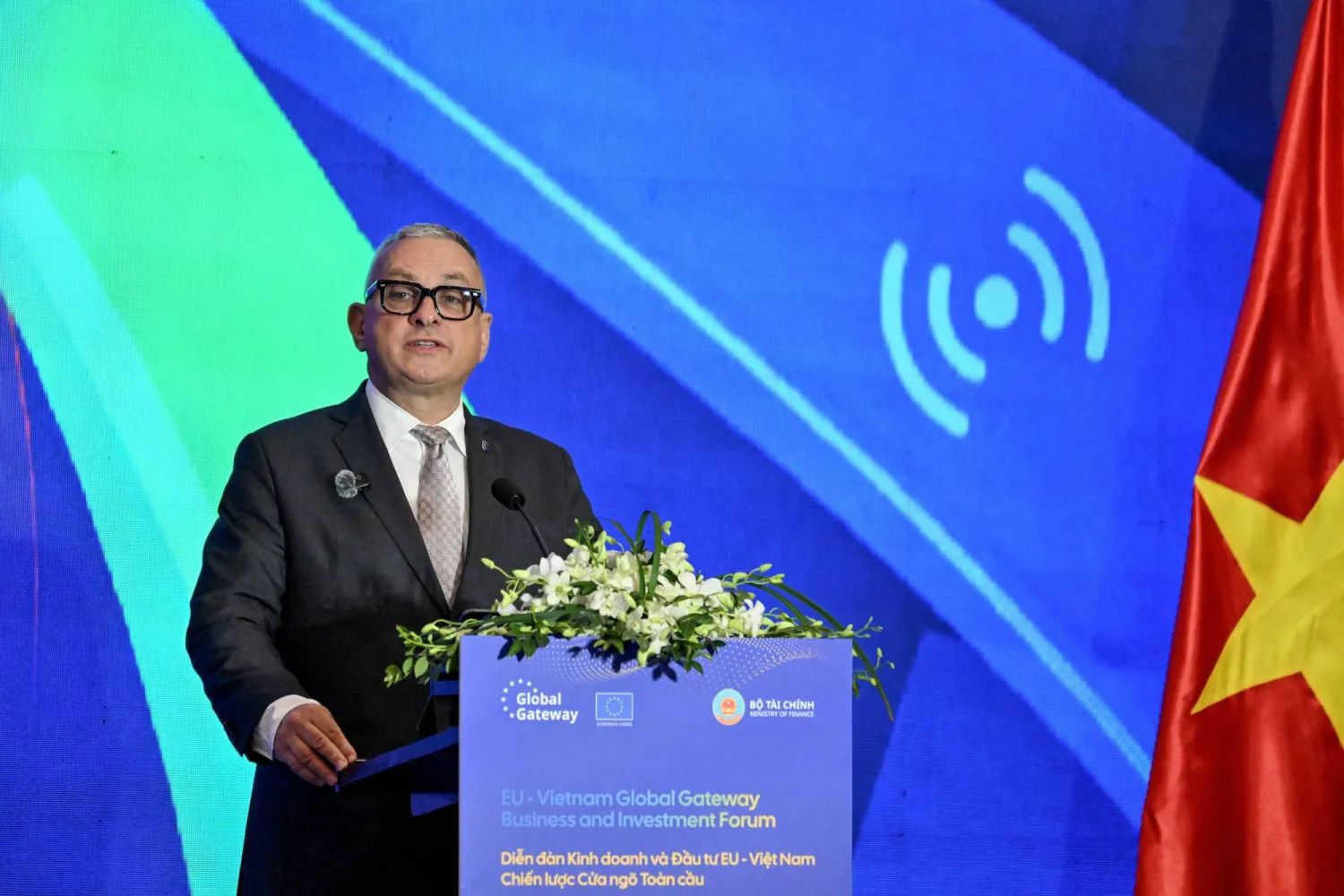
EU Commissioner for International Partnerships Jozef Sikela speaks during the EU-Vietnam business and investment forum in Hanoi on March 24, 2026. (Photo by Nhac NGUYEN / AFP)
TT

Chinese Firms' Involvement in 5G Network May Deter Investors, EU Warns Vietnam

EU Commissioner for International Partnerships Jozef Sikela speaks during the EU-Vietnam business and investment forum in Hanoi on March 24, 2026. (Photo by Nhac NGUYEN / AFP)

The involvement of Chinese vendors in the rollout of Vietnam's 5G network may deter foreign companies from investing in the Southeast Asian nation, a top EU official said on Tuesday.

European telecom firms Ericsson and Nokia are developing Vietnam's core 5G network, but in recent months Vietnamese state-owned operators have awarded 5G contracts to Chinese rivals Huawei and ZTE.

That marks a notable shift following years of caution towards China, and the change has ⁠sparked concerns among ⁠Western officials.

"Be careful with dependencies in strategic areas," EU Commissioner for International Partnerships Jozef Sikela said when asked about the Chinese contracts.

"5G is the new battlefield," he told Reuters on the sidelines of an EU-Vietnam investment forum in Hanoi. "Through the network you can access a lot and you can control a lot, ⁠and you have to be always careful who is your trusted vendor."

"If investors have doubts about the security of their data, they might decide not to take the risk and not to invest," he said.

Vietnam's foreign ministry and the Chinese embassy in Hanoi did not immediately reply to emailed requests for comment.

Vietnam is a major industrial hub and hosts large manufacturing operations of big Western multinationals, including European firms Adidas and Lego. Its decades-long economic boom hinges on foreign investment.

The European Union and European states ⁠on Tuesday ⁠announced a new package of investment in Vietnam's transport and energy sector.

Sikela said risks to future investments from unsecure networks were at this stage theoretical, and noted that several European countries allowed Chinese telecom vendors in the past.

Huawei and ZTE are banned from the telecom networks of several European countries and in the United States, because they are seen as risks to national security.

The companies have criticized the restrictions as unfair, rejecting the concerns as baseless.

Vietnamese officials have said that Chinese telecom equipment is reliable and cheaper, while downplaying security risks. Additional contracts with Chinese firms are under discussion, Reuters reported earlier this month.



Alibaba Unveils Next-gen Chip for Agentic AI

FILE - The logo of Chinese technology firm Alibaba is seen at its office in Beijing, Aug. 10, 2021. (AP Photo/Mark Schiefelbein, File)
TT

Alibaba Unveils Next-gen Chip for Agentic AI

FILE - The logo of Chinese technology firm Alibaba is seen at its office in Beijing, Aug. 10, 2021. (AP Photo/Mark Schiefelbein, File)

Alibaba on Tuesday revealed its next-generation XuanTie C950 5-nanometer processor at an internal conference, the company said in a blog post, as the Chinese tech giant gears up for the shift towards agentic AI.

The 3.2 GHz server chip, built using open-source RISC-V chip architecture, was billed as "the highest performing RISC-V CPU in the world" at a conference hosted by DAMO Academy, Alibaba's research arm, according to Chinese media reports.

The chip performs more than three times ⁠faster than its predecessor, ⁠the XuanTie C920, the reports said, according to Reuters.

The company did not reveal which fab manufactured the chip.

“RISC-V’s open-standard nature allows chip designers to customize instruction sets and accelerate specific AI workloads with no or low licensing fees. This is particularly important for the ⁠development of AI agents," the blog post said.

Alibaba is accelerating in-house chip development through its T-Head semiconductor arm, primarily focusing on the Zhenwu 810E chip series for AI training and inference, while the XuanTie series is focused on high-performance cloud systems and agentic AI.

The move comes after Alibaba last week launched Wukong, its enterprise platform optimized for AI agent workflows, as companies and institutions throughout China adopt OpenClaw.

⁠Its international ⁠equivalent, Accio Work, was launched on Monday. The agentic AI platform says it can autonomously run complex business operations for small and medium-sized enterprises.

The firm reorganized some of its AI-focused teams under the newly created Alibaba Token Hub earlier this month, which focuses on building AI work platforms for enterprises.

The business strategy shift comes as Alibaba finds new ways to ensure profitability as Chinese AI models' token prices have dropped dramatically amid fierce domestic competition.


EU Digital Rules Should Apply to Big Tech's Smart TVs, Broadcasters Tell Antitrust Chief

FILE PHOTO: Apple logo is seen in this illustration taken September 24, 2025. REUTERS/Dado Ruvic/Illustration/File Photo
TT

EU Digital Rules Should Apply to Big Tech's Smart TVs, Broadcasters Tell Antitrust Chief

FILE PHOTO: Apple logo is seen in this illustration taken September 24, 2025. REUTERS/Dado Ruvic/Illustration/File Photo

Google, Amazon, Apple and Samsung's smart TVs and virtual assistants should fall under the EU’s toughest tech rules because of their growing market power, the world's largest broadcasters told EU antitrust chief Teresa Ribera on Monday.

The call by the Association of Commercial Television and Video on Demand Services in Europe (ACT) whose members include Canal+, RTL, Mediaset, ITV, Paramount+, NBCUniversal, Walt Disney, Warner Bros Discovery, Sky and TF1 Groupe comes amid mounting concerns among broadcasters over Big Tech's encroachment into their industry as they push back against their rivals.

Android TV, which increased its market share from 16% to 23% from 2019 to 2024, Amazon Fire OS whose market share rose from 5% to 12% ⁠in the same ⁠period and Samsung's Tizen OS with its 24% market share should be designated as gatekeepers under the EU's Digital Markets Act, the broadcasters said, citing data from a 2025 market study.

The DMA, applicable since 2023, sets out obligations aimed at curbing the power of major tech companies, boosting competition and expanding consumer choice.

"A limited number of operators are therefore gaining growing ability to shape outcomes for millions of users and ⁠businesses by controlling access to audiences and content distribution," ACT said in a letter to Ribera seen by Reuters.

"It is crucial that the Commission designate major TV operating systems as gatekeepers and ensure adequate oversight to guarantee fairness and contestability," the broadcasters said.

The lobbying group said their Big Tech rivals may have incentives to retain end-users within their own ecosystem and to contractually or technically restrict linking or redirection, for example from one media application to another media application.

The Commission, which acts as the EU competition enforcer, Google, Amazon, Apple and Samsung did not immediately respond to emailed requests for comment.

The broadcasters also voiced concerns about virtual assistants, the most well known of which are Amazon's Alexa and Apple's Siri, while ⁠OpenAI entered the ⁠field last year with a beta feature called Tasks for its AI chatbot ChatGPT.

The European Commission has yet to label any virtual assistants as gatekeepers under the DMA.

"The lack of designation of virtual assistants creates a regulatory void, allowing powerful AI assistants to become de facto gatekeepers for media content through mobile phones, smart speakers and in-car radio infotainment services, without being subject to DMA obligations," the broadcasters said.

They urged Ribera to subject smart TVs and virtual assistants to the DMA on the basis of qualitative criteria even if they do not meet the quantitative benchmarks which are more than 45 million monthly active users and 75 billion euros ($87 billion) in market capitalization.

Signatories to the letter include the Association of European Radios (AER), the European Broadcasting Union (EBU), the European association of television and radio sales houses (egta), Confindustria Radio Televisioni (CRTV), Televisión Comercial en Abierto (UTECA) and Verband Österreichischer Privatsender (VOP).


Musk Launches 'Terafab' Project to Make Own AI Chips

(FILES) CEO of SpaceX and Tesla, South African-Canadian-US businessman Elon Musk speaks during the World Economic Forum (WEF) annual meeting in Davos on January 22, 2026. (Photo by Fabrice COFFRINI / AFP)
TT

Musk Launches 'Terafab' Project to Make Own AI Chips

(FILES) CEO of SpaceX and Tesla, South African-Canadian-US businessman Elon Musk speaks during the World Economic Forum (WEF) annual meeting in Davos on January 22, 2026. (Photo by Fabrice COFFRINI / AFP)

Elon Musk announced Saturday a plan to make chips for artificial intelligence, robotics and data centers in space, in the latest bold project by the world's richest person.

The "Terafab", a manufacturing facility based near Austin, Texas, will aim to produce one terawatt of computing power per year, Musk said.

A terawatt is equivalent to one trillion watts. That is slightly less than the total power generation capacity of the United States, according to an industry group.

Musk said the project would be run jointly by his electric-vehicle firm Tesla and his rocket company SpaceX.

He did not disclose the initial investment. Previous US media reports have put the figure between $20 billion and $25 billion, AFP said.

Musk, who has no prior experience in semiconductors, said the Terafab was necessary because Tesla and SpaceX's demand for computing power was expected to far exceed that of global chip suppliers.

"We're very grateful to our existing supply chain, to Samsung, TSMC, Micron, and others... but there's a maximum rate at which they're comfortable expanding," Musk said.

"That rate is much less than we would like... and we need the chips, so we're going to build the Terafab."

An "advanced technology fab" in Austin will have the facilities to design, manufacture, test and improve each chip, Musk said.

Eventually, the project aims to make chips to support 100 to 200 gigawatts of computing power on Earth, and a terawatt in space.

Musk did not give a timeline for the Terafab's output, and has previously promised grand results from other projects on compressed time scales.

He said the Terafab would ultimately help humanity become a "galactic civilization" capable of harnessing the resources of other planets and stars.