



Sweden May Oppose Tesla's Supervised Self-driving Tech in Europe over Speeding Concerns

A Tesla Robotaxi travels down Congress Avenue in downtown Austin, Tuesday, June 16, 2026.  (Mikala Compton/Austin American-Statesman via AP)
A Tesla Robotaxi travels down Congress Avenue in downtown Austin, Tuesday, June 16, 2026. (Mikala Compton/Austin American-Statesman via AP)
TT

Sweden May Oppose Tesla's Supervised Self-driving Tech in Europe over Speeding Concerns

A Tesla Robotaxi travels down Congress Avenue in downtown Austin, Tuesday, June 16, 2026.  (Mikala Compton/Austin American-Statesman via AP)
A Tesla Robotaxi travels down Congress Avenue in downtown Austin, Tuesday, June 16, 2026. (Mikala Compton/Austin American-Statesman via AP)

A Swedish transport authority is recommending a vote against the Europe-wide rollout of Tesla's supervised self-driving software, unless the U.S. EV maker disables its ability to exceed legal speed limits, a regulatory letter shows.

In a previously unreported letter dated April 30, obtained through a freedom of information request, the Swedish Transport Administration (TRV) said Tesla's Full Self-Driving (Supervised) feature should not be approved for European Union roads unless its ability to ignore speed limits is removed.

The letter was sent to the EU's Technical Committee on Motor Vehicles (TCMV), which is due to meet again on June 30 to discuss the matter, ahead of a vote at a later date on whether to roll out the technology across the bloc.

Tesla has already secured approval in some European countries for FSD, which allows vehicles ⁠to steer themselves ⁠on city streets and highways under human supervision. EU-wide approval would support Tesla's sales in the region, where it faces growing competition from Chinese EV makers.

Tesla, led by CEO Elon Musk, did not respond to requests for comment. Its user manual says drivers should not rely solely on the system for speed limits and must "drive at a safe speed based on traffic and road conditions".

FSD allows users to set a "Speed Offset", letting the vehicle exceed posted limits by a driver-defined margin.

In its letter, the TRV said that "allowing automated systems to systematically exceed legal speed limits ... risks undermining both the ⁠legal framework and the expected safety benefits of vehicle automation".

It called for the feature to be removed. "Failing this, the Swedish Transport Administration recommends that TCMV vote against the proposed introduction," it said.

Internal documents reviewed by Reuters show the Swedish Transport Agency (STA), the country's national type approver, has raised concerns with Tesla and Dutch regulator RDW, including in a two-hour meeting on June 4. The RDW approved the use of FSD in April and is backing an EU-wide rollout.

A TRV spokesperson said its position had not changed since the April letter and that it was aligned with the STA.

"It is my understanding that Sweden's representative in TCMV will only vote in favor if Tesla's speeding functionality is removed," the person said.

The STA, which represents Sweden at the TCMV, said discussions were ongoing within the EU committee and it was "assessing the matter to establish a Swedish position".

Tesla's ⁠FSD uses cameras and ⁠map data to detect speed limits. In the US, it can exceed those limits, offering a range of driving modes such as Sloth, Chill, Standard, Hurry and Mad Max.

Those options are not offered in Europe. Instead, Tesla provides "Contextual Max Speed", which adjusts to traffic flow, and "Speed Offset", allowing speeds above the legal limit.

Other Nordic countries, including Finland and Norway, have also raised concerns, though Lithuania, Estonia, Denmark, and Belgium have recently allowed FSD, following the Netherlands.

An Estonian transport official said speeding remained a concern but that the country approved FSD because the driver retains ultimate responsibility under the supervised system. Estonia has yet to decide how it will vote.

A spokesperson for Denmark's road authority said drivers have full responsibility when using FSD, including adhering to speed limits.

EU approval requires a qualified majority of 15 of the bloc's 27 member states representing at least 65% of the population.

If rejected, the Dutch provisional approval would lapse after six months, and national approvals based on it would also be withdrawn, according to the Danish road authority.



Cerebras Says to Invest Billions in Europe

A person is silhouetted next to the logo of the first Global Dialogue on AI Governance, in Geneva on July 6, 2026. (Photo by Fabrice COFFRINI / AFP)
TT

Cerebras Says to Invest Billions in Europe

A person is silhouetted next to the logo of the first Global Dialogue on AI Governance, in Geneva on July 6, 2026. (Photo by Fabrice COFFRINI / AFP)

US chip maker Cerebras, a US rival of Nvidia, told AFP on Thursday it will invest "several billion dollars" in Europe to boost the computing capacity of its AI data centers on the continent.

"This is a massive expansion" to meet the "rapidly growing" needs of European customers, chief executive Andrew Feldman told AFP in an interview on the sidelines of a Paris artificial intelligence conference.

The Californian company operates three data centers in France, Finland and Norway, which are to be expanded to reach 200MW of computing capacity by 2027.


US Crackdown on Top AI Fuels Open-Source Surge

Early suspicions about Chinese AI models as a security threat are somewhat fading. (AFP)
TT

US Crackdown on Top AI Fuels Open-Source Surge

Early suspicions about Chinese AI models as a security threat are somewhat fading. (AFP)

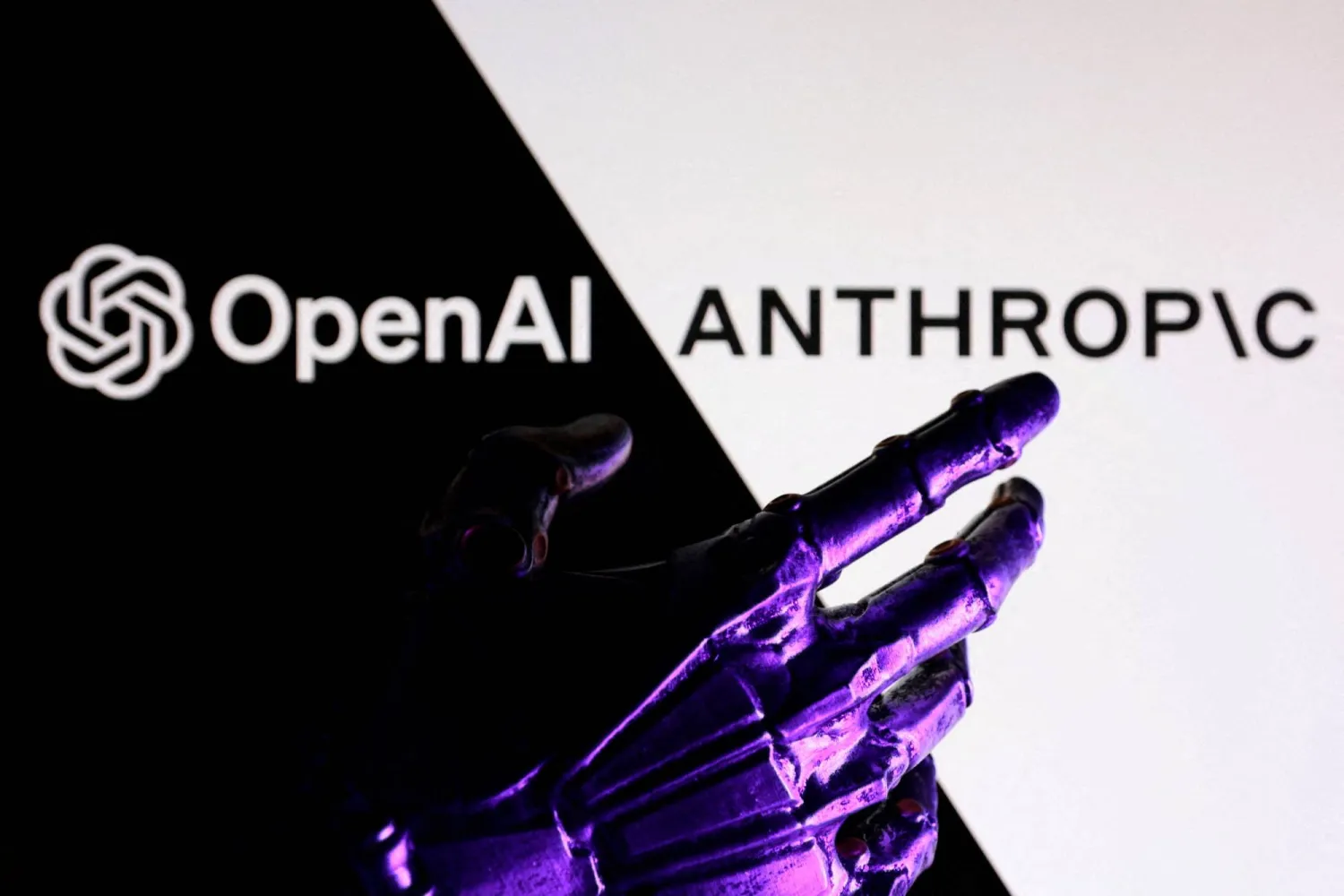
The US government's shock moves to restrict access to top artificial intelligence systems from Anthropic and OpenAI have sparked growing interest in open-source models -- especially ones from China.

The de facto bans from an anti-regulation White House blindsided the tech world, which had grown accustomed to AI labs releasing ever more powerful models with nary a worry of government intervention.

The episode has thrust a long-simmering debate to the fore: open versus closed AI.

Most of the best-known AI models -- like OpenAI's ChatGPT or Anthropic's Claude -- are "closed," meaning the company keeps the underlying code and data locked away.

Users can access the AI via an app or website, mainly through a subscription, but the company controls who gets in and can shut down access at any time.

"Open-source" or "open-weight" models work differently: the developers release the model's core files for anyone to download, modify and run on their own computers. Once released, no one -- not the company, not a government -- can take them back.

In early June, the Trump administration ordered Anthropic to block non-Americans from using its most powerful -- and closed -- models, Mythos 5 and Fable 5.

Faced with the complexity of screening users, the startup simply pulled the models offline entirely.

Shortly after, OpenAI agreed to let the government approve every customer for its newest model, GPT-5.6.

"If everything you need to do has to be on a specific frontier model, that makes whatever you're building a whole lot less reliable" when it is suddenly unavailable, said Oren Michels, co-founder and CEO of Barndoor AI.

Haitham Mengad, co-founder of Stems Labs, a startup focused on AI-powered music creation, felt the disruption firsthand.

"Fable has been a game-changing model for me. Honestly, when they took it off, it was the first time that I realized... it's almost like a drug," he recalled.

The Mythos episode "was a powerful moment" for seeing open source as an alternative, Mengad said.

'Being flexible'

Open models were already gaining fans because using closed AI keeps getting more expensive.

Around the same time, China's Zhipu AI (also known as Z.ai) released GLM-5.2, an open model that performed nearly as well as top offerings from Anthropic and OpenAI on several benchmarks.

"GLM-5.2 is free to download, fine-tune, and run on an enterprise's own servers, putting pricing pressure on frontier labs at the same time that access looks shaky," AI analyst Andrew Curran noted.

On OpenRouter, a platform that routes requests across different AI models, Google, Anthropic and OpenAI's combined share of usage dropped from 55 percent to 33 percent between January and June.

China's open DeepSeek now leads by a clear margin.

"You want to be as flexible as you can be. Maybe a year and a half ago some large company might say we bought Anthropic or we bought OpenAI, and now no one, no one buys only one," said Michels.

Among Western companies, France's Mistral stands largely alone in championing open models. US tech giant Meta, once a vocal open-source advocate, has stepped back from that.

Meanwhile, early suspicions about Chinese AI models as a security threat are fading, at least somewhat.

"I don't think there's any risk, to be honest," said Mengad. The fears are more "psychological, emotional than rational."

Once you download an open model and run it on your own hardware, the company that made it -- Chinese or otherwise -- has no access to your data or control over how you use it.

Still, some experts think the government crackdown could also end up coming for open models as they become more powerful.

"If Mythos-level models are considered risky, China will also not want them to be open," said Ethan Mollick, a professor at the University of Pennsylvania and a leading voice on AI -- meaning governments everywhere, not just Washington, may want to keep top-tier AI locked down.


Meta Plans Billions for 1st AI Data Center in Canada, Largest Outside the US

FILE - A Meta logo is shown on a video screen at LlamaCon 2025, an AI developer conference, in Menlo Park, Calif., April 29, 2025. (AP Photo/Jeff Chiu, File)
TT

Meta Plans Billions for 1st AI Data Center in Canada, Largest Outside the US

FILE - A Meta logo is shown on a video screen at LlamaCon 2025, an AI developer conference, in Menlo Park, Calif., April 29, 2025. (AP Photo/Jeff Chiu, File)

Facebook and Instagram parent Meta said Wednesday it will invest more than US$9.1 billion to build its first artificial intelligence data center in Canada and its largest outside the United States.

The facility will be built in Sturgeon County, Alberta, and powered by a natural gas-fired plant being developed by a consortium that includes Calgary-based Pembina Pipeline Ltd.

Technology and Innovation Minister Nate Glubish called the project “a big deal for Alberta,” saying the province had created a regulatory framework to attract data center investment.

Alberta has been courting hyperscale data centers as demand for artificial intelligence infrastructure surges. But the rapid growth of AI has fueled concerns about the vast amounts of electricity and water such facilities require, as well as their strain on power grids and nearby communities.

Because Alberta’s electricity grid cannot support multiple large AI data centers, the province is prioritizing projects that build or secure their own power generation, as Meta plans to do.

According to The Associated Press, Meta said the data center will use a closed-loop cooling system that won’t draw water from surrounding sources. The company also plans to invest US$42 million in local infrastructure, including roads and water systems.

Last week, Pembina Pipeline, Morgan Stanley Infrastructure Partners and Kineticor Asset Management announced they would proceed with the Greenlight Electricity Center in Sturgeon County. Meta was identified Wednesday as the customer. The 932-megawatt power plant is expected to begin operating in the second half of 2030.