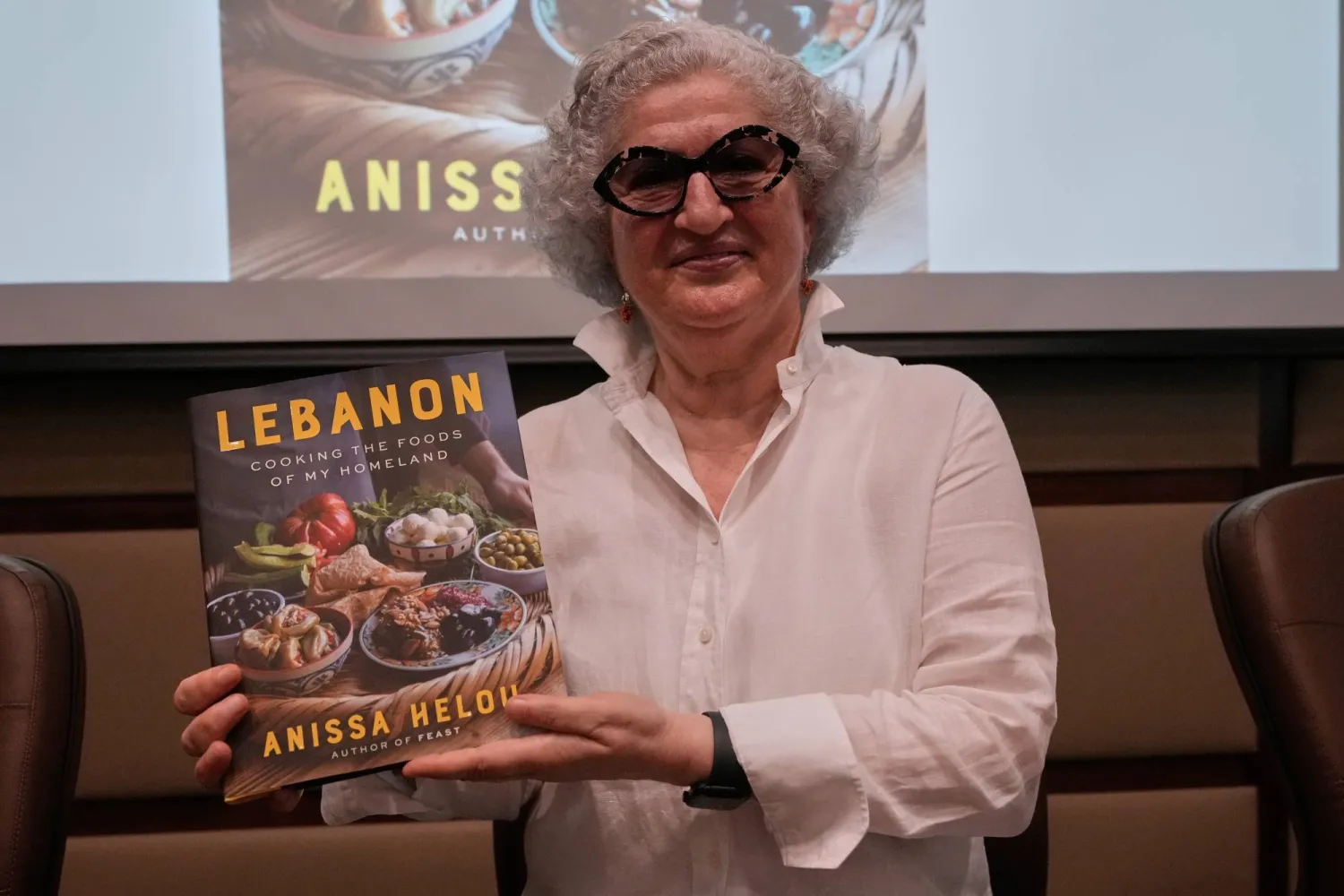
Before becoming one of the Middle East’s most acclaimed cooks and food writers, Anissa Helou had no intention of either path. She entered the world of cooking and writing almost by accident when she was in her late 30s.
Now 74, Helou has a wide following in the region and elsewhere and has released nearly a dozen books since the 1990s about food in the Middle East and beyond. Last month she received Britain’s prestigious Guild of Food Writers Lifetime Achievement Award.
The daughter of a Lebanese mother and a Syrian father, Helou was born into a Christian family and grew up watching her mother, grandmother and paternal aunt cooking. It opened her eyes to the food traditions of the two countries, both widely known in the region for their varied and flavorful cuisine.
“I was always fascinated by the kitchen, by their movements (and) by how they put things together, by the chopping,” Helou said about her mentors. “I love being in the kitchen with them and of course I loved eating.”
Helou’s latest book, “Lebanon: Cooking the Foods of My Homeland,” was officially released in late June in Beirut in a ceremony at Lebanon's Tourism Ministry attended by scores of people including food critics and restaurant owners.
The book, which comes as the country has been battered by two wars in the past three years between Israel and Hezbollah, includes a section about food in some of the southern Lebanese villages that have suffered the worst destruction, The Associated Press reported.
During her repeated visits there, most recently in October 2023, she found residents had their own regional variations of traditional cuisine. They include mujadara, a dish mainly consisting of lentils that is often cooked with rice, but in southern Lebanon is more likely to be made with bulgur.
“I discovered more, like, variations and added dishes, rather than something that was a complete revelation,” Helou said.
She has picked walnuts from a tree growing along the giant wall separating southern Lebanon from northern Israel and met residents who have lost their homes and businesses in the Hezbollah-Israel conflict.
Helou recalled Moussa Ibrahim from the southern village of Dibbine, which has been the site of intense clashes between Israeli troops and Hezbollah fighters.
Fighting there in 2024 caused Ibrahim to lose his business producing mouneh: vegetables, fruits, grains and dairy preserved with traditional Lebanese techniques including sun-drying, salting, pickling or submerging in olive oil.
Representing the Middle East and Muslims through recipes Helou, who has traveled the world to sample food, said she loves Korean and Japanese in addition to Middle Eastern cuisine.
“Lebanese, Iranian and Moroccan are among the greatest cuisines,” Helou said earlier this month in her late mother's apartment in the Mount Lebanon town of Ballouneh.
“Lebanese cuisine is kind of a little bit more sophisticated, a lot fresher, more vibrant” compared with some other Middle East food, Helou said as she prepared a traditional Lebanese lamb confit called awarma.
Asked for the home of the region’s best food, Helou did not hesitate to move outside Lebanon and name Syria’s largest city, Aleppo.
Famed for its centuries-old covered market, which was badly damaged during Syria’s civil war beginning in March 2011, Aleppo is known for varied and elaborate cuisine with influences from Persia, North Africa and Armenia.
“I think that Aleppo is undoubtedly the gastronomic capital of the Middle East, regardless of me being Syrian,” she said.
Global anti-Islamic sentiments rose dramatically after ISIS took large parts of Syria and Iraq and declared a so-called caliphate in 2014, launching deadly attacks in the region and the world.
Helou responded with a book of about 300 recipes of dishes from Muslim countries.
“I was thinking, one way of presenting Islam and Muslim people positively could be through their foods,” she said.
Starting late in the world of cooking Helou, who left Lebanon at the age of 21, holds citizenship in Lebanon, Syria and the United Kingdom and has spent much of her time in Britain and Italy. She still regularly visits Lebanon, cooking and asking people how they make specific dishes.
Helou refused to cook for years while she was a young woman and told her partner at the time not to expect her to make meals.
“I didn’t want to be domesticated. I was like a feminist and so I didn’t cook for a very long time,” she said.
One day a friend prepared a meal at their home and Helou saw the happiness it gave her partner, prompting her to think she should start cooking.
Her decision to become a food writer came in 1992 when a discussion with a group of Lebanese living abroad gave Helou the idea of filling a gap in Lebanese cookbooks with a collection of her mother's recipes. As it happened, there was a publisher looking for someone to write such a book.
“That’s how I started, by sheer coincidence,” Helou said.