


Ukrainian War Veterans Swim the Bosphorus Strait in a Triumph over Their War Injuries 

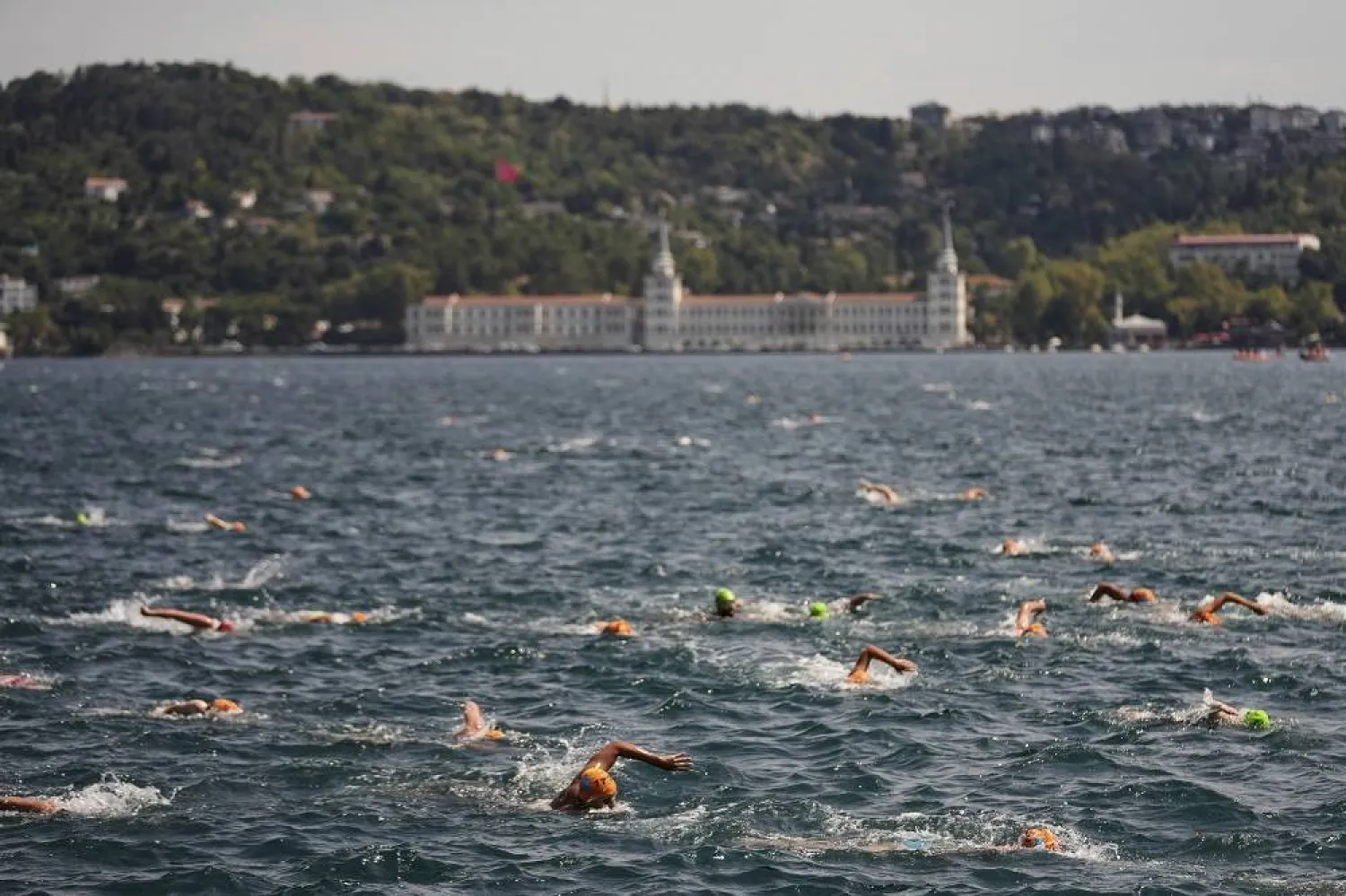
Competitors take part in a 6.5 km swimming race across the Bosphorus Strait, from the Asian side to the European side, in Istanbul, Türkiye, Sunday, Aug. 24, 2025. (AP) 
TT

Ukrainian War Veterans Swim the Bosphorus Strait in a Triumph over Their War Injuries 

Competitors take part in a 6.5 km swimming race across the Bosphorus Strait, from the Asian side to the European side, in Istanbul, Türkiye, Sunday, Aug. 24, 2025. (AP) 

During a pool training session months ago, Ukrainian war veteran Oleh Tserkovnyi was struck by an idea: What if a group of veterans swam across the strait of Bosphorus, between Türkiye’s European and Asian shores? And if they did it on Aug. 24, Ukraine’s Independence Day?

The symbolism of the day would draw attention to the toll and devastation inflicted by Russia's full-out war on Ukraine, now in its fourth year.

When the 34-year-old pitched the idea to fellow veterans in their One for Another support group, none raised injuries, particularly their amputations, as a barrier. Two joined him right away.

They trained for months, with the support of Superhumans Center, a veterans' rehabilitation clinic in Ukraine, and coached by CapitalTRI, an amateur triathlon team in Kyiv. They agreed their race would have another goal — to raise money for prosthetics, which remain costly and urgently needed by many of Ukraine’s wounded.

"We’re not asking for pity," Tserkovnyi told The Associated Press shortly before the competition. "We’re asking for support."

After months of rigorous training, discipline and physical challenges, the three Ukrainian veterans on Sunday joined more than 2,800 swimmers from 81 countries in the 6.5-kilometer (4-mile) crossing from Asia to Europe.

The Bosphorus Intercontinental Swimming Race is an open-water event held each year in Istanbul, organized by the Turkish Olympic Committee since 1989.

All three Ukrainians completed the crossing, each swimming for more than an hour. The two veterans with amputations faced setbacks even before the start — the organizers initially barred them from competing, insisting they have to be in a separate category for people with disabilities.

But they persevered and swam the race, alongside the others.

For the Ukrainians, it wasn’t just about endurance but about reclaiming control over bodies transformed by war and sharing their recovery with a world that often seems indifferent to the injuries they carry.

Seeking balance in the water

Sports had always been a part of Tserkovnyi’s life, but war and injury pushed him to use it as a survival tool after two severe, life-changing concussions — a bridge back to life for war veterans with disabilities.

"Sport itself heals — we’ve seen that firsthand," he said. "And the community, it pulls you through. It pushes you, it disciplines you."

When he speaks, he’s quick to point out the changes he sees in himself — the stutter, the involuntary twitch in his eye.

"It’s what’s left over. It used to be much worse," he said.

Both of his concussions were the result of prolonged exposure to artillery fire while serving on the front line. He was a sniper when the second one hit. Afterward, he said, it felt like he had lost his sense of balance entirely.

"There were times I could walk, but then suddenly I'd just tip over like a pencil," Tserkovnyi said. "I have third-degree hearing loss on one side, no peripheral vision."

The sense of being "a sick person," he said, felt so foreign to him that he threw himself into recovery with everything he had. For a long time, he also had PTSD symptoms, including dramatic flashbacks to the war.

But it was in the pool that he found a way to recognize the warning signs. "I began to understand what triggers them, when they come, and how to stay ahead of them," he said.

A path back to oneself

Engineer Pavlo Tovstyk signed up as a volunteer in the early days after Russia’s full-scale invasion of Ukraine in February 2022. Serving as a driver in an intelligence unit, he stepped on a landmine in June 2023.

The blast took his foot and subsequent surgeries led to a partial amputation of his left leg.

The 47-year-old, who used to be an active swimmer as a child, never thought swimming would become a lifeline. He was still recovering from his injury when he began sneaking into the swimming pool, keeping it a secret from the doctors.

"Water became a kind of savior for me," he said. "At the time, everything felt disoriented. But in the water, my thoughts, my strength, my body — it all came together again. I became myself again. Just ... different."

The idea to swim the strait in Türkiye started almost as a dare, then became a plan.

"To cross the Bosphorus, you need not just physical strength, but a certain mindset — a state of determination that all of us managed to find within ourselves," he said.

Calm found in purpose

Oleksandr Dashko discovered swimming only after losing his left leg.

The 28-year-old had joined the military at the start of the Russian invasion and served in the infantry in various front-line areas.

In June 2023, a mine exploded near him and shrapnel tore into his knee.

"I didn’t take it very graciously, let’s say," he said as he recounted the conflicted feelings that tormented him for so long. Adjustment to life with an amputation has been slow and mentally taxing.

It was only over the past year that he was able to focus on physical rehabilitation and swimming, he said, has become the activity that brings him a sense of calm.

The challenge of swimming the Bosphorus became a purpose for Dashko.

"When I do nothing, I slip back to that state right after the injury — depression, apathy, the feeling that the amputation is winning," he said. "But when something like this shows up on my path, it gives me a jolt — to live, to move forward, to motivate others."

Physical goals, he said, help anchor him. He hopes for more such challenges, not just for himself, but for other veterans.

"Honestly, if it weren’t for this, I’d probably be drunk and lying under a fence somewhere," he said.



French Prisons Risk Becoming 'Human Warehouses', Says Council of Europe

An inmate stands in his two-person cell near a mattress set for a third inmate at Gradignan prison, near Bordeaux, southwestern France, on October 3, 2022. Thibaud Moritz, AFP
TT

French Prisons Risk Becoming 'Human Warehouses', Says Council of Europe

An inmate stands in his two-person cell near a mattress set for a third inmate at Gradignan prison, near Bordeaux, southwestern France, on October 3, 2022. Thibaud Moritz, AFP

France's prisons risk transforming into "human warehouses", the Council of Europe said on Thursday, as overcrowding, poor conditions and violence strain a system at record inmate levels.

The warning follows a 2024 visit to four French detention centers, where the Council of Europe's anti-torture committee reported filthy cells, a lack of clean bedding and, at one prison, infestations of rats, cockroaches and bedbugs.

Since the visit, overcrowding has only worsened, committee head Alan Mitchell said in a press release, calling conditions in the country's incarceration system "extremely" concerning, reported AFP.

Last month, France reported a record 86,229 inmates, with a national average of 136.5 prisoners per 100 beds, according to interior ministry figures.

"This situation can turn a prison into a human warehouse, seriously compromising human dignity," Mitchell added.

Violence between prisoners is also widespread, the report said, creating a "climate of fear" marked by frequent fights and a lack of staff intervention.

Most inmates spend nearly 20 hours a day in their cells, while juveniles are confined for excessive periods, with only one to two hours of education daily, the press release said.

France is one of the 46 member states of the Strasbourg-based Council of Europe, the continent's watchdog for democracy and human rights.

The country has some of the worst prison overcrowding in Europe, ranking third worst after Slovenia and Cyprus, according to a Council of Europe report published in July.

In a separate case, the European Court of Human Rights last week condemned France for the ninth time since 2013 over prison conditions, ruling that detention conditions at a prison in Strasbourg amounted to "inhuman and degrading" treatment, after a 42-year-old detainee lodged a complaint.


Macron’s ‘Top Gun’ Shades Charm Internet as Leaders Wrangle Over Greenland

 French President Emmanuel Macron, wearing sunglasses, speaks during a meeting on the institutional future of New Caledonia at the Elysee Palace in Paris, France, January 16, 2026. (Reuters)
French President Emmanuel Macron, wearing sunglasses, speaks during a meeting on the institutional future of New Caledonia at the Elysee Palace in Paris, France, January 16, 2026. (Reuters)
TT

Macron’s ‘Top Gun’ Shades Charm Internet as Leaders Wrangle Over Greenland

 French President Emmanuel Macron, wearing sunglasses, speaks during a meeting on the institutional future of New Caledonia at the Elysee Palace in Paris, France, January 16, 2026. (Reuters)
French President Emmanuel Macron, wearing sunglasses, speaks during a meeting on the institutional future of New Caledonia at the Elysee Palace in Paris, France, January 16, 2026. (Reuters)

French President Emmanuel Macron's aviator sunglasses have caught the eye, with social media users debating his choice of a "Top Gun" look as he criticized US President Donald Trump over Greenland during his speech in Davos.

As he spoke at the annual World Economic Forum in the Swiss mountain resort of Davos on Tuesday, the French president wore dark, reflective sunglasses.

Memes, comments and speculation over his appearance surged on social media, with some supporters praising him for his "Top Gun" look while opponents dismissed it as bombastic or speculated ‌about his ‌health.

Macron's office said the choice to ‌wear ⁠sunglasses during his ‌speech, which took place indoors, was to protect his eyes because of a burst blood vessel.

One meme, with the headline "Duel in Davos," was styled like a Top Gun parody, with Macron and Trump eyeballing each other, both wearing military-style flight suits, and Macron, looking very small next to Trump, sporting oversized aviator sunglasses.

References to the ⁠1986 movie starring Tom Cruise were ubiquitous.

"Trump: be careful ... Macron is here," one social ‌media user said on X, with a ‍picture of the French ‍president with the aviator glasses. "Could he not find some more sober ‍glasses?" another user asked.

Even Trump weighed in, mocking Macron for his glasses in his own Davos speech on Wednesday.

Meanwhile, some of Macron's colleagues had gotten in on the act, with European Affairs Minister Benjamin Haddad posting a version of the "Soyboy vs Yes Chad" meme with Chad donning aviators and draped in a French flag.

Italian ⁠group iVision Tech, which owns Henry Jullien, said the model worn by Macron was its Pacific S 01, with a price tag of 659 euros ($770) on its website. It said it sent Macron the sunglasses as a gift but that he had insisted on paying for them, and made sure they were made in France.

The Milan-listed stock was up almost 6% on Wednesday.

"The news this morning came as a surprise," the group's chief executive Stefano Fulchir said. "We were flooded with calls and requests on the ‌website ... The site crashed."


3 Authors Win $10,000 Prizes for Blending Science and Literature

This combination of images shows cover art for “Ancient Light” by Kimberly Blaeser, left, “Bog Queen” by Anna North, center, and “Forest Euphoria: The Abounding Queerness of Nature” by Patricia Ononiwu Kaishian. (University of Arizona Press/Bloomsbury Publishing/Spiegel & Grau via AP)
TT

3 Authors Win $10,000 Prizes for Blending Science and Literature

This combination of images shows cover art for “Ancient Light” by Kimberly Blaeser, left, “Bog Queen” by Anna North, center, and “Forest Euphoria: The Abounding Queerness of Nature” by Patricia Ononiwu Kaishian. (University of Arizona Press/Bloomsbury Publishing/Spiegel & Grau via AP)

Three authors who demonstrated how scientific research can be wedded to literary grace have been awarded $10,000 prizes.

On Wednesday, the National Book Foundation and the Alfred P. Sloan Foundation announced the winners of the fifth annual Science + Literature awards. The books include Kimberly Blaeser's poetry collection, “Ancient Light,” inspired in part by the environmental destruction of Indigenous communities; the novel “Bog Queen” by Anna North, the story of a forensic anthropologist and a 2000-year-old Celtic druid; and a work of nonfiction, Patricia Ononiwu Kaishian's “Forest Euphoria: The Abounding Queerness of Nature.”

“These gifted storytellers shine a scientific and poetic light on the beauties and terrors of nature and what they reveal to us about our deepest selves, our humanity, and our existence on this planet,” Doron Weber, vice president and program director at the Sloan Foundation, said in a statement, The AP news reported.

Ruth Dickey, executive director of the National Book Foundation, said in a statement that the new winners continue the awards' mission to highlight “diverse voices in science writing that ... enlighten, challenge, and engage readers everywhere.”

The Book Foundation presents the National Book Awards, one of the literary world's most prestigious events. The Sloan Foundation has a long history of supporting books that join science and the humanities, including Kai Bird's and Martin J. Sherwin’s Pulitzer Prize-winning “American Prometheus,” which director Christopher Nolan adapted into the Oscar-winning “Oppenheimer.”

“At a time when science is under attack, it has become more urgent to elevate books that bring together the art of literature with the wonders of science,” Daisy Hernández, this year's chair of the awards committee and a 2022 Science + Literature honoree, said in a statement.