


Viking Ships Make Final High-risk Voyage to New Oslo Home

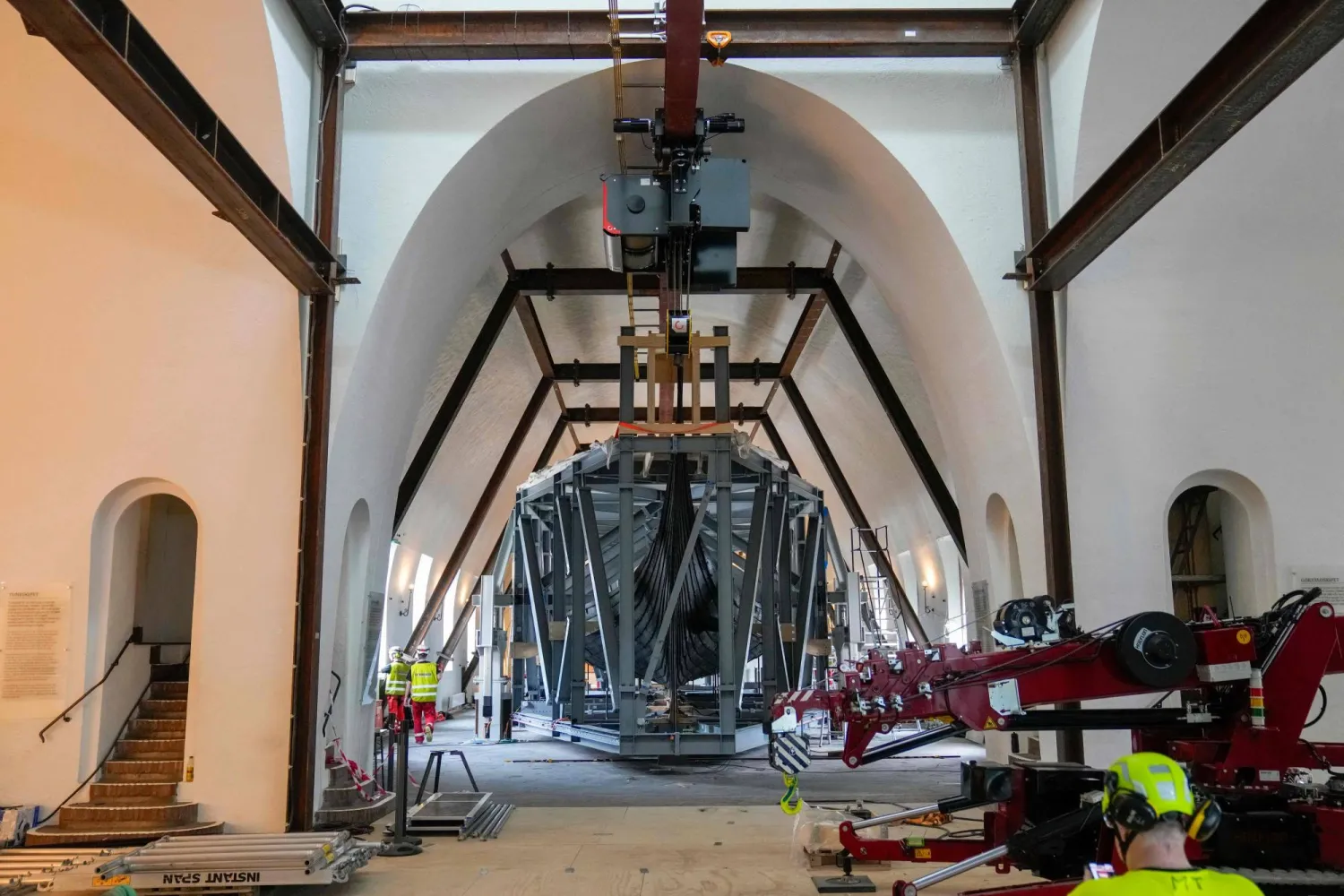
The Oseberg viking ship, which is in the Viking Ship Museum on Bygdّy in Oslo, is being prepared for relocation to the new Viking Age Museum, on September 1, 2025 in Oslo, Norway. (Photo by Fredrik Varfjell / NTB / AFP)
TT

Viking Ships Make Final High-risk Voyage to New Oslo Home

The Oseberg viking ship, which is in the Viking Ship Museum on Bygdّy in Oslo, is being prepared for relocation to the new Viking Age Museum, on September 1, 2025 in Oslo, Norway. (Photo by Fredrik Varfjell / NTB / AFP)

Three 1,200-year-old Viking ships that have stood the test of time are embarking on their final and possibly riskiest journey to their new forever home in Norway.

The first to make the move is the Oseberg, which will on Wednesday slowly inch its way from its current location in the old Viking Ship Museum to a newly built addition that will house the national treasures in optimal conditions.

The extremely fragile oak hull, encased in a heavy protective steel rig, will make the hundred-meter journey over 10 hours, lifted by a crane moving on a track on the ceiling.

"There is something deeply moving when you think that these ships -- with their long history and all the voyages they have undertaken -- will embark on their final journey," museum director Aud Tonnessen said.

Named after the places where they were discovered, the Oseberg, Gokstad and Tune -- all believed to have been built between 840 and 910 -- have been housed in a cross-shaped building considered too small and unsuitable to conserve them properly.

"They've been subjected to humidity, vibrations ... Over time, the strain became so intense that they started showing signs that they would eventually collapse onto their supports," AFP quoted Tonnessen as saying.

A decision was therefore taken to move them to a new climate-controlled facility, built as an extension to the old museum, which should make it possible to maintain the ships in their current condition for at least another century.

The relocation process is perilous.

"We have to complete this operation without causing any further damage to the ships, but we know that each handling is harmful to them," said curator David Hauer, who has been planning the project for years.

"These are clinker hulls (featuring partially overlapping planks) that are 1,200 years old. At the slightest deformation, they split between the rivets, the wood cracks," he explained.

- Endless precautions –

Endless precautions have been taken to prevent any breakage or vibrations during the relocation. The ship will be moved extremely slowly, at a pace of 5.5 minutes per meter.

Among other things, an oil services company experienced in high-precision work -- such as positioning massive structures 300 meters below the sea with millimeter accuracy -- has been called in.

"But this is yet another level," Hauer said.

"The level of precision required, for example when it comes to vibrations, is the same as for electron microscopes in hospitals" which require extreme stability, he said.

"Except here, it involves lifting the electron microscope, moving it, and then setting it back down so you can use it again," he said.

If everything goes as planned, the Gokstad is scheduled to be relocated next during the autumn, and then finally the Tune in the summer of 2026.

All three ships were found in separate burial sites southwest and southeast of Oslo between 1867 and 1904, each one very distinct from the other.

Richly decorated with ornate carvings, Oseberg is considered the best preserved Viking ship in the world.

Gokstad is meanwhile the largest of the three, measuring 23 meters (75 feet) long and five meters wide and with space for 32 rowers.

Tune is much more decomposed than the other two and is believed to have been a particularly fast warship.



Antarctica's Tourism Boom Raises Concerns about Contamination and Disease

This handout photograph released by The British Antarctic Survey on April 8, 2026, shows Emperor Penguins on Antarctica on November 13, 2010. (Photo by PETER BUCKTROUT / BRITISH ANTARCTIC SURVEY / AFP)
TT

Antarctica's Tourism Boom Raises Concerns about Contamination and Disease

This handout photograph released by The British Antarctic Survey on April 8, 2026, shows Emperor Penguins on Antarctica on November 13, 2010. (Photo by PETER BUCKTROUT / BRITISH ANTARCTIC SURVEY / AFP)

Driven in part by fears that the frozen landscapes of Antarctica may be irreversibly melting away because of climate change, tourism to the bottom of the world is soaring. And experts warn that with more visitors comes an increased risk of contamination, illness and other damage to the continent.

While visitor numbers are still small — in part due to the high costs and time it can take — they are growing so fast that scientists and environmentalists are sounding alarms.

A deadly outbreak of the rare hantavirus aboard a Dutch ship on a weekslong polar cruise has brought attention to the growing tourism trend, The Associated Press said.

Most expeditions head to the Antarctic Peninsula, one of the fastest-warming places in the world. From 2002 to 2020, roughly 149 billion metric tons (164 billion tons) of Antarctic ice melted per year, according to the National Aeronautics and Space Administration.

A common route is to voyage south from Argentina toward Antarctica before heading north up the coast of Africa — the same route taken by the cruise ship MV Hondius.

“The sites you will see in Antarctica are extremely unique and not replicable anywhere else on the planet — the whales, the seals, the penguins, the icebergs — it’s all really stunning and it makes a huge impression on people,” said Claire Christian, executive director of the environmental group Antarctic and Southern Ocean Coalition.

Explosive growth of trips to the southern continent

In 2024, more than 80,000 tourists touched down on the vast ice-cloaked continent and 36,000 viewed from the safety of ships, according to data collected by the International Association of Antarctica Tour Operators.

The International Union of Concerned Scientists estimates that tourism to Antarctica has grown tenfold in the past 30 years.

That number could rise further in the next decade as costs fall with more ice-capable hulls hitting the water and technological advances, said Hanne Nielsen, a senior lecturer of Antarctic law at the University of Tasmania. Her colleagues at the university estimate the annual figure could triple or quadruple to over 400,000 visits in that time.

Some tourists come to Antarctica for “last chance tourism,” knowing the melting landscape is rapidly changing, Nielsen said.

Risks of contamination Officials have not indicated any evidence of contamination from the MV Hondius.

However, flocks of migratory birds brought avian flu from South America to Antarctica in recent years, according to the US Centers for Disease Control and Prevention.

That outbreak prompted the International Association of Antarctica Tour Operators and others to harden rules for tourists’ conduct and hygiene to protect visitors from being contaminated. To protect the fragile ecosystem from invasive species large and microscopic, visitors are told to stay away from animals and to avoid touching the ground with anything but their feet.

“There are rules that people are bound by when they’re heading south,” Nielsen said, describing her five voyages as a former guide. Crews and passengers use vacuums, disinfectants and brushes to scrub shoes and equipment clear of bugs, feathers, seeds and microbe-carrying dirt.

“Between the tongues and the laces of the boots you can find a lot of things,” she said.

Cruise ships have been struck by outbreaks of diseases like norovirus, which can spread quickly in a ship's close quarters. In 2020, a COVID-19 outbreak on the Diamond Princess turned the cruise ship into an incubator for the then-mysterious virus.

Hantavirus usually spreads by inhaling contaminated rodent droppings.

The Hondius' island hopping cruise The World Health Organization said Tuesday that MV Hondius left Ushuaia, Argentina, on April 1 and visited Antarctica and several isolated islands.

WHO is investigating possible human-to-human transmission on the cruise ship, said Dr. Maria Van Kerkhove, WHO’s director of epidemic and pandemic preparedness. Officials suspect the first infected person likely contracted the virus before boarding, she said, and officials have been told there are no rats on board.

Antarctica is governed by the Antarctic Treaty, which in 1959 enshrined the territory as a scientific preserve used only for peaceful purposes. A series of rules that followed “aim to ensure that all visits, regardless of location, do not adversely impact the Antarctic environment or its scientific and aesthetic values,” according to the treaty’s secretariat.

Companies and scientific ventures voluntarily comply with biosecurity guidelines and submit environmental impact assessments for Antarctic operations.

The treaty was written when tourism numbers were much lower, Christian said.

“Activity needs to be regulated appropriately, as you would with any of the world’s sensitive and precious ecological sites,” Christian said from Hiroshima, Japan, where she was preparing for an Antarctic Treaty Consultative Meeting. There she'll join calls to strengthen protections for Antarctica's penguins, whales, seabirds, seals and krill — tiny creatures at the base of the food chain.

For now, the lure of the frozen frontier continues to draw visitors.

“You can put a footprint in Antarctica and it’s still there 50 years later,” Christian said.


Bear Attack Injures 2 Hikers in Yellowstone National Park in the US

FILE - This photo provided by the National Park Service shows a sign marking the north entrance of Yellowstone National Park, May 7, 2018. (Jacob W. Frank/National Park Service via AP, File)
TT

Bear Attack Injures 2 Hikers in Yellowstone National Park in the US

FILE - This photo provided by the National Park Service shows a sign marking the north entrance of Yellowstone National Park, May 7, 2018. (Jacob W. Frank/National Park Service via AP, File)

Two hikers were injured in a bear attack on a popular hiking trail near Yellowstone National Park's Old Faithful geyser, park officials said Tuesday.

The attack was described by officials as a single event Monday afternoon along the Mystic Falls Trail.

A large area of the park near the Midway Geyser Basin was temporarily closed pending an investigation, The Associated Press reported. The area includes at least five trails and several backcountry campsites.

Park officials said one or more bears were involved, but did not specify which species. The park has populations of both grizzly bears and black bears, which can be difficult to tell apart at times. Grizzlies can be more aggressive and they grow much larger — as much as twice as big as black bears. Black bears usually have darker coloring.

Further information — including whether the victims were hiking together and whether they were hospitalized for their injuries — was not being immediately released, said Yellowstone spokesperson Ashton Hooker.

Yellowstone gets more than 4 million visits by tourists annually and attacks by grizzlies or black bears are rare.

In September, a hiker suffered injuries to his chest and arm in an attack on the Turbid Lake Trail northeast of Yellowstone Lake, and a grizzly killed a woman just west of Yellowstone in 2023. The last fatal bear mauling in the park was in 2015 when a 63-year-old Billings, Montana man was killed while hiking alone in the park's Lake Village area.

The fate of bears that attack humans is typically dictated by the circumstances of the encounter.

Following the 2015 fatal attack, officials captured and killed an adult female grizzly because it had eaten part of the victim's body and hid the rest, which is not normal behavior for a bear defending its young.

By comparison, last year's attack on the Turbid Lake Trail happened during a surprise encounter between the victim and the bear. The animal's reaction was considered natural, so it was not relocated or killed.

The heavily traveled Mystic Falls trail where Monday's attack occurred includes a loop that leads to a 70-foot (21-meter) tall waterfall. The trailhead is about two miles (three kilometers) northwest of Old Faithful.


Saudi Space Agency Launches 2nd Edition of 'SARI 2' Initiative in Partnership with Aramco Digital

Saudi Space Agency Launches 2nd Edition of 'SARI 2' Initiative in Partnership with Aramco Digital
TT

Saudi Space Agency Launches 2nd Edition of 'SARI 2' Initiative in Partnership with Aramco Digital

Saudi Space Agency Launches 2nd Edition of 'SARI 2' Initiative in Partnership with Aramco Digital

The Saudi Space Agency (SSA), in partnership with Aramco Digital, announced on Tuesday the launch of the second edition of the “SARI 2” initiative, as an extension of ongoing efforts to empower national talent and foster innovation in the space sector.

The initiative aims to attract undergraduate students from universities across the Kingdom and enable them to develop and launch small satellites, contributing to the advancement of national capabilities and reinforcing the Kingdom’s position in space science and technology.

SARI 2 also seeks to achieve a set of strategic objectives, including supporting scientific research and experiments, providing hands-on opportunities in satellite development and industrial space communication solutions, fostering an innovative environment among universities, and strengthening students’ technical and engineering skills in space-related disciplines and technologies.

The initiative offers participants the opportunity to form student teams to work on advanced projects, including the design of satellites for applications that support various technology sectors.

The SSA, in strategic partnership with Aramco Digital, also provides an integrated educational ecosystem to support participants through expert mentorship, intensive training programs, and workshops that enhance scientific and engineering skills, in addition to providing the technical resources necessary to ensure high-quality project execution.

The SARI 2 initiative serves as a national platform that contributes to preparing a new generation of innovators and researchers in the space sector by offering university students the opportunity to engage in advanced applied environments and execute practical projects, while also strengthening partnerships between the agency, universities, and the private sector, in support of the Kingdom’s space sector development objectives.