

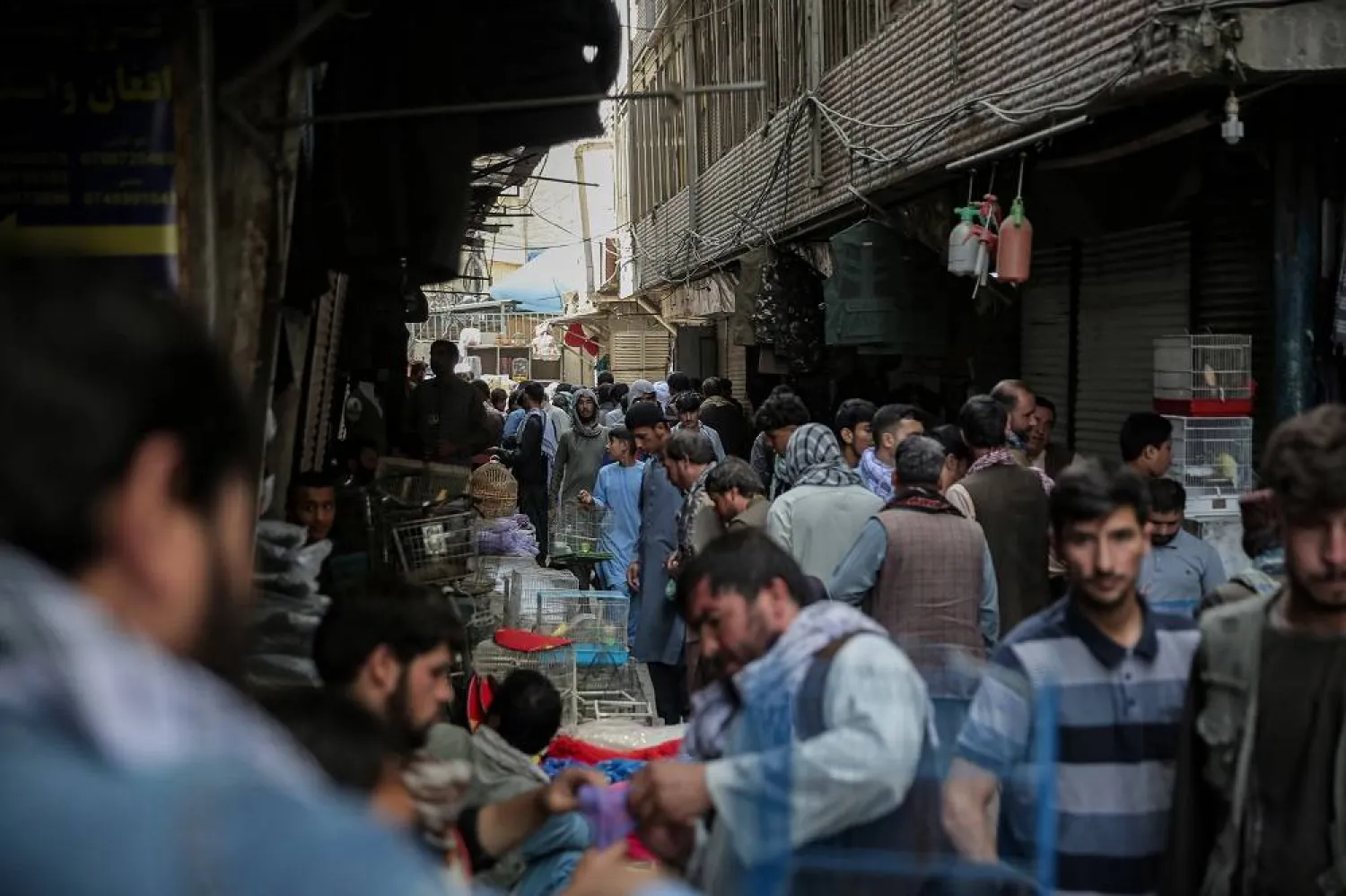

Kabul’s Wells Run Dry, Driving Children Out of Class and into Water Queues 

People walk along vendors offering birds at Kucheh Kah Farooshi Bazar in old Kabul, Afghanistan, 26 September 2025. (EPA)
TT

Kabul’s Wells Run Dry, Driving Children Out of Class and into Water Queues 

People walk along vendors offering birds at Kucheh Kah Farooshi Bazar in old Kabul, Afghanistan, 26 September 2025. (EPA)

Eight-year-old Noorullah and his twin, Sanaullah, spend their days hauling yellow jerrycans on a wheelbarrow through Kabul's dusty alleys instead of going to school - an ordeal for one family that reflects Afghanistan's deepening water crisis.

Once supplied with water from their own well, the family of 13 has had to queue at communal taps or pool money for costly water tankers since their supply dried up four years ago.

With climate change increasing the frequency of droughts and erratic rainfall in Afghanistan, aid agencies say Kabul is among the most water-stressed cities in Asia, with shortages fueling disease, malnutrition and school dropouts.

The Afghanistan Analysts Network, an independent Kabul-based research group, in a report this month warned the city's groundwater could run out by 2030, with other Afghan cities also running dry. The crisis is deepening inequality, as poor families spend up to 30% of their income on tanker water while the wealthy dig ever-deeper private wells.

The twin boys queue with dozens of children at a communal tap, where shoving and shouting often flare into fights as the heat builds.

STANDING IN LINE FOR HOURS

Noorullah, who has epilepsy, said he once collapsed with a seizure while fetching water. His brother added, "Sometimes we stand in line for three hours. When the heat is too much, we feel dizzy."

Their father, 42-year-old shopkeeper Assadullah, feels there is no choice. Sitting outside his small shop with empty water barrels stacked nearby, he said, "From morning until evening, my children go for water six or seven times a day."

"Sometimes they cry and say they cannot fetch more, but what else can we do?"

The shortages have gutted his income too. On a good day, he earns $2–$3, however, he often closes the shop to help his sons push their loads.

"Before, we used to receive water through a company. It lasted us three or four days. Now even that option is gone," he said.

In the family's yard, his wife, Speray, washes dishes in a plastic basin, measuring out each jug. She said her husband has developed a stomach ulcer and she contracted H. pylori, a bacterial infection linked to unsafe water. "I boil water twice before giving it to our children, but it is still a struggle," she said.

SNOWMELT ONCE REPLENISHED KABUL'S WATER BASIN

Kabul's population has surged past six million in two decades, but investment in water infrastructure has lagged. War wrecked much of the supply network, leaving residents dependent on wells or costly tankers, and those are failing.

Just a few streets from Assadullah, 52-year-old community representative Mohammad Asif Ayubi said more than 380 households in the neighborhood faced the same plight. "Even wells 120 meters (nearly 400 feet) deep have dried up," he said, a depth once considered certain to reach water.

Droughts and erratic rainfall patterns have limited the snowmelt that once replenished Kabul's water basin and left the riverbed dry for much of the year. "Kabul is among the most water-stressed areas," said Najibullah Sadid, a water researcher based in Germany.

UN envoy Roza Otunbayeva warned the UN Security Council earlier this month that droughts, climate shocks and migration risk turning Kabul into the first modern capital to run out of water "within years, not decades".

For Assadullah, the wish is simple. "If we had enough water, my children wouldn't have to run around all day," he said. "They could go to school. Our whole life would change."



Mummified Cheetahs Found in Saudi Caves Shed Light on Lost Populations

This undated image provided by Communications Earth and Environment shows the mummified remains of a cheetah. (Ahmed Boug/Communications Earth and Environment via AP)
TT

Mummified Cheetahs Found in Saudi Caves Shed Light on Lost Populations

This undated image provided by Communications Earth and Environment shows the mummified remains of a cheetah. (Ahmed Boug/Communications Earth and Environment via AP)

Scientists have uncovered the mummified remains of cheetahs from caves in northern Saudi Arabia.

The remains range from 130 years old to over 1,800 years old. Researchers excavated seven mummies along with the bones of 54 other cheetahs from a site near the city of Arar.

Mummification prevents decay by preserving dead bodies. Egypt's mummies are the most well-known, but the process can also happen naturally in places like glacier ice, desert sands and bog sludge.

The new large cat mummies have cloudy eyes and shriveled limbs, resembling dried-out husks.

“It’s something that I’ve never seen before,” said Joan Madurell-Malapeira with the University of Florence in Italy, who was not involved with the discovery.

Researchers aren’t sure how exactly these new cats got mummified, but the caves’ dry conditions and stable temperature could have played a role, according to the new study published Thursday in the journal Communications Earth and Environment.

They also don't know why so many cheetahs were in the caves. It could have been a denning site where mothers birthed and raised their young.

Scientists have uncovered the rare mummified remains of other large cats, including a saber-toothed cat cub in Russia.

It's uncommon for large mammals to be preserved to this degree. Besides being in the right environment, the carcasses also have to avoid becoming a snack for hungry scavengers like birds and hyenas.

Cheetahs once roamed across most of Africa and parts of Asia, but now live in just 9% of their previous range and haven't been spotted across the Arabian Peninsula for decades. That’s likely due to habitat loss, unregulated hunting and lack of prey, among other factors.

In a first for naturally mummified large cats, scientists were also able to peek at the cheetahs' genes and found that the remains were most similar to modern-day cheetahs from Asia and northwest Africa. That information could help with future efforts to reintroduce the cats to places they no longer live.


Vonn Launches Social Media Search Mission After Ski Pole Goes Missing

 US' Lindsey Vonn crosses the finish line to win the Women's Downhill event of the FIS Alpine Ski World Cup in Altenmarkt Zauchensee, Austria, on January 10, 2026. (AFP)
US' Lindsey Vonn crosses the finish line to win the Women's Downhill event of the FIS Alpine Ski World Cup in Altenmarkt Zauchensee, Austria, on January 10, 2026. (AFP)
TT

Vonn Launches Social Media Search Mission After Ski Pole Goes Missing

 US' Lindsey Vonn crosses the finish line to win the Women's Downhill event of the FIS Alpine Ski World Cup in Altenmarkt Zauchensee, Austria, on January 10, 2026. (AFP)
US' Lindsey Vonn crosses the finish line to win the Women's Downhill event of the FIS Alpine Ski World Cup in Altenmarkt Zauchensee, Austria, on January 10, 2026. (AFP)

Lindsey Vonn may be dominating World Cup downhills at 41, but even the US speed queen is not immune to missing equipment.

Vonn took to social media on Thursday with an unusual plea after losing a ski pole in Tarvisio, Italy, ahead of this weekend's World Cup event.

"Someone took ‌my pole ‌in the parking ‌lot ⁠today in ‌Tarvisio. If you have seen it, please respond to this. Thank you," Vonn wrote on X, posting a photo of the matching pole complete with her initials on the ⁠hand strap.

Vonn, a favorite for the speed events ‌at next month's Milano-Cortina ‍Olympics, retired ‍from the sport in 2019 and ‍had a partial knee replacement in April 2024 but returned to competition later that year and has been enjoying a fairy-tale comeback that has defied age and expectation.

Already the oldest ⁠World Cup winner of all time, Vonn continued her astonishing, age-defying form with a downhill victory in Zauchensee, Austria last week.

That triumph marked Vonn's fourth podium from four downhills this season, cementing her lead in the World Cup standings and her status as the woman to ‌beat at next month's Olympics.


ISS Crew Splashes Down on Earth After Medical Evacuation

FILE - This photo provided by NASA shows the Moon's shadow covering portions of Canada and the US during a total solar eclipse as seen from the International Space Station on Monday, Aug. 8, 2024. (NASA via AP, File)
TT

ISS Crew Splashes Down on Earth After Medical Evacuation

FILE - This photo provided by NASA shows the Moon's shadow covering portions of Canada and the US during a total solar eclipse as seen from the International Space Station on Monday, Aug. 8, 2024. (NASA via AP, File)

Four International Space Station (ISS) crewmembers splashed down in the Pacific Ocean early Thursday, video footage from NASA showed, after a medical issue prompted their mission to be cut short.

American astronauts Mike Fincke and Zena Cardman, Russian cosmonaut Oleg Platonov and Japan's Kimiya Yui landed off the coast of San Diego about 12:41 am (0841 GMT), marking the first-ever medical evacuation from the ISS.