

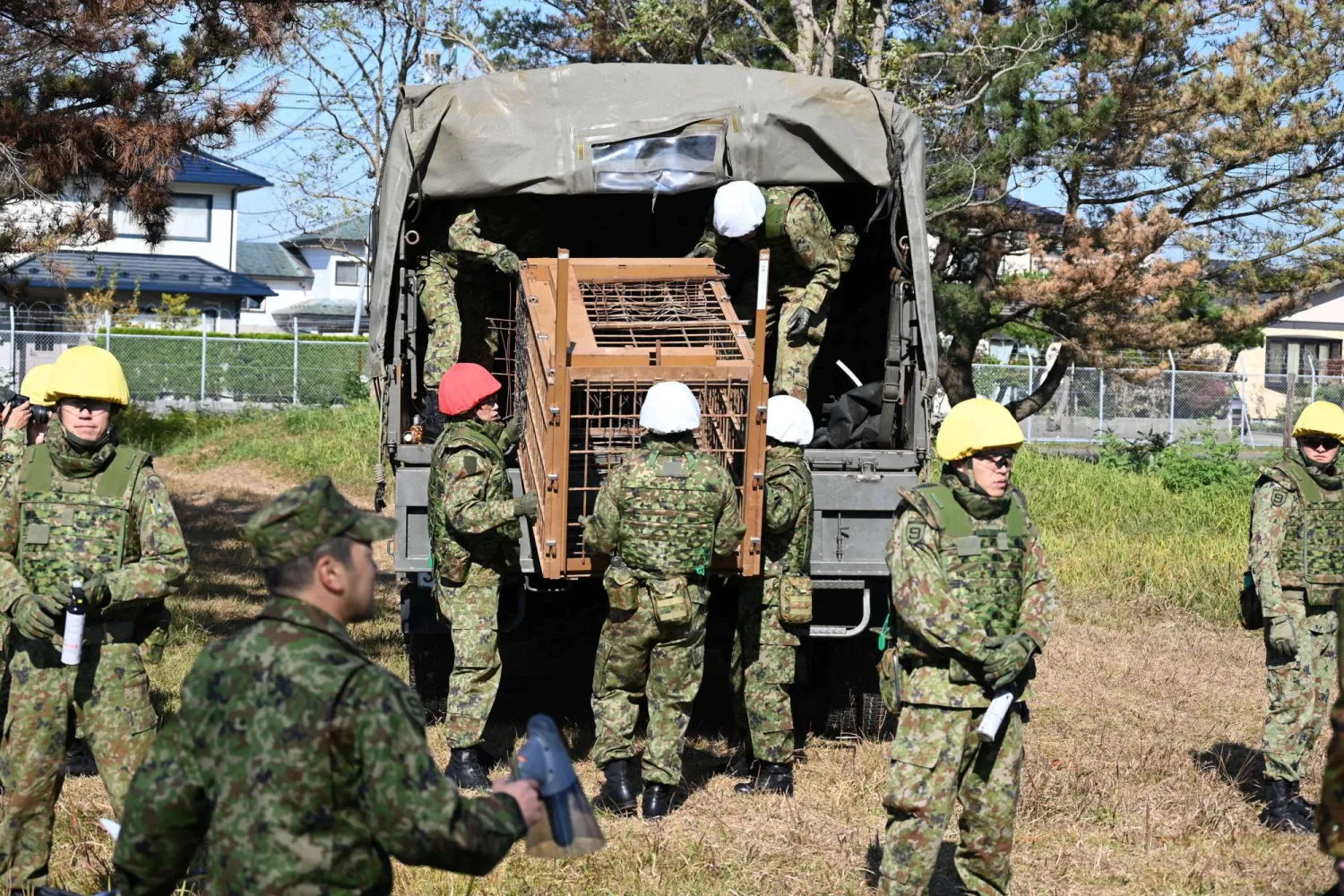

Japan Dispatches Troops to Help Combat Deadly Wave of Bear Attacks 

In this photo provided by the Japan Self-Defense Forces Akita Camp, Self-Defense forces personnel unload a bear cage from a military truck in JSDF Akita Camp, Akita, northern Japan, Thursday, Oct. 30, 2025. (JSDF Akita Camp via AP) 
TT

Japan Dispatches Troops to Help Combat Deadly Wave of Bear Attacks 

In this photo provided by the Japan Self-Defense Forces Akita Camp, Self-Defense forces personnel unload a bear cage from a military truck in JSDF Akita Camp, Akita, northern Japan, Thursday, Oct. 30, 2025. (JSDF Akita Camp via AP) 

Japan's military deployed troops to the country's mountainous north on Wednesday to help trap bears after an urgent request from local authorities struggling to cope with a wave of attacks.

The operation began in the town of Kazuno, where residents for weeks have been told to avoid the thick forests that surround it, stay home after dark and carry bells to deter bears that might forage near their homes for food.

There have been more than 100 bear attacks with a record 12 people killed across Japan in the year since April, according to the environment ministry. Two-thirds of those deaths were in Akita prefecture, where Kazuno is located, and nearby Iwate.

"The townspeople feel the danger every day," Kazuno Mayor Shinji Sasamoto said after meeting 15 or so soldiers who rolled into town in an army truck and several jeeps, equipped with body armor and large maps.

"It has affected how people live their lives forcing them to stop going out or cancel events," Sasamoto said.

The troops will help transport, set and inspect the box traps used to capture the bears but they are culled by trained hunters with weapons more suited to that purpose.

Authorities in Akita say bear sightings have jumped six-fold this year to more than 8,000, prompting the prefecture's governor to request help from Japan's Self-Defense Forces last week.

After Kazuno, a town of around 30,000 people known for its hot springs, dramatic landscapes and variety of sweet apples, the soldiers will head for the cities of Odate and Kitaakita under an agreement due to last until the end of the month.

ATTACKS IN SUPERMARKET, HOT SPRING RESORT

Rising bear numbers, climate change-driven shifts in natural food sources and depopulation of rural areas are increasingly bringing people into contact with bears in Japan. An ageing band of hunters that authorities once relied on are overwhelmed.

In recent weeks, bears have attacked customers inside a supermarket, jumped a tourist waiting at a bus stop near a UNESCO World Heritage site and mutilated a worker at a hot spring resort. Some schools have had to temporarily close after bears were spotted wandering in and around their grounds.

Bear attacks often peak in October and November, as the animals forage intensively before winter hibernation.

Japanese black bears, common across most of the country, can weigh up to 130 kg (287 pounds). Brown bears on its northern island of Hokkaido can weigh as much as 400 kg.

Japan previously deployed the military to assist in wildlife control around a decade ago when they provided aerial surveillance for hunts of wild deer. Elsewhere, the British army provided logistical support in the mass culling of animals infected with foot-and-mouth disease in 2001.

Japan plans to recruit more licensed hunters as part of a package of emergency measures to deal with the bear problem due to be announced later this month, Deputy Chief Cabinet Secretary Kei Sato told a press conference in Tokyo. In September, it relaxed gun rules to make it easier for hunters to shoot bears in urban areas.

"As bears continue to enter populated areas in many regions and injuries from bear attacks increase daily, we absolutely cannot afford to put off bear countermeasures," he said.



China's LandSpace Hopes to Complete Rocket Recovery in Mid-2026

Zhuque-3 rocket by China’s private rocket firm LandSpace, takes off from the Jiuquan Satellite Launch Center, China, December 3, 2025, in this screengrab taken from handout drone footage provided by LandSpace. LandSpace/Handout via REUTERS
TT

China's LandSpace Hopes to Complete Rocket Recovery in Mid-2026

Zhuque-3 rocket by China’s private rocket firm LandSpace, takes off from the Jiuquan Satellite Launch Center, China, December 3, 2025, in this screengrab taken from handout drone footage provided by LandSpace. LandSpace/Handout via REUTERS

Chinese rocket developer LandSpace plans to successfully recover a reusable booster in mid-2026, a company executive said in an interview, underscoring the Beijing-based firm's ambition to become China's answer to SpaceX.

The ability to return, recover, and reuse a rocket's engine-packed first stage, or booster, after launch is crucial to reducing costs and making it easier for countries to send satellites into orbit, and to turn space exploration into a commercially viable business similar to civil aviation, Reuters reported.

Earlier this month, privately-owned LandSpace ‌became the first ‌Chinese entity to conduct a full reusable rocket ‌test, when ⁠Zhuque-3 ​blasted off ‌from a remote area in northwest China for its maiden flight, drawing comparisons to US aerospace giant SpaceX.

SECOND ATTEMPT PLANNED

While LandSpace failed to complete the crucial final step of landing and recovering the rocket's engine-packed booster, it hopes to clear this challenge in mid-2026 with a second test flight, Zhuque-3 deputy chief designer Dong Kai told Chinese podcast Tech Early Know in an interview published on Tuesday.

"If the second flight's recovery (stage) succeeds, we ⁠plan that on the fourth flight we will use a reused first stage to launch," Dong said.

So far, ‌the only company that has mastered reusable rocket technology is ‍SpaceX, founded by the world's richest ‍person Elon Musk. SpaceX's Falcon 9 launches around 150 times a year, or roughly ‍three times per week, with its booster reused dozens of times if necessary.

Musk said in October that LandSpace's Zhuque-3 design could allow it to beat the Falcon 9, but went on to state that the Chinese challenger's launch cadence would take more than five years to ​reach that of SpaceX's workhorse model, at which point the US firm would have transitioned to its heavier, new-generation model Starship and "doing over ⁠100 times the annual payload to orbit of Falcon".

INITIAL PUBLIC OFFERING

LandSpace's Dong said that, while the company was already building an engine for a future Starship-like model, he was not optimistic that in five years Falcon 9's work rate could be surpassed, noting that all rocket models in China combined this year totalled only around 100 launches.

"It's very difficult for a single company to reach that kind of frequency. It requires the support of an entire ecosystem," Dong said, adding that LandSpace had 10 launches planned next year for all its models.

Other executives have previously said that the financial cost of a high-frequency testing and launch regimen was crucial to SpaceX's success, and that LandSpace's only ‌hope of amassing enough funds to sustain a similar programme would be by tapping China's capital markets, pointing to plans for an initial public offering next year.


Russia Plans a Nuclear Power Plant on the Moon within a Decade

November's full moon, also known as Beaver Moon, rises over Fort-de-France in the French overseas island of Martinique, on November 5, 2025. (AFP)
TT

Russia Plans a Nuclear Power Plant on the Moon within a Decade

November's full moon, also known as Beaver Moon, rises over Fort-de-France in the French overseas island of Martinique, on November 5, 2025. (AFP)

Russia plans to put ​a nuclear power plant on the moon in the next decade to supply its lunar space program and a joint Russian-Chinese research station as major powers rush to explore the earth's only natural satellite.

Ever since Soviet cosmonaut Yuri Gagarin became the first human to go into space in 1961, Russia has prided itself as ‌a leading power in ‌space exploration, but in recent ‌decades ⁠it ​has fallen ‌behind the United States and increasingly China.

Russia's ambitions suffered a massive blow in August 2023 when its unmanned Luna-25 mission smashed into the surface of the moon while attempting to land, and Elon Musk has revolutionized the launch of space vehicles - once a Russian specialty.

Russia's state space corporation, Roscosmos, ⁠said in a statement that it planned to build a lunar power ‌plant by 2036 and signed a contract ‍with the Lavochkin Association ‍aerospace company to do it.

Roscosmos said the purpose of ‍the plant was to power Russia's lunar program, including rovers, an observatory and the infrastructure of the joint Russian-Chinese International Lunar Research Station.

"The project is an important step towards the creation of ​a permanently functioning scientific lunar station and the transition from one-time missions to a long-term lunar exploration program," ⁠Roscosmos said.

Roscosmos did not say explicitly that the plant would be nuclear but it said the participants included Russian state nuclear corporation Rosatom and the Kurchatov Institute, Russia's leading nuclear research institute.

The head of Roscosmos, Dmitry Bakanov, said in June that one of the corporation's aims was to put a nuclear power plant on the moon and to explore Venus, known as earth's "sister" planet.

The moon, which is 384,400 km (238,855 miles) from our planet, moderates the earth's wobble ‌on its axis, which ensures a more stable climate. It also causes tides in the world's oceans.


Seasonal Rains Transform Saudi Arabia’s Rawdat Muhanna into Natural Lake

People visit Rawdat Muhanna after recent rainfall. (SPA)
TT

Seasonal Rains Transform Saudi Arabia’s Rawdat Muhanna into Natural Lake

People visit Rawdat Muhanna after recent rainfall. (SPA)

Rawdat Muhanna, or Muhanna's Garden, located near the town of Al-Nabqiyah in the eastern part of Saudi Arabia’s Qassim region, has witnessed a notable influx of visitors and picnickers in recent days following rainfall that filled the Rawdat with water, transforming it into a vast natural lake.

The rare and striking scene has drawn residents and visitors from within and outside the region, reported the Saudi Press Agency on Tuesday.

Stretching over more than 10 kilometers, Rawdat Muhanna has become a breathtaking natural landscape amid the sands of Al-Thuwairat. The contrast between the blue waters and the red desert sand has created a picturesque panorama, making the site a favored destination for nature enthusiasts and photographers.

Rawdat Muhanna is one of the region’s prominent seasonal parks, as several valleys flow into it, most notably Wadi Al-Mustawi. These valleys contribute to the accumulation of large volumes of water, which in some seasons can remain for nearly a year, boosting the site’s ecological value and making it one of the most beautiful natural areas in the Qassim desert.

Visitors said Rawdat Muhanna has become an ideal destination for outdoor recreation and relaxation.