


Famed Jerusalem Stone Still Sells despite West Bank Economic Woes

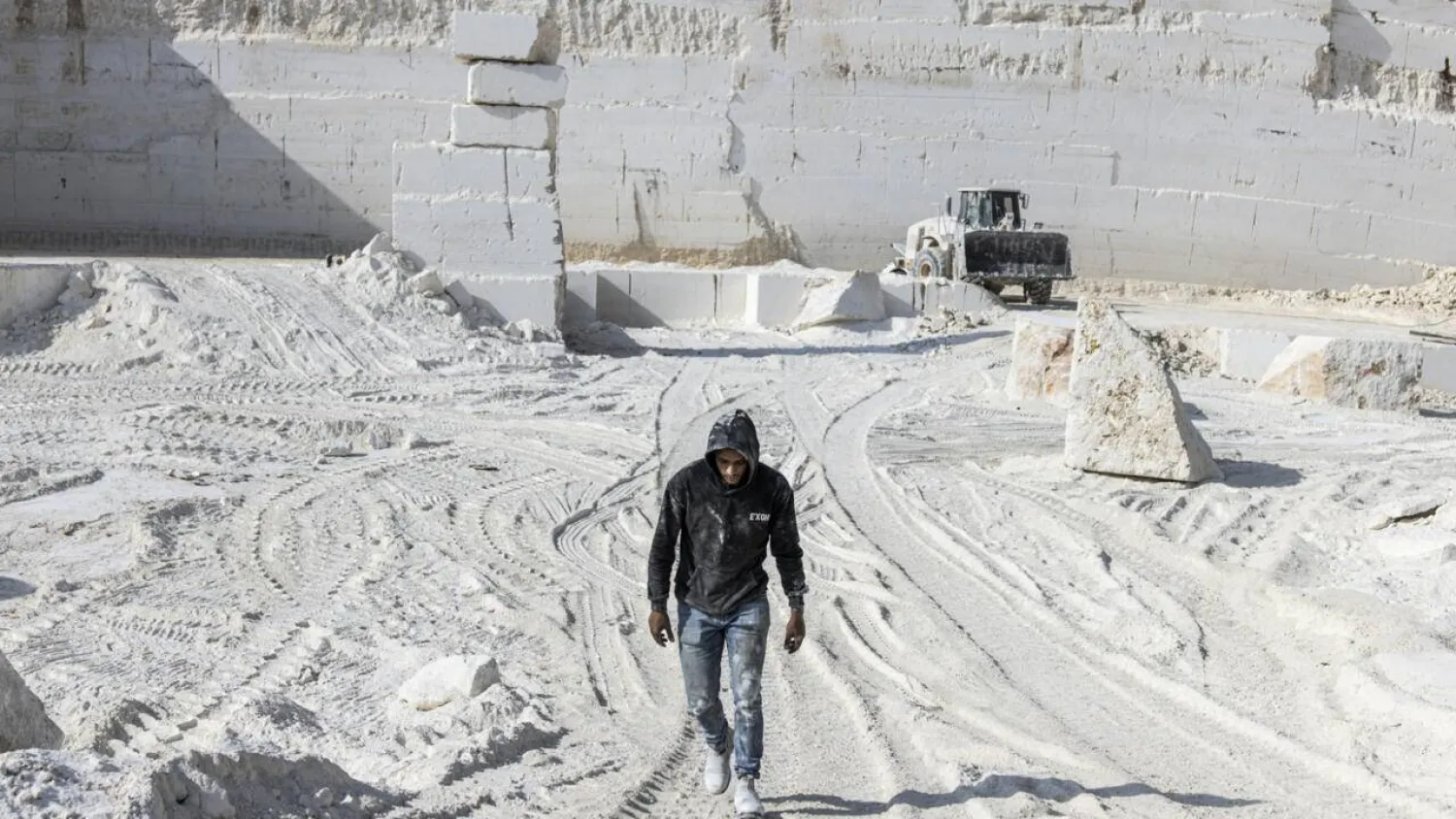
Quarry work in the occupied West Bank is tough, but there are few other options available in the territory's wilting economy. JOHN WESSELS / AFP
TT

Famed Jerusalem Stone Still Sells despite West Bank Economic Woes

Quarry work in the occupied West Bank is tough, but there are few other options available in the territory's wilting economy. JOHN WESSELS / AFP

Despite the catastrophic state of the Palestinian economy, Faraj al-Atrash, operator of a quarry in the occupied West Bank, proudly points to an armada of machines busy eating away at sheer walls of dusty white rock that stretch into the distance.

"This here is considered the main source of revenue for the entire region", Atrash said at the site near the town of Beit Fajjar, close to the city of Hebron.

The quarry is a source of Jerusalem stone, the famed pale rock used throughout the Holy Land and beyond for millennia and which gives much of the region its distinctive architectural look.

But Atrash, in his fifties, said "our livelihood is constantly under threat".

"Lately, I feel like the occupation (Israel) has begun to fight us on the economic front," he said.

Atrash fears the confiscation of the quarry's industrial equipment, the expansion of Israeli settlements and the Palestinian financial crisis, said AFP.

The war in Gaza, triggered by Hamas's October 2023 attack on Israel, dealt a severe blow to a Palestinian economy that was already in poor shape.

The Palestinian territories are "currently going through the most severe economic crisis ever recorded," according to a report by the United Nations Conference on Trade and Development presented in late November.

Israel, which has occupied the West Bank since 1967, has recently set up hundreds of new checkpoints across the territory, paralyzing commercial transport.

Beyond restrictions on freedom of movement, a halt in permits for West Bank Palestinians seeking work inside Israel has also had a severe impact.

- Soaring costs -

"There are problems with exports and market access because we used to export most of the stone to Israel, and after October 7, we ran into difficulties," explained Ibrahim Jaradat, whose family has owned a quarry for more than 40 years near Sair, also near Hebron.

The Palestinian Authority, which exercises partial civilian control over some of the West Bank, is on the brink of bankruptcy.

Public services are functioning worse than ever, Atrash said, adding that fixed costs such as water and electricity had soared.

Quarries account for 4.5 percent of Palestinian GDP and employ nearly 20,000 workers, according to the Hebron Chamber of Commerce.

Around 65 percent of exports are destined for the Israeli market, where some municipalities mandate the use of Jerusalem stone.

"The people who buy the stones from us to resell them to construction sites are mostly Israelis," said Abu Walid Riyad Gaith, a 65-year-old quarry operator.

He lamented what he said was a lack of solidarity from Arab countries, which he said do not buy enough of the rock.

- 'Afraid to build' -

Other threats hang over the industry.

Most of the roughly 300 quarries in the West Bank are located in Area C, land which falls under full Israeli authority and covers the vast majority of its settlements.

"Many (Israeli) settlers pass through here, and if Israel annexes Palestine, it will start with these areas," said one operator, speaking on condition of anonymity.

Some members of Israel's government, one of the most right-wing in the country's history, openly discuss plans to annex parts or all of the West Bank.

Israeli settlements in the West Bank are illegal under international law.

They are expanding at the fastest rate since at least 2017, when the United Nations began tracking such data, according to a recent report by the UN chief.

The physical demands of working in a quarry are intense, but for many Palestinians there are few other options as the West Bank's economy wilts.

"We are working ourselves to death," Atrash said, pointing to his ten laborers moving back and forth in monumental pits where clouds of dust coat them in a white film.

In the neighboring quarry, blinking and coughing as he struggled with the intense work was a former geography teacher.

With the Palestinian Authority's budget crisis meaning he was no longer receiving his salary, he had looked for work in the only local place still hiring.

All the laborers AFP spoke to said they suffered from back, eye and throat problems.

"We call it white gold," said Laith Derriyeh, employed by a stonemason, "because it normally brings in substantial amounts of money".

"But today everything is complicated; it's very difficult to think about the future."

"People have no money, and those who do are afraid to build," he added.


Japan City Gets $3.6 Mn Donation in Gold to Fix Water System

FILE PHOTO: Factories line the port of Osaka, western Japan October 23, 2017. REUTERS/Thomas White/File Photo
TT

Japan City Gets $3.6 Mn Donation in Gold to Fix Water System

FILE PHOTO: Factories line the port of Osaka, western Japan October 23, 2017. REUTERS/Thomas White/File Photo

Osaka has received an unusual donation -- 21 kilograms of gold -- to pay for the maintenance of its ageing water system, the Japanese commercial hub announced Thursday.

The donation worth $3.6 million was made in November by a person who a month earlier had already given $3,300 in cash for the municipal waterworks, Osaka Mayor Hideyuki Yokoyama told a press conference.

"It's an absolutely staggering amount," said Yokoyama, adding that he was lost for words to express his gratitude.

"I was shocked."

The donor wished to remain anonymous, AFP quoted the mayor as saying.

Work to replace water pipes in Osaka, a city of 2.8 million residents, has hit a snag as the actual cost exceeded the planned budget, according to local media.


Thai Cops Go Undercover as Lion Dancers to Nab Suspected Thief

People gather to watch performers outside Emsphere shopping mall on the first day of the Lunar New Year of the Horse, in Bangkok on February 17, 2026. (Photo by Lillian SUWANRUMPHA / AFP)
TT

Thai Cops Go Undercover as Lion Dancers to Nab Suspected Thief

People gather to watch performers outside Emsphere shopping mall on the first day of the Lunar New Year of the Horse, in Bangkok on February 17, 2026. (Photo by Lillian SUWANRUMPHA / AFP)

Thai police donned a lion dance costume during this week's Lunar New Year festivities to arrest a suspect accused of stealing about $64,000 worth of Buddhist artifacts, police said Thursday.

Officers dressed as a red-and-yellow lion made the arrest on Wednesday evening after receiving a report earlier this month of a home burglary in the suburbs of the capital, Bangkok, AFP reported.

Capital police said the reported break-in involved "numerous Buddhist objects and two 12-inch Buddha statues", along with evidence of repeated attempts to enter the house, according to a statement.

With few leads, police kept watch for weeks before hatching an unusual plan to join a lion dance procession at a nearby Buddhist temple.

"Officers gradually moved closer to the suspect before arresting him," police said.

A video released by police showed the festive lion dancers approaching the suspect before an officer suddenly emerged from the head of the costume and, with help from colleagues, pinned him to the ground.

Police estimated the value of the stolen items at around two million baht ($64,000).

The suspect, a 33-year-old man, has a criminal record involving drug offences and theft, police added.


Sudan's Historic Acacia Forest Devastated as War Fuels Logging

Little is left of the once sprawling acacia forest south of Sudan's capital. Ebrahim Hamid / AFP
TT

Sudan's Historic Acacia Forest Devastated as War Fuels Logging

Little is left of the once sprawling acacia forest south of Sudan's capital. Ebrahim Hamid / AFP

Vast stretches of a once-verdant acacia forest south of Sudan's capital Khartoum have been reduced to little more than fields of stumps as nearly three years of conflict have fueled deforestation.

What was once a 1,500-hectare natural reserve has been "completely wiped out", Boushra Hamed, head of environmental affairs for Khartoum state, told AFP.

Al-Sunut forest had long served as a haven for migratory birds and a vital green shield against the Nile's seasonal floods.

"During the war, Khartoum state has lost 60 percent of its green cover," Hamed said, describing how century-old trees "were cut down with electric saws" for commercial timber and charcoal production.

Where tall acacias once cast cool shade over a wetland just upstream from the confluence of the Blue and White Nile, barren ground now lies exposed, criss-crossed by people gathering whatever wood remains.

Hamed called it "methodical destruction", though the perpetrators remain unknown and there has been no investigation.

Similar devastation is unfolding across several regions -- including western Darfur, neighboring Kordofan and the central states of Sennar and Al-Jazirah -- as insecurity and economic collapse drive unchecked logging, according to Sudan's Forests National Corporation.

According to a 2019 study by the Nairobi-based African Forest Forum, Sudan had already lost nearly half of its forested land since 1960 due to agricultural expansion, firewood collection and overgrazing.

By 2015, the country ranked among Africa's least forested nations, with around 10 percent of its territory still covered by woodland, the study said.

The report had also warned of further degradation if reforestation and sustainable management efforts were not implemented -- concerns now compounded by the ongoing conflict.

- 'Barrier' -

Aboubakr Al-Tayeb, who oversees Khartoum's forestry administration, said the damage "affects not only Khartoum, but Sudan and the wider African continent."

"The forest was home to several migratory species from Europe," he told AFP.

More than a hundred bird species, including ducks, geese, terns, ibis, herons, eagles and vultures, had been recorded in the area, alongside monkeys and small mammals.

Al-Nazir Ali Babiker, an agronomist, said the loss of tree cover could cause more severe seasonal flooding because the "forest acted as a barrier" against rising waters.

Flooding strikes Sudan every year, destroying homes, farmland and infrastructure and leaving many families with no choice but to flee to safer areas.

The war in Sudan, which erupted in April 2023, has already killed tens of thousands, displaced 11 million and shattered critical infrastructure.

Before the fighting, forests supplied roughly 70 percent of Sudan's energy consumption, primarily through charcoal and firewood, according to data from the African Forest Forum.

Al-Sunut had also been a popular leisure spot for Khartoum residents.

"We used to come in groups to study and have a good time," recalls Adam Hafiz Ibrahim, a student at Omdurman Islamic University.

Today, wood gatherers have supplanted the usual walkers. Disregarding army notices alerting them to landmines, men and women traverse the dry, open ground that now stands where the ancient forest once grew.

"We're not cutting the trees. We just pick up whatever wood's already on the ground to use for the fire," said Nafisa, a woman in her forties navigating the dry grasslands.

"We found the trees down. We collect the wood to sell to bakeries and families," said Mohamed Zakaria, a construction worker who lost his job because of the war.

Experts say that the economic hardship caused by the war combined with a lack of enforcement has encouraged logging.

"The logging continues, because those responsible for forest protection cannot access many areas," said Mousa el-Sofori, head of Sudan's Forests National Corporation.

Efforts to replant acacias are underway, Tayeb of the Khartoum forestry administration said, but seedlings grow slowly and can take years to mature.

Restoring the lost woodlands would be "long and costly", said Sofori.

"Some of these forests were centuries old," he added.
