


Meteorologists Blame a Stretched Polar Vortex, Moisture, Lack of Sea Ice for Dangerous Winter Blast

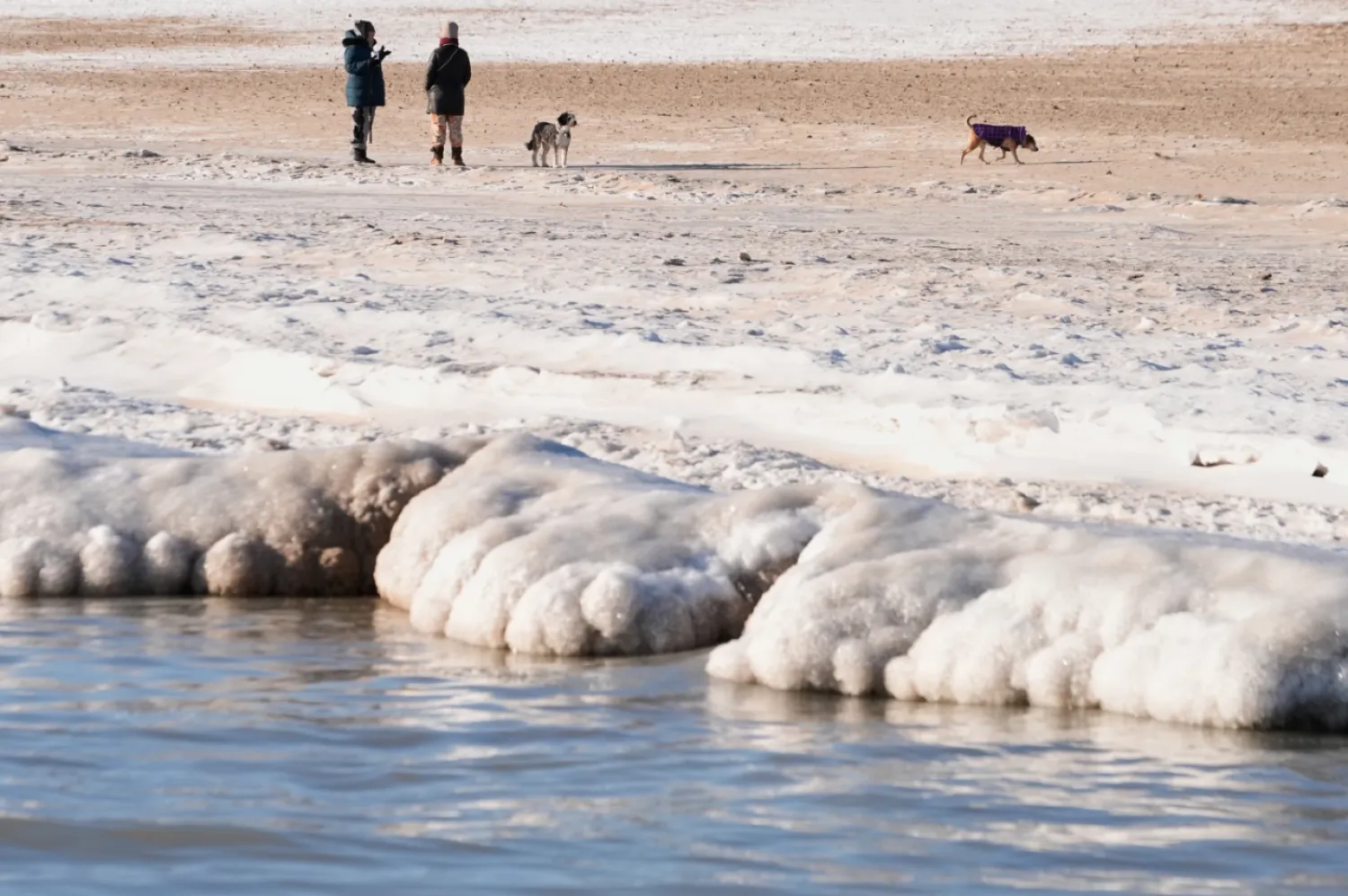
Ice forms along the Lake Michigan shore as People walk their dogs on a beach, Tuesday, Jan. 20, 2026, in Chicago. (AP Photo/Kiichiro Sato)
TT

Meteorologists Blame a Stretched Polar Vortex, Moisture, Lack of Sea Ice for Dangerous Winter Blast

Ice forms along the Lake Michigan shore as People walk their dogs on a beach, Tuesday, Jan. 20, 2026, in Chicago. (AP Photo/Kiichiro Sato)

Warm Arctic waters and cold continental land are combining to stretch the dreaded polar vortex in a way that will send much of the United States a devastating dose of winter later this week with swaths of painful subzero temperatures, heavy snow and powerline-toppling ice.

Meteorologists said the eastern two-thirds of the nation is threatened with a winter storm that could rival the damage of a major hurricane and has some origins in an Arctic that is warming from climate change. They warn that the frigid weather is likely to stick around through the rest of January and into early February, meaning the snow and ice that accumulates will take a long time to melt.

Wednesday’s forecast has the storm stretching from New Mexico to New England, threatening at least 250 million people.

“I think people are underestimating just how bad it’s going to be,” said former National Oceanic and Atmospheric Administration chief scientist Ryan Maue, now a private meteorologist.

The polar vortex, a patch of bitter cold air that often stays penned up in northern Canada and Alaska, is being elongated by a wave in the upper atmosphere that goes back to a relatively ice-free part of the Arctic and snow-buried Siberia. As the bone-chilling temperatures sweep through the US, they'll meet with moisture from off California and the Gulf of Mexico to set up crippling ice and snow in many areas.

Origins of the system in a warming Arctic The origins of the system begin in the Arctic, where relatively warmer temperatures add energy to the polar vortex and help push its cold air south.

“The atmosphere is aligned perfectly that the pattern is locked into this warm Arctic, cold continent," Maue said. "And it’s not just here for us in North America, but the landmass of Eastern Europe to Siberia is also exceptionally cold. The whole hemisphere has gone into the deep freeze.”

As far back as October 2025, changes in the Arctic and low sea ice were setting up conditions for the kind of stretched polar vortex that brings severe winter weather to the US, said winter weather expert Judah Cohen, an MIT research scientist. Heavy Siberian snowfall added to the push-and-pull of weather that warps the shape of the normally mostly circular air pattern. Those conditions “kind of loaded the dice a bit'' for a stretching of the polar vortex, he said, The AP news reported.

Cohen co-authored a July 2025 study that found more stretched polar vortex events linked to severe winter weather bursts in the central and eastern US over the past decade. Cohen said part of the reason is that dramatically low sea ice in the Barents and Kara seas in the Arctic helps set up a pattern of waves that end up causing US cold bursts. A warmer Arctic is causing sea ice in that region to shrink faster than other places, studies have found.

Arctic sea ice is at a record low extent for this time of year, according to the National Snow and Ice Data Center.

Where the winter blast will strike The center of the stretched polar vortex will be somewhere above Duluth, Minnesota, by Friday morning, ushering in “long-lasting brutal cold,” Maue said. Temperatures in the North and Midwest will get about as cold as possible, even down to minus 25 or 30 degrees Fahrenheit (minus 32 to minus 34 degrees Celsius), Maue said. The average low temperature for the Lower 48 states will dance around 11 or 12 degrees (minus 12 to minus 11 degrees Celsius) on Saturday, Sunday and Monday, Maue said.

Two Great Lakes — Erie and Ontario — may freeze up, which would at least reduce the famed lake-effect snow a bit, Maue said.

National Weather Service meteorologist Zack Taylor of the national Weather Prediction Center said most areas east of the Rockies will be impacted by the bitter cold, snow or ice. Treacherous freezing rain could stretch from the southern plains through the mid-South and into the Carolinas, he said.

“We’re looking at the potential for impactful ice accumulation. So the kind of ice accumulation that could cause significant or widespread power outages or potentially significant tree damage,” he said.

And if you don't get ice, you could get “another significant swath of heavy snow,” Taylor said. He said it was too early to predict how many inches will fall, but “significant snowfall accumulations” could hit "the Ozarks region, Tennessee and Ohio valleys, the central Appalachians, and then into the mid-Atlantic, and perhaps into the portions of the northeast.”

Maue said in the mid-Atlantic around the nation's capital, there's a possibility that “you can get two blizzards on top of each other in the next 14 days.”



International Crew Set to Dock at Space Station

A SpaceX Falcon 9 rocket with the company's Dragon spacecraft on top launches from Cape Canaveral, en route to the International Space Station © Jim WATSON / AFP
TT

International Crew Set to Dock at Space Station

A SpaceX Falcon 9 rocket with the company's Dragon spacecraft on top launches from Cape Canaveral, en route to the International Space Station © Jim WATSON / AFP

Four astronauts are set to dock at the International Space Station on Saturday for a months-long research mission, replacing a crew forced to return to Earth early over a medical issue.

The US space agency's international Crew-12 blasted off early Friday aboard a SpaceX Falcon 9 rocket from the Cape Canaveral launch site in Florida.

After more than 30 hours in flight, the astronauts are expected to arrive at the ISS and dock by about 3:15 pm Eastern (2015 GMT).

Crew-12 is composed of Americans Jessica Meir and Jack Hathaway, along with French astronaut Sophie Adenot and Russian cosmonaut Andrey Fedyaev, AFP reported.

"We have left the Earth, but the Earth has not left us," Meir said as the astronauts ventured into space. "When we gaze on our planet from above, it is immediately clear that everything is interconnected."

"We are one humankind."

The travelers are replacing Crew-11, which returned to Earth in January a month earlier than planned in the first medical evacuation in the space station's history.

The ISS, which orbits 250 miles (400 kilometers) above Earth, has since been staffed by a skeleton crew of three.

NASA declined to disclose any details about the health issue that cut the previous mission short.

Once the astronauts arrive, they will be one of the last crews to live aboard the football field-sized space station.

Continuously inhabited for the last quarter-century, the aging ISS is scheduled to be pushed into Earth's orbit before crashing into an isolated spot in the Pacific Ocean in 2030.

- Microgravity and the human body -

During their eight months on the outpost, the astronauts will conduct many experiments, including research into the effects of microgravity on their bodies.

Meir, who previously worked as a marine biologist studying animals in extreme environments, will serve as the crew's commander.

Adenot has become the second French woman to fly into space, following in the footsteps of Claudie Haignere, who spent time on the Mir space station.

Among other research, she will test a system that uses artificial intelligence and augmented reality to allow astronauts to carry out their own medical ultrasounds.

The ISS, once a symbol of warming post-Cold War relations, has been a rare area of continued cooperation between the West and Russia since Moscow invaded Ukraine in 2022.

However, the space station has not entirely avoided the tensions back on Earth.

In November, Russian cosmonaut Oleg Artemyev -- who had long been planned to be a member of Crew-12 -- was suddenly taken off the mission.

Reports from independent media in Russia suggested he had been photographing and sending classified information with his phone while training at a SpaceX facility. Russian space agency Roscosmos merely said he had been transferred to a different job.

His replacement, Fedyaev, has already spent some time on the ISS as part of Crew-6 in 2023.


Falling Cocoa Prices Won't Necessarily Mean Cheaper Valentine's Day Chocolates

A man passes a Fannie May chocolate shop in downtown Chicago on Valentine's Day, Feb. 14, 2021. (AP Photo/Nam Y. Huh, File)
TT

Falling Cocoa Prices Won't Necessarily Mean Cheaper Valentine's Day Chocolates

A man passes a Fannie May chocolate shop in downtown Chicago on Valentine's Day, Feb. 14, 2021. (AP Photo/Nam Y. Huh, File)

Cocoa prices have fallen nearly 70% since last Valentine's Day, but that won’t make heart-shaped boxes of chocolate or even chocolate Easter bunnies more affordable this year.

Chocolate prices at US retail stores rose 14% between Jan. 1 and the first week of February compared to the same period last year, according to market research company Datasembly. That’s on top of a 7.8% increase for the same period in 2025.

Europe has seen even steeper price increases. In Germany, chocolate prices rose 18.9% in 2025, according to government figures.

Here’s what caused the price of cocoa futures to rise and then fall — and why that may not be reflected in the prices customers are paying, The AP news reported.

Cocoa, climate and cost Cocoa prices more than doubled in 2024 due to insufficient rainfall and crop diseases in West Africa, which supplies more than 70% of the world’s cocoa. Cocoa, which is made from the dried beans of the cacao tree, is the main ingredient in both dark and white chocolate.

Weather conditions have improved since then in Ivory Coast and Ghana, and cocoa production is increasing in Ecuador and other countries, according to an analysis by J.P. Morgan. The resulting supply increase is one reason cocoa prices are coming down.

But they're also dropping because of lower global demand. Chocolate getting more expensive has turned off consumers, so manufacturers have cut the amount of chocolate they use or shifted to other products like gummy candies to keep prices in check, said Chris Costagli, a food thought leader at the market research company NIQ.

In the US, annual retail sales of chocolate rose 6.7% in 2025 compared to the prior year, largely because of price increases, according to NIQ data. But the number of individual products sold was down 1.3%, as consumers bought less chocolate overall.

Tariffs on treats The Trump administration's tariffs were another reason US chocolate prices increased last year.

The administration put a tariff averaging 15% on cocoa-producing countries last February, which raised the price of US cocoa imports, according to the US Federal Reserve.

In November, the administration removed tariffs on cocoa and other commodities that can't be grown in the US, including coffee, spices and tropical fruit.

But tariffs of 15% or more on products from the European Union, including chocolates, remain in place.

What goes up... may stay up So far, declining cocoa prices haven't necessarily let chocolate lovers pay less.

Costagli compares the situation to gas prices. Even when the cost of oil goes down, prices at the pump don't immediately follow because companies need to use up the oil they bought at a higher price.

Chocolate makers like The Hershey Co. have long-term contracts that may require them to pay more than current cocoa prices. The market also is volatile; companies know that another bout of poor weather or a surge in demand could make cocoa prices surge again.

But Costagli said companies also watch shoppers' reaction to prices.

“If the customer is still willing to pay that higher price point, do we really take the price down?" he said.

Mondelez International, which owns chocolate brands like Oreo, Cadbury and Toblerone, raised its prices by 8% globally in 2025 to counter higher cocoa costs.

In Europe, the company hiked prices by even more and saw a significant decrease in the amount of its products sold. As a result, Mondelez lowered prices this year in some markets, including the United Kingdom and Germany.

“We have learned that certain price points are very important, and so we have adjusted already to put our products at the right price point,” Mondelez Chairman and CEO Dirk Van de Put said during a February conference call with investors.

Van de Put said Mondelez didn't plan immediate price cuts in North America, where both its price increases and its sales volume losses were more moderate.

Trading up ... or down Two segments of the chocolate market grew in the US last year: value brands and super-premium brands, Costagli said.

The expanded interest in higher-end chocolate may seem surprising if consumers balked at paying more for a Snickers bar or a pack of Reese's Peanut Butter Cups. But the companies behind super-premium lines like Ferrero Rocher, Justin's and Lindt Excellence were less aggressive about instituting cocoa-related price increases since their products already were more expensive, Costagli said.

As mainstream chocolate makers like Hershey and Mars raised prices, some customers decided they'd just spend a little more, he said.

“It's given the aspirational shopper that little push they need to trade up. If they wanted a better product, if they wanted better experience, better product characteristics, organic, fair trade, whatever it might be,” Costagli said.

On the flip side, value brands — think Whitman's or some store-brand chocolates — also sold more products in the US last year as price-conscious shoppers traded down from mainstream brands.

“The savings you get by trading down is actually greater than it used to be,” Costagli said. “So from an aspirational perspective, it’s easier to trade up, and from a financially insecure perspective, it saves you more to trade down.”


Najran Farmers Launch Annual Date Palm Pollination Season

Photo by SPA
Photo by SPA
TT

Najran Farmers Launch Annual Date Palm Pollination Season

Photo by SPA
Photo by SPA

Farmers across Najran Region have started the date palm pollination season, a critical phase in ensuring a high-quality harvest in this vital agricultural sector.

According to local farmer Ahmed Al-Saqour, the process begins each February with the emergence of palm spathes and follows a rigorous preparation period involving pruning fronds, clearing thorns, and removing offshoots from the "mother palms", SPA reported.

Pollination is carried out manually by carefully placing high-quality pollen powder into the developing spathes to ensure maximum yield.

This traditional practice supports over 526,000 fruit-bearing trees across 2,696 hectares, contributing more than 40,000 tons of premium dates to the local market annually and serving as a cornerstone of Najran’s regional economy.