


Spain and Portugal Continue to Battle Storm Leonardo as New Storm Approaches

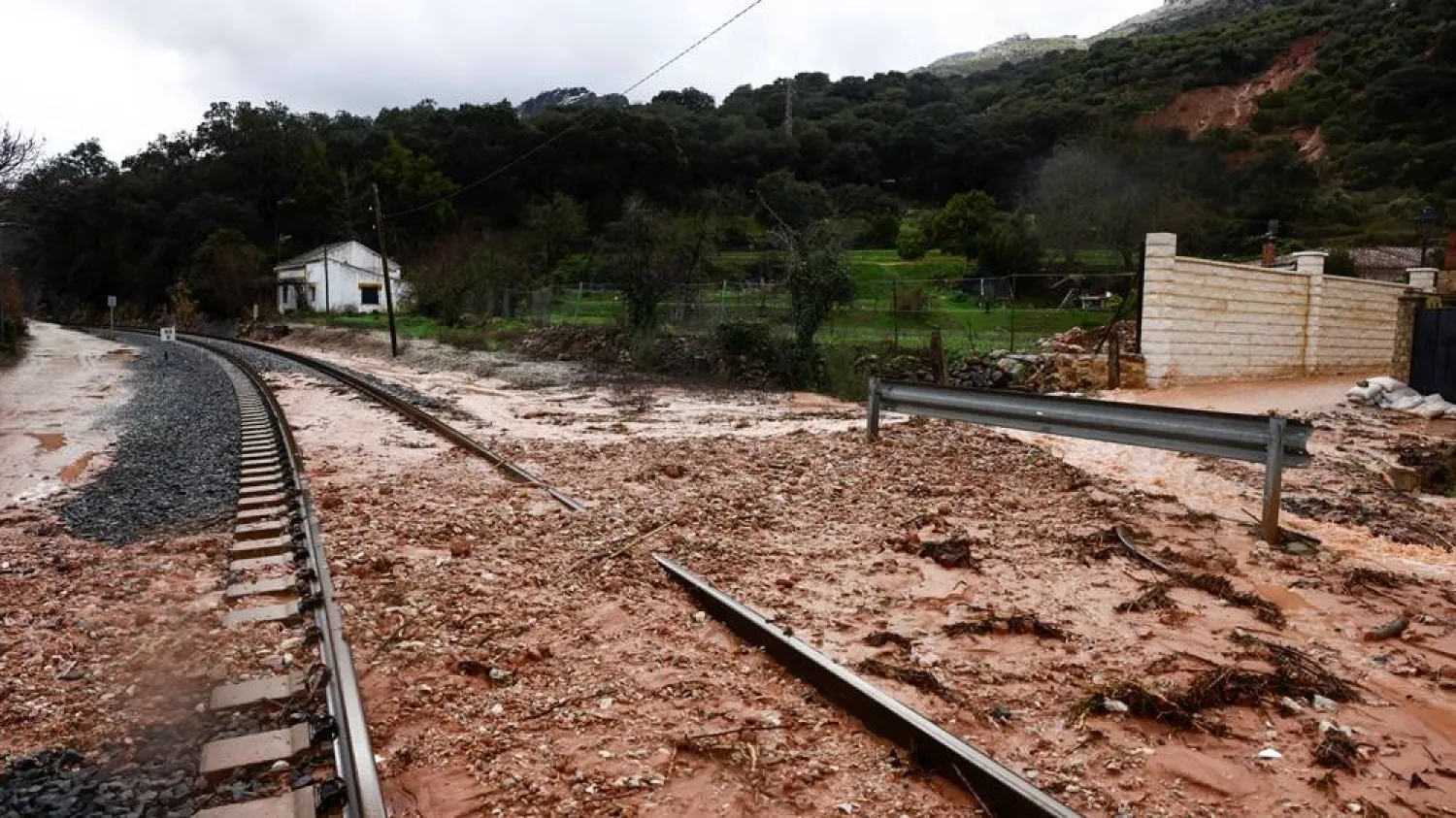
 A mountain landslide blocks railway tracks during heavy rains, as storm Leonardo hits parts of Spain, in Benaojan, Spain, February 6, 2026. (Reuters)
A mountain landslide blocks railway tracks during heavy rains, as storm Leonardo hits parts of Spain, in Benaojan, Spain, February 6, 2026. (Reuters)
TT

Spain and Portugal Continue to Battle Storm Leonardo as New Storm Approaches

 A mountain landslide blocks railway tracks during heavy rains, as storm Leonardo hits parts of Spain, in Benaojan, Spain, February 6, 2026. (Reuters)
A mountain landslide blocks railway tracks during heavy rains, as storm Leonardo hits parts of Spain, in Benaojan, Spain, February 6, 2026. (Reuters)

Storm Leonardo continued to batter the Iberian Peninsula on Friday, bringing floods and putting rivers at risk of bursting their banks while thousands of people were evacuated from their homes in Spain and Portugal.

In southern Spain's Andalusia region, some 7,000 people have had to leave their homes due to successive storms.

Among them were around 1,500 people ordered to evacuate the mountain village of Grazalema, where Andalusia's regional leader Juan Manuel Moreno warned that aquifers were "full to the brim with water,” and at risk of collapsing.

“It's raining on already saturated ground. The land is unable to drain," Moreno said. “We urge extreme caution. This is not over.”

Spanish police said Friday they had found a body located 1,000 meters (about 0.6 miles) away from where a woman had disappeared Wednesday after she fell into a river in Malaga province while trying to rescue her dog. Police said they had not yet identified the body, but believed it belonged to the 45-year-old woman.

Another storm front, Marta, was expected to arrive Saturday, with Spain's weather agency AEMET saying it would bring even more rain and heavy winds, including to areas already drenched by Storm Leonardo.

Marta is expected to affect Portugal, too.

Of particular concern was southern Spain's Guadalquivir River, which flows through Córdoba and Seville and eventually into the Atlantic Ocean, and whose water levels have dramatically risen in recent days.

Additional rain Saturday could leave many more homes at risk in Córdoba, local authorities warned.

In Portugal, parts of Alcacer do Sal were submerged after the Sado River overflowed, forcing residents to leave the city located 90 kilometers (about 56 miles) south of Lisbon.

Alerts were issued also for regions near the Tagus River due to rising water levels.

A separate storm in late January left a trail of destruction in Portugal, killing several people, according to Portuguese authorities.



AROYA Cruises Debuts Arabian Gulf Voyages for 2026

AROYA offers a curated experience featuring culturally inspired entertainment and diverse dining options - SPA
TT

AROYA Cruises Debuts Arabian Gulf Voyages for 2026

AROYA offers a curated experience featuring culturally inspired entertainment and diverse dining options - SPA

AROYA Cruises, a subsidiary of the PIF-owned Cruise Saudi, has officially launched its inaugural season in the Arabian Gulf.

Running from February 21 to May 8, the season marks a milestone in regional tourism by blending authentic Saudi hospitality with international maritime standards, SPA reported.

AROYA offers a curated experience featuring culturally inspired entertainment and diverse dining options.

The season is designed to provide guests with a dynamic way to explore the Gulf, setting a new benchmark for luxury travel that reflects the Kingdom's heritage on a global stage.


Snowstorm Brings Much of Denmark to a Halt

A car drives in heavy snow at Store Heddinge in South Zealand, Denmark, 05 February 2026.  EPA/Mads Claus Rasmussen
A car drives in heavy snow at Store Heddinge in South Zealand, Denmark, 05 February 2026. EPA/Mads Claus Rasmussen
TT

Snowstorm Brings Much of Denmark to a Halt

A car drives in heavy snow at Store Heddinge in South Zealand, Denmark, 05 February 2026.  EPA/Mads Claus Rasmussen
A car drives in heavy snow at Store Heddinge in South Zealand, Denmark, 05 February 2026. EPA/Mads Claus Rasmussen

Denmark authorities halted public transport, closed schools and cancelled flights on Friday as heavy snowfall blanketed much of the country.

The Nordic country's meteorological institute DMI warned that heavy snow would likely continue until Friday evening in the east, where the capital Copenhagen is located.

Police said people should avoid going outdoors unless necessary and stay indoors in the capital and the surrounding region.

Copenhagen's airport cancelled flights to Paris and Berlin and warned of "delay and cancellation risks because of snowy conditions." Many schools were closed.

In the second-largest city of Aarhus, bus services were cancelled.


Turkish Border Region Feels Economic Fallout from Iran

Turkiye shares 550km of border with Iran, including 300km in the province of Van alone and traditionally, Van, the capital of the province. (AFP)
TT

Turkish Border Region Feels Economic Fallout from Iran

Turkiye shares 550km of border with Iran, including 300km in the province of Van alone and traditionally, Van, the capital of the province. (AFP)

As vice-president of the chamber of commerce in the eastern Turkish city of Van, Fevzi Celiktas's job is to boost the local economy. But he has one major problem: his neighbors.

"We have some of the most feared countries in the world right on our doorstep: Iraq, Syria, and Iran," he told AFP.

"This greatly complicates our development."

Celiktas is not indifferent to the fate of Iranians who cross to the Turkish side of the border after the ruthless repression of protests in January.

But the collapse of their economy and currency, which sparked the popular uprising, is being felt acutely in the province.

Türkiye shares a 550-kilometer (342-mile) border with Iran, 300 of which flank Van province, with the main pedestrian border crossing of Kapikoy just a 90-minute drive from the provincial capital, also called Van.

The latest crisis is another blow to the struggling economy in this region of 1.1 million people which lies at the eastern end of Anatolia.

Perched on the eastern shores of Lake Van and surrounded by snow-capped mountains, the city of Van has traditionally offered escape and relaxation for Iranian tourists.

Visitors come to shop, enjoy the local bars or take out boats on Türkiye’s largest lake, which is also the second-largest in the Middle East.

"Iranian tourists are our main clientele," said Emre Deger, head of Van's tourism professionals association, whose own hotel has seen occupancy rates decline year after year.

Even though winter is the low season, a third of its rooms are usually occupied, he explained.

"But currently, all the hotels are empty or at 10 percent of capacity at best," he added.

- 'For the internet' -

For eight to 10 days after the crackdown on Iranian protesters when there was an internet blackout, the flow of visitors "completely dried up", Deger said.

"Those who came were just here for the internet," he added.

Every morning when the Kapikoy crossing opens, a few dozen travelers arrive in the cold, wearily boarding buses or taxis headed for Van.

Apart from a handful of students and the odd few with long-term plans outside of Iran, not many are prepared to speak, quickly scurrying off to discreet hotels where they keep to themselves.

"Most even hesitate to go out to get food," said Deger, who is waiting for March 21 when Iranians mark Nowruz, Persian New Year, to see if the tourists will return.

One Iranian woman in her 30s from the northwestern city of Tabriz said she understood the decline in visitors.

"There's no middle class left in Iran. We're all at the bottom, the very bottom," she said, without giving her name.

"Everyone is poor."

Back in Iran, she used to work in insurance, but now has a job at an elegant café in downtown Van.

"In the whole of January, I saw maybe two Iranians here," she said.

- 'Our money is worthless' -

"Two years ago, when you came to Türkiye with 5 or 10 million rials ($4-$8), you were fine. Now you need at least 40 or 50 million rials. Hotels, food, everything has become more expensive for us.

"Our money is worthless now."

The monthly salary she earned in Iran would barely last three days in Van today, she added.

"Our customers used to fill entire suitcases with clothes (to take home). But it's very quiet now," said Emre Teker in his clothing store.

Celiktas also blamed US and European sanctions for crippling Iran's economy -- and Van's.

"The Van bypass still isn't finished after 18 years of construction," he said. "It's become a joke, sometimes written on the back of trucks: 'May our love be like the Van bypass and never end'."

If a country faces trade restrictions for decades, it inevitably has consequences, he said.

"In a neighborhood, if your neighbor bothers you, you can move. But you can't do that with countries: you can't replace Iran with Germany, Italy, France, or Russia," he said.

"So you have to reach some sort of agreement."
