


India Moves Closer to Dengue Vaccine as Final Trials Underway

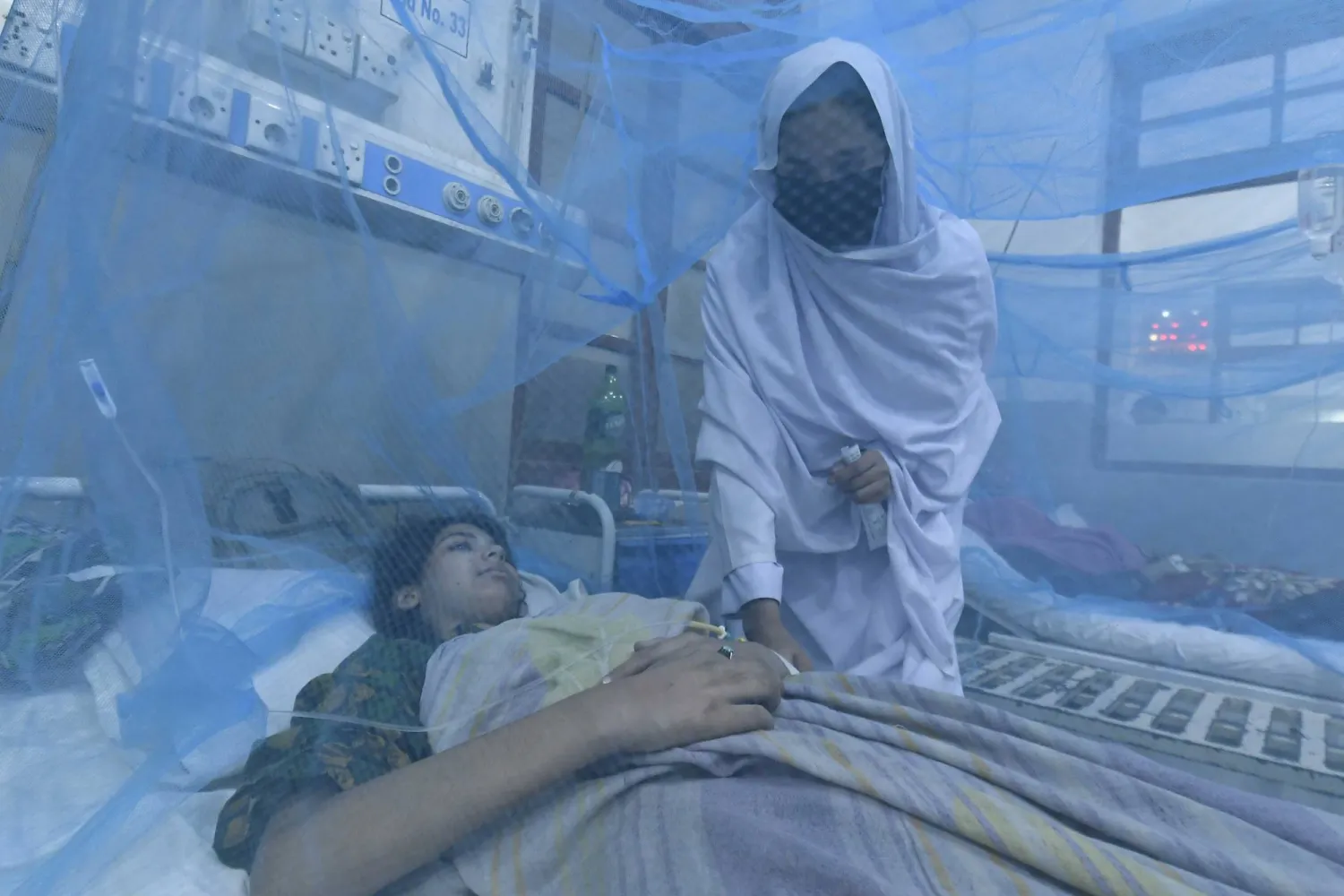
Patients suffering from dengue fever receive medical treatment at Civil Hospital in Karachi, Pakistan, 05 November 2025. EPA/SHAHZAIB AKBER
TT

India Moves Closer to Dengue Vaccine as Final Trials Underway

Patients suffering from dengue fever receive medical treatment at Civil Hospital in Karachi, Pakistan, 05 November 2025. EPA/SHAHZAIB AKBER

As dengue surges globally, an Indian vaccine candidate has entered the final stage of testing, raising hopes for one of the world's first single-dose shots against the deadly mosquito-borne disease.

Dengue, which causes severe flu-like symptoms and debilitating body aches, has exploded globally, fueled by rising temperatures and densely populated cities.

The World Health Organization (WHO) says that almost half the world's population is now at risk, with 100-400 million infections every year. India alone has recorded over one million cases and at least 1,500 deaths since 2021.

Hoping to stem the global epidemic, Panacea Biotec has begun final Phase III trials of its vaccine, DengiAll, which has been pursuing for nearly 15 years.

More than 10,000 volunteers across the country are enrolled in the study, overseen by the Indian Council of Medical Research, with the vaccine on track for rollout as early as next year if the trial results are favorable.

"We will try to get this vaccine out there as soon as possible," Syed Khalid Ali, chief scientific officer of Panacea, told AFP in New Delhi.

Doctor Ekta Gupta, professor of clinical virology at the Institute of Liver and Biliary Sciences in New Delhi, said dengue was now considered hyperendemic in India, with all four virus serotypes circulating simultaneously.

"This vaccine is very much needed right now to control the occurrence of these cases, or at least prevent the severity."

- Climate change -

Monsoon outbreaks regularly push Indian hospitals to their limits, crowding urban wards and leaving rural regions grappling with late diagnoses and poor access to care.

Higher temperatures and changing rainfall patterns create ideal conditions for Aedes mosquitoes -- the vectors of dengue -- to reproduce and spread the virus.

Children are particularly vulnerable to the more severe form, called dengue hemorrhagic fever, as they are more likely to suffer low platelet counts and shock.

Participants in Phase III trials, which started in 2024, were randomly assigned to receive either the vaccine or a placebo, with the results expected later this year.

Vaccines against all four dengue serotypes have long posed a scientific challenge. Immunity to one strain does not protect against others, and secondary infections can be more severe.

Most existing candidates require multiple doses.

If approved, DengiAll would become one of the world's first single-dose dengue vaccines, following Brazil's approval of a similar shot last year.

It would also be the first such vaccine available in India, where no dengue shot is currently licensed for public use.

"We will be the second (single-dose) vaccine to come out... But in India and several lower-middle-income countries, we will be the first ones to roll out the dengue vaccine," Ali said.

The candidate is based on a tetravalent strain originally developed by the US National Institutes of Health.

- 'Hope for future' -

Panacea is the most advanced of three Indian firms licensed to use the strain, having developed its own formulation and secured a process patent.

Inside the company's research labs, doctor Priyanka Priyadarsiny, head of biological R&D, said vaccine development involves several steps, from proof-of-concept studies to regulatory checks.

"We are extremely cautious about purity, safety and adverse effects," she said. "Only after meeting regulatory specifications can a product be considered safe for public use."

At present, the WHO recommends only one dengue vaccine, Qdenga, produced by Japan's Takeda for children aged six to 16 in high-transmission settings.

Qdenga, which requires two doses administered three months apart, is not currently available in India.

Ali said DengiAll could be given to people aged one to 60 and is expected to offer long-term protection.

In India, final approval would come from the Drug Controller General of India, while WHO prequalification would be required for large-scale international use.

Experts say a successful Indian-made vaccine could be key to affordability and mass rollout in lower-income countries.

Virologist and Oxford University fellow Shahid Jameel -- who is not connected with the trial -- warned dengue incidence could rise by 50-75 percent by 2050 under current climate change trends.

Still, he cautioned that only Phase III results would determine whether a candidate meets the criteria for a safe and effective dengue vaccine.

"Phase III testing and follow-up are needed to show if the above conditions are met," he told AFP.

"Only then can we have a useful dengue vaccine. It is still early days, but there is hope for the future."




Wadi Al-Aqiq in Madinah Blends Spiritual, Natural Appeal

Wadi Al-Aqiq was famed for the quality and sweetness of its water (SPA)
TT

Wadi Al-Aqiq in Madinah Blends Spiritual, Natural Appeal

Wadi Al-Aqiq was famed for the quality and sweetness of its water (SPA)

Wadi Al-Aqiq in Saudi Arabia's Madinah region stands out as one of the area’s most significant geographical and tourist landmarks, known for its striking terrain and the sweetness of its water.

The valley draws much of its fame from its association with the Prophet Muhammad, peace be upon him, and is known as the “Blessed Valley,” based on his saying: "Tonight there came to me a visitor from Allah, saying: 'Pray in this blessed valley.'"

Although several valleys across the Arabian Peninsula share the same name, Wadi Al-Aqiq remains the most renowned.

According to a report by the Saudi Press Agency (SPA), the valley was famed for the purity of its water, to such an extent that some Umayyad caliphs transported it to Damascus.

At the time, it was likened to the “Ghouta of Damascus” for its dense trees and lush greenery. Several of the Prophet’s companions settled along its banks, including Abu Hurairah and Saied bin Al-Aas.

They died there and were later carried to Madinah. Among the successors, Urwa bin Al-Zubayr and Sukaynah bint Al-Hussein had palaces in the valley, some of which remain standing today.

Wadi Al-Aqiq is now undergoing rehabilitation and development overseen by Al Madinah Region Development Authorityand related bodies.

The project stretches nearly 15 kilometers, from the Miqat Dhi Al-Hulayfah, south of Madinah, to Al-Jurf, in the north, aiming to balance urban growth with natural resources.

Works span key sites along the valley, including Qasr Urwa, the Al-Salam Road intersection, the Islamic University Square and the agricultural areas of Al-Jurf.

The projects are part of broader efforts to improve Madinah’s urban landscape and introduce environmentally friendly developments that enhance the city’s visual appeal.

The Wadi Al-Aqiq walkway has emerged as a leading destination for walking and recreation in Madinah, thanks to its distinctive natural setting.

Extending about 1,500 meters, it overlooks the “Blessed Valley,” mentioned in the Prophet’s traditions, giving it spiritual and historical weight that attracts visitors interested in religious and nature tourism.

Designed to blend with its surroundings, the walkway features prepared paths, seating areas overlooking the valley and shade trees lining the route. A modern lighting system enhances safety and highlights the site’s beauty at night.


Contrary to Jurassic Park Movie, T-Rex Dinosaur Ran on Tip-Toes

Rather than stomping heel-first, T-rex may have actually tip-toed as it roamed around on its giant feet (Shutterstock)
TT

Contrary to Jurassic Park Movie, T-Rex Dinosaur Ran on Tip-Toes

Rather than stomping heel-first, T-rex may have actually tip-toed as it roamed around on its giant feet (Shutterstock)

Ever since the release of the blockbuster Jurassic Park, the Tyrannosaurus rex has been associated with ground shaking tremors as it moved.

But in fact, rather than stomping heel-first, the prehistoric beast may have actually tip-toed as it roamed around on its giant feet, a study has found.

And it may have moved 20% faster than previously thought, the experts claim, at a speed fast enough to beat Usain Bolt.

The findings, published in the journal Royal Society Open Science, contradict previous theories on how the extinct species moved, according to The Independent.

Earlier analysis of T-rex footprints suggested their heels struck the ground first.

However, the team of scientists have now gathered data on T-rex anatomy to find that they have more in common with how birds walk. They said that the T-rex had a “very bird-like gait defined by higher stride frequencies” and moved with “elevated speeds.”

According to the researchers model, a T-rex that weighed about 1.4 tons and could have reached a top speed of 11.4 meters per second - meaning it could run 100 meters in 8.77 seconds.

In comparison, world record holder Usain Bolt ran 100 meters in 9.58 seconds.

A bigger T-rex, weighing 6.5 tons would still be able to move at 9.5 meters per second, the study found.

Study authors concluded that their study represents the first quantitative biomechanical analysis of the effects of foot-strike patterns on the gait of Tyrannosaurus.

A separate fossil study has recently revealed T-rex grew much more slowly than previously thought, taking several decades to reach their full size of around eight tons.

The study of 17 tyrannosaur specimens, ranging from early juveniles to massive adults, has revealed that the king of carnivores took 40 years to reach their full size.


NASA Overhauls its Artemis Program to Return Astronauts to the Moon

NASA logo (Reuters)
NASA logo (Reuters)
TT

NASA Overhauls its Artemis Program to Return Astronauts to the Moon

NASA logo (Reuters)
NASA logo (Reuters)

NASA said Friday it’s adding an extra moon mission by Artemis astronauts before attempting a high-risk lunar landing with a crew.

The shakeup in the flight lineup came just two days after NASA’s new moon rocket returned to its hangar for more repairs and a safety panel warned the space agency to scale back its overly ambitious goals for humanity’s first lunar landing in more than half a century.

Artemis II — a lunar fly-around by four astronauts — is off until at least April because of rocket problems, The AP news reported.

The follow-up mission — Artemis III — had been targeting a landing near the moon’s south pole by another pair of astronauts a year or two later. But with concern growing over the readiness of a lunar lander and moonwalking suits and long gaps between flights, NASA’s new administrator Jared Isaacman announced that mission would instead focus on launching a lunar lander into orbit around Earth for practice in 2027.

The new plan calls for a moon landing — potentially even two moon landings — by astronauts in 2028.

Isaacman stressed that three years between flights is unacceptable and that he’d like to get it down to one year or even less. During NASA’s storied Apollo program, he said, astronauts’ first flight to the moon was followed by two more missions before Neil Armstrong and Buzz Aldrin landed on the moon.

The Aerospace Safety Advisory Panel recommended this week that NASA revise its objectives for Artemis III “given the demanding mission goals.” It’s urgent the space agency do that, the panel said, if the United States hopes to safely return astronauts to the moon.