
Early Southwest Heat is Latest in Parade of Weather Extremes as Earth Warms

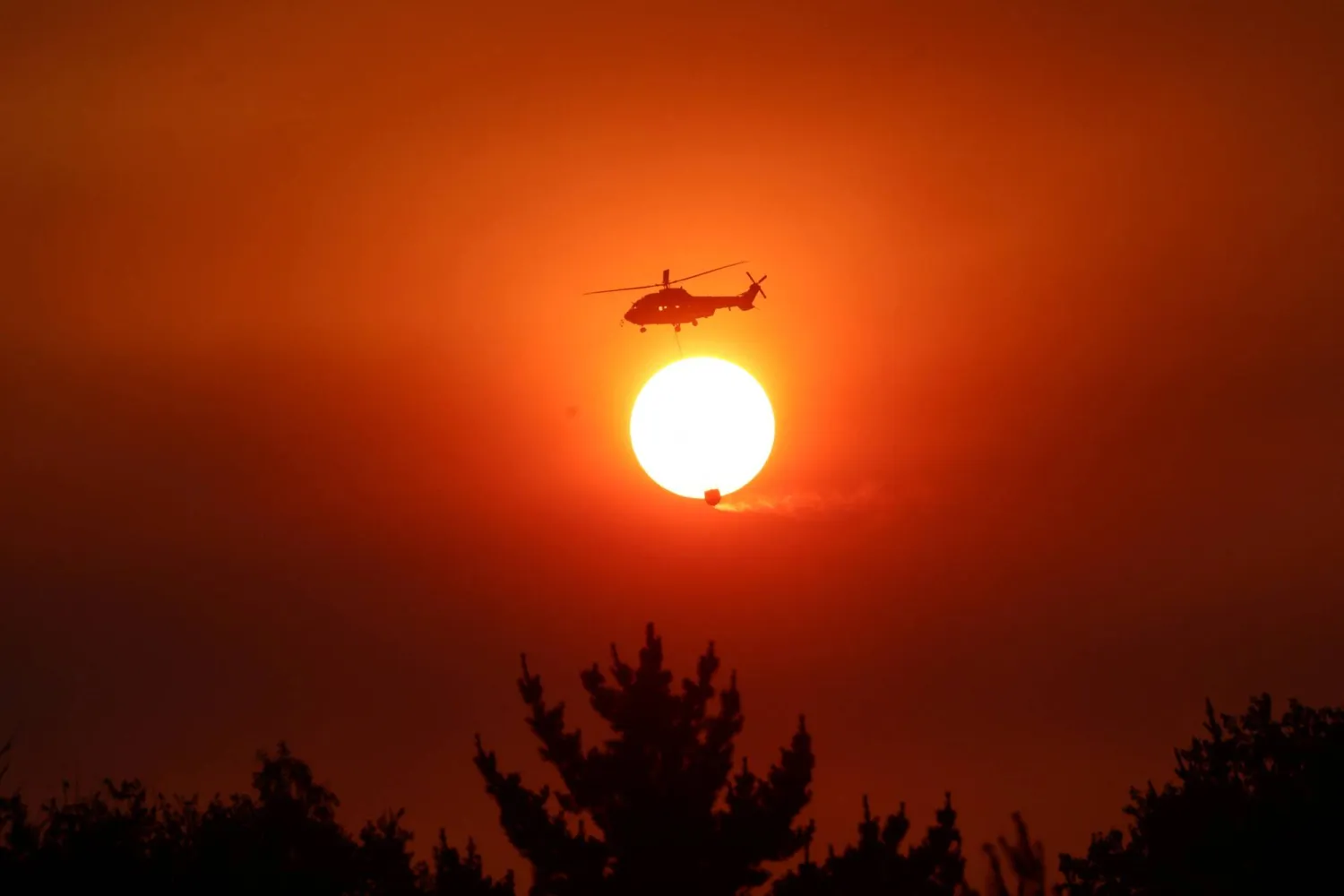
A helicopter battles a forest fire in the Biobio region, where multiple wildfires have prompted emergency evacuations, in Florida, Chile, January 21, 2026. (Reuters)
TT

Early Southwest Heat is Latest in Parade of Weather Extremes as Earth Warms

A helicopter battles a forest fire in the Biobio region, where multiple wildfires have prompted emergency evacuations, in Florida, Chile, January 21, 2026. (Reuters)

The dangerous heat wave shattering March records all over the US Southwest is more than just another extreme weather blip. It’s the latest next-level weather wildness that is occurring ever more frequently as Earth’s warming builds.

Experts said unprecedented and deadly weather extremes that sometimes strike at abnormal times and in unusual places are putting more people in danger. For example, the Southwest is used to coping with deadly heat, but not months ahead of schedule, including a 110-degree Fahrenheit (43.3 Celsius) reading in the Arizona desert on Thursday that smashed the highest March temperature recorded in the US.

On Thursday, sites in Arizona and southern California had preliminary readings of 109 F (about 43 C), which would be the hottest March day on record for the United States.

“This is what climate change looks like in real time: extremes pushing beyond the bounds we once thought possible,” said University of Victoria climate scientist Andrew Weaver. “What used to be unprecedented events are now recurring features of a warming world.”

March's heat would have been virtually impossible without human-caused climate change, according to a report Friday by World Weather Attribution, an international group of scientists who study the causes of extreme weather events.

More than a dozen scientists, meteorologists and disaster experts queried by The Associated Press put the March heat wave in a kind of ultra-extreme classification with such events as the 2021 Pacific Northwest heat wave, the 2022 Pakistan floods and killer hurricanes Helene, Harvey and Sandy.

The area of the US being hit by extreme weather in the past five years has doubled from 20 years ago, according to the National Oceanic and Atmospheric Administration's Climate Extremes Index, which includes various types of wild weather, such as heat and cold waves, downpours and drought.

The United States is breaking 77% more hot weather records now than in the 1970s and 19% more than the 2010s, according to an AP analysis of NOAA records. In the United States, the number and average cost of inflation-adjusted billion-dollar weather disasters in the last couple years is twice as high as just 10 years ago and nearly four times higher than 30 years ago, according to records kept by NOAA and Climate Central, a nonprofit group of scientists and communicators who research and report on climate change.

Trying to keep up with extremes and failing “It’s really hard to even keep up with how extreme our extremes are becoming,” said Climate Central Chief Meteorologist Bernadette Woods Placky. “It’s changing our risk, it’s change our relationship with weather, it’s putting more people in risky situations and at times we’re not used to. So yes, we are pushing extremes to new levels across all different types of weather.”

For government officials who have to deal with disaster it's been a huge problem.

Craig Fugate, who directed the Federal Emergency Management Agency until 2017, said he saw extremes increasing.

“We were operating outside the historical playbook more and more. Flood maps, surge models, heat records — events kept showing up outside the envelope we built systems around. That’s just what we saw,” Fugate said via email.

He added: “We built communities on about 100 years of past weather and assumed that was a good guide going forward. That assumption is starting to break. And the clearest signal isn’t the science debate. It’s insurers walking away.”

‘Virtually impossible’ without climate change Climate scientists at World Weather Attribution did a flash analysis — which is not peer-reviewed yet — of whether climate change was a factor in this Southwest heat wave. They compared this week's expected temperatures to what's been observed in the area in March since 1900 and computer models of a world with climate change. They found that “events as warm as in March 2026 would have been virtually impossible without human-induced climate change.”

That warming, from the burning of coal, oil and natural gas, added between 4.7 degrees to 7.2 degrees F (2.6 to 4 degrees C) to the temperatures being felt, the report found.

“What we can very confidently say is that human-caused warming has increased the temperatures that we’re seeing as a result of this heat dome, and it’s going to be pushing those temperatures from what would have been very uncomfortable into potentially dangerous,” said report co-author Clair Barnes, an Imperial College of London attribution scientist.

Examples abound of high heat and extreme weather The Southwest heat wave is solidly in the category of “giant events,” with temperatures up to 30 degrees Fahrenheit (16.7 degrees Celsius) above normal, said Stanford University climate scientist Chris Field.

He listed five others in the last six years: a 2020 Siberia heat wave, the 2021 Pacific Northwest heat wave that had British Columbia warmer than Death Valley, the summer of 2022 in North America, China and Europe, a 2023 western Mediterranean heat wave and a 2023 South Asian heat wave with high humidity.

And that doesn't include the East Antarctica heat wave of 2022 when temperatures were 81 degrees (45 degrees Celsius) warmer than normal. That's the biggest anomaly recorded, said weather historian Chris Burt, author of the book “Extreme Weather.”

Worsening wild weather influenced by climate change isn't just superhot days, but includes deadly hurricanes, droughts and downpours, scientists told AP.

Devastating floods hit West Africa in 2022 and again in 2024. Iran is in the midst of a six-year drought. And the deadly Typhoon Haiyan hitting the Philippines in 2013 shocked the world.

Superstorm Sandy, which in 2012 flooded New York City and neighbors, had tropical storm-force winds that covered an area nearly one-fifth the area of the contiguous United States. It spawned 12-foot seas over 1.4 million square miles, about half the size of the US, with energy equivalent to five Hiroshima-sized atomic bombs, said Yale Climate Connections meteorologist Jeff Masters.

And don't forget wildfires that are worsened by heat and drought, so recent extremes should include 2025's Palisades and Eaton wildfires, which were the costliest weather disaster in the United States last year, said Climate Central meteorologist and economist Adam Smith.

“This is due to climate change, that we see more extreme events, and more intense ones and have so many records being broken,” said Friederike Otto, an Imperial College of London climate scientist who coordinates World Weather Attribution.




Mounted New York Police Officer and His Horse Corner Suspected Purse Snatcher in Manhattan

A view shows the downtown Manhattan skyline in New York City, US, July 22, 2025. (Reuters)
TT

Mounted New York Police Officer and His Horse Corner Suspected Purse Snatcher in Manhattan

A view shows the downtown Manhattan skyline in New York City, US, July 22, 2025. (Reuters)

A New York City police officer on horseback nabbed a suspected purse snatcher after chasing her through the streets of Manhattan at full gallop — a wild scene evoking the clip-clopping past of a city where lights, sirens and squad cars are the norm.

The late Wednesday morning pursuit began when the victim reported the theft. The officer — whose name has not been released — and his horse quickly took up the chase that was captured on his bodycam and also by a television news crew that happened to be in the area for an unrelated story.

The officer repeatedly screamed at the suspect to stop running, but she refused while denying she had taken the purse.

The brief hoof chase went along sidewalks, under scaffolding, between parked cars and across streets before the woman was stopped by a pedestrian and then detained by the officer.

The woman was charged with larceny and providing false information. Authorities said she had been convicted of murder in the April 2000 fatal shooting of a cab driver and had served time in prison before being released. She is currently on lifetime parole.

No injuries were reported in the chase.


Back on Earth, Artemis II Crew Still Finding their Footing

HOUSTON, TEXAS - APRIL 16: Artemis II Commander Reid Wiseman, Pilot Victor Glover, Mission Specialist Christina Koch, and Mission Specialist Jeremy Hansen speak during a press conference at the NASA Johnson Space Center on April 16, 2026 in Houston, Texas. Danielle Villasana/Getty Images/AFP
TT

Back on Earth, Artemis II Crew Still Finding their Footing

HOUSTON, TEXAS - APRIL 16: Artemis II Commander Reid Wiseman, Pilot Victor Glover, Mission Specialist Christina Koch, and Mission Specialist Jeremy Hansen speak during a press conference at the NASA Johnson Space Center on April 16, 2026 in Houston, Texas. Danielle Villasana/Getty Images/AFP

Nearly a week after their Pacific splashdown, the astronauts who crewed the Artemis II mission that flew around the Moon told reporters Thursday they have yet to fully grasp the magnitude of the moment.

"It's been a week of medical testing, physical testing, doctors, science objectives," mission commander Reid Wiseman said during a press conference at NASA's Johnson Space Center in Houston.

"We have not had that decompression," he added.

The 50-year-old led fellow Americans Victor Glover and Christina Koch, and Canadian crewmate Jeremy Hansen, on a mission that took them farther into space than anyone has ever gone before.

Adjusting to life on Earth is taking a beat, AFP reported.

"Tomorrow will be one week, and I just was trying to live in a little hole for one week, been off social media, not on the news. So, no, I don't know," Glover, who piloted the mission, told reporters.

Nonetheless, he said his children and neighbors have clued him in to the excitement.

Artemis II was the first crewed mission to venture to the Moon's orbit since 1972, and the only one in history to include a woman, or a Black astronaut, or a non-American. Their voyage was broadcast live by US space agency NASA, and the media coverage of the launch and return to Earth was watched by millions of people.

For Koch, waking up to the reality means remembering gravity has taken hold.

"In the first few days, I thought I was floating. I truly thought I was floating, and I had to convince myself I wasn't," Koch said.

Their mission lasted almost 10 days, but NASA has ambitions to return to the Moon for longer visits to establish a base in preparation for future missions to Mars.

The United States is targeting a lunar landing in 2028, before the end of President Donald Trump's term and a deadline set by rivals in China.


Hidden Cave, Hippo Bones Under Welsh Castle May Rewrite History

Previous small-scale excavations at Pembroke Castle have already uncovered evidence of early humans and animals. PHOTO: UNIVERSITY OF ABERDEEN
TT

Hidden Cave, Hippo Bones Under Welsh Castle May Rewrite History

Previous small-scale excavations at Pembroke Castle have already uncovered evidence of early humans and animals. PHOTO: UNIVERSITY OF ABERDEEN

A prehistoric hidden cave and hippo bones found beneath a Welsh castle could transform understanding of ancient life in Britain, researchers said Thursday, calling the site a "once-in-a-lifetime discovery".

Previous small-scale excavations at Pembroke Castle have already uncovered evidence of early humans and animals, including a now extinct hippopotamus that roamed Wales 120,000 years ago.

A major five-year archaeological project led by the University of Aberdeen will investigate the "enormous" cave, accessed via a spiral staircase from the 11th Century castle, AFP reported.

"There is no other site like it in Britain -- it is a once-in-a-lifetime discovery," said Rob Dinnis, who will lead the project.

The cave, previously thought to have been emptied by the Victorians, is now described as "one of the most important prehistoric archives in Britain".

"Despite the limited work done so far, we can already say that Wogan Cavern is a truly remarkable site," Dinnis said in a statement.

"Not only is there extremely rare evidence for early Homo sapiens, there are also hints at even earlier human occupation, probably by Neanderthals."

"We have also found hippo bones, which probably date to the last interglacial period, around 120,000 years ago," he added.

Earlier finds have revealed bones of mammoth, woolly rhinoceros, reindeer and wild horse, alongside stone tools and evidence of human occupation across multiple periods.

With larger-scale excavation due to resume in May, the researchers hope to gain "insights into past climate change, extinct species, and the multiple periods when humans called the cave their home".

They said the site could chart a long sequence of human activity, from hunter-gatherers after the last Ice Age around 11,500 years ago to some of Britain's earliest Homo sapiens between 45,000 and 35,000 years ago, and possibly even earlier Neanderthal presence.

"Wogan Cavern provides a unique chance to use all the scientific techniques now available to archaeologists," said professor Kate Britton of the University of Aberdeen.

"Because the bones are well preserved, we can learn a lot about past environments and ecosystems," she added.

At Pembroke Castle, staff say the discovery adds a new dimension to the site's long history as a medieval fortress and birthplace of Henry VII in 1457.

"This is incredibly exciting news for everyone at the castle," said castle manager Jon Williams.

"We are thrilled that work on this wonderful cave will continue."