


Saudi Traveler Showcases Al-Ahsa’s Beauty and the Rise of Solo Camping Adventures

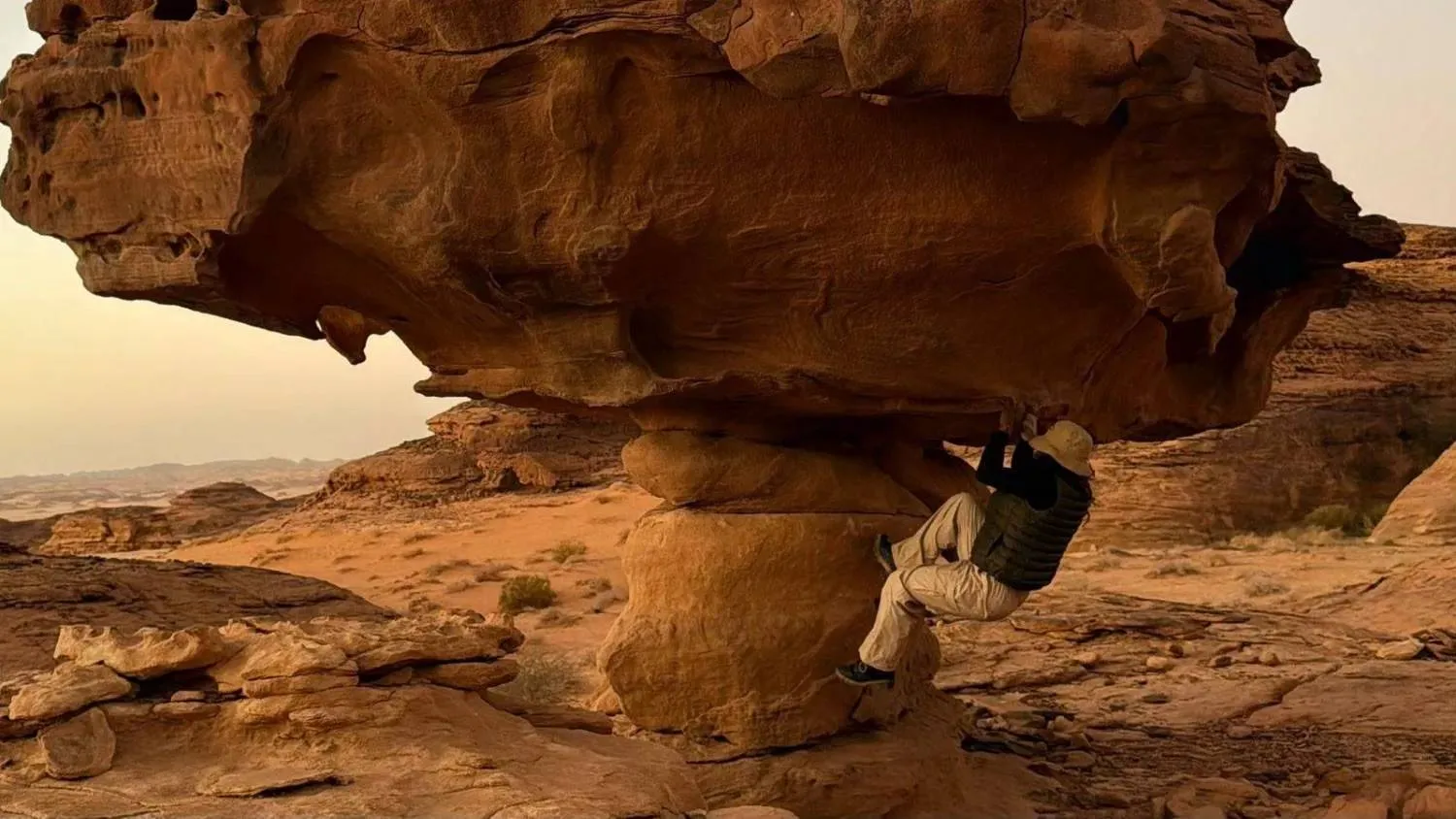
Traveler Salwa Ibrahim climbing the rock formations of AlUla (Traveler’s Archive) 
TT

Saudi Traveler Showcases Al-Ahsa’s Beauty and the Rise of Solo Camping Adventures

Traveler Salwa Ibrahim climbing the rock formations of AlUla (Traveler’s Archive) 

In recent years, Saudi Arabia has undergone a transformation in the way travel is perceived. Journeys are no longer viewed simply as movement from one place to another, but as immersive cultural experiences that deepen people’s connection to places and redefine the meaning of discovery. Interest in overland travel and camping has grown steadily, evolving into a lifestyle rooted in environmental awareness and respect for nature.

This shift has been driven in part by the Kingdom’s remarkable geographic diversity — from sweeping deserts and lush valleys to dramatic coastlines — creating an ideal environment for exploration and outdoor adventure.

Solo travel, in particular, has emerged as a powerful form of self-discovery, where camping is no longer a casual pastime, but an experience built on careful planning, openness to uncertainty, and a balance between safety and adventure.

Saudi traveler and content creator Salwa Ibrahim has made local geography the focus of her work. Specializing in highlighting tourism destinations across Saudi Arabia, Ibrahim says her goal is to help audiences experience places as she did — emotionally as much as visually.

Speaking to Asharq Al-Awsat, Ibrahim said that despite the growing accessibility of international destinations, she remains deeply connected to the region she calls home.

“My primary focus has been Saudi Arabia and the Gulf countries because of the richness of their landscapes,” she said. “I documented these places through a series called The Other Side, where I showcase unconventional destinations and experiences beyond the usual tourist routes. There are astonishing places across Saudi Arabia that many people still know very little about.”

Unlike tightly scheduled travel itineraries, Ibrahim prefers a slower, more immersive approach.

“I don’t rely on a strict daily schedule,” she said. “I give myself enough time to absorb a place fully. I might spend two or three nights in one location, or even several days if I feel it deserves more time.”

She pointed to Wadi Al-Disah as one destination she has returned to repeatedly throughout her travels.

Among the places that have left the strongest impression on her are three major valleys in Saudi Arabia, each defined by its own distinct landscape and atmosphere. Ibrahim described Wadi Al-Disah as a vast natural sanctuary surrounded by towering mountains, threaded with green pathways and seasonal streams that create an environment strikingly different from the surrounding desert.

Wadi Tayyib Al-Ism, she said, is distinguished by the dramatic meeting of jagged mountain formations and the waters of the Gulf of Aqaba, creating a rare harmony between contrasting natural elements. As for Wadi Lajab, Ibrahim called it “a sensory experience in itself,” where visitors pass through a narrow rocky canyon flanked by soaring cliffs and flowing water.

She also described the Bajdah Desert in the Tabuk region as “one of the most visually surreal places” in Saudi Arabia, citing the interplay of red mountains, sand dunes, and complex geological formations, as well as the abundance of natural caves that make the area ideal for advanced exploration.

Ibrahim said her Jeep Wrangler four-wheel-drive vehicle was essential to launching these journeys.

“My Jeep Wrangler was a fundamental part of the experience,” she stated. “It allowed me to reach places that smaller vehicles simply cannot access.”

Her trips begin long before she sets out on the road. Preparation, she explained, involves more than logistics; it requires complete mental readiness. Her planning process includes studying maps and access routes, pinpointing campsites, saving emergency contacts, coordinating with trusted local guides, and packing enough food supplies and practical cooking equipment to minimize risks during each trip.

Despite her meticulous planning, Ibrahim intentionally leaves room for spontaneity.

“Some of the most memorable experiences come from unexpected changes in direction,” she said. “Those moments often lead me to places that were never part of the original plan.”

That balance between discipline and flexibility has become central to her style of travel and exploration.

Ibrahim selects destinations through a combination of research, recommendations from followers on social media, and personal intuition, which she says often plays a decisive role in her final decisions. She relies heavily on mapping applications and advice from local guides, while also paying close attention to recurring suggestions from her audience.

In her interview with Asharq Al-Awsat, Ibrahim stressed that Al-Ahsa holds a particularly special place in her work. More than just another stop on her travels, the region has become a personal project through which she hopes to reshape visual perceptions of the area. Al-Ahsa is also her hometown.

“I don’t present palm trees as a stereotypical image,” she said. “I try to convey a complete experience that reflects Al-Ahsa’s unique diversity. The region is home to millions of palm trees and multiple landscapes that coexist within one area, alongside vast deserts stretching toward the Rub’ al Khali and Al-Dahna, as well as a coastal extension. This overlap makes Al-Ahsa one of the richest natural environments in Saudi Arabia.”

Ibrahim’s philosophy of travel goes beyond sightseeing. She believes beauty is not defined by a destination’s popularity, but by a traveler’s emotional connection to it. In her view, even simple or lesser-known places can hold extraordinary value for those who connect with them deeply.

She cited AlUla as one example, describing its rock formations and mountains as possessing a uniquely powerful visual and spiritual presence.

Solo travel, however, was not easy at first. Ibrahim said fear accompanied her during her earliest camping trips, prompting her to stay close to main roads for safety. Over time, those fears evolved into a turning point that shaped both her personal and professional life.

As solo travel became a defining part of her identity, its impact extended into her work as a nurse, strengthening her ability to make decisions and handle pressure with confidence.

Ibrahim’s experience reflects the high levels of safety found across Saudi Arabia and the Gulf region, though she emphasizes that awareness and personal responsibility remain essential — particularly for young women interested in solo travel or camping. Advance planning, choosing familiar destinations, and avoiding isolated areas without sufficient experience are all critical to ensuring a safe experience.

Saudi Arabia’s tourism sector has also seen significant development in recent years, including the expansion of designated camping facilities and stronger tourism infrastructure. These changes have helped foster a growing culture of overland travel and exploration, positioning the Kingdom as an increasingly attractive destination for travelers from within Saudi Arabia and abroad, especially during the winter season.


British Climber Summits Everest for Record 20th Time, 2 Die on Mountain

Climbers walk in a long queue as they head to summit Mount Everest in the Solukhumbu district, also known as the Everest region, Nepal, May 18, 2026. REUTERS/Purnima Shrestha
TT

British Climber Summits Everest for Record 20th Time, 2 Die on Mountain

Climbers walk in a long queue as they head to summit Mount Everest in the Solukhumbu district, also known as the Everest region, Nepal, May 18, 2026. REUTERS/Purnima Shrestha

A Briton improved his own Everest record on Friday and notched his 20th ascent to the world’s highest peak, as two Indian climbers died on the mountain, taking the season's toll to five, hiking officials said.

Kenton Cool, 52, climbed the 8,849-meter (29,032-foot) peak before dawn and was descending to lower camps. He was expected to reach the base camp over the weekend, his expedition organizers said, according to Reuters.

An Indian climber died at Camp II and another at the Hillary Step, Nivesh Karki of their expedition organizing company Pioneer Adventure said. Both had climbed the summit on Thursday but ⁠died during descent, ⁠he said on Friday.

Hillary Step is located below the summit in the "death zone", so called because of the dangerously low level of natural oxygen.

Details of their deaths were not available.

"One body is at very high altitude and we are trying to bring the second body from camp II," Karki told Reuters.

Cool, the ⁠British climber, is “quietly rewriting the record books,” said four-time Everest climber and expedition organizer Lukas Furtenbach of the Austria-based Furtenbach Adventures company.

“More Everest summits than any non-Sherpa ever... and still making it look like just another walk in the hills. Absolute legend," Furtenbach told Reuters from the base camp. Cool climbed with one of Furtenbach's teams.

Cool, who first climbed Everest in 2004 and has since repeated the feat every year except some years when authorities closed the mountain due to various reasons, said scaling the height of Everest was ⁠not routine.

“It ⁠never gets any easier or any less frightening. It’s the tallest mountain in the world and with it comes an incredible sense of majesty,” Cool said in a statement.

“I rely on every bit of experience I have to move safely in this environment. Standing on the summit for the twentieth time is incredibly special.”

The record for the highest number of summits at Everest is held by a Nepali Sherpa, Kami Rita, at 32.

Everest has been climbed by more than 8,000 people, many of them multiple times, since it was first scaled by New Zealander Sir Edmund Hillary and Sherpa Tenzing Norgay in 1953.


SpaceX Scrubs Launch of Upgraded Starship from Texas, to Retry Friday

(FILES) The Space Exploration Technologies Corp. (SpaceX) headquarters on January 28, 2021 in Hawthorne, California. (Photo by Patrick T. FALLON / AFP)
TT

SpaceX Scrubs Launch of Upgraded Starship from Texas, to Retry Friday

(FILES) The Space Exploration Technologies Corp. (SpaceX) headquarters on January 28, 2021 in Hawthorne, California. (Photo by Patrick T. FALLON / AFP)

SpaceX on Thursday scrubbed the launch of its 12th Starship rocket from Texas and said it will attempt the high-stakes test flight again on Friday, as Elon Musk's space company nears a record-breaking public listing.

Starship V3, uncrewed and featuring dozens of upgrades tailored for rapid Starlink satellite launches and NASA moon missions, was to be a key test for the vehicle following months of testing delays. It is also poised to affect investor confidence ahead of what might be the biggest initial public offering in history, where SpaceX is targeting a valuation of $1.75 trillion.

SpaceX had ⁠spent months redesigning ⁠Starship after a streak of failures last year, culminating in the V3 design that was meant to launch on Thursday. It called off Thursday's launch seconds before its planned liftoff, after multiple pauses to the countdown triggered by fuel temperature and pressure readings. Musk said on X that the hydraulic pin on one of the ⁠launch tower's giant mechanical arms did not retract as designed.

"If that can be fixed tonight, there will be another launch attempt tomorrow," Musk said of the faulty arm, according to Reuters.

SpaceX said it is preparing to launch Starship during a 90-minute launch window which opens at 5:30 p.m. Central Time (2230 GMT) on Friday. The fully reusable Starship, which SpaceX has spent more than $15 billion developing, is key to Musk's goals of cutting launch costs, expanding his Starlink satellite business and pursuing ambitions ranging from deep-space exploration to orbital ⁠data centers - all ⁠factored into his IPO valuation.

Before the launch attempt on Thursday, Musk sought to temper expectations in case of failure, saying, "There is a large pipeline of V3 ships and boosters in the factory." He said a failure would not affect the cadence of future Starship test launches "by more than a month or so."

SpaceX's engineering culture, considered more risk-tolerant than many of the aerospace industry's more established players, is built on a flight-testing strategy that pushes newly developed spacecraft to the point of failure, then fine-tunes improvements through frequent repetition.


'Dread': Coral Scientists Fear Bleaching El Nino Could Bring

(FILES) This underwater photo taken on April 5, 2024, shows bleached and dead coral around Lizard Island on the Great Barrier Reef, located 270 kilometres (167 miles) north of the city of Cairns. (Photo by DAVID GRAY / AFP)
TT

'Dread': Coral Scientists Fear Bleaching El Nino Could Bring

(FILES) This underwater photo taken on April 5, 2024, shows bleached and dead coral around Lizard Island on the Great Barrier Reef, located 270 kilometres (167 miles) north of the city of Cairns. (Photo by DAVID GRAY / AFP)

The arrival of a potentially powerful El Nino weather system this year could devastate coral reefs around the world already weakened by back-to-back rounds of bleaching, scientists warn.

Forecasters are increasingly convinced that this year will see a return of the weather phenomenon, and that it could be exceptionally strong.

El Nino, which occurs around every two to seven years, shifts normal weather patterns on land, bringing drought to some places and heavy rains elsewhere.

It is associated with warmer seawater and, in some places, reduced cloud cover, both of which are bad news for global coral reefs.

"Every global coral bleaching event has been during an El Nino year," said Clint Oakley, a coral scientist at Victoria University of Wellington.

He described feeling "dread, although not surprise", at the prospect of a strong El Nino, which could prove "serious and devastating for many reefs around the world".

Coral's survival depends on a special relationship with a kind of algae.

The algae reside in the structure built by corals, and in return produce nutrients for their host by photosynthesis.

But for reasons that still elude scientists, this arrangement falls apart when seawater warms too much and the algae leave or are expelled.

The algae provide coral's characteristic colors, and their departure leaves behind a ghostly white structure that is gradually starving.

If the waters cool quickly enough, the coral can survive on food stores until algae resume residence.

But even if that happens, it will be malnourished, vulnerable to infection and less able to devote the energy needed for reproduction.

"And if it takes too long for the waters to cool down, or if the heat is too extreme, then they will essentially starve and they'll die," explained Jen Matthews, a coral scientist at University of Technology Sydney.


(FILES) This underwater photo taken on June 14, 2024 shows bleached corals around Koh Tao island in the southern Thai province of Surat Thani. (Photo by Lillian SUWANRUMPHA / AFP)

Periodic, localized bleaching is a natural and even healthy process for reefs.

The problem is repeated mass bleaching, which has become the norm with rising sea temperatures caused by climate change.

"If you're being bleached before you've even recovered and been able to produce juveniles again, then that's only a downwards trajectory from there," said Oakley.

The last global mass bleaching event was declared in 2024.

In the Caribbean, some types of coral are now "functionally extinct", while Australia's Great Barrier Reef -- the only living creature visible from space -- lost between 15 and 40 percent of its coral cover in different locations between 2024 and 2025.

A super El Nino would push sea temperatures up, from a baseline that is already often too warm for corals.

"The average sea temperature for the last few years is the same as what it was at the peak of the 1998 global bleaching event," said Oakley.

There are some corals globally that have proven resilient to warmer waters, but they cannot make up for the losses caused by rounds of bleaching.

Scientists are also experimenting with techniques ranging from nutritional gel to feed corals to shading techniques and genetic engineering to protect reefs.

"There's a lot of really important and innovative management strategies out there," Matthews said, "but they're all just buying time."

There are still uncertainties about El Nino's arrival and impacts, and scientists caution that forecasts should be interpreted with that in mind.

"An El Nino is likely, but the strength and duration are still uncertain," said Kimberley Reid, a research fellow in atmospheric sciences at the University of Melbourne.

"El Nino is one piece of the puzzle that affects the weather at a certain location, but there are other factors like local ocean temperatures and winds across the Indian Ocean," she added.

Even without an El Nino, the long-term prospects look dire for coral.

Up to 50 percent of the world's coral has been lost in recent decades, diminishing ecosystems that provide nurseries for fish that feed the world, and protect coastlines from storm surges.

It is a sobering reality, said Matthews.

"If we don't get our act together on climate change, then all we're doing is buying time until our reefs, as we know them, disappear."
