
Groundbreaking: ‘Controlled’ Quakes Triggered Under Swiss Alps

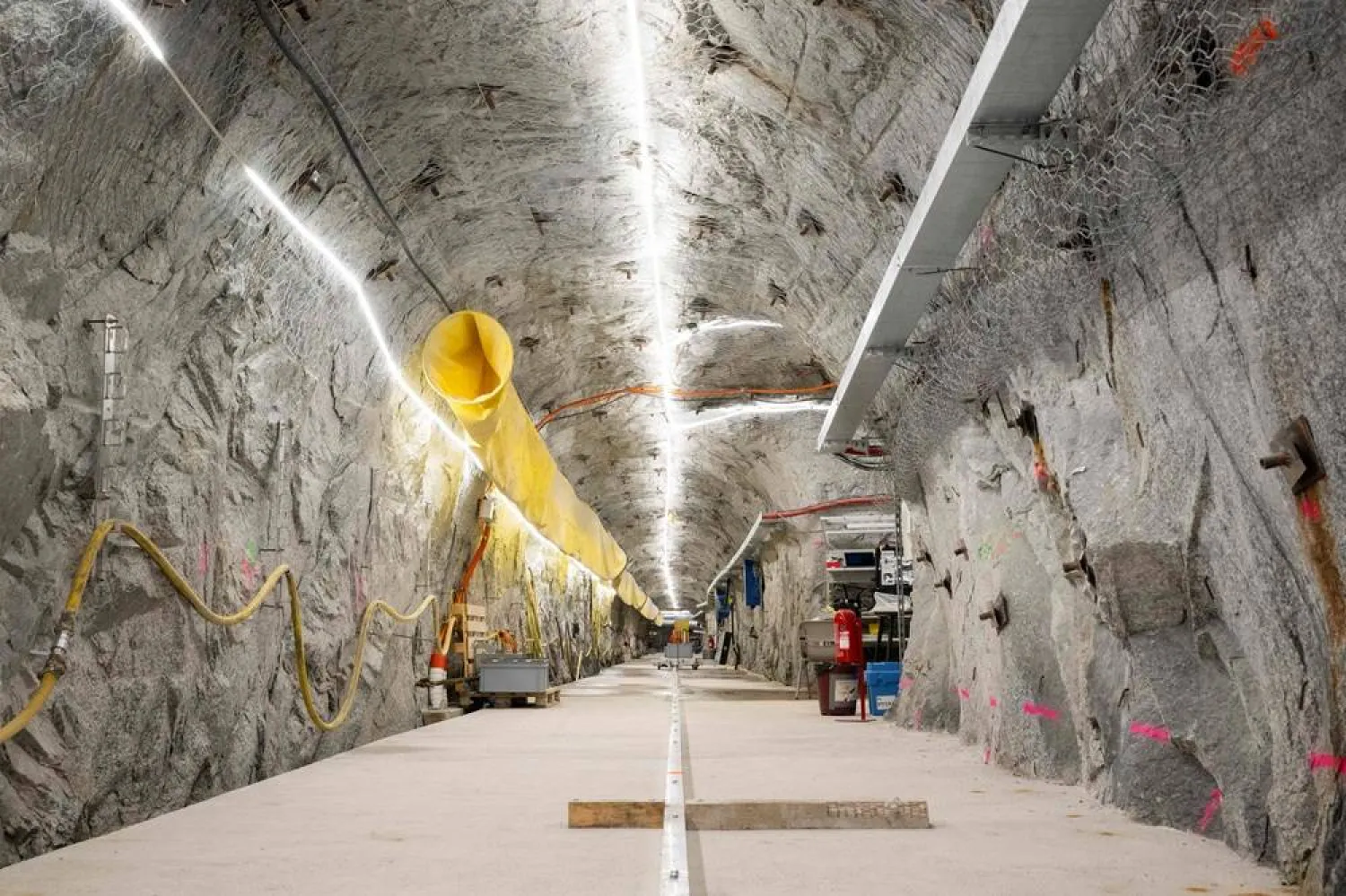
This photograph taken on April 29, 2026 shows a view of the BedrettoLab tunnel, a unique underground research facility operated by the Federal Institute of Technology Zurich (ETH Zurich) located 1,500m beneath the Swiss Alps within a 5.2 km tunnel near Bedretto. (AFP)
TT

Groundbreaking: ‘Controlled’ Quakes Triggered Under Swiss Alps

This photograph taken on April 29, 2026 shows a view of the BedrettoLab tunnel, a unique underground research facility operated by the Federal Institute of Technology Zurich (ETH Zurich) located 1,500m beneath the Swiss Alps within a 5.2 km tunnel near Bedretto. (AFP)

Researchers have made the ground shake in southern Switzerland, triggering thousands of tiny earthquakes in a monitored setting, as they seek to discover seismicity insights that could reduce risks.

"It was a success!" said Domenico Giardini, one of the lead researchers on the project, as he inspected a crack in the rock wall lining a narrow tunnel far below the Swiss Alps.

Wearing a fluorescent orange jumpsuit and helmet, the geology professor at the Federal Institute of Technology in Zurich (ETH Zurich) switched on his headlight to get a better look.

"We had seismicity," he said excitedly, explaining that the goal was "to understand what happens at depth when the Earth moves".

Giardini was standing in the BedrettoLab carved out in the middle of a narrow 5.2-kilometer (3.2-mile) ventilation tunnel leading to the Furka railway tunnel.

Reached by specially adapted electric vehicles that slide through the dank darkness along concrete slabs laid over a muddy dirt floor, the deep underground laboratory is the ideal location to create and study earthquakes, Giardini said.

"It is perfect, because we have a kilometer and a half of mountain on top of us... and we can look very close at the faults, how they move, when they move, and we can make them move ourselves," he told AFP.

- 'Earthquake machine' -

Typically, researchers seeking to study earthquakes place sensors near known faults and wait.

In the BedrettoLab, by contrast, researchers filled a pre-selected fault with sensors and other instruments, and then sought to trigger movement.

For the experiment, dubbed Fault Activation and Earthquake Rupture (FEAR-2), dozens of scientists from across Europe spent four days in late April injecting 750 cubic meters of water into boreholes drilled into the tunnel's rock walls, aiming to provoke a magnitude-1 earthquake.

"We don't create a new fault... We only facilitate that it moves," Giardini said.

During the experiment, no people were in the tunnel for safety reasons, with everything managed remotely from the ETH Zurich lab in northern Switzerland.

When AFP visited the Zurich lab a day into the experiment, scientists were excitedly discussing the first signs of seismicity on the monitors.

"This is kind of pushing the frontier of science," said Ryan Schultz, a seismologist specialized in man-made earthquakes.

The excitement was interrupted by a sudden power cut in the tunnel that sent the scientists in Zurich scrambling for answers.

"We have our earthquake machine... Now we have to play with the parameters," said Frederic Massin, a French seismologist and technical expert, as he studied his screen for clues to what had caused the outage.

The glitch was short-lived and pumping soon resumed.

- 8,000 earthquakes -

In the end, some 8,000 small seismic events were induced along the targeted fault, but also, surprisingly, along other faults running perpendicular to the main one, sparking local magnitudes ranging from -5 to -0.14.

"We did not reach the target magnitude that we had set, but we reached just below," Giardini said.

That alone was a huge success, he insisted, pointing out that although there had been previous efforts to create tiny earthquakes in lab settings, it was "never at this scale and never this deep".

"It's simply never been tried."

The findings, he said, would help determine the best injection angles for reaching magnitude 1 at the BedrettoLab when researchers next give it a try in June.

Magnitudes on the Richter scale are measured logarithmically, with each whole number increase representing ten times more in measured amplitude.

Magnitudes below zero are still palpable. Anyone standing near the fault during the largest triggered quakes, at -0.14, would have felt an acceleration of "1.5 G", or 1.5 times the standard acceleration due to gravity, Giardini said.

They would have flown "in the air with a big jump", he explained.

- 'Safe' -

Nothing was felt at the surface, and Giardini stressed that by lubricating an existing fault, the team was adding only "about one percent of what is the natural risk".

The experiment, he insisted, was completely "safe".

Giardini explained the importance of the research, stressing: "If we master how to produce quakes of a certain size, then we know how not to produce them."

This was particularly important in connection with underground activities like excavation and extraction, he said, pointing for instance to quakes triggered by disposal of wastewater from the fracking industry in Texas.

He also highlighted South Korea's 5.4-magnitude Pohang quake in November 2017, triggered by water injections at the country's first experimental geothermal power plant.

"Without realizing it, they started injecting and initiating induced seismicity on a large fault, creating a very serious quake," Giardini pointed out.

"We're not saying we should not go underground," he insisted.

"We need to learn how to do it more safely."



Nazi-Looted Portrait Found in Home of Dutch SS Leader’s Family

This handout photograph taken in an undisclosed area and released by Arthur Brand on May 11, 2026, shows the painting "Portrait of a Young Girl" by Dutch artist Toon Kelder, an art piece stolen from the world-famous Goudstikker collection by the Nazis, discovered in the house of the descendants of a notorious Dutch SS collaborator. (Handout and Arthur Brand / AFP)
TT

Nazi-Looted Portrait Found in Home of Dutch SS Leader’s Family

This handout photograph taken in an undisclosed area and released by Arthur Brand on May 11, 2026, shows the painting "Portrait of a Young Girl" by Dutch artist Toon Kelder, an art piece stolen from the world-famous Goudstikker collection by the Nazis, discovered in the house of the descendants of a notorious Dutch SS collaborator. (Handout and Arthur Brand / AFP)

An artwork plundered by the Nazis from the world-famous Goudstikker collection has surfaced in the family of a notorious SS collaborator in the Netherlands, Dutch art detective Arthur Brand told AFP Monday.

"Portrait of a Young Girl", by Dutch artist Toon Kelder, had likely been hanging for decades in the home of descendants of Hendrik Seyffardt, Brand said, describing it as "the most bizarre case of my entire career".

The case has drawn parallels to a find that made global headlines in 2025, when an 18th-century Nazi-looted painting -- also from the collection of late Jewish art dealer Jacques Goudstikker -- featured in a property ad in Argentina.

In the Dutch case, Brand said he was approached by a man who had recently uncovered two horrifying secrets: he was a descendant of Seyffardt, and his family had displayed the looted art for years.

This family member, who wished to remain anonymous, told Brand he saw the painting hanging in the hallway of the granddaughter of Seyffardt, who was assassinated by Dutch resistance fighters in 1943.

Seyffardt, one of the highest-ranking Dutch collaborators with the Nazis, commanded a Waffen-SS unit of Dutch volunteers on the Eastern Front.

The New York Times splashed news of his death on its front page in 1943, and a lavish Nazi state funeral was held for him in The Hague, complete with a wreath sent by Adolf Hitler.

According to Brand, Seyffardt's granddaughter told the family member the painting was "Jewish looted art, stolen from Goudstikker. It is unsellable. Don't tell anyone."

But the family member wanted the story to go public, so contacted Brand, who has made a name for himself cracking numerous high-profile cases of stolen art.

This family member told De Telegraaf daily: "I feel ashamed. The painting should be returned to the heirs of Goudstikker."

The grandmother, quoted by the Dutch daily, said the family was discussing whether the painting should be returned to the Goudstikker heirs, and denied knowing it was looted.

"I received it from my mother. Now that you confront me like this, I understand that Goudstikker's heirs want the painting back. I didn't know that," she was quoted as saying.

- 'Truly tops everything' -

Brand launched his own investigation. The painting has a Goudstikker label on the back and the number 92 carved into the frame.

He searched the archives of an auction in 1940 where part of the looted Goudstikker collection went under the hammer and found item number 92: "Portrait of a Young Girl" by Toon Kelder.

Hermann Goering, a top Nazi official, plundered Goudstikker's entire collection when the art dealer fled to England in 1940.

Brand surmises that the Dutch collaborator Seyffardt acquired the painting at the 1940 auction and it was then passed down throughout the generations.

Lawyers for the Goudstikker heirs confirmed to Brand that this painting was looted and have called for its return.

The family member who contacted Brand also wants the painting returned to the Goudstikker heirs, but the police are powerless as the theft has passed the statute of limitations.

The Dutch Restitution Committee, which advises on looted Nazi art, is also hamstrung as it cannot compel private individuals to return artworks.

"The family member sees public exposure as the only way to hopefully return the painting to the Goudstikker heirs, where it rightfully belongs," Brand told AFP.

Brand, who has been nicknamed the "Indiana Jones of the Art World" for his extraordinary finds, said this surpassed anything he had uncovered before.

"I have recovered Nazi-looted art from World War II before, including pieces in the Louvre, the Dutch Royal Collection, and numerous museums," he said.

"But discovering a painting from the famous Goudstikker collection, in the possession of the heirs of a notorious Dutch Waffen-SS general, truly tops everything."


In India, Heat-triggered Insurance Offers 'Some Relief'

Rakhi Gulshan Singh, a seamstress and policyholder of a heat insurance scheme, preparing a meal inside her single-room rented home in Ahmedabad. Shammi MEHRA / AFP
TT

In India, Heat-triggered Insurance Offers 'Some Relief'

Rakhi Gulshan Singh, a seamstress and policyholder of a heat insurance scheme, preparing a meal inside her single-room rented home in Ahmedabad. Shammi MEHRA / AFP

Clothes seller Lata Solanki used to face a devastating choice when India's summer heat hit dangerous levels: risk her health going door-to-door for sales, or lose her income?

But now the 42-year-old is part of an insurance scheme that pays out when temperatures hit a threshold, so she can stay home without jeopardizing her finances, said AFP.

The "parametric" model pays out automatically when specific triggers are breached, in Solanki's case after two consecutive days at 43.72 degrees Celsius.

The payout is modest, but it helps, she told AFP in Ahmedabad, one of India's hottest cities.

"At least we feel there is some support," she said. "Because of the heat, the fan runs day and night. The bill goes up."

In 2023, the year before she joined the scheme, Solanki kept working during a heatwave and ended up sick at home for 20 days, losing at least 2,000 rupees ($21) in income.

The following year, she received 750 rupees from the scheme, small but more than the cost of the premium, and a relief in a country where the average monthly rural household income is 10,000 rupees ($105).

India lost an estimated 247 billion hours of labor to extreme heat in 2024, equivalent to nearly $194 billion in economic losses, according to the Lancet Countdown research group.

Agriculture and construction bore the brunt, and climate change is accelerating the number of days of extreme heat India sees.

Parametric insurance is seen as a way to protect the most vulnerable from climate impacts like heat, but also heavy rain.

In India's northeastern state of Nagaland, the government has insured its entire population against economic losses due to heavy rainfall under a parametric model since 2024.

The federal government is examining how to extend the schemes more widely to "supplement insurance mechanisms and reinforce protection to the people".

- 'Some relief' -

Unlike traditional insurance, parametric policies do not require individual damage assessments.

Instead, payouts are triggered automatically by heavy rain, high heat or even air pollution.

The scheme helping Solanki is a collaboration between the non-profit Mahila Housing Trust (MHT) and global insurer Go Digit, supported by the Climate Resilience for All initiative.

MHT program manager Nital Rahul Patel said the idea emerged after surveys and discussions with women workers in Ahmedabad, where temperatures sometimes hit 45C (113F).

"They would say it is very hot every year," she said. "But when we broke down their expenses, we realized incomes were falling by 2,000-2,500 rupees ($21-26) over four months of summer."

The scheme began in 2024 with 26,000 women across Gujarat. Their 354-rupee premium was covered by Climate Resilience for All.

In 2025 enrolment rose, but the scheme made no payments because the temperature threshold was not met.

This year, the trigger has been revised down to 42.74 degrees Celcius, and the scheme aims to cover more than 30,000 women.

If temperatures hit the threshold for two days, they will qualify for payments ranging from 850 to 2,000 rupees ($21).

Higher temperatures trigger higher payments, but the amount is a one-off, not cumulative. It is assessed and paid at the end of the heat season in September.

Rakhi Gulshan Singh, a seamstress earning around 4,000 rupees a month, signed up even though she works indoors.

"When I run the sewing machine, it becomes even hotter," the 30-year-old said, who got a payout in 2024. "It is small, but it gives some relief."

- 'Faster and more transparent' -

Adarsh Agarwal, appointed actuary at Go Digit, said his company has covered more than 50,000 people since it began working on parametric insurance two years ago.

While still a "niche product", he said demand has increased.

There is now "more knowledge and more curiosity", he told AFP, and his firm has offered both heat and air-quality parametric schemes.

Payment thresholds are set based on historical weather data and intended to be "practical, sustainable and aligned to the intended segment while managing basis risk", he added.

The schemes can be "faster and more transparent" than traditional insurance, said Aniruddha Bhattacharjee, senior researcher for climate resilience and engineering at Climate Trends.

But payouts tend to be small, and effectiveness depends on how accurately trigger thresholds reflect actual ground realities, since models are largely built on historical data.

India's government weather forecasters are already predicting boiling, above-average temperatures in May and June, which Solanki joked might turn out to be good news.

"Maybe we will get a payout," she said.

But regardless, she plans to stay enrolled "even if it means paying the premium from our pockets".


No Trees, No Fans: Surviving Extreme Heat in India’s Salt Pans

A worker harvests salt at the Little Rann of Kutch (LRK) region of Gujarat on April 29, 2026. (AFP)
TT

No Trees, No Fans: Surviving Extreme Heat in India’s Salt Pans

A worker harvests salt at the Little Rann of Kutch (LRK) region of Gujarat on April 29, 2026. (AFP)

India faces challenging heatwaves each year, but few places endure conditions as searing as the country's western desert salt pans, where workers rely on simple techniques to survive almost unbearable temperatures.

Up to 50,000 workers in Gujarat spend eight months on the remote salt pans without electricity or healthcare, relying on a tanker to deliver drinking and washing water every 25 days.

They use shaded rest breaks, cloth-cooled water bottles and staggered hours to survive.

In Gujarat's Little Rann of Kutch summer temperatures routinely cross 45C, and can climb to 47-48C.

The same dry heat that makes life punishing also makes the desert ideal for salt production -- Gujarat produces roughly three-quarters of India's total salt output.

"We work in staggered timing... doing our work in early mornings and after sunset," said 42-year-old Babulal Narayan, who rakes the salt as brine water dries in shallow pools.

During the hottest hours, many retreat to makeshift huts -- frames of sticks draped with coarse homespun cloth, plastered with wild donkey dung.

"We sit here every two to three hours, so that we do not feel weak or dizzy," said 17-year-old salt worker Bhavna Rathore.

The dung blocks the sun and allows heat to escape, while the rough cloth allows some air to pass through, she explained.

The huts offer shelter in a landscape without trees or natural shade, and where the sun reflects harshly off the white salt crust.

- 'Heatwave' -

Kanchan Narayan, 44, uses a damp cloth-wrapped bottle hung on a string, cooling the drinking water inside via evaporation.

"The wind helps to cool the water," she said.

Poornima, a salt pan worker, sips black tea during the day -- saying the hot drink induces sweating in the dry weather to cool the body.

The salt is produced by pumping saline water from bore-wells into shallow pans, where the liquid evaporates under the sun and wind.

Workers rake the surface daily to ensure even crystallization. Over weeks, a thick crust of salt forms, which the workers break and stack into mounds.

The job has always involved enduring harsh conditions, but this year the India Meteorological Department (IMD) forecasts an "above-normal number of heatwave days" across several regions, including Gujarat.

Workers are exposed to the heat for longer than before.

Previously, they relied on expensive diesel pumps to bring the saline water to the surface. But a switch to solar has brought down costs and allowed families to operate the pans for longer.

That means work that used to end in March now continues into the hottest months.

- 'Fever' -

The consequences for workers can be deadly, with regular reports of fatigue, dizziness and nausea -- signs of heat stress, when the body's natural cooling systems are overwhelmed.

This can cause organ failure and even death.

Several studies have found high levels of dehydration, heat stress and even signs of kidney malfunction among these communities.

"I take a paracetamol whenever fever becomes high," said Kanchan, a rare worker wearing rubber boots -- to protect against prolonged exposure to brine, that can crack skin so deep it bleeds.

India has no fixed legal temperature at which work must stop.

Instead, it relies on IMD heatwave thresholds -- around 40C for alerts and 47C for "severe" conditions -- with local authorities imposing restrictions.

The desert conditions make the extreme heat marginally more survivable -- at low humidity, sweat evaporates more quickly off the skin, cooling the body.

But conditions are growing harder, with heatwaves intensifying and unseasonal storms also threatening livelihoods.

A sudden rainstorm can dissolve crystallized salt overnight -- forcing workers to restart the evaporation cycle.

"A big dust storm hit us last month, destroying salt worth 200,000 rupees ($2,100)," Narayan said.

He and five relatives made a profit of 250,000 rupees ($2,635) -- or $450 each for eight months of hard work.

But families say they have little alternative.

"What else will we do?" said 65-year-old worker Rasoda Rathore.

"We have no land to farm, no livestock to earn our livelihood from... this is all we know."