


Fossils Challenge Assumptions on How Animals Adapted to Land

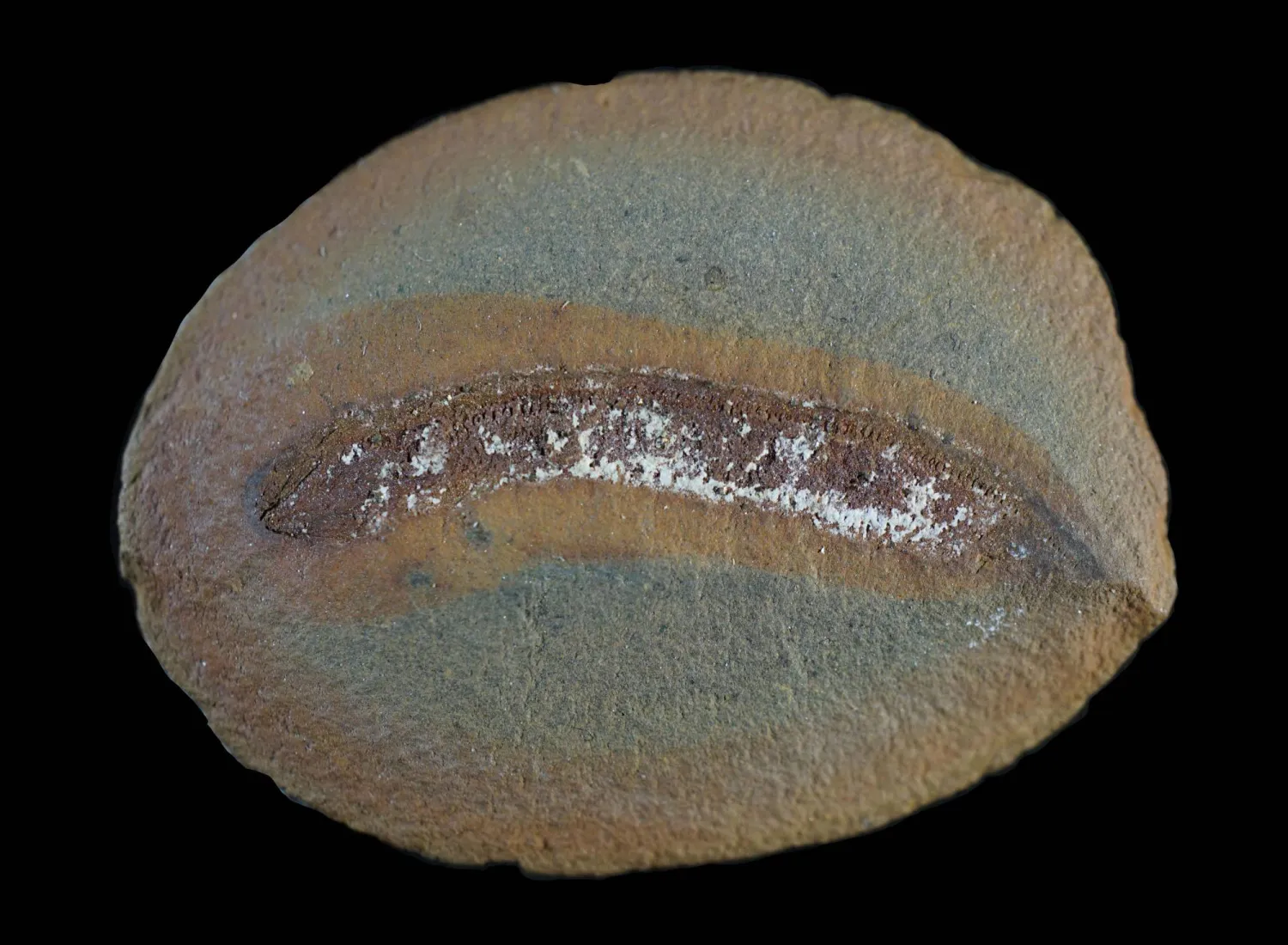
This undated image courtesy of The Field Museum shows an Embolomere fossil. (Photo by Arjan MANN / Field Museum / AFP)
TT

Fossils Challenge Assumptions on How Animals Adapted to Land

This undated image courtesy of The Field Museum shows an Embolomere fossil. (Photo by Arjan MANN / Field Museum / AFP)

Scientists have long posited the earliest water animals to transition to land had amphibious tadpole features, going through a metamorphosis akin to that of today's frogs.

But new research out Thursday in the journal Science challenges that conventional assumption. It presents analysis of rare fossils which scientists say fill knowledge gaps on the development of the creatures that gave rise to the first land-dwelling vertebrates.

The research centers on specimens excavated from the Mazon Creek fossil beds in northern Illinois, southwest of Chicago.

The world-renowned site features iron carbonate concretions that formed some 309 million years ago, fossilizing within them ancient creatures that had once thrived in the area's lush swamps, shallow seas and river deltas.

It's known for its exceptionally well-preserved specimens including soft tissue.
The new study analyzes dozens of fossils to examine the evolution between fish and tetrapods, or four-legged animals.

At the center was a specimen determined to likely be the baby of a crocodile-esque creature known as an embolomere, which lived mostly in the water but did develop little legs.

In its juvenile stage, popular thought would have anticipated it to show tadpole-like features like external gills, explained Jason Pardo, a research associate at Chicago's Field Museum and the study's co-lead author.

But it didn't, he said.

The body of the baby -- the specimen of which the researchers said are about the size of a short, narrow macaroni noodle -- instead showed evidence of direct development, meaning it was more or less put together the way they would be into adulthood.

That's not what we would expect to see in amphibians, whose metamorphosis from tadpoles into adults includes much more dramatic rearranging and development of organs and limbs.

"We now actually have some direct fossil record evidence," Pardo told AFP, "that this metamorphosis, this amphibian-like life cycle that we've for 150 years assumed was part of our history, turns out that it wasn't part of that at all."

John Long, an Australian paleontologist who has also done extensive research in this field, called the study "quite outstanding."

"Not much was known about their early life stages," he explained to AFP of the animals that gave rise to the first tetrapods.

"This detailed work on a bunch of simply glorious fossils nails it that they went straight into a juvenile phase so didn't need to go through the tadpole stage."

Jason Anderson of the University of Calgary said the "impressive" paper highlights "the power of fossils to address questions we thought impossible given they take place in short periods of time, and in tissues not normally preserved over hundreds of millions of years."

Both he and Pardo also noted that the study underscores that amphibians are impressive evolutionary creatures in their own right.

"Our amphibians, instead of being relicts of earlier stages in the evolutionary history of tetrapods, are themselves highly evolved creatures," Anderson told AFP.

The fossil serving as the focal point of the study had been in the collections at the Field Museum for a long time when the then-director showed it to paper co-author Arjan Mann, who became enthralled.

While both were doctoral students in Canada, Mann and Pardo puzzled over it for years.

Eventual analysis with scanning electron microscopy at the Canadian Museum of Nature allowed researchers to confirm it as a probable embolomere.

Throughout their research the duo analyzed that fossil's juvenile features along with another, smaller embolomere and other species of fossil baby tetrapod relatives.

Mann -- the Field Museum's Assistant Curator of Early Tetrapods -- noted that their research was made possible by the remarkable discoveries at the Mazon Creek site and the amateur scientists who for decades have combed it, a hobby that over the years turned up the specimens analyzed in the paper.

"This paper, in a way, is kind of a love letter to them, that shows the power of what we can do with working together with this community to synthesize really high-impactful new research," Mann told AFP.




Indonesia to Capture Last-known Wild Bornean Rhino for IVF

A rhinoceros walks in Bandia Conservation Park, in Mbour, Senegal June 14, 2026. REUTERS/Raghed Waked
TT

Indonesia to Capture Last-known Wild Bornean Rhino for IVF

A rhinoceros walks in Bandia Conservation Park, in Mbour, Senegal June 14, 2026. REUTERS/Raghed Waked

Indonesia's government is racing to capture the last-known Bornean rhino in the wild in a bid to preserve the species through in-vitro fertilization, a government official told AFP on Friday.

Just two Bornean rhinos are known to exist in the world, both female: Pahu in Indonesia's Kelian rhino sanctuary, and Pari, living wild in Kutai Kartanegara regency.

Bornean rhinos are a subspecies of Sumatran rhinos, and officials believe they are close enough to interbreed and preserve some genetic heritage from the Bornean line.

Conservationists previously tried to extract eggs from Pahu for the process.

But she is around 40 and has various health problems, so the process has been unsuccessful so far, explained Ari Wibawanto, head of the provincial conservation agency in East Kalimantan, where both Kelian and Kutai Kartanegara are located.

The last hope lies with Pari, who appears younger than Pahu in images captured by monitoring cameras.

Conservationists have spent months preparing the capture, installing pit traps and even carrying out test runs.

"We carried out several simulations using cattle that are roughly the same size as Pari," he told AFP.

Rhino translocations are a risky process and have ended in disaster in Indonesia in the past.

Last year, a Javan rhino died shortly after a world-first translocation for the species, apparently due to preexisting conditions.

And in 2016, a female Sumatran rhino died after relocation because of an injury previously sustained from a poaching trap.

Ari said a dedicated team had been working on making the capture and relocation as smooth as possible.

"We strengthened our procedures to make sure they don't cause technical problems, health issues, or behavioral issues, so the animal doesn't get stressed," he said.

Once secured, Pari will be airlifted to a facility for monitoring before egg extraction.

"Sumatran rhinos are larger than Bornean rhinos. So, if we try to mate them manually or through normal natural mating, it is likely that it will not work properly," Ari said.

"We take egg cells from the Bornean rhino. We collect them and then fertilize them with sperm from the Sumatran rhino outside the womb."

If the fertilization is successful, a surrogate would likely be used for a safer pregnancy, Ari said.

The conservation body is also considering a cloning program by collecting samples of skin and gums, he added.

Fewer than 50 individuals each from the Javan and Sumatran rhino species are believed to exist in the wild, all of them in Indonesia, according to the International Rhino Foundation.

In 2024, scientists in Germany successfully conducted IVF of a southern white rhino, sparking hope that a similar method could be applied to another species of rhinos.


1,200-Year-Old Tree Said to Have Sheltered Robin Hood Has Died

A 1,200-year-old Major Oak tree, where Robin Hood allegedly used as a hide out, stands in Sherwood Forest near Nottinghamshire, England, on October 19, 2007. (AP Photo/Simon Dawson, File)
TT

1,200-Year-Old Tree Said to Have Sheltered Robin Hood Has Died

A 1,200-year-old Major Oak tree, where Robin Hood allegedly used as a hide out, stands in Sherwood Forest near Nottinghamshire, England, on October 19, 2007. (AP Photo/Simon Dawson, File)

A massive ancient oak tree linked to the legend of Robin Hood may have been loved to death.

The 1,200-year-old Major Oak in Sherwood Forest is believed to have died after it didn’t sprout leaves this spring, the Royal Society for the Protection of Birds said Thursday.

Visitors over the past two centuries who viewed the tree’s gnarled limbs and sprawling canopy in Nottingham compressed the soil, making it difficult for rain to reach its roots, the conservation group said, according to The Associated Press.

The forest has been under threat for years and the tree had been rumored to have died in the past — only to have the group confirm it was still alive. That is no longer the case.

“The tree’s failure to produce leaves this year is heartbreaking for everyone,” Hollie Drake of the RSPB said in a statement announcing the death.

The tree is said to have sheltered Robin Hood, the legendary 13th century bandit who stole from the rich and gave to the poor and took refuge in the forest when being pursued by the sheriff of Nottingham.

It got its name after being mentioned in a book on oaks by Major Hayman Rooke in 1790 that led to the first wave of fans who flocked to the forest.

It’s impossible to say what killed the tree, but the footprints of millions contributed to its downfall, along with intervention to shore up its massive limbs using cables and poles. Climate change that has brought heat waves and drought was also blamed.

Tree experts found the root system strangled and starved.

“Ancient trees like the Major Oak are the ‘conservation white rhinos of the UK’ but their decline is far less visible,” said Ed Pyne, of the Woodland Trust. “Saving them is vital to the health of the world we live in and yet most disappear quietly, without the recognition or care given to the Major Oak.”

In addition to its place in folklore, the forest is known for Sherwood oaks that floated the ships of Vice Admiral Horatio Nelson’s Royal Navy in the late 18th and early 19th centuries and as timbers in the roof of St Paul’s Cathedral in London.

The Major Oak was spared from the saw and has been protected by a fence since the 1970s.

“The Major Oak will continue to stand at the heart of Sherwood as a natural monument for visitors to come and see, living on in the legend of Robin Hood and continuing to provide as much support to the forest’s ecosystem in death as in life,” Drake said.


Ebola Virus Survives Unnoticed in Human Body for Months, New Research Reveals

Scientist holds blood sample for Ebola virus test
TT

Ebola Virus Survives Unnoticed in Human Body for Months, New Research Reveals

Scientist holds blood sample for Ebola virus test

Ebola virus can survive unnoticed in the human body for months or even years following infection, posing the danger of triggering a disease relapse or even a new outbreak, according to a new research led by microbiologists.

The findings were recently published in Nature Microbiology by researchers from the Icahn School of Medicine at Mount Sinai and the Bernhard Nocht Institute for Tropical Medicine (BNITM).

Researchers found that infectious Ebola virus has been detected in semen for months or even a year after infection and that the virus can also persist in other immune-privileged organs such as the central nervous system, particularly the brain.

Immune-privileged means that the immune system reacts in a weakened and controlled manner in these areas in order to protect sensitive tissue.

As a result, researchers said, the immune system cannot always eliminate the virus completely.

“This persistent viral presence increases the risk of later inflammatory disease and relapses in individual patients and, albeit rarely, of retransmission to others,” the research said.

To learn more about the disease, the research team successfully used an established cerebral organoid model to perform long-term infection studies.

To make these organoids, they stimulated human induced pluripotent stem cells in a way that allowed them to develop into spherical brain-like structures consisting of various types of cells of the central nervous system.

The researchers showed that Ebola virus can replicate in cerebral organoids for up to 120 days. They also found that Ebola virus was able to spread in the cerebral organoids in two ways: directly from an infected cell to a neighboring cell and by budding from the host cell, which is the classical way the virus spreads.

Dr Lina Widerspick, first author of the publication and head of the Bundeswehr Institute of Microbiology in Munich, said, “These cerebral organoids enable us to investigate in detail the mechanisms that Ebola virus and other filoviruses use to persist in the human central nervous system.”

She noted that through experiments in this model system, researchers can gain insights that help them improve understanding of the long-term effects of persistence, like the severe and sometimes fatal inflammation seen in Ebola virus disease survivors with meningoencephalitis.

Also, it is known that the Ebola virus genomes mutate when they replicate for a long time, since their genetic machinery cannot proofread the genomes as human machinery would do.

The research team has now identified defective viral genomes and particles, and mutations in the Ebola virus genomes in late-stage persistently infected cerebral organoids.

Dr Gustavo Palacios, Professor of Microbiology at the Icahn School of Medicine and co-last author of the publication, said, “Our work in human cerebral organoids highlights the potential of this model system to investigate persistent infections in immune-privileged tissues.”

He said further studies are now important to expand studies towards less-studied filoviruses like Bundibugyo virus that is causing the current outbreak in Africa.