


Su Filindeu…World’s Rarest Pasta

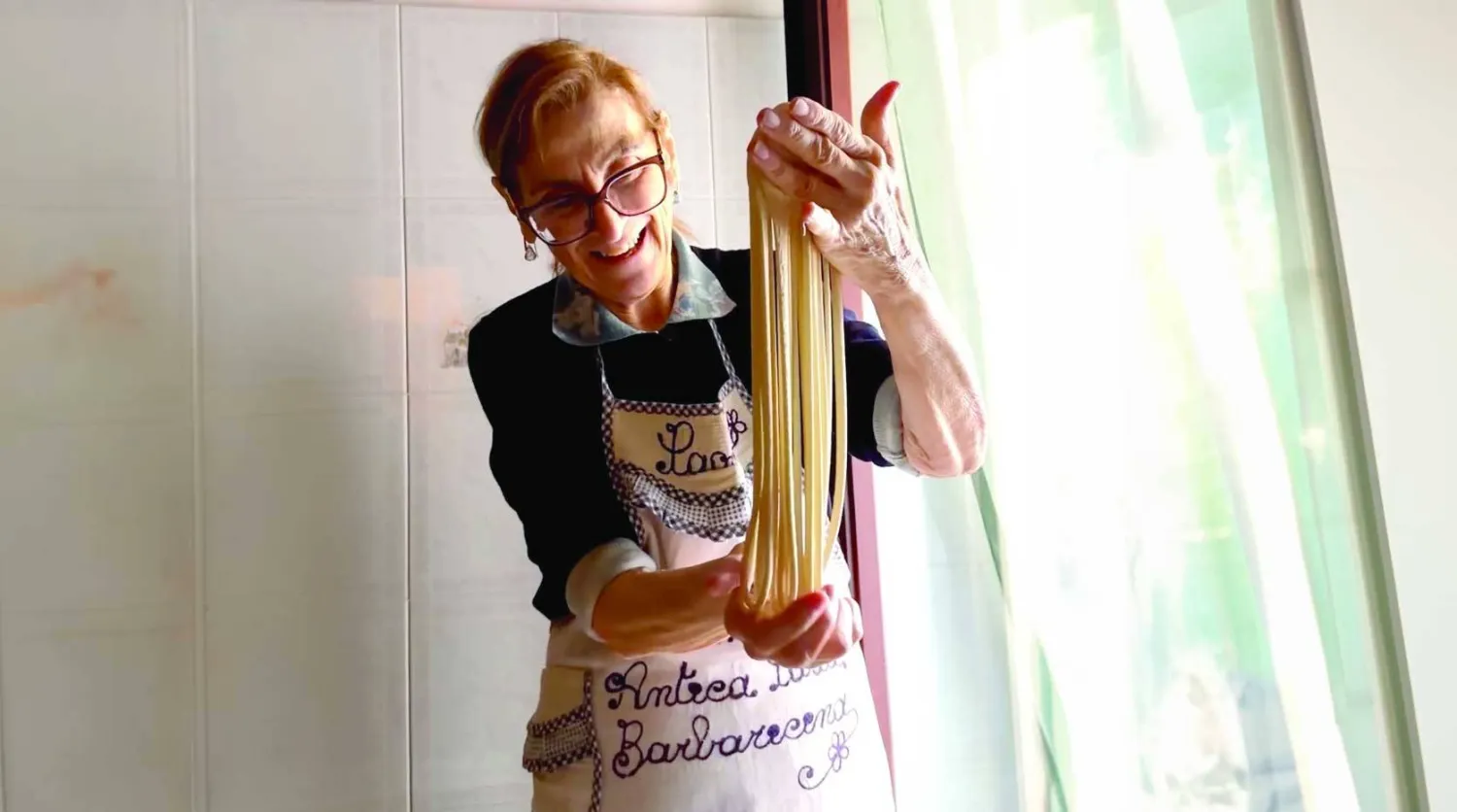
A woman wearing glasses and an embroidered apron pulls and stretches pasta dough into numerous thin strands (The New York Times)
TT

Su Filindeu…World’s Rarest Pasta

A woman wearing glasses and an embroidered apron pulls and stretches pasta dough into numerous thin strands (The New York Times)

Sardinia: Matt Goulding

In the mountains of Northern Sardinia, a 300-year-old pilgrimage comes with a serving of the world’s rarest pasta.

The name tells you all you need to know about the significance of Sardinia’s most elusive pasta: su filindeu, the threads of God. Of the more than 350 officially recognized shapes of pasta in Italy, this is considered the rarest.

Paola Abraini is one of only a handful of people who still know how to make su filindeu. “To lose this tradition would be like losing a piece of our identity,” she said.

Stretched by hand, a single ball of dough is converted into 256 gossamer strands that are stretched across a drying rack called a fundo in a triangular pattern, to evoke the Holy Trinity.
She holds up the circular board covered in a grid pattern with the pasta strands.

It’s a meticulous process that has proven difficult to pass down to younger generations. Every detail of su filindeu matters, including its relationship with its Mediterranean environs. “When it is dried in the sun it becomes light and golden,” said Abraini.

Twenty years ago, Abraini was among the last custodians of the vanishing foodway. But her tireless work as a teacher has helped bring it back from the brink of extinction.

For most of its centuries-long history, su filindeu was a tradition passed down through a single line of matriarchs from Nuoro, a town in the mountainous interior of the island. In fact, Abraini came to learn the intricate craft from her mother-in-law at 16.

Whereas most handmade pasta in Italy is rolled out with a wooden dowel called a mattarello, every pass of su filindeu dough halves the width and doubles the number of strands. Do that eight times and you end up with the requisite 256 threads.

Such finesse requires a not-so-secret ingredient: salt, which tightens the network of gluten in the flour, giving the dough the elasticity required to stretch so thin.

It’s not a recipe that can be read and recreated by enterprising cooks in kitchens abroad; the technique must be felt in the flesh, learned through repetition and error until the fingertips know the difference between just right and just wrong.

To master it requires mastering many variables, including the effect of hard water versus soft water, when to add the salt solution, how to adjust to the weather.

This level of dedication has made younger generations of local women reluctant to take up the practice.

Many have come to Nuoro to learn but few have succeeded at the intricate craftwork. Even the pasta barons of Barilla, the world’s largest pasta company, couldn’t crack the code for these noodles.

Su filindeu is closely bound to its home in the north of Sardinia, a sparsely populated tableau of verdant flora and sheer stone, hearty food and strong beliefs.

Much of the island’s history and culture have been defined by isolation, nowhere more so than Nuoro, which Grazia Deledda, the 1926 Nobel Prize-winning writer who grew up there, called “the most cultured and combative town on the island.”

At the heart of that culture is a biannual Catholic pilgrimage, which begins in the church of Rosario di Nuoro in May and October.

Some of the town’s oldest, and youngest, citizens make the trek.

At midnight on May 1, hundreds of pilgrims set out from Nuoro. Together they traverse over 20 miles of mountainous terrain to the church of San Francesco di Lula.

Some travel in groups of family and friends, telling stories and trading gossip deep into the night. Others prefer a solitary journey of reflection through the darkness.

Orange light peeks out from behind a mountain as the sun rises, a small forest in the foreground.

The first groups of pilgrims arrive at San Francesco di Lula shrine just as the sun rises above the limestone crest of the Monte Albo massif — a spiritual journey now illuminated.

Local lore has it that a bandit back in the 17th century was falsely accused of murder. After being exonerated, he built a church outside the village of Lula and dedicated it to Saint Francis of Assisi, defender of the poor and steward of nature.

The overnight journey evokes a wide range of emotions in Sardinia’s pilgrims — joy, hope, solemnity and catharsis.

The pilgrims endure the journey and the community responds with restorative hospitality: water and coffee, a footbath, and eventually, a bowl of pasta.

Ask five pilgrims why they make the journey, and you’ll get varied answers: For faith. For pride. For a loved one. For exercise. And, of course, for pasta.

One thing that most pilgrims agree on: this is as good as su filindeu gets. For centuries, it was served exclusively at San Francesco di Lula. But recently a few restaurants in Sardinia started to serve the pasta outside of the pilgrimage.

Context is everything, though. Eaten any other time, the dish doesn’t taste the way it does after an overnight mountain hike. It’s the effort that matters — both in the making of the pasta and the pilgrimage to eat it.

Sheep, many of which live in those same mountains, outnumber humans two to one on Sardinia. They play a central role in island culture and cuisine — including as the base for the su filindeu broth.

It takes a village to make the dish, but the division of kitchen labor at San Francesco di Lula is clear: men make the broth, and women cook (and bless) the pasta.

Soft cubes of sheep’s milk cheese are stirred into the broth just before serving. The final creation is more delicate than the sheep-on-sheep treatment would suggest — aromatic, gentle, almost sweet.

For three centuries, the pasta and the pilgrimage have been inexorably connected.
The power of the pilgrimage is found in the balance between solitude and community, sacrifice and hospitality, pain and pleasure.

Seated at the long communal tables, some of the pilgrims have consumed dozens of bowls of su filindeu over the course of decades. Others are just beginning their journey.

The New York Times


New Space Object ‘Black Hole Star’ Discovered by Astronomers

 The James Webb Space Telescope, which spotted the new astronomical object called a "black hole star". (NASA TV/AFP file)
The James Webb Space Telescope, which spotted the new astronomical object called a "black hole star". (NASA TV/AFP file)
TT

New Space Object ‘Black Hole Star’ Discovered by Astronomers

 The James Webb Space Telescope, which spotted the new astronomical object called a "black hole star". (NASA TV/AFP file)
The James Webb Space Telescope, which spotted the new astronomical object called a "black hole star". (NASA TV/AFP file)

Astronomers announced Wednesday they had discovered a new type of astronomical object called a "black hole star", potentially solving a mystery involving strange red dots spotted in the early universe.

The object looks like a star the size of our solar system, but produces 100 billion times more energy than any star -- a mighty blast of power closer to what is produced by a black hole.

The black hole star, which dates from 660 million years after the Big Bang, was spotted by a US-led team of astronomers using the James Webb Space Telescope, according to a study published in the journal Nature.

Since history's most powerful telescope went online in 2022, it has been spotting many extremely bright cosmic objects dubbed "little red dots" in the early universe that have baffled scientists.

"What exactly these objects are has been one of the most debated topics of the JWST era," lead study author Rohan Naidu of Hawaii University said in a statement.

The team had been trying to find clues for a different mystery: why JWST keeps finding bright galaxies in the universe's infancy, when it was thought to have been too early for them to have become so huge.

But while looking through the images, they spotted a little red dot.

- 'Pure black hole star light' -

"When we see something very red in the universe, we often assume that it is surrounded by dust, like soot or ash," said Robert Simcoe, a study co-author from the Massachusetts Institute of Technology.

"The same way that the wildfire smoke from Canada recently made the sky in Boston look bright red, astronomical objects can also appear redder than their intrinsic color when you see them through a veil of dust," he added.

However, when the team sifted through their data, they found that at certain wavelengths, the object's light simply disappeared.

To their surprise, this suggested that it is not dust making this object appear red -- it is hydrogen gas.

This explained the object's color, but not how it could be pumping out so much energy.

"You can't be powering this by nuclear fusion, which is the energy source that sits at the heart of all the stars," Naidu explained.

Using modelling simulations, they determined the most likely scenario was that the object is powered by a central black hole surrounded by a cocoon of gas that makes it resemble a star.

The team named the object MoM-BH*-1. The BH and asterix is for black hole star -- and the number one suggests they believe there are more out there.

"Every little red dot is consistent with being a black hole star," Naidu said.

"What is special about MoM-BH*-1 is, the black hole star is essentially completely outshining its surrounding host galaxy, such that we're seeing pure black hole star light."


Britain’s Andy Green Sets Another Speed Record, This Time in a Hydrogen-Powered Car

 The JCB Hydromax sits on the Bonneville Salt Flats in Wendover, Utah, where Andy Green aims to drive it to a land speed record for cars powered by hydrogen internal combustion engines, Monday, Aug. 10, 2026. (AP)
The JCB Hydromax sits on the Bonneville Salt Flats in Wendover, Utah, where Andy Green aims to drive it to a land speed record for cars powered by hydrogen internal combustion engines, Monday, Aug. 10, 2026. (AP)
TT

Britain’s Andy Green Sets Another Speed Record, This Time in a Hydrogen-Powered Car

 The JCB Hydromax sits on the Bonneville Salt Flats in Wendover, Utah, where Andy Green aims to drive it to a land speed record for cars powered by hydrogen internal combustion engines, Monday, Aug. 10, 2026. (AP)
The JCB Hydromax sits on the Bonneville Salt Flats in Wendover, Utah, where Andy Green aims to drive it to a land speed record for cars powered by hydrogen internal combustion engines, Monday, Aug. 10, 2026. (AP)

The only person to break the sound barrier in a car earned another world record Tuesday in a show of force for hydrogen power.

British driver Andy Green reached 406.320 mph (653.908 kph) in a car powered by two hydrogen internal combustion engines with a combined 1,600 horsepower, setting the record for that vehicle category, according to the Fédération Internationale de l’Automobile, the international governing body of motor sports.

The 64-year-old retired Royal Air Force pilot rocketed across the crystalline crust at Utah’s famous Bonneville Salt Flats in a 32-foot (9.75-meter) car engineered by British construction equipment manufacturer JCB. The engines, adapted from those used in the company’s heavy machinery, mix pressurized hydrogen gas with air and ignite it to create bursts of power.

“It’s magic to be able to showcase this technology and to showcase how good the engineering is on the best racing surface in the world, Bonneville Salt Flats,” Green told The Associated Press after the run.

To be clear, Tuesday’s feat didn’t come close to approaching the overall land-speed record, which Green set with jet power in 1997. That year, he climbed into the Thrust SSC, a black needle sandwiched between two cartoonishly large jet engines, and hit 763.035 mph (1,227.985 kph), breaking the sound barrier and achieving a feat no one has come close to matching. His runs in Nevada’s Black Rock Desert produced sonic booms that shook the nearby town of Gerlach.

In 2006, Green also set the land-speed record for a diesel-powered car — 350.092 mph (563.4 kph) — at the Bonneville Salt Flats. He returned there Tuesday with the goal of beating that mark using hydrogen power, which he has called the “fuel of the future.”

In targeting his diesel speed, Green easily topped the previous hydrogen combustion world record of 185.5 mph (298.5 kph). He had a 10-mile (16-kilometer) straightaway to build speed. A few dozen JCB staff members and reporters watched from a distance through cameras and binoculars.

Green said the cockpit of the car he used on Tuesday was “probably a little hotter” than in the jet-powered vehicle from 1997, with temperatures routinely above 122 degrees Fahrenheit (50 degrees Celsius).

“But I have been training four months for that, both training in the gym and actually just getting used to it with hot baths,” he said.

A remnant of a prehistoric lake bed, the Bonneville Salt Flats are about 100 miles (160 kilometers) west of Salt Lake City and sit atop a shallow aquifer that cools the tires. The low-friction surface and dry desert air are conducive to speed and have beckoned drivers since the first race there in 1914.

“It looks like snow, and it behaves a bit like packed snow — it is surprisingly slippery,” Green said.

Green was no stranger to speed when he took his first racing job. He had been flying supersonic military jets when he spotted a 1994 British newspaper ad seeking a high-speed driver to break the sound barrier.

Green did not approach supersonic speeds on Tuesday, but JCB engineers hope his feat with hydrogen power will shake up the clean-energy industry.

The company's chairman has argued that hydrogen can better handle the demands of heavy industries than electric power.

Hydrogen is only as clean as its source, and the vast majority is currently produced from fossil fuels. JCB signed a deal to buy green hydrogen, which is created using renewable energy but makes up a tiny fraction of global hydrogen production.

The concept and development of such technology has been around for decades, but has had a resurgence over the past several years, said Greg Keoleian, a professor of sustainable systems at the University of Michigan and co-director of the school’s MI Hydrogen initiative.

Many major automakers have already developed hydrogen internal combustion engines or hydrogen fuel cell technology, but the higher cost of hydrogen production compared with gas and diesel is a barrier to wider usage, Keoleian said.

“It represents an important energy carrier for decarbonizing areas of the economy,” he said. “As far as its deployment, it’s influenced heavily by the cost.”

An emerging focus, he said, is extracting hydrogen from natural deposits instead of separating it from water, a prospect that could significantly reduce costs.


Rising Kenyan Lakes Push Crocodiles Closer to Homes

A crocodile perches on the roof of what was the conference hall of a tourist lodge now completely inundated in the rising waters of the Lake Bogoria in Marigat sub-county, Baringo county on July 27, 2026. (AFP)
TT

Rising Kenyan Lakes Push Crocodiles Closer to Homes

A crocodile perches on the roof of what was the conference hall of a tourist lodge now completely inundated in the rising waters of the Lake Bogoria in Marigat sub-county, Baringo county on July 27, 2026. (AFP)

A crocodile basks in the sunshine on the roof of a submerged conference hall at a holiday resort in central Kenya, in a visible sign of how rising lake waters are endangering thousands of families and local businesses.

Lake Baringo and other lakes in Kenya's Rift Valley have risen to levels not seen in at least half a century, with scientists attributing the surge to extreme rainfall linked to climate change.

Tens of thousands of people have been displaced to higher ground, according to official data, yet many victims say the lakes keep following them.

In 2011, when the lake recorded its first significant surge, Mary Milka Tiren, 40, lost her husband after a hippo attacked him on his way home from his job at a popular tourist resort, which is now completely submerged.

A decade later, her nine-year-old son spent three months in hospital after a crocodile attack, leaving a scar on his right arm.

"It wanted to rip off his whole arm from the shoulder... but he was rescued by his peers after a long struggle," Tiren said.

"We've seen a rise in crocodile attacks not because there are more crocodiles, but because the lake is now close to the homesteads," Kenya Wildlife Service (KWS) senior warden Jackson Komen told AFP.

"We also have hippo attacks because when the lake expanded, the (riverbank) riparian ecosystem -- where we used to have pasture -- was lost."

- 'Ecological disaster' -

An AFP analysis of Copernicus Sentinel and NASA Landsat satellite imagery shows Lake Baringo's surface area has expanded by 70 percent since 2010, from about 138 square kilometers (53 square miles) to 234 square kilometers.

Neighbouring Lake Bogoria, which is notable for its high sodium levels, has also grown by 21 percent over the same period, increasing from 34 to 41 square kilometers.

As the waters of the two lakes -- one freshwater and the other alkaline -- rise, the distance between them has narrowed.

"If the two lakes mix, then the fish, crocodiles and hippos may not survive... we may have an ecological disaster that we don't know how to deal with," said Komen.

Lake Baringo provides vital drinking and irrigation waters, and supports a thriving fishing industry.

"It may trigger a complete change... I don't know whether human beings will still be able to live here," Komen said.

The distance between the two lakes is now estimated to be about 10 kilometers (six miles).

Scientist Mathew Herrnegger, of Austria's University of Natural Resources and Life Sciences, said "the overflow is already happening".

"Satellite altimetry shows that the lake level of Bogoria is high enough that it overflows towards Baringo," he said.

But how much water will reach Baringo and what impact it will have is unclear, he added.

- Tourism decline -

The expansion of the two lakes has also dealt a major blow to tourism.

"We lost 80 percent of our community wildlife conservancies," Komen said, with giraffes, ostriches, warthogs and impalas all moved to safety.

AFP saw at least four holiday resorts engulfed by Lake Baringo's waters, another stranded and abandoned on an island.

At Lake Bogoria, known for its flamingoes and hot springs, rising waters have driven away a significant number of the birds and submerged some of the springs.

Michael Baimet, the director at the local disaster department, said tourism earnings had dropped from roughly $1 million annually to $200,000.

Google reviews show visitors complaining about dwindling flamingos at Lake Bogoria and impassable roads caused by rising water levels.

- 'Risky' -

Schools have not been spared the devastation.

Official records show roughly 12 institutions around Lakes Baringo and Bogoria have been affected, some completely submerged.

About 240 students and staff at Kokwa Island Primary and Junior School in Marigat must now cross crocodile-infested Lake Baringo, with the lone ferry's multiple trips cutting into learning time.

Most exposed is the girls' dormitory, inches from the lapping waves.

"It is too risky for the girls who board as hippos and crocodiles come into the school at night," said one school official.

"We've been forced to employ two security officers to keep the students safe."

The school fears El Nino rains expected in October could engulf the dormitory.

Families on the same island know they have to relocate as the waters advance, but finances remain a major issue.

Faith Mpayei, 40, has moved the fence around her once two-acre (0.8-hectare) farm twice since 2016, when she said the lake began advancing rapidly.

Her fence now lies submerged, while the water stands nearly a third of the way up her house.

"It has reduced me to zero," said the mother-of-five.

"We are helpless... I am here just for the time being, I have to relocate... there's nothing left to do here."
